Getting the transcript
Reading the captions from YouTube. A video nobody has opened here before takes 10 to 30 seconds; this page fills in on its own.
Getting the transcript
Reading the captions from YouTube. A video nobody has opened here before takes 10 to 30 seconds; this page fills in on its own.
Lume · @lume-channel
Where viewers went back to watch this video again, from YouTube's public Most replayed graph, lined up with what was said at that moment.
Most replayed moment #1
10:428.1x the video's typical replay level
blind machine that saw only the magnetic code. And a blind bank that was looking the other way. But now Patrick [music] faced a different, far scarier problem. Money in an account is not money in your hands.
Said at 10:36
Most replayed moment #2
3:437.0x the video's typical replay level
turns the paper over in his hands and thinks one thing. >> What happens if I actually deposit it? >> It was a joke. He admitted that himself. Patrick wasn't trying to steal anything. He was 100% certain what would happen
Said at 3:37
Most replayed moment #3
12:406.8x the video's typical replay level
Physical. Something the bank can't just delete. And Patrick comes up with a move that will make the bank commit its third blunder of this whole story. A move after which there is no going back. For anyone. Patrick walks into a branch in person.
Said at 12:32
The graph counts replays. It does not show where viewers stopped watching.
Words
3,409
Runtime
21:50
Speaking pace
156wpm
Reading time
14min
156 words per minute, below the 160 25th percentile of 349 measured videos. That distribution comes from the 349-video hook study.
Opening (first 30 seconds)
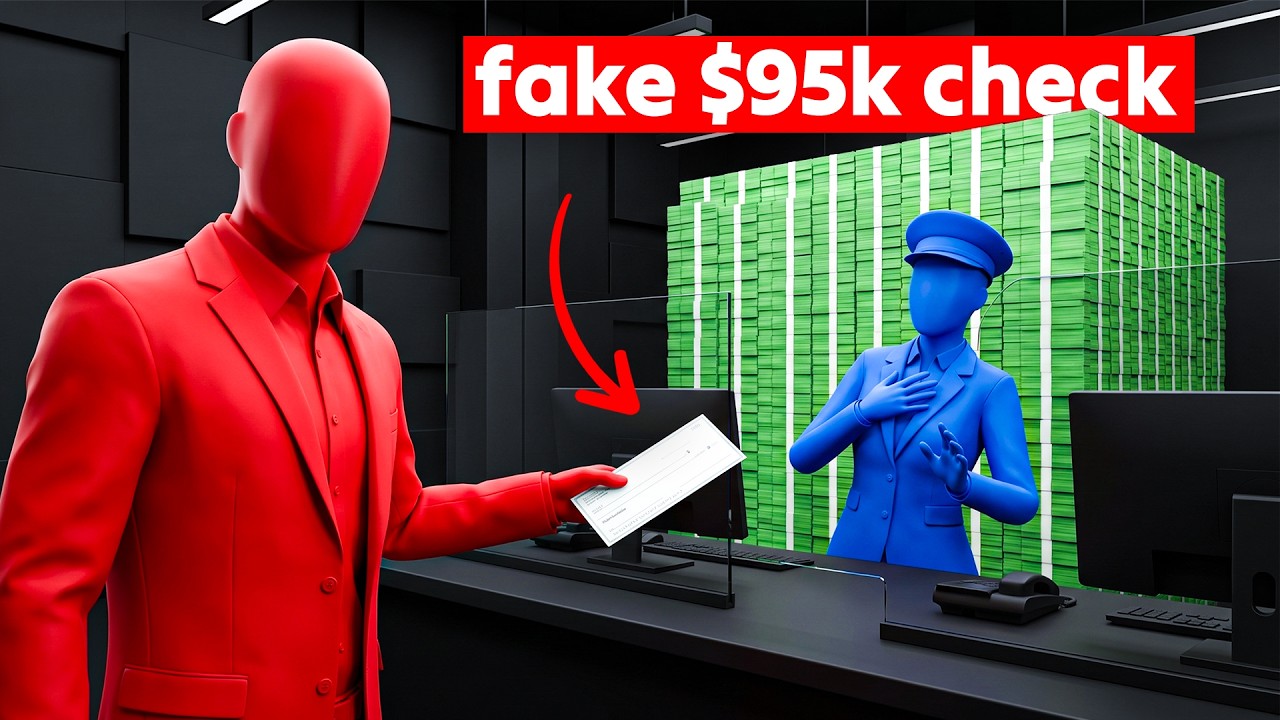
San Francisco, May 1995. In the mailbox, junk, a pizza coupon, a car wash flyer, and [music] a check. A check for $95,093.35. The guy holding it has exactly $200 to his name. He and his girlfriend split a single ice cream cone because two cones is a luxury they can't afford. He laughs. It's obviously spam. Printed right across the front in plain letters, non-negotiable. He feeds the thing into an ATM as a joke, nothing more.
78 words, the words spoken in the first 30 seconds at 156 words per minute.
Free, no signup. See how the first 30 seconds hold attention, with rewrites.
Sentence shape
| Measure | This transcript |
|---|---|
| Sentences | 318 |
| Average words per sentence | 10.7 |
| Longest sentence | 45 words |
| Questions asked | 12 |
| Sentences containing a number | 38 |
Most used terms
Filler phrases
9 in total: like 7 · actually 2.
A literal whole-word count of the same phrase list the Prepublish browser extension uses, so a phrase inside another word is not counted and a phrase used in its ordinary sense still is. It is a count and not a judgement.
Free, no account. See where attention is likely to drop, with a rewrite for each weak line. The free check shows the scores and the one issue costing the most. Or run it on the words above first.
Free · No login · See a sample audit first if you prefer.
What this transcript is
Every word below is the caption track YouTube publishes for this video, pulled from the video itself and reproduced unchanged. It is not Prepublish's writing, not a summary, and not a re-transcription: it is the video's own published captions. English captions, generated automatically by YouTube, in the video’s original language. Source: the video on YouTube. A channel that would rather this page did not exist can ask for its removal through the contact page, and it is removed.
San Francisco, May 1995. In the mailbox, junk, a pizza coupon, a car wash flyer, and [music] a check. A check for $95,093.35. The guy holding it has exactly $200 to his name. He and his girlfriend split a single ice cream cone because two cones is a luxury they can't afford. He laughs. It's obviously spam. Printed right across the front in plain letters, non-negotiable. He feeds the thing into an ATM as a joke, nothing more.
And the bank cashes it. Not a glitch that lasts a day, not a week. $95,000 sit in his account, and the bank does not take them back. How does an unemployed man with $200 force a bank to hand him a small fortune without forging a single signature, without stealing anything, without breaking one law? And why, when he finally gives the money back, every last cent of it, does he walk out of this story richer than if he'd kept it?
Hold on to that second question because the answer to it rewrote the rules of banking for an entire country. His name was Patrick Combs, 29 years old, living in Haight-Ashbury, the San Francisco neighborhood that once roared with the hippie era, and by the mid-90s had settled into cheap apartments and people scraping by. Patrick had just published a book, a guide for students, how to find yourself, how to start a career, how not to get lost after college.
He believed in that book. He'd poured everything into it, time, money, hope, and it wasn't selling. Stacks of copies sat there like dead weight. The dream that words on paper would make him a success was falling apart in front of him. Here's the irony nobody could see yet. It would be a completely different piece of paper that made him rich, one he'd get for free in the mail, buried in a pile of junk. In his memoir, he'd later describe those months without flinching.
"$200 in the account, >> [music] >> every parking ticket a small catastrophe, one ice cream cone between two people because two was extravagant." And into that life, a man counting pennies, the mailman drops a check for almost $100,000. Except it isn't an inheritance. It isn't a lottery. It isn't a wire sent to the wrong account. It's an advertisement, an aggressive mailer from one of those get-rich-fast seminars that flooded American mailboxes in the '90s.
The marketers' logic was simple. To get someone to open the envelope, put something inside that looks like real money. So they printed a fake check, signed sample, stamped non-negotiable across the face, and filled in a number designed to make a heart skip a beat, $95,093.35. But they made one fatal mistake, a mistake that would cost an entire bank its reputation. To make the check look as solid, as convincing as possible, they didn't print it on ordinary paper.
They printed it on a real bank stock with real magnetic ink. And that magnetic ink is the key to this whole story. For now, Patrick [music] just turns the paper over in his hands and thinks one thing. >> What happens if I actually deposit it? >> It was a joke. He admitted that himself. Patrick wasn't trying to steal anything. He was 100% certain what would happen next. He'd feed the ad into the ATM, the machine would swallow it, and in the morning some bank clerk would fish it out, see the giant non-negotiable, and toss it in the trash.
Worst case, Patrick tells his friends a funny story. He walks up to a First Interstate Bank ATM. And here comes the detail that makes this story a little eerie. He didn't even sign the back of the check. You always sign the back when you deposit a check. It's the most basic rule there is. Patrick didn't even do that. He just slid a piece of advertising stamped sample into the slot. Giggling, picturing some bank employee rolling their eyes at it the next day.
The ATM swallowed the check, printed a receipt. Patrick went home and forgot all about it. He was certain the system would reject him. He didn't know one thing. He didn't know how a bank actually reads a check. And he didn't know that the very autumn he dropped his little joke into that machine, the bank behind it was living through the worst chaos in its history. Two bombs planted under this system were already ticking, and soon they'd go off in favor of an unemployed man from Haight-Ashbury.
While he slept, a machine in a dark room in the bank was doing its work. A few days later, Patrick walks [music] up to the ATM. Out of habit, to check on his $200. And the balance slip reads $95,293. The money cleared. First reaction, it's an error that'll vanish within the hour. He comes back the next day. The money's still there. He comes back the day after. Still there. And now something strange happens to Patrick.
Psychological. He described it himself later. He develops an addiction, an adrenaline addiction. For weeks he runs to the ATM almost every 10 minutes, inserts the card, prints the balance slip, sees the 95,000, pockets the slip, and runs back again to check the money still there. He's afraid. Afraid the number will dissolve as suddenly as it appeared, that it's just [music] a glitch about to be fixed. But the days pass.
One, three, a week, two, the money doesn't disappear. And somewhere in here, a different thought clicks in Patrick's head, scarier than the joke. A question that changes everything. What if they never take [music] it back? But to understand why the bank didn't take the money, and why legally it soon couldn't, you have to look inside the machine. You have to see the two mistakes that collided at a single point. One of them is technical.
The other is the dirty laundry the bank never liked to mention on the news. Mistake one, the machine. How did an ATM and a bank computer read a check in 1995? Not the way a human does. At the bottom of every check is a row of strange-looking numbers printed in special magnetic [music] ink. It's called the MICR line. Baked into it is the bank's routing number and the account number. The automated reader scanned exactly that magnetic code and nothing [music] else.
This technology wasn't some 90s gimmick. MICR was developed back in the 50s, when American banks were drowning in paper. They were writing millions of checks and processing them by hand, and the system was choking. The fix was numbers printed in magnetic ink in a special font, numbers a machine could read instantly. It was a brilliant idea that saved the banking system from a paper collapse. For decades it worked flawlessly.
But that brilliant idea had one blind spot built right into it. The machine trusted the magnetic code without question. It didn't ask. If the correct MICR line is at the bottom of a check, then to the computer, it's a real check, period. The machine didn't read words. It didn't see sample. It didn't see the giant non-negotiable across the face. To the machine, those words did not exist. And the marketers making their ad look solid had printed a real working MICR line down there in real magnetic ink.
So, when the ATM scanned Patrick's joke, it didn't see an advertisement. It saw a perfectly valid magnetic code. And it credited the money automatically. The computer did exactly what it was trained to do. The problem was that no living clerk ever checked it. And that's mistake two, the people. Under American law, the Uniform Commercial Code Article 4, a bank has a hard deadline. It's called the midnight deadline rule.
If a bank wants to bounce a check it shouldn't be paying, it has to do it fast, by the end of the next business day after the check is presented. Miss that deadline, and in a huge number of cases, the bank itself is now on the hook for the money. The window is short. Patrick had that window on his side, and the bank slept through it. Think about the absurdity for a second. The law hands the bank the protection. The bank gets to say no to a check quickly, decisively.
The whole system rests on the idea that there are alert people inside the bank who catch the mistake in time. That power was in the bank's hands from the very start. It didn't have to prove anything. Didn't have to sue anyone. Just push reject in time. The bank didn't push it. The clock ticked. The deadline passed. And from that moment, the law flipped 180° Now, it was the bank [music] that was responsible for its own carelessness.
Why did living human beings inside the bank sleep through a blunder that crude? Here's the historical fact that usually gets skipped. That very autumn of 1995, a war was raging over First Interstate Bank. The giant Wells Fargo had launched a hostile takeover. A deal worth somewhere around 11 and 1/2 billion dollars. One of the loudest banking battles of the era. Inside the bank's back office, it was chaos. Clerks were terrified of layoffs.
Nobody knew who'd still have a job tomorrow. Paperwork got lost. Procedures fell apart. The top executives were off fighting for billions on Wall Street. And while they fought, a [music] 29-year-old unemployed man legally emptied the register through an ATM. Two mistakes met at a single point. A blind machine that saw only the magnetic code. And a blind bank that was looking the other way. But now Patrick [music] faced a different, far scarier problem.
Money in an account is not money in your hands. Patrick understood one thing. He was sitting on a bomb. And he does something that for 1995 took real nerve. He goes online. This is the era of modems. The screech of a dial-up connection. Early forums and bulletin boards where the first internet oddballs hang out. Patrick [music] posts his story there. And it explodes. Right there. Long before television ever hears about it.
Hundreds of messages a day start pouring in. Strangers from all over the country advising him, egging him on, warning him. Some write, "Pull out all the cash and run to Mexico before it's too late." Others, "It's an FBI trap. They're already watching you. Others still, this is your one shot. Don't be an idiot. And here, Patrick develops a temptation he'd later call his Robin Hood dilemma. He seriously considers pulling out every dollar and giving it away.
Not to himself. To the homeless of San Francisco. The ones he sees on the streets of his poor neighborhood every single day. He pictures himself as a folk avenger. The man who took from the bank and gave to the people. But the fear is stronger. He's afraid of the FBI. Afraid this really is a federal crime. Afraid that cash would turn him from a man who found a loophole into a man who stole. And so, he reaches a cold, clear conclusion.
Money in an account is an illusion. It's just numbers on the bank's server. The bank can erase them with a single keystroke. As long as it's in the account, it isn't his. The money has to become real. Physical. Something the bank can't just delete. And Patrick comes up with a move that will make the bank commit its third blunder of this whole story. A move after which there is no going back. For anyone. Patrick walks into a branch in person.
And he asks for one very specific thing. A cashier's check for the full amount. Let's unpack what that is. Because this is exactly where the genius of the move hides. An ordinary check is a promise backed by your account. If the bank wants, it pays. If there's a problem, it freezes it. A cashier's check is an obligation of the bank itself. The bank takes the money out of its own reserves and guarantees this check will be paid.
It's almost the same as cash. Reversing it is nearly impossible. Patrick steps up to the window. Asks them to issue a cashier's check. The teller looks at the system, sees $95,000 in the account, all clean funds present, and personally writes Patrick a bank-guaranteed check for the full amount. [music] That is financial checkmate. Now the money is no longer numbers on a server that can be wiped. Now it's paper, backed by the bank's own obligation, out of the bank's own reserves.
Patrick takes that cashier's check, walks into a completely different bank, and locks it in a physical safe deposit box. The money materialized and became untouchable. He turns the key, shuts the box, and goes home. For the first time in days, he exhales. It looks like he's won. It looks like the story is over. But you and I still haven't answered the big question. Remember it? Why does the man who just outsmarted a bank for $95,000 end up giving every cent of it back and getting richer for it?
That answer is still a long way off. Because the bank finally wakes up, and it is very, very angry. About 4 weeks pass, and Patrick's phone rings. On the other end, the bank's chief security officer, a man whose job is getting money back and breaking people like Patrick. This is not a polite conversation. It's not a request. It's a threat. The tone is roughly this. >> You have committed a federal crime. Do you understand [music] that?
If that check is not sitting on my desk tomorrow morning, I am sending the police to your door. You will go to prison. >> Patrick hangs up with his heart hammering. All his confidence evaporates in a second. This isn't a blind machine or a chaotic back office. This is a professional saying the words federal crime and police. This is the moment 99 out of 100 people fold, hand back the check, apologize, and count themselves lucky they didn't end up in a cell.
Patrick does something else. He doesn't go to the bank. He goes to the library, a law library, and [music] he starts line by line reading that same article 4 of the Uniform Commercial Code. The internet helps him again. One of his anonymous correspondence on the forum, apparently someone who knows the law, tells him exactly where to look, what to pay attention to, which words to hunt for in the statute. >> [music] >> And what Patrick finds there flips the balance of power completely.
It turns out [music] that in that phone call, the one who was bluffing wasn't him. It was the bank. Here's what Patrick understood reading the law. For this to be a crime, fraud, forgery, theft, [music] you need criminal intent and a criminal act. What did Patrick do? He didn't forge a signature. He didn't even sign it at all. He didn't steal anyone's check. It was mailed to him personally. He didn't impersonate anyone.
He put a piece of paper into his own account under his own real name. Under the law, everything that followed isn't criminal. It's a civil dispute between a customer [music] and a bank. And in that civil dispute, the law says it plainly, the bank is responsible for accepting the check and blowing its own deadline to return it. In other words, the threat the police will be at your door tomorrow was empty. There was nothing for the police to charge.
The bank couldn't file a criminal complaint because there was no crime. At most, the bank could sue him in civil court, slowly, publicly, and with very shaky odds. Patrick arms himself with this knowledge, and now he dictates the terms. He comes back with an audacious ultimatum. He tells the bank something like this. >> Fine, I'll give you the money back, every last [music] cent. But on one condition, you write me an official letter on your letterhead, in black and white, admitting that I am not a fraud, that I did nothing illegal, and that you, you yourselves made a whole series of stupid mistakes.
[music] >> The bank refuses. Of course it refuses. Admitting that in writing is humiliating. Instead, the bank tries to lean on him, freeze him out, crush him with authority. And that's [music] when Patrick reaches for the one weapon the bank has no defense against. He writes a letter. Not to the bank, to the Wall Street Journal. A story about an unemployed guy who fed a junk mail check into an ATM, got $95,000, and is now being threatened by the very bank that slept through its own rules.
In the '90s, a story like that was pure [music] dynamite. The article runs, and it detonates. The next day, there are TV vans parked outside Patrick's rented apartment. National networks, cameras, microphones, reporters. Overnight, Patrick Combs turns from a terrified debtor into a national hero. The man who publicly, honestly, and legally beat the banking system. And now, it's the bank that's trapped, [music] in the middle of an $11 billion takeover, in front of the whole country.
Picture the bank's position. You are First Interstate. Wells Fargo is swallowing you. Every move you make is under Wall Street's microscope. Your reputation is the one asset you have left in this deal. And at that exact moment, on the front pages and the evening news, there's a story about how your bank slept through a junk mail check, credited almost $100,000 to an unemployed guy, and then tried to scare him with a crime that doesn't exist.
You are the laughing stock of the [music] entire country. The bank's lawyers do the math. Sue publicly, you lose the image war even if you win the case. Push harder, more humiliation in the press. And the guy is offering to give all the money back anyway. So, the bank capitulates. The executives do the thing they dreaded. They sign that humiliating letter, officially, on their letterhead, admitting that Patrick did nothing illegal, and that every mistake at every step was theirs.
Patrick gets his trophy, and he gives the money back. And here comes the detail that makes this whole story almost unbelievably cinematic. The day Patrick walked into the bank to return the check was in October 1995. The same week all of America was glued to their televisions for the verdict in the O.J. Simpson trial, one of the most sensational court cases of the century. And that, by his own telling, played a part.
The bank was counting on the fact that on the day the entire country was staring at the Simpson case, its own embarrassment, quietly handing back a check, would get lost in the noise, that nobody would notice. Patrick handed the bank back [music] $95,093, every last cent. Did he lose? On the surface, yes. The money went back to the bank. But now, the main answer. The one we've been putting off since the very beginning.
Why, having given all the money back, did Patrick walk out of this story richer than if he'd kept it? Patrick did not get $95,000. [music] He got something worth far more. A story an entire [music] country wanted to hear, and his name at the center of it. Not as a thief, but as the man who beat the system fair and square. If he'd kept that money, at best, he'd have had $95,000 once. And most likely, years of lawsuits and a wrecked [music] reputation.
Instead, he turned the story into a career. He wrote a book about it with a title that is itself a winning scoreboard: Man 1, Bank 0. He built a one-man stage show out of the story. And with it, he packed rooms, playing comedy in theater festivals, and by some accounts, reaching off-Broadway caliber stages and European venues. He became a sought-after motivational speaker. The man you fly in to tell the story of how an ordinary guy with $200 in the bank outplayed an entire bank at its own game.
The words are the caption track's own and nothing is reworded or re-transcribed. Paragraph breaks are placed between sentences so the text reads as prose.
Free tools for your own script: paste a draft and see where it stands before you record it.
Paste your draft and see where viewers are likely to drop off, with a rewrite for each weak line.
Paste the first 30 seconds of your own draft for a hook score and rewrites.
Check your draft against YouTube's advertiser-friendly guidelines before you record it.
Read this channel's public videos and transcripts, and download a writing brief for it.