Getting the transcript
Reading the captions from YouTube. A video nobody has opened here before takes 10 to 30 seconds; this page fills in on its own.
Getting the transcript
Reading the captions from YouTube. A video nobody has opened here before takes 10 to 30 seconds; this page fills in on its own.
Omar · @lighttrok
Words
1,177
Runtime
7:16
Speaking pace
162wpm
Reading time
5min
162 words per minute, between the 160 25th percentile and the 181 median of 349 measured videos. That distribution comes from the 349-video hook study.
Opening (first 30 seconds)
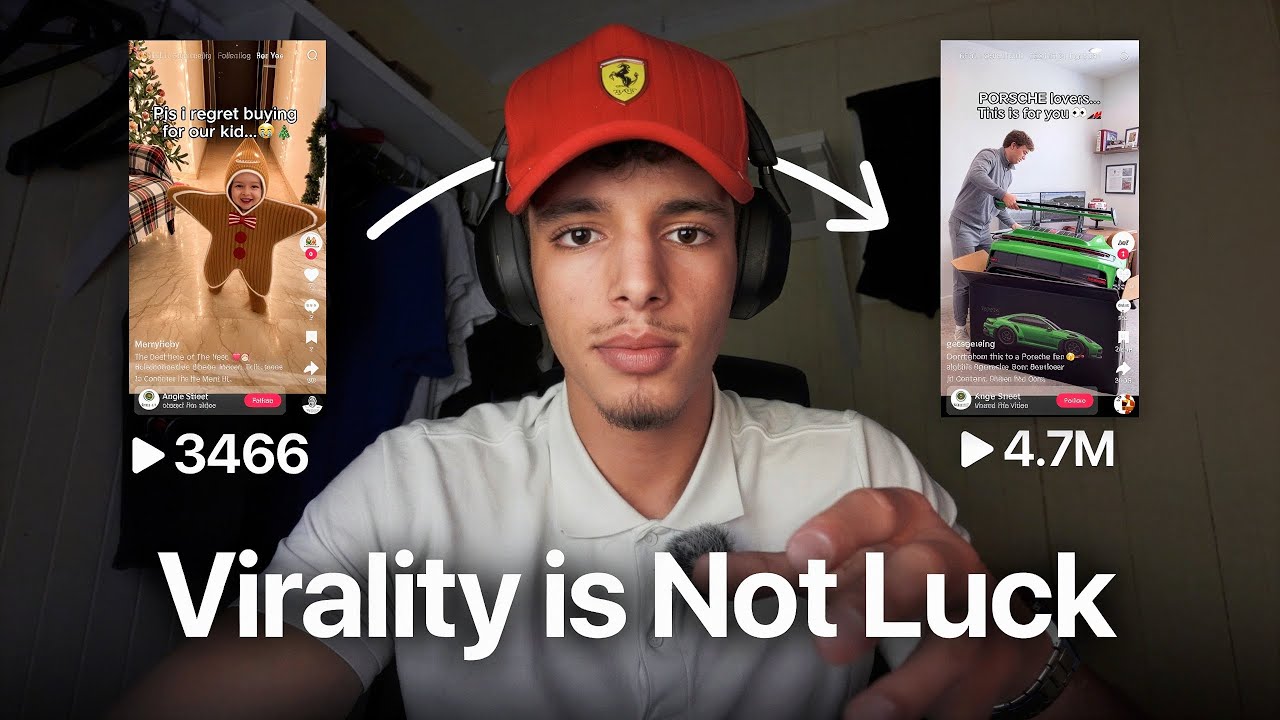
Hey people, today's August 31st, and in this video I wanted to go over to you how you're going to go viral consistently and master the skill of virality. Without any further, let's jump into the sauce. One disclaimer I want to make is that virality is not luck. It is not luck. If you have that thought in your mind, you need to remove it for a reason. Because if it was luck, me here, I wouldn't go viral consistently.
81 words, the words spoken in the first 30 seconds at 162 words per minute.
Free, no signup. See how the first 30 seconds hold attention, with rewrites.
Sentence shape
| Measure | This transcript |
|---|---|
| Sentences | 89 |
| Average words per sentence | 13.2 |
| Longest sentence | 51 words |
| Questions asked | 12 |
| Sentences containing a number | 2 |
Most used terms
Filler phrases
4 in total: actually 3 · like 1.
A literal whole-word count of the same phrase list the Prepublish browser extension uses, so a phrase inside another word is not counted and a phrase used in its ordinary sense still is. It is a count and not a judgement.
Free, no account. See where attention is likely to drop, with a rewrite for each weak line. The free check shows the scores and the one issue costing the most. Or run it on the words above first.
Free · No login · See a sample audit first if you prefer.
What this transcript is
Every word below is the caption track YouTube publishes for this video, pulled from the video itself and reproduced unchanged. It is not Prepublish's writing, not a summary, and not a re-transcription: it is the video's own published captions. English captions, generated automatically by YouTube, in the video’s original language. Source: the video on YouTube. A channel that would rather this page did not exist can ask for its removal through the contact page, and it is removed.
No Script X-ray for this video: YouTube shows a Most replayed graph only once a video has enough views.
Hey people, today's August 31st, and in this video I wanted to go over to you how you're going to go viral consistently and master the skill of virality. Without any further, let's jump into the sauce. One disclaimer I want to make is that virality is not luck. It is not luck. If you have that thought in your mind, you need to remove it for a reason. Because if it was luck, me here, I wouldn't go viral consistently. And other advanced people who does this, they wouldn't go viral consistently if it was luck.
And I'm going to explain to you exactly how you're going to replicate what I do so you can go viral consistently with your products. The first point I want to go to is take inspiration. Take inspiration. You need to abuse this ability of taking what's working and implementing it to what you are currently doing. Whether you run a Harry Potter product, whatever product you're running. If you see something that's working, a concept, a text hook, a sound, why wouldn't you want to implement it to yours and have the chance of going viral?
If it has worked once, it could work twice. Most likely, if something is working for somebody else, it is going to work for you, too, if you implement it in the correct way. For example, if you have some text hook, "Don't let a Stranger Things fan see this." You can just take this and put it on your video, "Don't let a Harry Potter fan see this." And boom, viral. That's why you need to abuse the inspiration. Take inspiration.
Don't be afraid. You're not going to get shadow banned. Just do it and see if it works. The number one thing I advise everybody out there when it comes to virality is that you need to try it and see if it works. If you ask me or any advanced person, is this concept going to work? They can tell you what they expect and maybe it's accurate, but nobody actually knows if it's going to work. But if it has worked for somebody else, most likely it is going to work for you.
Which brings me to my next point, split testing. You need to see the variables and understand what went viral in this video. Is it the background? Is it the sound? Is it the hook? Is it the actual visual or the text hook? You need to analyze and pay attention for why the video worked. If you have an outlier, you need to abuse the split testing method on it. You need to split test it. What worked good? The text hook. Okay, I'm going to use this text hook and change the background.
And boom, you go viral again and again and again. Split testing is so powerful. It's the most OP thing you can do once you've gotten an outlier or you've seen another competitor have an outlier and you split test that with your product. And since AI has been so big recently, it's so easy to replicate videos. If a competitor went viral with a video, you can take the same exact hook and go viral with it just because simply you changed the avatar.
If the guy's video got 1 million views, it simply is proven to work. It is working currently. So, take the same hook and change the avatar, change the text hook, analyze the video. What can you change so you can go viral for your product? But do not change anything big because if you change the entire scene of the first hook, there's no point of you split testing that. Because why are you split testing something that doesn't really exist because the hook worked and you decided to take the entire base out and split test the remaining.
You're not really split testing. You're coming up with your own stuff. Split test what is working and change something really small. It could be even an emoji, a word. That is how powerful split testing small variables is. And make sure when it comes to virality, you don't go viral for the wrong reason. Many people out there, they wonder, I go viral consistently, but why do I not make money? Because you're going viral for the wrong reason or you're running a bad product.
If I market a product to the brain rot audience, do you truly believe that they would buy the product? They are there for a reason. They are there for the memes. They're there for the laugh. But not to buy a product. And what makes it worse is that they are kids. And kids doesn't have money. So you need to understand that you have to go viral for the correct reason. If you have a solution to the problem people have, I guarantee you will make money if you market it in the correct way and actually show that you can solve their problem.
Now look, I could be here and tell you a bunch of tips on how to go viral, how to change the text hook, and what specific sound you should use, but it all depends on your product. It all depends on the bigger picture. You cannot look only at one pixel and determine if this product is going to go viral if you use that text hook or you use that sound or that You need to look at the entire picture and understand it. And how do you understand this?
It is by experience. You need experience points. You need to do more. You need to film more. You need to do more AI videos. And by doing more and running more products, that is exactly how you're going to start to understand how virality actually works and how the skill gets built. To sum it up, take more inspiration. Take more proven to work videos, proven to work text hooks, proven to work sounds, and implement it to your product.
This is the easiest way for any advanced, intermediate, even beginner. If you guys are beginners, you need to implement this. If you're trying to be creative and find this Albert Einstein type of video concepts, I guarantee you nothing will work. Maybe you hit a one-time wonders thing, and then what happens after it? You cannot go viral consistently because you're trying to be different. And the viewers behind the screens doesn't care if you make a creative video if it's shitty.
They only care if you can provide them with value. With that being said, hopefully you'll found this valuable. And if you have any other question or any concerns you want me to make a YouTube video on, make sure you drop it in the comments, and make sure you join the Discord in the description to surround yourself with like-minded brothers and be up to date with the market. Hopefully this made sense, and hopefully it helped.
The words are the caption track's own and nothing is reworded or re-transcribed. Paragraph breaks are placed between sentences so the text reads as prose.
Free tools for your own script: paste a draft and see where it stands before you record it.
Paste your draft and see where viewers are likely to drop off, with a rewrite for each weak line.
Paste the first 30 seconds of your own draft for a hook score and rewrites.
Check your draft against YouTube's advertiser-friendly guidelines before you record it.
Read this channel's public videos and transcripts, and download a writing brief for it.