Getting the transcript
Reading the captions from YouTube. A video nobody has opened here before takes 10 to 30 seconds; this page fills in on its own.
Getting the transcript
Reading the captions from YouTube. A video nobody has opened here before takes 10 to 30 seconds; this page fills in on its own.
Sam Piliero · @SamPiliero
This video has no Most replayed graph yet: YouTube shows one only once a video has enough views. These are the moments viewers replayed most in Sam Piliero's most watched videos.
Most replayed moment at 0:39
7.2x that video's typical replay level
launching, and changing campaigns right now. Okay, first things first, go into Claude, go to the bottom left corner, and click settings, and then click connectors. Once you're here, click add custom connector. Name this Facebook Ads MCP, and then paste in
Said at 0:32
Most replayed moment at 1:48
2.7x that video's typical replay level
this method 100%. So, first things first, what we need to look at is our audience segments. So, if you go to breakdowns and audience segments, we're now going to see the distinction between new audiences here, existing customers, and engaged customers. Now, if you don't already know what these are, I highly
Said at 1:42
Most replayed moment at 2:40
2.4x that video's typical replay level
solution from the same exact product. And so, I'm a part of Alex Hormozi's private group for $1 million plus business owners. And I posted my full take on Andromeda. And before I break this down, which I will in a second, note that the man himself replied and gave me the stamp of approval. So, just
Said at 2:34
The graph counts replays. It does not show where viewers stopped watching.
Words
4,506
Runtime
21:54
Speaking pace
206wpm
Reading time
19min
206 words per minute, above the 201 75th percentile of 349 measured videos. That distribution comes from the 349-video hook study.
Opening (first 30 seconds)
I made a simple list of 21 ways that you can be better at Facebook ads. So, in this video, I'm going to take you through all 21 ways, show you the in-platform examples of everything that I'm talking about, the inner workings of the systems that we use here at The Moonlight Ers. And by the way, if you don't know me, my name is Sam. I've spent over $500 million in Facebook ads over the last 10 years to drive over $2 billion in sales across over 100 businesses that we actively work with at The Moonlight Ers right now. So,
103 words, the words spoken in the first 30 seconds at 206 words per minute.
Free, no signup. See how the first 30 seconds hold attention, with rewrites.
Sentence shape
| Measure | This transcript |
|---|---|
| Sentences | 293 |
| Average words per sentence | 15.4 |
| Longest sentence | 48 words |
| Questions asked | 7 |
| Sentences containing a number | 72 |
Most used terms
Filler phrases
77 in total: actually 30 · like 30 · literally 7 · basically 4 · right? 4 · I mean 1 · you know 1.
A literal whole-word count of the same phrase list the Prepublish browser extension uses, so a phrase inside another word is not counted and a phrase used in its ordinary sense still is. It is a count and not a judgement.
Free, no account. See where attention is likely to drop, with a rewrite for each weak line. The free check shows the scores and the one issue costing the most. Or run it on the words above first.
Free · No login · See a sample audit first if you prefer.
What this transcript is
Every word below is the caption track YouTube publishes for this video, pulled from the video itself and reproduced unchanged. It is not Prepublish's writing, not a summary, and not a re-transcription: it is the video's own published captions. English captions, generated automatically by YouTube, in the video’s original language. Source: the video on YouTube. A channel that would rather this page did not exist can ask for its removal through the contact page, and it is removed.
I made a simple list of 21 ways that you can be better at Facebook ads. So, in this video, I'm going to take you through all 21 ways, show you the in-platform examples of everything that I'm talking about, the inner workings of the systems that we use here at The Moonlight Ers. And by the way, if you don't know me, my name is Sam. I've spent over $500 million in Facebook ads over the last 10 years to drive over $2 billion in sales across over 100 businesses that we actively work with at The Moonlight Ers right now.
So, please take everything I'm saying here with a grain of salt, but understand that it still comes from the place of real experience and expertise. Okay, first on my list is to always use the purchase objective or whatever metric you are actually optimizing for. What I simply mean by this is when you're creating a campaign in the ads manager and you are actually selecting your main objective, you want to make sure your actual target, your conversion event, is the thing that you care about the most.
So, when we go down to our ad set level and we select the conversion, we're selecting our conversion location, most of the time it's going to be website, and choose your performance goal and your actual conversion event for the actual conversion that you want. Never add to carts, never initiate checkouts. Make sure it is the event that you're actually optimizing for. Facebook is tremendously good at actually getting you the actual event that you want.
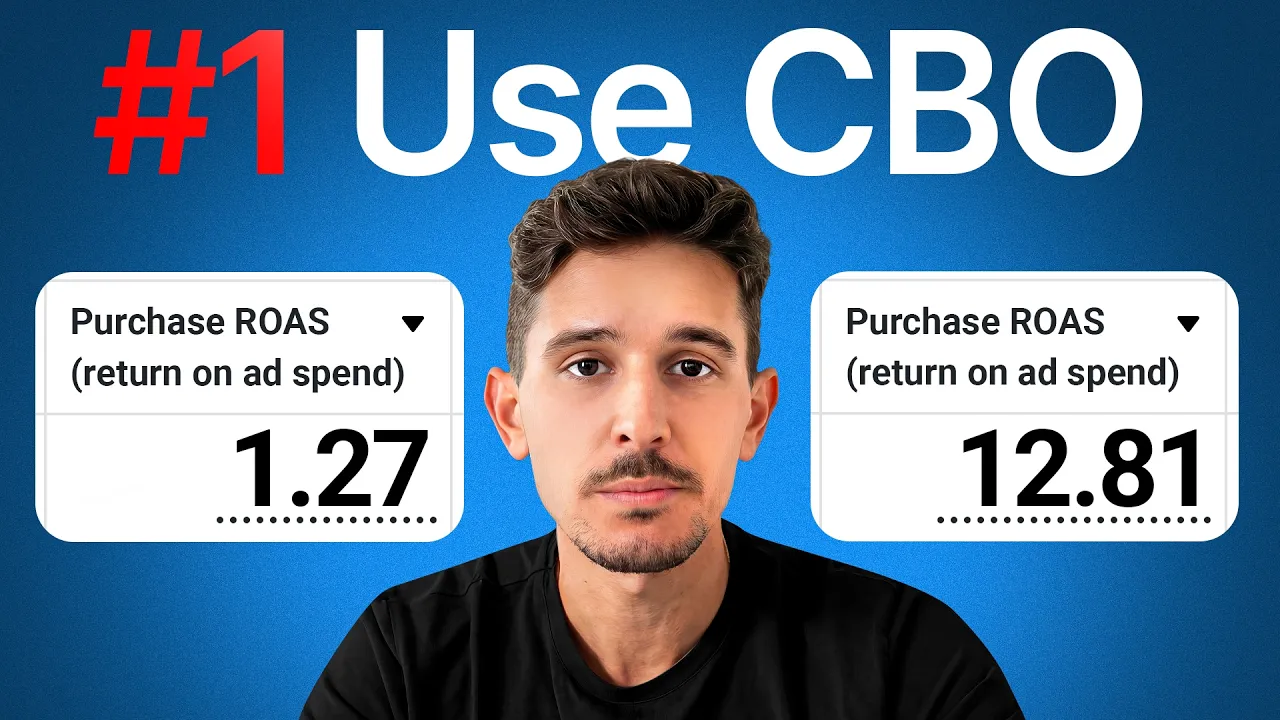
There's almost been no cases where I've ever seen someone use add to carts or add payment info that has driven more purchases than driving purchases standalone as the event. Second is to always use CBO. So, I'm going to put this for you very simply. This green blob, that's your money. That's how much money you have that you could possibly spend on Facebook ads. And each of these red squares are your campaigns. When you have a complicated structure, you wind up setting budgets on an individual level.
You're spending money because you think you're smarter than the algorithm. When you have a simple structure that focuses on CBO, meaning campaign budget optimization, you're actually allowing the budget to be distributed. So, in this example, if the red blocks were our ad sets and we had our campaign set to campaign budget optimization, Facebook is going to spend the money according to what is working the best. This means that ad set number one right here might get literally triple the amount of spend as ad set number three.
This is completely acceptable, completely normal. Facebook is spending your money where it's most likely to convert. At this point, I basically exclusively use CBO. is reserved for extreme situations. 99.9% of the time, you don't want to be the outlier. Do not use CBO. Number three on my list is new creative always goes into a new pack. Now, what I really mean by this is new creative gets launched into a new ad set. So, if we go into the Facebook Ads Manager, we pull up a sales campaign, what you'll notice is that the accounts that we run and the accounts I've shown many, many times before is that we use what's called a pack-based system.
This means that every time we launch new creatives, we do so in a grouping of avatar and concept together in a new ad set. For example, if I were to launch new ads, I would name this and group it by avatar concept. So, the avatar could be woman who really want to get their nails done and have beautiful nails. That's an avatar. The concept could be us versus them, three reasons why, UGC in car, whatever your concept is, that's attached here.
This allows us to easily see groupings of creatives at the ad set level. And then, of course, we want to have somewhere around four to six ads. That seems to be the sweet spot these days of number of ads in an individual ad set. Number four, evaluate over 7 to 14-day windows. One of the biggest mistakes that I see most advertisers make these days is they launch ads and they immediately jump in and try to make adjustments a day later, two days later.
They think that their new ads aren't as good as their old ads. They make a bunch of changes and destroy what they just spent so much time creating. So, what I like to do is very simple. I like to look back on a 7 to 14-day window to evaluate which ads to pause, which new ads to create, and so on. And the reason for this is very simple. Impressions take time to convert. So, if I impress person number one and person number two after a one-day window and expect them to convert, then to be completely honest, I'm delusional.
These people are going to take a number of ad placements along the way to actually convert on my product. Now, if you're selling $3 products, $5 products, sure, you might need them to convert in a one-day window because you simply can't afford multiple impressions for the conversion. That's a completely different story, but that's a 1% of people watching this. Everybody else has a journey that the customer needs to go on.
The advantage you have when you actually start to spend consistently on Facebook is different people marked by my little circles here will be at different parts of the journey. Because of that, you're always going to have people close to the purchase, and you're going to have other people that are just starting. As you spend more money, more people will be at the start, naturally. So, I don't like to look at yesterday.
I don't like to look at 2 days ago. I always like to look at 7-to-14-day windows. Of course, look at yesterday's numbers, get an idea of what's going on, but especially when you scale or make changes, always look back on a 7-to-14-day window. Number five, we're going to go in the platform platform for this one. Use incremental attribution to evaluate your creative. Now, this is a very simple thing that everybody could do these days, and it's incredible that this is available to us.
So, if you go into your ad account, you click columns and compare attribution settings, you have the option to select incremental attribution. This is going to show you the conversions that happened because of Facebook, and you're most likely to see a drop-off in these conversions from your normal 7-day click, 1-day view, 1-day engage conversions. So, what I like to do is I like to evaluate our prospecting creative from the perspective strictly of incremental attribution.
So, what I really mean by this is you can see my drop-off here is 379 to 206. This means my cost per acquisition went from $14 to $26, still very, very efficient. And if I pulled in my ROAS metrics in here, we'd see changes as well. I am focused on the creatives that did the best job of driving incremental attribution. These creatives are most scalable. They're not sneaking in at the last second to steal a conversion that may have been attributed elsewhere.
They are strictly grabbing the conversions for the most part that happened because of the ad. That's important. Moving on to number six, compare Meta and any ad platforms to Shopify constantly. So, one of the things that I like to do, we basically do this for every client that we work with, is we like to have our data side by side. So, this is going to seem like an overwhelming amount of data, but this is what we do for every client that we work with.
What we like to look at is our total spend in the platform next to our Shopify total sales. This gives us a better idea of the actual business health and it doesn't force us to rely just on the platform metrics. For example, this ad account is getting around a 5x return on ad spend, which we can see right here, but the actual business is getting an 8.5 total return on investment across the blended business. So, what this means is we spent $84,000, but the business drove $727,000 in total sales.
Then we also want to track this daily, so we have a breakdown that looks like this with our spends by day, purchases by day according to the platforms, and then our Shopify metrics right next to it. We also have this exact template that you can steal inside the school community if you'd like to join. This moves us on to number seven, do regular pixel gut checks. So, we'd go into our events manager, we click on our correct data set, and we would scroll down to the purchase event and select it.
And what we're looking for is parity between the blue lines. And what we'd expect is the blue line and the green line are very similar. We click view details, we'll be able to see the total events right here and the reported events against these. I expect a 10% difference between browser and server events, where server events are typically 10% higher. In this case, we're actually exactly 10% higher, so that's pretty good.
In either case, 10-15% that's where you want to be. If you see these completely whacked out, your tracking is incorrect, get it fixed. Number eight is default to broad targeting. Now, there's a reason behind this and I will explain it with some fun graphics. Old school Facebook focused on interest audiences. You would basically set your interest, which we'll mark as INT, and that interest would actually go out and specifically target the interest, and you would create ads for that interest group.
You would build ads specific to your interest. New school Facebook works the exact opposite way. You actually create your ads first, specifically targeting an avatar, and then those ads go find the interest or people for you. It's a very big difference. It's the opposite. And in saying interest here, it's more like it just finds people. Because of this, it's more important than ever to not restrict the algorithm, and instead allow it to be broad.
You could still run exclusions. You could still run inclusions where they're necessary. But for the most part, when it comes to your cold prospecting, we do want broad targeting. This moves us on to number nine, iterate on winning concepts. I am not going to stand for people saying you could only run new concepts, only new concepts, 100% creative diversity. It's just not what works. Every big business is actively running iterations of what's actively working the best for them.
Let me explain. So, here's how it works. I'm going to show you with two simple creatives. This is from AG1. Let's say you have a creative that you upload and it works, meaning it is driving above your target KPI and it is actually spending. It is now your job to duplicate this creative and create iterations. When I say duplicate, I don't mean exactly duplicate. I mean literally make changes to the creative. Change the callouts.
Change the backgrounds. Reshoot the creative. Change the headlines. Change your primary text. You want to leverage this creative as much as possible, because you've already found the winner, which is the hardest part. And then, you constantly are creating new, different, diverse creatives. And when those work, let's say this one worked here, then yes, again, we are creating iterations of that creative. You go horizontal first and then vertical with what's actually working.
And to be honest, I pretty much explained number 10 here. Creative is the targeting. Everybody has heard this, but let me explain it very simply. The creative that you put out into the market has a direct relationship to who you are targeting more than your pixel, more than your website, more than anything else that you give the system. Even if historically you have run all 65 plus age groups, that's only people you've targeted, that's all of your purchases on your entire business.
If you run a creative in your ad account that is geared to a younger group, it's going to get shown to a younger group. So, don't focus as much on the little levers in the ad account anymore. Focus more on the creative input that creates the output for you. Creative actually picks who sees your ads. Okay, number 11, scale aggressively when you are over your goal. I see so many advertisers do this. They start from a certain spend, they increase their spend, they wait, they increase, wait, increase, wait, and all of these are like 10% adjustments, right?
They go up 10%, they go up 10%. All of a sudden, a year has gone by and they've grown 30%. I don't know about you guys, but if I'm running a million-dollar business and I grew 30% over the course of a year, that would not be enough growth when it comes to e-commerce. And in fact, I'd probably be swept to the side by 10 other competitors who grew 300% year-over-year because multi-hundred percentile growth is completely possible in early stages of business.
In late stages, if you're Apple, you're not going to grow 300% unless you reinvent the wheel. need to reinvent the wheel to go from a million to three million. It could be done in a matter of a months. Where instead, when we scale aggressively, we're going to do something completely different. In this case, when the iron is hot, your ad account will look very different. You might stay steady for a period of time and then scale massively upwards of 100% in your total spend.
And then, yes, you might decline a little bit and then plateau again, only to again increase massively later on. A shorter period of time will go by that you were able to capture more customers truly striking when the iron is hot. Now, I'm not telling you to go 10x your ad account today, but what I am telling you is to look at your incremental new conversions in your ad account and actually determine can I scale? Am I far above goal?
If you have a target of 2x and you're hitting a 4x, you have massive wiggle room in your ad account to actually spend more money. Okay, number 12, the rule of 10,000. This is a rule that we use to determine how many new ads do we need on a weekly or bi-weekly basis. It's really simple. For every 10k spend, you want to create one ad per week. It is actually that simple. $10,000 spend per month, one ad per week. If you spend 100k, you're uploading 10 new ads per week.
Now, for some people that sounds like a lot, for other people that sounds like very little. If that sounds little to you, understand that there is a floor. That floor is two ads per week. So, basically, if you're spending less than $10,000 or rather less than $20,000, you want to be uploading two ads consistently every single week. If creating two ads a week is a challenge for you, which I totally understand in the early stages of a business, then group these together bi-weekly, meaning four ads every two weeks or even six ads every three weeks.
Quality is more important than quantity. Just get these ads consistently flown into the account. Okay, number 13. We've already gone through what to do when you're scaling aggressively, when things are working, when there's a sale, when there's an offer. But, what do you do during evergreen businesses as usual times? Let's say your target is something like a 2x and you're hitting a 2.3x, right? You're 10-15% above goal.
I like to scale in increments of 20 to 30% every 3 to 5 days and I look back, just as we said before, on a 7 to 14-day window. If we do that consistently, we ladder up the account and if we add in, just as we talked about before, those big increments, then we have scaling compounding in multiple places. So, we have our 10 to 30% increments during business as usual, and when things are way above goal, we're increasing scale massively in chunks.
So, to put this into full circle here, when we're at a 4x and we only need to be at a 2, we're scaling very aggressively. When we only need to hit a 2, but we're at a 2.3, we are still scaling. And in this case, we're actually just scaling simply by 10% to 30% increments. As simple as that. Okay, number 14. This is one of my favorite things. Always view your account with audience breakdowns. So, when you're inside of your ad account, click on this breakdowns button right here, and click audience segments.
Once you do this, you're going to be able to see your total spend on new customers versus existing customers versus engaged customers. I actually like to optimize everything from this POV. I like to literally look on a campaign level with these breakdowns already preset. This moves me on to number 15. Use value rules over hard restrictions. Now, value rules were introduced just a few months ago. They've been a fantastic tool so far.
They allow us to modify the back end of the algorithm for what our account deems valuable. This is fantastic. This is new, and Facebook has never allowed this before, and we have seen this be such a good tool instead of axing things out of accounts. For example, old school, we would have paused down a specific age group, a specific gender, something that we didn't want to target. New school, we can now just put value changes on that.
In your ad set settings, there's an option to select value rules and click apply rule set. From here, you're able to create rule sets based on what you think is most valuable to your business. A very simple example of this is let's say you know a specific age group comes back and purchases over and over and over again, right? 65-plus, they are clearly more valuable than other age groups. But, Facebook doesn't know that cuz it only looks at the first purchase.
So, what we might do is we might take the age, we might say 65-plus as we just showed in the example, increase by something like 50% based on actually how much more LTV they provide. And we'll say 65 plus LTV 50% increase. What this is going to do when we apply it to the ad set is Facebook will actually use that as a guide to actually spend more against the 65 plus. It will literally look at those purchases as 50% more valuable.
This allows you to shift spend or decrease spend where you see fit in your account without just hard excluding certain ages, certain genders, or other things. This brings me to number 16. Always run an existing retention campaign. Most ad accounts group together broad prospecting and retention together. We always want to separate these. I like to call these swim lanes. Swim lanes are really simple. We have new customers here and we have existing customers here.
And when it comes to our swim lanes, I want to make sure that when I'm spending more money, I am spending on my new customer acquisition. And then when I am monitoring my existing customer, I'm looking at different metrics. I'm giving them different creatives. I'm managing to a frequency. I want to make sure when I scale, I'm scaling into new and I'm keeping my existing customer spend steady. So simply put, we break out new and existing, we exclude existing from new, and we allow these to run in two separate campaigns.
Okay, number 17, study the ad library every single week. You should be going into the Facebook ads library, which is free for everybody, and you should have a list of competitors that you pay attention to. You could use tools like Magic Brief Motion that allow you to do the same exact thing, but just understand that what's in the Facebook ads library is actually what's running inside ad accounts. So type in your competitors, take a look at what they're actually running.
And one of the things I like to do is sort by most recent, so you'll be able to see the ads in chronological order for what they're actively launching. And you can see they started running certain ads on different dates. So we can actually pay attention to what they're launching, who they're launching it with, so we can see like sponsored placements as well. We get ideas, we can steal from our competitors. Book I always like to reference is Steal Like an Artist.
We're not stealing, we're using it as inspiration for what we're actually going to create. This brings me to number 18. Quality beats quantity in ads every single time. If you think you can get away with just quantity of creative and launching a boatload of ads, your ads are going to get lost into the void. Look at the accounts on Instagram or Facebook that have thousands of posts and all of those reels or images get a couple of likes and maybe 10 or 20 views.
This is because the content and the quality of that content is low. And then you'll see on the flip side, there are some accounts that post once a month and they get millions of views. It's because the quality of that content is so much better. So before you rush to make a few ads, focus on the quality of those ads. It will make all the difference in your performance of your entire ad account. Okay, let's get tactical.
Number 19, none of this was in order if you can't tell. This was just a random list I put together. Do day of week analysis. Day of week analysis is one of the single most tactical things that you can do when it comes to running your ad account. This can go for actually all different kinds of ad accounts in your business in general. Facebook spends the same amount of money every single day of the week. So you look at Monday, Tuesday, Wednesday, Thursday, Friday, Saturday, and Sunday.
If you give Facebook a $100 daily budget, it's going to spend the same $100 every single day of the week. Right? It has no choice. It spends the 100 bucks. Maybe it varies 10% across the week. But, if you look at your Shopify, which we'll mark in green here, you would probably see variance between certain days of the week. A very common variant is Monday through Friday has a conversion rate of 1% and then Saturday and Sunday has a conversion rate of 1.5%.
If this was the case, this means that Saturday and Sundays are going to be more profitable days. So, we should increase our expenditure on Saturdays and Sundays. The easiest way to do this is literally by just lowering our budget Monday through Friday. We put like a minus 20% against our baseline and then using that delta on Saturday and Sunday. So, it's not plus 20%. It's greater than plus 20%. Actually, I think it's plus 33% to not only use the minus threshold that we have where we're going above baseline on Saturdays and Sundays.
This will then in time balance out our spend and we want CVR conversion rate to be equal every single day of the week. That's the goal. ROAS conversion rate should generally be stable every day. So, look at your day of week profit and actually understand should I be spending more on certain days of the week. It's one of the easiest ways to squeeze some money out of your account. This brings me to number 20. Your website means a lot.
Literally, the copy on your website could have a drastic change in your CPMs. And one of the ways you could waste money easier than ever is by having high CPMs. High CPMs or rather your cost per 1,000 impressions is really your cost of advertising and everyone's are slightly different. If you're at the extreme range of CPMs, you're going to have a hard time being profitable. In this example inside of our school community, their CPMs were $200 and went down to the $60 range by making adjustments to their website.
I don't think this is a promise to everyone, but if you have claims on your website, if you have aggressive copy, Meta is literally reading that because their pixel is on your website and they're seeing that this might not be something we can show to everyone. So, that's my simple version of explaining that your website means a lot. And the further version of that is that all your traffic is being sent to your website.
So, make sure your website is actually optimized. Look at your competitors in your space. And if you don't feel like you have a beautiful looking website, go to your competitors, steal their designs, and plop it into Claude to copy the templates of their website. It is that easy to do. Everyone could be a developer these days. Number 21. Test your offer before blaming your ads. I see this all the time. People think constantly, "Oh, my ad creative isn't good enough.
Let me reinvent, reinvent, reinvent. New strategy, new hack, new structure, new ad format." And they keep running the same offer. Your product and your offer are what give value to your customer. The better your product, the better your offer, the easier it is for you to make your ads. All of this is what actually drives value to the customer to get you your sustainable return on ad spend, to allow you to scale your ad account.
Those are my 21 ways. I hope you all got a ton of value out of this video. If you want to see more detailed guides on how we structure our ad accounts and really everything you need to know for 2026 post Andromeda, click this video right here where I go through everything A to Z. A little bit more interactive than this, but again, I hope you got a ton of value out of this and I'll see you in the next one.
The words are the caption track's own and nothing is reworded or re-transcribed. Paragraph breaks are placed between sentences so the text reads as prose.
Free tools for your own script: paste a draft and see where it stands before you record it.
Paste your draft and see where viewers are likely to drop off, with a rewrite for each weak line.
Paste the first 30 seconds of your own draft for a hook score and rewrites.
Check your draft against YouTube's advertiser-friendly guidelines before you record it.
Read this channel's public videos and transcripts, and download a writing brief for it.