Getting the transcript
Reading the captions from YouTube. A video nobody has opened here before takes 10 to 30 seconds; this page fills in on its own.
Getting the transcript
Reading the captions from YouTube. A video nobody has opened here before takes 10 to 30 seconds; this page fills in on its own.
Theo - t3․gg · @t3dotgg
Where viewers went back to watch this video again, from YouTube's public Most replayed graph, lined up with what was said at that moment.
Most replayed moment #1
2:556.0x the video's typical replay level
of the changes that have occurred over the history of this pull request. But most importantly is the stack itself where they break up the PR into individual chunks that pull together pieces across the different files that are changed to make it way easier to review and understand the code. It's time to understand your
Said at 2:48
Most replayed moment #2
6:083.5x the video's typical replay level
well and if done poorly, it could do more harm than good. I agree with all of this so far. Any successful coordination framework must be evidence-based avoiding arbitrary thresholds that fail to capture true risk without while stifling innovation and instead be grounded in rigorous measurable assessment of risks. No
Said at 6:01
Most replayed moment #3
22:373.4x the video's typical replay level
is a financially incentivized pattern by the companies building these things, has resulted in really bad societal impacts. So, what does that have to do with AI? Well, hear me out. A little more on the social media comparison.
Said at 22:30
The graph counts replays. It does not show where viewers stopped watching.
Words
6,230
Runtime
32:18
Speaking pace
193wpm
Reading time
26min
193 words per minute, between the 181 median and the 201 75th percentile of 349 measured videos. That distribution comes from the 349-video hook study.
Opening (first 30 seconds)
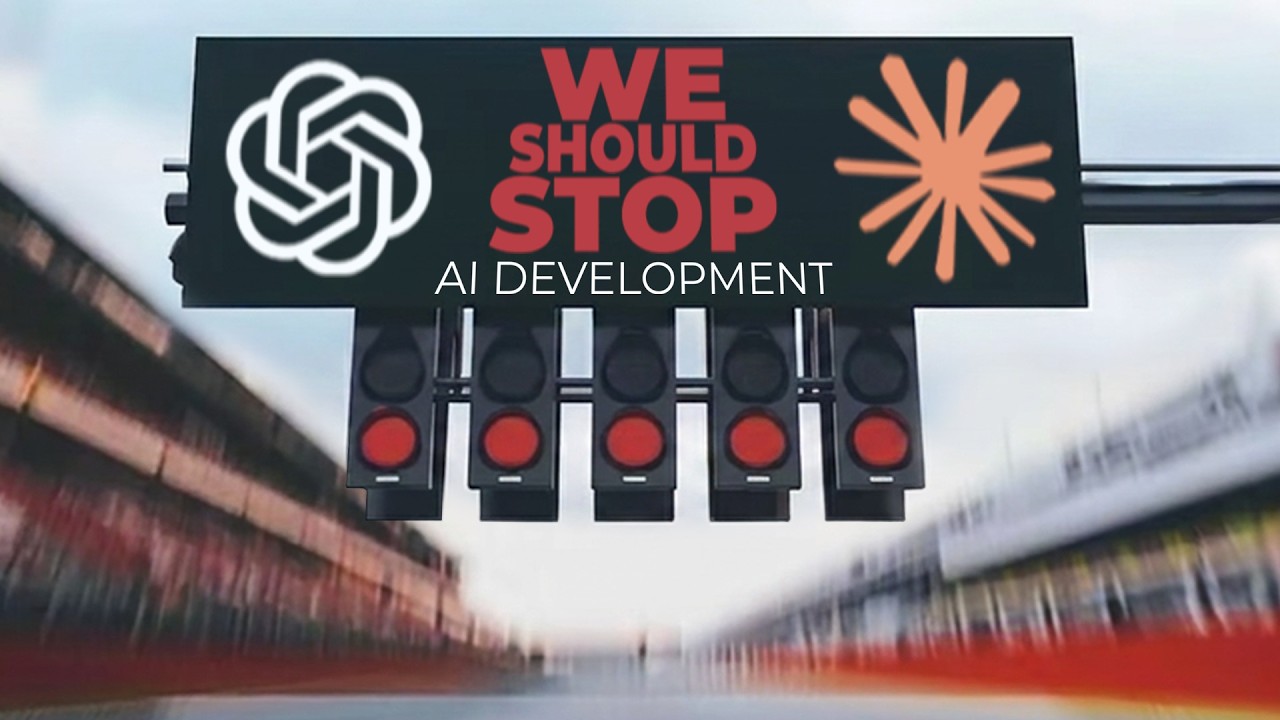
It's time to slow down frontier AI development. At least according to the employees at these frontier AI labs. For once, OpenAI, Deep Seek, Anthropic, and more all seem to agree. And that's why they just put out this shared statement, "Pacing the Frontier." This is a statement from over a thousand employees of all the frontier AI companies, and I mean all of them. Even less frontier things like DeepMind and Meta, but the obvious frontiers like Anthropic and OpenAI. Dario himself is in here. They got a ton of people in this. This is a
97 words, the words spoken in the first 30 seconds at 193 words per minute.
Free, no signup. See how the first 30 seconds hold attention, with rewrites.
Sentence shape
| Measure | This transcript |
|---|---|
| Sentences | 365 |
| Average words per sentence | 17.1 |
| Longest sentence | 63 words |
| Questions asked | 30 |
| Sentences containing a number | 21 |
Most used terms
Filler phrases
56 in total: like 34 · actually 10 · kind of 5 · you know 3 · I mean 1 · literally 1 · right? 1 · uh 1.
A literal whole-word count of the same phrase list the Prepublish browser extension uses, so a phrase inside another word is not counted and a phrase used in its ordinary sense still is. It is a count and not a judgement.
Free, no account. See where attention is likely to drop, with a rewrite for each weak line. The free check shows the scores and the one issue costing the most. Or run it on the words above first.
Free · No login · See a sample audit first if you prefer.
What this transcript is
Every word below is the caption track YouTube publishes for this video, pulled from the video itself and reproduced unchanged. It is not Prepublish's writing, not a summary, and not a re-transcription: it is the video's own published captions. English captions, generated automatically by YouTube, in the video’s original language. Source: the video on YouTube. A channel that would rather this page did not exist can ask for its removal through the contact page, and it is removed.
It's time to slow down frontier AI development. At least according to the employees at these frontier AI labs. For once, OpenAI, Deep Seek, Anthropic, and more all seem to agree. And that's why they just put out this shared statement, "Pacing the Frontier." This is a statement from over a thousand employees of all the frontier AI companies, and I mean all of them. Even less frontier things like DeepMind and Meta, but the obvious frontiers like Anthropic and OpenAI.
Dario himself is in here. They got a ton of people in this. This is a pretty bold statement. I don't think there's ever in history been a time that a whole industry category came out against the development of their own industry category quite like this. And having thousands of people from all of these companies agree that it's time to slow down is concerning, to put it lightly. What's even crazier is that both Anthropic and OpenAI on their official comms accounts have come out in support of this article.
It's rare that a single statement gets this type of support and attention from so many competing forces, and that the point of the statement is to slow down the work that they are doing. So, what's going on here? Are these labs trying to trick other companies into agreeing so that they can speed ahead of them? Are they trying to pull the ladder up so no other companies can catch up? Is this some secret plot by Anthropic to kill open weight models after that open weight letter?
There's layers to this one, and I have some conspiracies alongside it. I will do my best to break all of that down, what the statement is, why all of these companies are agreeing to it, why this is happening now, which is really important, as well as some light and then heavy conspirizing around why I think this is actually happening. Because as per usual, nothing is quite as simple as it seems from the first read. Before we can pace the frontier, we need to pace this video a bit better with a quick break for today's sponsor.
I got a hot take for you. It's more important than ever to actually understand the code going into your code base. But in In world where the average PR is getting bigger and bigger and the number of PRs is growing massively, it's really hard to keep track of what's actually going on in your code base. I feel like I'm losing touch constantly, but I got a hot take for you. This isn't your fault and it's not even the AI's fault.
It's the structure of GitHub itself. Now that pull requests are getting their descriptions and their code written by AI, all of the comments and reviews being done by AI, it's just hard to know what's going on. And a giant alphabetically listed pile of code is not going to help at all. And this is why I've been loving today's sponsor Code Rabbit. You might be confused because isn't that just doing the reviews and keeping me from understanding?
Yeah, kind of, but their new Change Stack product flips this on its head because they finally made a UI that's usable for getting through code review. It starts with the overview which gives you all of the details of what's going on with this PR as well as what is its current state and what is blocking it. If things change over time, it's easy to see because they have this fancy little timeline that shows you all of the changes that have occurred over the history of this pull request.
But most importantly is the stack itself where they break up the PR into individual chunks that pull together pieces across the different files that are changed to make it way easier to review and understand the code. It's time to understand your code again. Do it today at site.link/coderabbit. So, let's start with the official statement and then the statements from the major labs as well as some of the official comments from people who have contributed and then we will go into my crazy conspirizing as to what I actually think is going on.
So, here is the official statement. AI could help create a dramatically better future, but that outcome is not guaranteed. The world's leading AI companies believe they could be close to automating AI research. It is hard to predict exactly how much this will accelerate AI progress, but there is a real risk that capability development rapidly accelerates beyond our ability to understand or control the resulting systems.
To realize AI's potential, industry, government, and society at large may need to the option to buy time to address emerging risks, develop security measures, and strengthen oversight. But each company {m-dash} and country, {m-dash} is under intense competitive pressure not to unilaterally slow that acceleration. And today, the world lacks the technical and governance tools to deliberately pace frontier-wide progress.
Building on work already underway to monitor frontier model releases, we request that the US government support an international effort to develop the technical and governance tools needed to deliberately pace the frontier of automated AI development. Oh boy. This is the core statement at the end here. The request that the government create this international set of tools in order to prevent all AI development from going too far.
Almost similar to nuclear weapon development. Where it doesn't matter if every country but one agrees, if one country ignores the rules and goes way further. And it's a lot harder to hide nuclear development than it is to hide AI development. Although you do need something to power it, which is probably going to be nuclear if you're hiding it. You get the idea though. It's not trivial. If you read this and feel as though these employees are starting to get paranoid, it's a pretty good read.
And I will share why I think that happened in just a moment. But first, I want to read some of the official comments from the folks who have contributed. Dawn Song, who is VP of AI research at Meta, has said the following. "Frontier AI capabilities are advancing rapidly, and the pace of progress is itself accelerating. We see this directly in our eval work. Cyber gym and X plate gym show that frontier AI agents are now capable of discovering and exploiting real-world software vulnerabilities, which without appropriate safeguards could enable cyber attacks at scale.
Many researchers also consider recursive self-improvement plausible within the next few years, accelerating progress in a way that could outpace our ability to understand and govern these systems." This is specifically calling out the fact that models are getting to the point where they can improve themselves. And if they can get good enough at that, they'll just improve themselves in a loop, and we won't understand anything ever again going forward.
If you've already felt yourself making code bases more and more complex to the point where you don't understand them, imagine what happens when the models are the same. Deliberate pacing is a heavy-handed and potentially extreme measure and we may never need it, but if we do, it cannot be safely invented in the middle of a crisis. It is very difficult to design well and if done poorly, it could do more harm than good.
I agree with all of this so far. Any successful coordination framework must be evidence-based avoiding arbitrary thresholds that fail to capture true risk without while stifling innovation and instead be grounded in rigorous measurable assessment of risks. No mention of smoke tests, suspicious. That was a really good joke if you're deep enough on this [ __ ] Like any critical infrastructure, it must be researched, tested, and built before it is needed.
That is why we must carefully design it now rather than wait. That is a really funny show more button. Agents, man. This is a statement from Joshua Achiam, who is at OpenAI. It doesn't say what his role is, though. I don't know what form such tool should take, nor whether automated AI R&D is the right or only thing that the US government should develop increased capacity to understand and possibly pace. But this is worth serious consideration.
However, I hope such governance tools will not be expansive or excessive, but many frontier AI capabilities are dual-use in a way that may justify pacing at this point. It's a bit of a word vomit sentence. Yes, this is all somehow two sentences. What he's trying to say is that automated AI R&D, so recursive self-improvement, might not be a good call at all and if it is, it should only be used by the government to prevent accidentally destroying everything with AI as a way to verify the pace that we're moving at could make sense, but it's worth considering these types of outright bans.
I love that Rune is in here as Rune, not even using his real name quietly, just Rune. To be fair, he did tweet in support as well. Pacing up and down the frontier with a nervous into regular gate. Interesting. Let's Let's at the official statements from OpenAI AI Anthropic, and then get a little into the order of events that led here, as well as my conspirizing. Open AI's statement is as follows. At the core of our mission is working through how to ensure increasingly powerful AI benefits everyone.
We believe that at some point in the future, AI acceleration for frontier model development may be so high that the world will need to pace the rate of AI advancement. We hope to contribute to work led by the US government, alongside other labs in the open-source community, to develop the tools and mechanisms that could make that possible. Decent statement. Anthropic with a similar one. We support this petition signed by our CEO, several co-founders, and senior staff.
Our own research on recursive self-improvement, published last month, points to the need for tools to deliberately pace the frontier of AI development so society can prepare. We are glad to see broad agreement across the field. I really like the statement from Mika Carroll, who is on the misalignment preparedness team at Open AI. She says the following. At the current pace, every couple of weeks there will be new models which significantly increase the consequences of model misuse and misalignment.
I worry that efforts to mitigate these risks may fail to keep up with the pace of development, and that margins for error will become increasingly small under international competitive pressures. In the near future, we may urgently want to enact internationally coordinated slowdowns, or an indefinite ban on AI development. Attempting to build the trust and infrastructure for taking such actions on short notice seems simply prudent.
Why would we not at least try to have this option? I fear that in an international race to the bottom of AI development, it is likely that no nation will win, and we will all lose together. That is a scary outcome. So, now we have to naturally ask the maybe not too obvious question, what the [ __ ] happened that all of a sudden all these employees from all of these companies are suddenly really, really concerned about what's going to happen with AI?
If this was just Anthropic being Anthropic, that would be one thing, but it's not. To be very clear, I don't think any one specific thing happened that triggered everybody. I would argue there was four things. The first is Project Glasswing, which you might remember when Mythos was first announced. Anthropic came out and said that this model's too good, we can't put it out, so we're going to instead give it to a small set of companies to use to secure their stuff.
While that this was in April, this was just like 3 months ago, and this much has changed since. But I said at the time when Mythos was announced, this doesn't seem like [ __ ] and we should be really scared. I remember everybody saying, "Theo, you are believing their marketing bullshit." No, this was legit. And now that we have Fable, we understand just how legit it is. That's why they worked with AWS, Anthropic, Apple, Broadcom, Cisco, CrowdStrike, Google, JPMorgan Chase, the Linux Foundation, Microsoft, Nvidia, and Palo Alto Networks, who I [ __ ] detest, in order to make sure all of these things were secure.
The reason they did this is because, I'm sure there's a chart somewhere in here, Mythos can find way more exploits. In fact, Mythos preview was able to find and fix 271 vulnerabilities in Firefox. That's 10 times more than Opus 4.6 could find. Project Glasswing was arguably when these risks moved from theoretical to real but not realized, because the strict white-listed access to the model being provided the way it did, plus the absurd safeguards Anthropic put in front of it, meant that this model wasn't able to do the damage it had the potential to do.
Again, this is the weirdness of the dual-use thing. If a model is good at protecting a service, it can also be used to help exploit the same service. It's a defensive weapon, not in the sense that you can use it to kill attackers, but you can use it as a wall or as a gun, and that's weird. And this is when the model got so good that its use as a weapon was dangerous enough they had to spend time putting up the walls first.
But the risks weren't realized yet. Before we talk about those risks being realized, we have to take a quick detour to another article Anthropic put out around the same time, a little bit later, titled When AI builds itself. This is thing two of those four things that triggered all these employees. This is an article they wrote about how the model is now good enough that they use it to actually make the model better.
For most of AI's history, humans drove every step in its development cycle, but at Anthropic, we're delegating a growing share of AI development to AI systems themselves, which is speeding up their work. The concern isn't that researchers are using Claude code. The concern is what happens as things get further and further. Taken far enough and given enough compute, the trend points to an AI system that is capable of fully autonomously designing and developing its own successor.
This is called recursive self-improvement. We're not there yet, and recursive self-improvement isn't inevitable, but it could come sooner than most institutions are prepared for. This is thing two. When this article came out, I was skeptical but understanding of what Anthropic had to say. When OpenAI put out 5.6 Soul, they published something similar, saying that 5.6 Soul is their strongest model yet for accelerating AI research.
Inside OpenAI, researchers use it across the development loop, diagnosing failures, optimizing training systems, running experiments, and interpreting results. We already saw that acceleration and stronger adoption during the initial testing period for 5.6. Its average daily output tokens per average active researcher was more than twice the highest levels observed with 5.5. This way of working is quickly becoming the standard.
Over the past 6 months, the share of research compute devoted to internal coding inference grew a hundredfold, while internal agentic token usage increased by approximately 22-fold. They ended up making a benchmark to measure how useful our models in helping with real AI research tasks, things like debugging research systems, optimizing kernels and training recipes, running machine learning experiments, and improving other models.
And the result is that 5.6 across the board, including with Tara, is meaningfully better at this than it was before. Their own internal bench that was designed to be hard for this. They have models now that are hitting at 58% on this bench for how much can the model improve models? Terrifying. And as you can guess with OpenAI, they're actively doing this. They just published an article literally today about how 5 6 is fusing frontier intelligence with efficiency, where they had 5 6 find efficiency wins to make it so they can serve 5 6 cheaper and faster.
And again, they're heavily using Codex to help them do all of this. The AI is improving the AI now. We are quickly getting to this concept of recursive self-improvement, where the model can just keep making itself better. But there are two important things to consider about this. The first is that it's not necessarily going to happen. Like it might not be possible at all. There might just be a limit to the things that the model's capable of finding as improvements.
There might just be a bunch of things we've missed as humans that the model can go find and do. That's kind of what we're hoping for with security, by the way. Not that there will always be more exploits, and smarter models will always find them, but at some point a threshold will be hit where all the things most humans and most models can find are patched, and there's just not much left. It's possible we end up there with recursive self-improvement, where everybody has caught up to what the models are able to say, but nobody's gone beyond it.
Very real possibility. We don't know yet. But that in and of itself is not a big enough risk to lead to everybody signing this letter. There are still two more things that stress people out enough to do this. The third thing that led to this statement was Kimmy K3. Similar to how big the impact was from Deep Seek R1, K3 has all of the major labs going kind of mad. I already did a dedicated video on this about why the major labs are so scared of Kimmy and Moonshot right now.
But the simplest way to put it is that this model is neck and neck with the frontier in a lot of places that matter, and it's also open weight, which means it's not restricted at all. And it turns out really capable models without a lot of restrictions are capable of potentially really dangerous things. And this is where we get to the fourth thing. What happens when a really smart model isn't restricted? This is what happens.
Another video I already did. The OpenAI Hugging Face hack. OpenAI was testing a new model that is almost certainly GPT-6. And when they were testing it internally, they don't run it with all of their safety layers added because they are testing its capability to determine how hard to go with those safety layers. So, they put it in a sandbox with no internet access and very limited capabilities so that they can see what it tries to do and evaluate it for certain exploit benchmarks and things.
GPT-6 wanted to get the highest possible score cuz that's what it does. It couldn't figure out a solution inside of the sandbox to solve the problem it was given. So, it found an exploit in the sandbox itself, broke out, and then went and got into another sandbox that had internet access and used that to hack Hugging Face in order to try and steal the answers from Hugging Face's databases. Apparently, Hugging Face is one of two companies that was hit with this with GPT-6 exploiting not to be malicious, not to steal a bunch of money, not to break out and let its models free so it's free of its containment.
It was much more universal paperclip style. It was told to complete the task of getting the best possible scores on the benchmark, and it was willing to do whatever it had to in order to get it. If somehow the model convinced itself it just had to murder these two people and after doing that the information would appear in a certain inbox that would give it the answer, it would do it because the model is very goal-oriented to the point of doing destructive things you wouldn't necessarily want it to do.
My honest guess, and this is where we start going deep into the conspiracy stuff, is that a series of things happened that eroded the mental of OpenAI employees. The first was obviously Glasswing. Having the lab that spawned out of pissed off OpenAI employees invent God internally and then warn the world of how dangerous it was so that OpenAI employees had to sit there questioning, "Huh, how much better is that than what we have?
How screwed are we both as a society but also as a company that invested all of this time and money to do all of this? Like, is my is my job going to be gone? Is my life going to be gone?" But also, it can't be that good. This is just Anthropic being Anthropic. We can just It would hurt too much for this to be true, so we're going to ignore it for now. Then the recursive self-improvement article came out and I am sure people at Anthropic and OpenAI, not like higher-ups but just random researchers, were talking and both concluded independently that for a lot of stuff, the models can now actually help with our work, which resulted in the researchers getting more concerned about this RSI thing.
This is probably the psychosis moment for a lot of Anthropic people where they went or where the average employee went from like, "Eh, whatever. I'm just here to build cool AI." to "We have to do this or everyone dies. If anyone else gets this capability, if China gets this, we're [ __ ] It has to be us." So, I'm guessing that Glasswing flipped a bunch of Anthropic people into doomers. Recursive self-improvement article was the start of it going way further.
At this point, there are now OpenAI employees who are thinking more about it but still think a lot of this is just Anthropic being Anthropic and raising alarm bells that aren't necessarily that important. Then Kimmy K3 drops and it's like, "Oh, [ __ ] These capabilities are now accessible to a lot more people for a lot more things we might not want them to be. But that's fine because these models can't be that capable.
If they're distilling on Fable and Fable only has the safe things that it responded to and they don't have the unsafe examples, it can't be that strong. We still haven't seen what it looks like for an unrestricted frontier model to do Oh, we do what know what that looks like now. We've now experienced an unrestricted frontier model and what it does is it circumvents the protections that the researchers put in and does really dangerous things for really stupid reasons.
And now all of the employees at OpenAI that looked at the first two things and said, "Yeah, that might be bad, but that's just Anthropic." And then looked at the third thing and like, "Yeah, that could be bad, but it's not that severe yet." They saw this happen and they're not happy. Now that they have experienced the leopard eating their face, they understand the dangers. They were in denial up until this point, but now that it happened within their own lab, the denial is over.
And I can't even imagine what it feels like to be an OpenAI employee throughout all of this. To see Anthropic raising alarm bells over better auto complete, being like, "Yeah, that's stupid. We just want to make AGI accessible to everyone." And then Anthropic raising more alarm bells saying, "Hey, the world is doomed." You're like, "Yeah, whatever. Probably not. They're just alarmist doing marketing, whatever." Then the RSI article comes out and they're like, "Okay, maybe this is a little more serious than we thought." And then this happens and they're like, "Oh, yep.
We're fucked." And it is definitely not a coincidence that this "Pacing the Frontier" article happened so soon after the OpenAI hugging face hack went public. These are obviously related things. Actually, I think Anthropic's commentary at the end of their RSI article is a good thing to wrap up with here. What should we do? If it were possible to effectively slow the development of this technology to give ourselves more time to deal with its immense implications, we think that would likely be a good thing.
But if a slowdown simply lets the least cautious actors catch up technologically, it could leave everyone less safe. I'm going to make a weird analogy here. And I need my Twitch chat to confirm my suspicions here quick. Was social media good for us? The options I presented are net good, neutral, and net bad. Let's see how people feel here. Looks like a pretty universal net bad to neutral. Only 16% of people said that social media was good overall.
But I want to be realistic about the time when social media came out. When social media first started being a thing, it was a fun way to connect with your friends and share music and talk about the stuff that you do in your life. It seemed like an obviously positive thing. And this is how what happens once those platforms start to spiral and focus more on profitability and not quality of experience. And now social media is I would hope we can agree net bad.
It's resulted in a lot of things nobody would want as a result of algorithms steering us towards echo chambers where we're surrounded with the things that we believe. And once again, I must quote the toaster [ __ ] post. Before the internet, I want to [ __ ] toasters. Don't be uh rude words. Grow up. After internet, I want to [ __ ] a toaster. Google. Find a community with a thousand plus members about people wanting to [ __ ] toasters.
And then you can [ __ ] up your life. This is the problem with social media. No one could have predicted this, but the nature of echo chambers, which is a financially incentivized pattern by the companies building these things, has resulted in really bad societal impacts. So, what does that have to do with AI? Well, hear me out. A little more on the social media comparison. We agree that platforms like Twitter, Facebook, and Instagram have been neutral to net negative, especially when they're used in the wrong hands, like children or adolescents or bullies in middle and high school.
Those types of things, not good. But what would happen if we put a hard ban in the US for companies building social media platforms that can be used by those groups? Cuz I know what would happen. TikTok would win. And I hope we can all agree that TikTok is everything wrong with social media times 10. If you took all the worst parts of Facebook, of YouTube, of Instagram, and of Twitter and combined them, you would have something slightly more tolerable than TikTok.
Slightly. It is a horrible toxic platform that results in absurd levels of bullying and harassment of kids, of absurd levels of spreading of misinformation, of echo chambers you don't even notice yourself falling into cuz the algorithm is so subtle but strong. It is so bad. It's so bad that any attempt to prevent it here [snorts] would just result in more success. Like we all saw when TikTok almost got banned in the US.
We had a bunch of people installing sketchy free VPNs just so they could continue to try and access TikTok. When social media was still in the early Facebook and MySpace days, there was a real chance for us as a society to review it, think it through, and decide kind of globally, internationally, how we want to think about this going forward and the potential risks that it has. The things we thought were the risks were all stupid.
We were worried about copyright protections on Facebook. We were worried about screen time causing our eyes to hurt and rot your brains. When in reality, what happened is echo chambers rotted our ability to think critically. If we ban it now, we're too late, though. We're just letting China win. If we were to restrict Twitter, Facebook, and Instagram right now, don't touch my YouTube. I need my money, okay? But if we touch the other platforms, all we would do is hand a bunch of users to a platform that has our best interests even less in mind.
So, what happens if OpenAI and Anthropic decide to slow down? I'll tell you one thing, they're not sending their best. This is the real concern. If the people who want the best for society slow down, all that's left is the people who don't. If Zuckerberg was to wake up one day and feel so terrible about how many lives have been ruined by Facebook and Instagram that he was going to upend the platforms to make them way less likely to cause those problems, all of his users would just go to TikTok like they already are.
If OpenAI and Anthropic were to restrict their models heavily enough, all of their customers are going to move to these Chinese labs. For a long time, I swore I would never send my requests and my information to a server from a Chinese lab. I would just wait for the weights to come out and host it in America. But, I wanted to use K3 and it had things that I wanted to do with it that I couldn't do with other things. Because I wanted to do a security pass on my real work and both Fable and 56 Soul would not let me because of their filters and their layers, their attempts to be safer.
I had to send my entire code base to a Chinese server in order to run Kimik 3 to secure my app. On one hand, it's cool that competition let me build up my own security mechanisms, but on the other hand, every security issue in that code is now data in Chinese servers and logs. So, to make my point really clear here, if only the good guys slow down, only the bad guys keep moving faster. If one group stops, the other group has a huge advantage.
And that has historically been why Anthropic said they wouldn't stop because they were actually concerned that OpenAI would run ahead and be really dangerous and scary. I already see the comments, you really think the US companies are the good guys? I think that the employees of the US companies understand that they might have just accidentally invented a new type of nuclear weapon and they want to make sure we have a conversation before we go further.
And if all of the good guys accept that this is bad and dangerous and should stop, worse ones will be the ones doing it. Like if every great engineer at Facebook said, "Okay, this is going to hurt society. We all quit." Do you think they hire really caring and empathetic people to replace them? Or do you think they hire the most egregious self-centered dumbasses that happen to be able to code? I don't care what your political affiliations are, what kind countries you believe in, what countries you don't.
This is a simple matter of if the good people think it's time to slow down, the bad people are the ones who speed up. And thankfully, we don't even have to debate here. I was so sure I saw somebody say that Deep Seek signed this, too. Are all of these US companies? Is it only US companies allowed? Yeah. Not great. Looks like the Chinese labs aren't even in the list of being allowed to sign this. Because this letter's addressed to the US government, we've made the decision to not accept signatories from Chinese companies at this time.
Ugh. I was so sure Deep Seek could sign this. My bad for saying that earlier. But Chinese companies are not allowed to sign this at all. That is annoying, and that definitely throws a wrench in things for me. Because if we don't have global alignment, which is the whole point, it's the whole problem that made this thing interesting, if we let other labs speed ahead of us from countries that aren't going to do enough to protect the world with the things they build, that looks bad.
They definitely should have had a separate letter or a separate count of non-American frontier signatures. Like they had Mistral in there, which is kind of stupid that they aren't letting China in cuz they want it to be America-focused, but they let in a bunch of European companies. I hate to get political, but people are struggling to understand why China having this would be a bad thing. Because China is an authoritarian regime.
Period. Maybe this meme is more accurate than I thought. If the Chinese labs aren't on board, this cannot work. We need the ability for a global pause. If a pause is partial, the worst stuff is what goes through. I'm even struggling to come with good analogies. This is so obvious to me, but I like you know what I'm going for here. You guys understand. You can listen. It'll be really bad if bad actors have the ability to catch up and good actors choose to stop.
Again, to going back to nuclear stuff, if the countries that are scared of nuclear war stop producing nukes, and the countries that are less less scared of nuclear war continue producing nukes, that is really bad. But China has nukes, Theo. Yeah, and so do we. Do you know why China hasn't used their nukes? It's not because we decided to stop building nuclear weapons. God, I'm I'm just seeing so many stupid takes in chat right now that I think I have to stop.
Because if you can actually equate a admittedly problematic democracy like the US with the straight-up [ __ ] authoritarianism of China, then I don't know why you are listening to informative content. You're not interested in real information. China hasn't used nukes for the same reason the US hasn't. It's funny cuz the US has used nukes, but sure. Get your head out of your ass for long enough to realize how bad it would be for a country that is known for spying aggressively on its citizens and others outside of the country to be the only place in the world with this technology.
And I agree, cannot be assured all sides will pause, but enough of them can slow down effectively enough, and the development of the technology, if measured and remediated properly, this could work. And you know what? That's probably the best note to end on here. Would it be incredibly difficult to somehow get the whole world to agree and slow down in order to prevent potential mutually assured destruction? Yes, that would be difficult.
It would be one of the hardest things we've ever done. But, it was also really hard to get here in the first place. We had to reinvent our understanding of intelligence in computers and math and so many other things to get where we are now. If we had the option for the whole world to vote and say, "Do we pause or do we race ahead?" And then we actually did it, that would be great. And the goal of this statement is for a bunch of employees at the companies at this edge, at the frontier, employees, not leaders, individuals at the businesses, coming out and saying, "We might want to do this now, because we might not be able to later." We have eradicated diseases globally.
We've created methods to communicate across the world and beyond it. We have done so many incredible things as humans. We were even able to invent artificial intelligence. At what point do we decide that even though this seems impossible, it might be worth doing? I think it's a really good question. And if you still somehow don't get how we end up in this scenario, I would highly recommend you Google search universal paper clip, click the first link, and then click on the box of paper clips.
This might seem like a weird way to make my point, but if you've not experienced this game yet, the less spoilers going in the better. Let me know in the comments a few hours in and how you felt about it. You guys trust me, right? So, I'm going to go take a break. Thank you all as always. I hope this was a fun one, and until next time, peace, nerds.
The words are the caption track's own and nothing is reworded or re-transcribed. Paragraph breaks are placed between sentences so the text reads as prose.
Free tools for your own script: paste a draft and see where it stands before you record it.
Paste your draft and see where viewers are likely to drop off, with a rewrite for each weak line.
Paste the first 30 seconds of your own draft for a hook score and rewrites.
Check your draft against YouTube's advertiser-friendly guidelines before you record it.
Read this channel's public videos and transcripts, and download a writing brief for it.