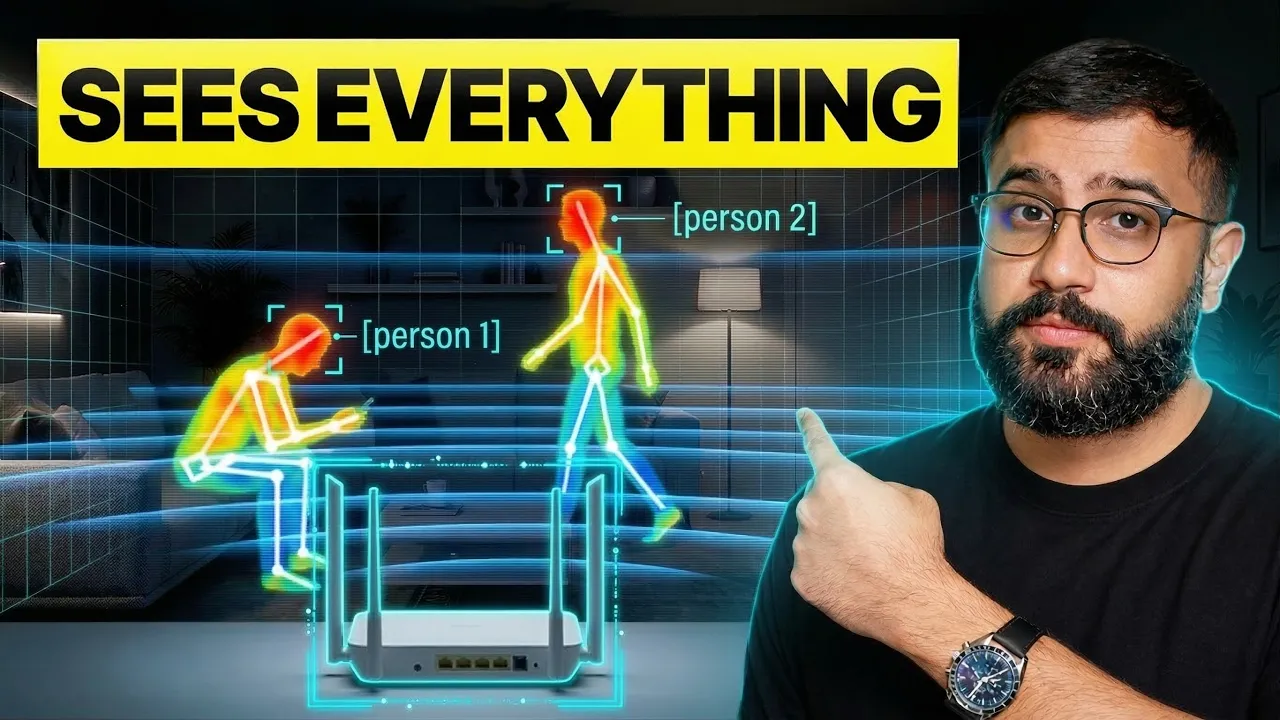
Your WiFi Can See You. Here's How. transcript
Bilawal Sidhu · @bilawalsidhu
Words
2,083
Runtime
11:16
Speaking pace
185wpm
Reading time
9min
185 words per minute, between the 181 median and the 201 75th percentile of 349 measured videos. That distribution comes from the 349-video hook study.
Opening (first 30 seconds)
Your Wi-Fi router can already detect when somebody walks through your home. Not with a camera, not with a sensor you bought, just the Wi-Fi signal bouncing off your body. All right, so here's how this works. Your Wi-Fi router is constantly sending out radio waves at about 5 GHz. These waves, of course, bounce off of everything. I'm talking your walls, your furniture, and of course, your body. And when you move through your home, those reflections change in ways that are really, really specific to what moved and how it moved.
93 words, the words spoken in the first 30 seconds at 185 words per minute.
Sentence shape
| Measure | This transcript |
|---|---|
| Sentences | 141 |
| Average words per sentence | 14.8 |
| Longest sentence | 40 words |
| Questions asked | 3 |
| Sentences containing a number | 16 |
Most used terms
- fi21
- wi21
- wi fi21
- radio11
- ai10
- sensing10
- called9
- course9
- router9
- dark8
- home8
- waves8
Filler phrases
19 in total: like 7 · basically 3 · kind of 3 · I mean 2 · actually 2 · right? 1 · you know 1.
A literal whole-word count of the same phrase list the Prepublish browser extension uses, so a phrase inside another word is not counted and a phrase used in its ordinary sense still is. It is a count and not a judgement.
What this transcript is
Every word below is the caption track YouTube publishes for this video, pulled from the video itself and reproduced unchanged. It is not Prepublish's writing, not a summary, and not a re-transcription: it is the video's own published captions. English captions, generated automatically by YouTube, in the video’s original language. Source: the video on YouTube. A channel that would rather this page did not exist can ask for its removal through the contact page, and it is removed.
Transcript
Your Wi-Fi router can already detect when somebody walks through your home. Not with a camera, not with a sensor you bought, just the Wi-Fi signal bouncing off your body. All right, so here's how this works. Your Wi-Fi router is constantly sending out radio waves at about 5 GHz. These waves, of course, bounce off of everything. I'm talking your walls, your furniture, and of course, your body. And when you move through your home, those reflections change in ways that are really, really specific to what moved and how it moved.
Your router already tracks something called channel state information, or CSI. It's basically how the router optimizes the signal between itself and all your devices. But CSI also encodes the shape and movement of everything between the router and your devices. And of course, that includes you. Xfinity figured this out. They shipped this feature called Wi-Fi motion to every customer with one of the newer gateways. This is at no extra cost.
You don't need any extra hardware. Your existing network essentially becomes a motion sensor. And of course, they market it as a smart home feature. I've got this working where when I walk into a room, I can automatically turn the lights on. Now, if I pull apart the marketing branding, the real term for this in the industry is called presence detection. That's the original term. Your router is capable of detecting your presence.
Of course, the companies are going to brand this as Wi-Fi motion, Wi-Fi sensing, Linksys aware, whatever sounds less creepy, basically. But the underlying capability is the same. Your router knows that you're there. Now, if what I'm saying is already evoking that scene from The Dark Knight where the Batman uses sonar from cell phones to catch the Joker, you would be pretty close to the money. Because motion detection is just step one.
Researchers have already published steps two and three. Let's get into it. So, in 2023, Carnegie Mellon University published a paper called dense pose from Wi-Fi. Using just Wi-Fi signal from a standard router, an AI model is able to reconstruct your full body pose. This is where we step beyond just someone in a room to actually understanding the position of your arms, your legs, your overall posture, multiple people in the room at once, through the walls, with no camera, just radio waves.
This is really wild tech. And then, it gets even more sophisticated. So, these Wi-Fi signals interact with your body in a very unique way, depending on your bone density, your body mass, your posture, etc. A 2025 paper called HuMi showed that we could take advantage of these Wi-Fi signals to identify who the person actually is, essentially re-identification. So, the way you walk, the way you shift your weight, even the way you sit, it creates this very unique biometric signature in the Wi-Fi signal.
And they use a transformer neural network to match those signatures to specific individuals. Now, this is simultaneously creepy, but also super useful. In a sense, your AI systems can know who the person in the room is, so you can change the preferences accordingly. And you don't need to have like an invasive camera in every single room to do it. So, if we take a step back, step one is Wi-Fi just detecting movement. This is already working in millions of homes.
Step two is Wi-Fi reconstructing your precise body pose through the walls. This is published research. Step three is Wi-Fi being able to re-identify a specific person just based on their unique signature, also published. Suddenly, we've gone from a very coarse-grained motion sensor to essentially a surveillance system that works in the dark, through walls, on a hardware that you already own. And the gap between detect motion and identify the person is a simple software update.
The hardware is already installed. You know, a little bit of edge computes and you're already there. Now, you can imagine this technology is very dual-use. You can use it for surveillance, but you can also use it to power your own AI Jarvis. But, what's really interesting is this This same physics, like radio waves essentially as a sensing medium, is being commercialized at a massive scale. A company called Xandar emerged after 9 years in stealth with a billion-dollar valuation and a hundred million dollars in funding.
The investors include Steve Jurvetson from the SpaceX board, the co-founders of Yahoo and Siri, and Skype's founding engineer. Now, I'll leave it to your own imagination to think about what a company was doing in stealth mode for nine freaking years, but the tech itself is worth digging into. What's Xandar? Xandar has built is essentially synchronizing existing Wi-Fi and 5G signals to sub-nanosecond precision. I mean, I'm talking about radio waves that travel at 30 cm per nanosecond.
If you can measure the timing of that precisely, you essentially get sub-meter quality positioning that works indoors, outdoors, through the wall, no GPS required, no new sensors required. They're calling it the foundational layer for physical AI. And honestly, that makes a ton of sense. Like, we've talked about this in the past. GPS does not work indoors. Cameras can drift. Nobody has cracked a universal positioning layer for the physical world.
Xandar is saying that we already have one. It's called Wi-Fi and 5G. We just weren't listening to it correctly. They've got a hundred patents filed, 90 of those have been issued, and there are zero rejections. They've already got half a billion dollars in contracts and many more MOUs. Now look, they haven't named their carrier partners yet, and of course, MOUs aren't signed deals, but that investor list and patent portfolio tells you that this is not vaporware.
All right, so Wi-Fi can see you through your walls, and a billion-dollar startup just turned every wireless network into a positioning grid. Now, here's where it gets really interesting because the defense world figured this out, too. You might know Palmer Lucky, co-founder of Oculus, sold it to Facebook, and then started this defense company called Anduril. We've covered their VR headset in the past. And as of this week, they just raised $4 billion at a $60 billion valuation with A16Z and Thrive Capital leading.
Kind of insane, but also goes to show you how much money and potential is left in the defense sector. One of their systems is the appropriately named Pulsar. Essentially an AI-powered electromagnetic warfare platform that can passively sense and classify RF activity. It listens to every radio frequency emission in an area and identifies what's producing it and geolocates the source and can even deliver an electronic attack.
All autonomous, all running on the edge AI, meaning you don't need to send this data up to some cloud to process. Anduril, of course, also deploys autonomous surveillance towers on the US-Mexico border through the CBP. These sensing arrays have like radar, thermal, camera all fused together through their Lattice AI platform into a single real-time operational picture. The essence is really the same principle as your Wi-Fi router sensing your body, except you're using more modalities, and this is a $60 billion defense contractor sensing everything on the border and the battlefield.
So, we went from the home to the enterprise to the battlefield. But, we have one more domain left to go, and that's space. And this is honestly where it starts to feel like science fiction. Let's take the same idea and move it into orbit. HawkEye 360 has 30 satellites flying in clusters of three about 500 km up, and they have a single job: detect and geolocate every freaking RF emitter on Earth. I'm talking ship radios, radar systems, GPS jammers, emergency beacons.
They use this technology to track dark ships. Basically, vessels that turn off their transponders to hide cuz they're doing illegal stuff. But, of course, that doesn't matter because satellites still see the radio signal. Meaning, you can go dark on AIS, this open-source data that I used to track the Iran strikes, but you can't go dark on physics. Pretty freaking wild. So, of course, this company has contracts with the NRO, the National Reconnaissance Office.
Raytheon's an investor, another company called Spire Global has 100 satellites doing the same kind of RF intelligence work. That little mini map in your home is effectively global. There are satellites overhead right now whose entire job is to light up every single RF emitter on the planet. Every radio, every radar, every phone is a dot on the map. So, if I take a step back, to me, these are not separate stories. Like your living room, Xynar, Anduril, HawkEye 360, all of them have the same fundamental insights.
Radio waves are a sensing medium. They're a modality to geo-locate and track things in the physical world, and they always have been, right? We just did not have the compute and the algorithms to make sense of it. We just treated radio waves as dumb pipes that were carrying data from point A to point B. But in reality, every single Wi-Fi signal, every single 5G pulse, every radio broadcast paints a spatial picture of the physical world.
Researchers learn to read it for automation. Xynar needs it for enterprise positioning. Anduril and HawkEye 360 read it for defense, whether they do it from land or from space. In other words, RF is the next spatial modality, and it'll sit right alongside LiDAR, RGB cameras, infrared cameras. Except this tech is already deployed in every building, on every battle space, and overhead in orbits. And it already works through the wall, in the dark, in shitty weather, with hardware nobody thinks twice about.
To take even a bigger picture, this is yet another layer being added to the stack for physical AI. I mean, think about the tech I had a chance to work on, visual positioning system. This is the tech that uses cameras, LiDAR, 3D maps, and all kinds of fancy sensors to let a device know exactly where it is, down to the centimeter. Now, VPS already works indoors and outdoors, but RF sensing is another modality entirely.
It could complement VPS as an additional sensor layer, or it could stand on its own as its own positioning system. Either way, you're adding day, night, and all-weather spatial awareness to work through walls in the dark using hardware people already have. That's what makes this super powerful for physical AI in the real world, not just augmented reality, but also robotics and home automation. Now, look, the question isn't whether radio waves become a primary sensing layer.
That is already happening at scale. Look at the companies that we talked about. Most people don't even know that their Wi-Fi is capable of seeing. The question is, what do we do with this technology? Like, it took us so long to realize that GPS location aggregated was both useful, but also pretty freaking scary. I think we're going to go through that same uncomfortable period with RF as a sensing layer. But, we have so many lessons from the past.
We need to take advantage of those learnings and have our eyes wide open, pun intended, about what we can and should do with this technology. In my opinion, it's super cool to have cameras outside your home, but cameras inside your home is kind of freaking creepy. So, if you can use these passive sensing modalities to figure out who and what's in a room, that's freaking amazing for so many different applications. If you got people in the wild trying to do bad things and evade the authorities, it's amazing to use this technology to track them down.
But, I keep going back to that scene from The Dark Knight. And really, the cliché quote comes to mind, with great power comes great responsibility. Meanwhile, most people don't even know their Wi-Fi can see. If you found this video interesting, please send it to a friend. And if you want to learn more about visual positioning system and how it fits into this physical AI picture, check out this video right here. If you're not subscribed yet, now's a great time.
I help you map the frontier every single week. Balavel signing off, and I'll see you all in the next one. Cheers.
The words are the caption track's own and nothing is reworded or re-transcribed. Paragraph breaks are placed between sentences so the text reads as prose.
Use this transcript
Three free tools that work on the material around a video like this one. No signup, no login.
Hook Analyzer
Paste the first 30 seconds of your own draft for a hook score and rewrites.
Policy Pre-Flight
Check your draft against YouTube's advertiser-friendly guidelines before you record it.
Channel Skill Generator
Read this channel's public videos and transcripts, and download a writing brief for it.