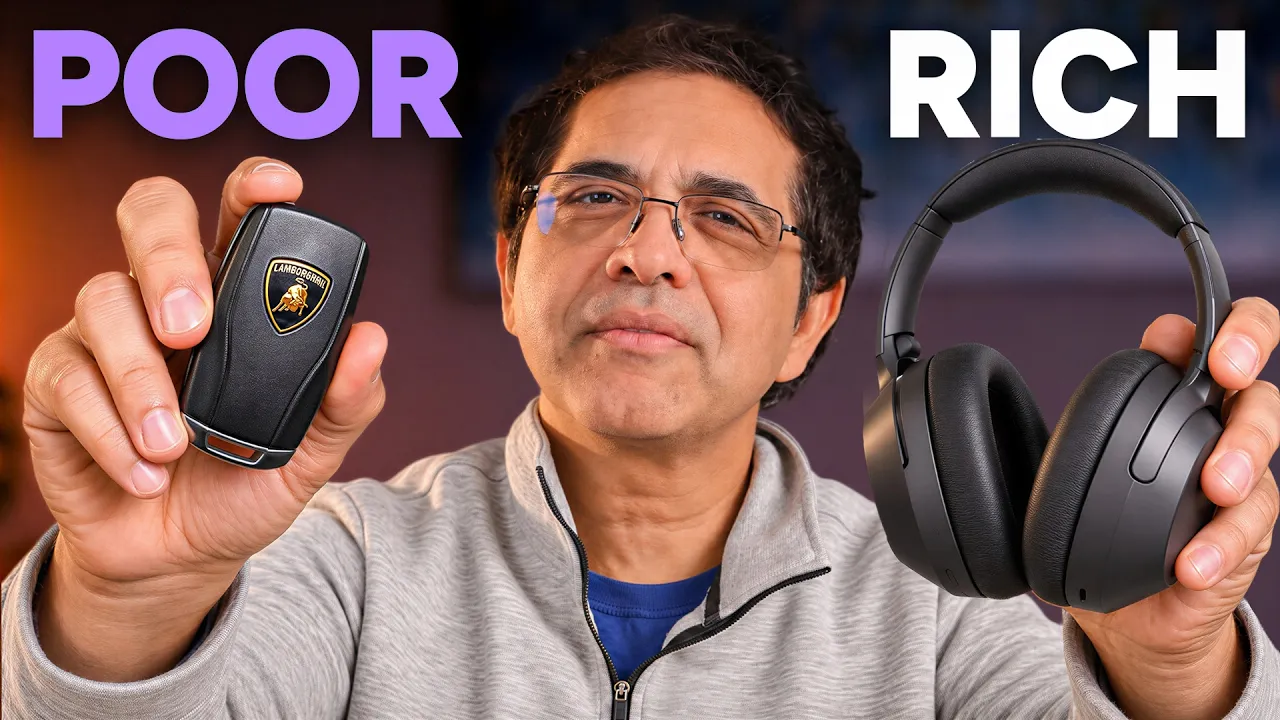
Once You Get Money, Upgrade These 8 Things Immediately transcript
Sandeep Swadia · @SandeepSwadia
Words
2,583
Runtime
19:10
Speaking pace
135wpm
Reading time
11min
135 words per minute, below the 160 25th percentile of 349 measured videos. That distribution comes from the 349-video hook study.
Opening (first 30 seconds)
Once you start making more money, the easiest mistake is upgrading the wrong things. You end up spending because you can afford it. But there is a better way to spend. I spent years on Wall Street and as a CEO [music] making tough calls about money. So I learned these lessons by getting it wrong a lot. Your next dollar has four possible jobs, four [music] categories
68 words, the words spoken in the first 30 seconds at 135 words per minute.
Sentence shape
| Measure | This transcript |
|---|---|
| Sentences | 204 |
| Average words per sentence | 12.7 |
| Longest sentence | 84 words |
| Questions asked | 14 |
| Sentences containing a number | 18 |
Most used terms
- music34
- money23
- life19
- upgrade18
- work9
- people8
- spend8
- best7
- financial7
- skills7
- buy6
- fund6
Filler phrases
12 in total: you know 5 · like 4 · actually 2 · right? 1.
A literal whole-word count of the same phrase list the Prepublish browser extension uses, so a phrase inside another word is not counted and a phrase used in its ordinary sense still is. It is a count and not a judgement.
What this transcript is
Every word below is the caption track YouTube publishes for this video, pulled from the video itself and reproduced unchanged. It is not Prepublish's writing, not a summary, and not a re-transcription: it is the video's own published captions. English captions, generated automatically by YouTube, in the video’s original language. Source: the video on YouTube. A channel that would rather this page did not exist can ask for its removal through the contact page, and it is removed.
Transcript
Once you start making more money, the easiest mistake is upgrading the wrong things. You end up spending because you can afford it. But there is a better way to spend. I spent years on Wall Street and as a CEO [music] making tough calls about money. So I learned these lessons by getting it wrong a lot. Your next dollar has four possible jobs, four [music] categories worth upgrading immediately. And the last one has the worst financial [music] return.
And that one matters the most. Money actually can buy you happiness, [music] just not the way we think. In 2010, Nobel Prizewinning psychologist Daniel Conaman suggested that happiness has a ceiling. According to his research, when you reach $75,000 a year, more money doesn't seem to improve your day-to-day emotional well-being. And for more than a decade, everyone quoted that number, except that it turns out we were all reading it wrong.
So in 2023, Conan teamed up with another researcher and they both arrived at a surprising conclusion. For most people, more money does keep making life better. But the relationship between money and happiness is not a straight line. Let's say you get X amount of lift in your happiness by going from $40,000 to $80,000. Now the same lift will happen only when you go from $80,000 to $160,000. And then if you want a similar lift once again, then you have to go from 160 to $320,000.
So it just takes more and more money to provide the same hit. It seems like money behaves just like any drug. The economic principle here is called diminishing marginal utility. The next dollar has to work harder than the last one because it's worth less to you. I love ice cream, so I know this well. Your fifth ice cream cone won't give you the same pleasure as your first one. Believe me, I've tried. So, being rich and living a life that's rich in meaning are two entirely different things.
If your net worth rises while your self-worth falls, you're just rich on paper. We want to talk about where will my next dollar create the most additional value for me. Can the additional money buy back your health, your time, your attention? Can it increase your future earning potential? Can it make your relationships, [music] your experiences, and your actual life richer? I call it the 4S framework. So, let's use this framework [music] to figure out what is actually worth upgrading.
And why? First, stamina. What if you showed up at work completely drunk? What would that do to your career? But that's exactly what happens to most of us who work hard. We just don't know it. In one of those landmark sleep studies, two sleep researchers [music] in Australia kept people awake through the night and repeatedly tested their reaction time and [music] their coordination. Then they compared those results with people who had been drinking.
By the end of the night, the sleepdeprived [music] group was performing as badly as the people who were drunk. And the longer they stayed awake, the worse it got. We all know that our ability to succeed depends on making sound decisions, which depends on how this machine up here works, our brain. Before you upgrade what you own, upgrade the machine that earns it. When you spend in this category, you will see the adverse effect in everything downstream.
And the most important upgrade is your sleep habits. And I'm not good at this. I stay up late knowing I shouldn't, but also I don't want to wake up early in the morning anymore. There was a time when I used to get up in the morning and I would have this really bad back pain. And I remember spending days researching to find the right mattress and pillows combination. They were more expensive, but why skimp on that? You spend a third of your life in that bed.
And that time decides the quality of the other 2/3 of your life when you're up. The underlying principle is to spend on things that improve the quality of your decisions. Now the second principle is adjacent to spend money when it makes the right behavior easier. You can buy a good habit when you know that you won't build it yourself. For instance, let's say you already know that you should work out. You won't find time for it somehow.
Same here. But maybe you put a stake in the ground by spending more on a great gym that you will be more likely to go to. If that doesn't work, maybe you can hire a trainer who comes to you. They will show up even if you don't want to. So that's how you buy a good habit. And the third principle, spend on the bottleneck. I realized I would work all day long while sitting in chairs and couches. So, I bought myself a standing desk and I've always been able to work in messy rooms.
It doesn't bother me, but I can't work when there is noise or music playing. So, one upgrade that I made was a really good pair of noiseancelling headphones. They were more expensive than Apple's ear pods, but to me, finding that silence was priceless. Most people use money to upgrade their lifestyle. I think it's better to upgrade your capacity to live it and enjoy it. So that's our first S for stamina. You know, my mentor used to say this a lot.
If you want to make more money, don't upgrade your lifestyle, upgrade your life skills. Long time ago, I was trying to move into Wall Street. I had spent my career in technology and [music] I was at a company that was acquired and it was a great exit and I thought I should do something different. Now I had an MBA but I had not paid attention to [music] corporate finance courses when I was at MIT. That was something that I wasn't feeling very confident about.
So I started taking courses for CFA certification and I started teaching myself how to build complex valuation models, how to analyze companies, how to [music] read financial statements and so on and so on and I did that for a long time and then I started applying and I got interviews from three very [music] large banks and each one of them asked me about my experience and I would just say listen I don't have a lot of experience [music] in finance.
So the best way is for you to give me a difficult financial modeling assignment and I would then deliver it in 3 or 4 days. And I wasn't some insanely brilliant guy or anything. It's just that I had practiced it over and over again before I showed up for the interview. And then those years in investment banking helped me understand businesses at a macro level and I was able to do sea level roles afterwards leading to a CEO position and then board seats.
And the key principle here is this. Invest in foundational [music] skills that bring you recurring benefits. Finance 101, communications, negotiations, [music] time management. The best skills don't pay you once, they keep paying you forever. [music] So spend your money upgrading those. And you know in the future that's heading our way the biggest differentiator for you will be your constant ability to learn new skills because AI will keep commoditizing a lot of skills you have already built today.
So you have to keep evolving. You have to keep adapting. The important question that you can ask every month is this. What skill gap is currently costing me the most? That's where your money should be invested. Every six months, create a learning budget both in terms of money and time. Take courses online or join an evening school or learn from mentors. You know, one of the best upgrades that I made in my life was my mentors.
When I became the CEO, I found a mentor who had just retired after building a company worth $60 billion. So just one conversation with him across the table was able to give me perspectives that I wouldn't have been able to discover for myself for years to come. The best thing you can buy is something no one can take away from you. And now we go to the third job. Security. The richer you get, the more expensive your mistakes become.
Making money and keeping money require totally different skills. In 2021, everybody was talking about this hedge fund called Archos, [music] and they were riding high. They had a portfolio of stocks that looked so spectacularly successful. Tens of billions of dollars, but there was one problem. Most of that portfolio was [music] financed with borrowed money. It's called leverage in finance. [music] So when a few of those stocks in the fund started going south, the fund could not meet the margin calls and banks [music] rushed to sell the collateral.
The entire enterprise collapsed within days. Credit Swiss [music] lost $5 and a half billion dollars, never recovered. So here's the principle that I always remember. Wealth is often built by making smart huge bets, but it's preserved by making smart hedges. When I was a teen, I ran away from my house and I was homeless for a while. And I know what zero feels like. And maybe that's why once I finally built some financial distance from zero, I've always asked one question.
What could send me back there? And you have to hedge against three key risks. First, concentration. I had a personal and painful experience with this risk. I held a large position in a single stock and the stock went from $19 to 140 and my advisor started telling me, hey, you got to implement some hedging strategies to protect the downside. But I was so bullish and I didn't do anything about it. And when the fall came, man, it came so fast and furious.
We had no time to adjust and recover. So once you have real savings, upgrade the savings by diversifying and hedging your risks. Keep enough emergency funds so if a market crash happens or there is a job loss or you've had a bad year, it doesn't force you to take more risks. Those extra dollars should buy you peace of mind. Second, constraints. Now this is another upgrade in terms of security that I learned late in my life.
I call it the BATNA fund. BATNA is a term that I learned from negotiators. Your better alternative to negotiated agreement. BATNA or simply put your ability to have a better option in your back pocket when you're negotiating the current one. So, I was able to walk away from a job, for example, that didn't excite me because I had saved enough money to get through six or nine months of job search. Upgrade your BATNA fund.
And finally, complexity. Once your finances become meaningfully more complex, it's a good idea to upgrade to a tax accountant, for example, or even hire a financial planner. They can help you work through your choices. A good attorney can also make sense because you can then take care of your estate plan and you should always have an estate plan because that's your way to provide security to those you love. A very good friend of mine who's a CEO of a very large company in LA lost his entire house including all the furniture to the fires in Los Angeles and he and his family had to rebuild their entire life from scratch.
But he had planned his life well. He had allocated his extra money for those specific risks so he didn't have to start back from zero. But stuff like that can happen to any of us. And that's why upgrading your financial security is the best move. Now, once you've done that, there is one final question left. What exactly are you protecting all of this for? This last upgrade has the worst financial returns. And that's the best part.
That's our fourth S, soul. Being rich and living a life that's rich in meaning are two entirely different things. And there are three places where an upgrade to make your life genuinely richer makes sense. The first is for yourself. Spend money on things you love. Things that truly light you up. Music, painting, cooking, golf, photography, whatever it is. I was trained in Indian classical music. When I got to a point when I could afford it, I paid for the courses at Berkeley School of Music in Boston because I wanted to learn about western principles of harmony and melody.
And I got to learn from a world-class faculty. I learned how they think about music, how they feel about music, how they see music. And those courses [music] are expensive, but those lessons enriched my life in so many ways. It was an amazing experience. You can find and fund your amazing experiences the same way. It's part of being generous toward your own self. The second upgrade is for the people you love. There is an old quip I heard somewhere.
A seeker asks a wise man, "What matters more in life, the journey or the destination?" And the wise man says, "Neither. What matters is the person you travel with." In 1938, Harvard researchers started following hundreds of people across their entire adult life. They tracked their careers, health, marriages, failures, successes, everything. That study, by the way, is still running today, almost 90 years later. Years into the research, they asked a simple question.
What factors in our midlife best predicts our happiness and health when we're 80? One factor stood out again and again, the quality of our relationships. The people who were more satisfied in their relationships at 50 were the healthiest at 80. So, invest [music] your time and money for those who care about you. Have dinner with your life partner. Go see a Broadway show together. Take long walks. And same for the family.
Take your kids somewhere they'll remember. Create the moment that becomes a story because that's all you're going to remember later. When you can afford to upgrade your life, please upgrade your generosity for others as well. Help a stranger. Support something you believe in. Volunteer. Build someone so they can believe in themselves. And it doesn't have to be just money, right? It could be your time. So that's the framework, stamina, skills, security, and soul.
And now you can go ahead and make your own list of upgrades that fit into these categories. You know, one of my favorite movies is Arrival. And at its heart, it asks a really hard and almost heartbreaking question. If you knew something would eventually end, would you still choose to go ahead with it? You may have your own answer, but my answer is yes. Of course, the value of life or relationship does not come from its permanence.
Our time here is brief. We know that. [music] But that brevity doesn't reduce its beauty. Maybe that's the ultimate upgrade. Using what you have [music] to build a life that matters to you. Thank you and I [music] love you.
The words are the caption track's own and nothing is reworded or re-transcribed. Paragraph breaks are placed between sentences so the text reads as prose.
Use this transcript
Three free tools that work on the material around a video like this one. No signup, no login.
Hook Analyzer
Paste the first 30 seconds of your own draft for a hook score and rewrites.
Policy Pre-Flight
Check your draft against YouTube's advertiser-friendly guidelines before you record it.
Channel Skill Generator
Read this channel's public videos and transcripts, and download a writing brief for it.