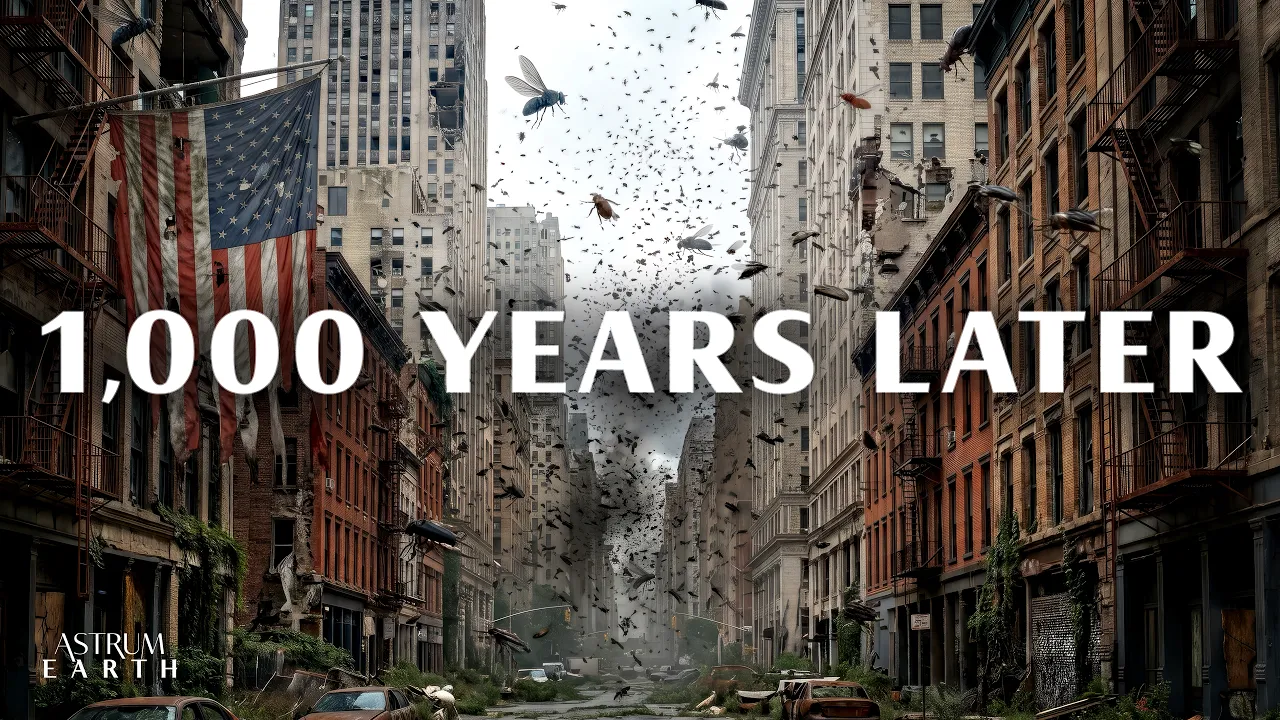
This Is What Would Take Over the Earth If Humans Vanished transcript
Astrum Earth · @AstrumEarth
Words
4,250
Runtime
26:54
Speaking pace
158wpm
Reading time
18min
158 words per minute, below the 160 25th percentile of 349 measured videos. That distribution comes from the 349-video hook study.
Opening (first 30 seconds)
Humans have taken over the world. Almost everywhere you look we’re surrounded by our own existence. Everyday objects, buildings, cars – even intangible things like language, music, and the stock market. It’s impossible not to notice us. But I’ve always wondered what would happen if we were removed from the equation. Well, luckily for you, that’s what we’re about to find out, as we wipe all 8.3 billion humans off the face of the Earth – in a flash,
79 words, the words spoken in the first 30 seconds at 158 words per minute.
Sentence shape
| Measure | This transcript |
|---|---|
| Sentences | 190 |
| Average words per sentence | 22.4 |
| Longest sentence | 61 words |
| Questions asked | 26 |
| Sentences containing a number | 35 |
Most used terms
- human21
- humans21
- world19
- years19
- species16
- earth11
- post10
- animals9
- climate9
- insects9
- likely9
- post human9
Filler phrases
39 in total: like 25 · actually 4 · kind of 3 · basically 2 · sort of 2 · I mean 1 · literally 1 · you know 1.
A literal whole-word count of the same phrase list the Prepublish browser extension uses, so a phrase inside another word is not counted and a phrase used in its ordinary sense still is. It is a count and not a judgement.
What this transcript is
Every word below is the caption track YouTube publishes for this video, pulled from the video itself and reproduced unchanged. It is not Prepublish's writing, not a summary, and not a re-transcription: it is the video's own published captions. English captions, published by the channel, in the video’s original language. Source: the video on YouTube. A channel that would rather this page did not exist can ask for its removal through the contact page, and it is removed.
Transcript
Humans have taken over the world. Almost everywhere you look we’re surrounded by our own existence. Everyday objects, buildings, cars – even intangible things like language, music, and the stock market. It’s impossible not to notice us. But I’ve always wondered what would happen if we were removed from the equation. Well, luckily for you, that’s what we’re about to find out, as we wipe all 8.3 billion humans off the face of the Earth – in a flash, gone.
Not lost to an aggressive global pandemic, or obliterated by an incoming asteroid, this is what would happen if we just… vanished. But even then, we’d still leave a lot behind, reminders of the civilisations that once stood. As nature reclaims the planet, the question then becomes: would any clues of our existence remain? Or would it be as if we never existed at all? I’m James Stewart, and you’re watching Astrum Earth.
Join me in this video as we dare to imagine our planet without the most dominant species that has ever lived on its surface. How long would our world survive without us? Would nature begin to reclaim all it had lost? Would any trace of humanity even remain after a thousand years - a million years? Or would Earth eventually erase us completely, as though we never existed at all? And the thing that I’m most interested in is which species would take over in our place, and that - I promise - is going to shock you!
Before you become overwhelmed with the philosophical dread at the thought of the human race disappearing completely, remember that this is just a thought experiment. I’m not going to freak you out by imagining how we may have met our grisly end, so let’s just pretend that we have vanished into thin air, and leave it at that, leaving no biological remains behind. In that (albeit improbable) case, what would happen in the hours, days, weeks, months, and years after we disappeared?
It’s quite likely that the immediate moments after our departure would be… how can I put this? Pure chaos. Within 24 to 48 hours, blackouts would start happening across the globe, with no one left to provide the fuel needed for power stations to function. Renewable energy sources like solar and wind turbines might be able to keep some power going for a while, but without proper zmaintenance of the world’s electricity distribution networks, these too would eventually cut out.
Anyway, what about nuclear power? Well, these reactors are already designed with backup protocols in the event of a natural disaster or power outage, so these would probably kick in soon after humans disappeared. They do come with a kill switch, called a SCRAM, which can shut the reactor down completely, but with no humans to maintain them, their cooling water would start to evaporate. And it’s only once this happens that things get pretty bad.
Reactors could be sent into meltdown, and likely release large amounts of radiation into the surroundings. There are currently around 440 nuclear reactors operating in 31 countries around the world, so that’s a lot of radiation. And it does beg the question – what would this do to Earth? Well, we don’t necessarily need to wait to see what would unfold in this scenario, because we’ve already experienced two major reactor accidents during our time on Earth - Chernobyl in 1986 and Fukushima in 2011.
Chernobyl is perhaps the more famous - a total meltdown of the nuclear reactor core, releasing substantial amounts of radiation into the environment. But in the nearly 40 years since, the nearby town of Pripyat was evacuated as a result of this contamination, and something amazing has happened. It has become a biodiversity hotspot, despite its resident animals experiencing years of chronic radiation exposure. In fact, a study published in 2015 looked at wildlife populations in the Chernobyl exclusion zone and found no evidence that the radiation had a long-term negative influence on mammal abundance.
Actually, quite the opposite - the number of elk, red deer and wild boar within the exclusion zone rivalled those of uncontaminated nature reserves in the region. There were more than seven times as many wolves than found in those other reserves. Chernobyl shows us that when faced with an environment deemed too dangerous for permanent settlement by humans, nature not only endures, but thrives. It’s therefore likely that if there were any nuclear disasters caused by our disappearance, nature could recover faster than we may expect – within a century, even.
And if it can take over radioactive ruins in that time, then what chance does the rest of our infrastructure stand? Nowadays, more than half of the world’s population lives in cities. They’re a unique product of the human experience, tailored for our busy lifestyles and cultural quirks, so what happens to them when you take away the very reason for their existence - us? In all the talk of a world without humans, there’s a rather lovely irony in welcoming a new one to the world, which is exactly what’s happening in my house pretty soon!
Before our new arrival, I wanted to make sure I was as healthy as I could be, to be the best Dad I can be. But also, I have a feeling I might need a bit of energy support pretty soon (lot of sleepless nights coming my way), so I’ve been drinking AG1. Just like you, we have a pretty hectic life here, so drinking something that’s clinically shown to fill common nutrient gaps, and contains 75 plus ingredients designed to support things like gut health, daily energy, and my immune system, all without turning my morning routine into a 17-step wellness ceremony is a total game changer!
I drink mine with my breakfast, and all I have to do is just mix one scoop of AG1 with around 250 ml of cold water, shake it up, and drink, that’s it! Trust me, I’m pretty fussy when it comes to flavours. This actually tastes really good - kind of like pineapple and vanilla. Trust me, it doesn’t feel like a chore - you know, how some drinks do! It’s been a couple of weeks now, and as someone that doesn’t drink caffeine, the energy support is so noticeable, especially in the afternoons when I used to flag a little bit around 3-4 o’clock.
So, why not do something for you, and invest in your health as well? We have a great deal for you right now - with 20% off your first subscription order of AG1 Next Gen or AG1 Pro. Just head to drinkag1.com/astrumearth or scan the QR code on the screen right here! Thanks to AG1 for sponsoring today’s video, and now, we head back to the actual chaos. As it turns out, at least one human was thinking about this question before we all disappeared.
Alan Weisman is an American author and journalist who wrote a handy book on this topic, called The World Without Us. Now in an interview about the book, Weisman used New York City as an example to describe the post-human era. And funnily enough, he believes that a post-human New York would look much like the pre-human New York. To give some context, the Lenape people, who had been living in parts of the Big Apple and surrounding areas for around 3,000 years, called the island “Manna-hata”, meaning “island of many hills” (and by the way - you may not think of New York as a particularly hilly area, but that’s because we Europeans got there, and evened it out).
Anyway, British explorer Henry Hudson was one of the first Europeans to write about Manhattan back in 1609, and described a forested land “very abundant in all kinds of timber suitable for ship-building, and for making large casks”. The Dutch geographer Joannes De Laet also wrote about the island, saying that “the land is full of noble forest trees and grape vines”. From these accounts, it’s clear that New York was once a rich forested landscape, with rough terrain and abundant wildlife.
So, if humans were to disappear, this is probably how it would look again - the question is, how? It might not be immediately obvious, but cities battle large volumes of groundwater running through their drainage systems every day, and it requires Herculean human effort to stop it from infiltrating systems like the underground or the subway. Even on a sunny day with no rain, New York subway maintenance workers must pump nearly 50 million liters of water away!
So, if all of those people were to suddenly disappear and the power cut out, it would be a matter of days before rivers surged through these tunnels and plunged the subway into darkness. The water would begin corroding the tracks and the steel columns that hold up the roofs of these tunnels, that would eventually cause the streets to collapse and allow the water to flood the city surface, too. Around 20 years after our disappearance, we’d see a kind of urban wetland forming, interspersed with skyscrapers.
But even they may not last very long. Now, this is not to say that skyscrapers aren’t designed to withstand a lot. They have steel and concrete supports, called piles, drilled down all the way into the bedrock to form their foundations. The tallest skyscraper in the world, the Burj Khalifa, has 192 piles, each 1.5 m in diameter and extending 50 m down into the ground. They are well-made But the problem here is that no matter how strong they are, these steel foundations are not designed to be waterlogged all the time.
And if they are surrounded by all those rivers I mentioned before, then water will infiltrate any miniscule cracks and force them apart even more. This especially happens in cold places, because water expands when it freezes. This freezing-thawing cycle creates the perfect conditions for skyscrapers to topple within 100 to 200 years. And as our concrete jungles collapse, what would replace them is… the real thing. Plants are tougher than we often give them credit for, and biological weathering is already a very real concern that we have to deal with in man-made environments.
For example, in the temple of Ta Prohm in Cambodia, you can see huge deciduous trees with roots that appear to swallow the temple itself. And in New York, several sidewalk trees show grit on par with New Yorkers themselves. This tree in West Chelsea, for example, has grown around the iron frame that was once put in place to contain it, leaving only small pieces poking out of the trunk. With no more weeding, the plants will most certainly take over our cities within just a few decades, infiltrating every microscopic crack in our pavements.
Perhaps only the hardiest pioneer plant species like lichens and mosses will colonise this new urban environment, but these will pave the way for others, and by the time we hit 500 years post humans, cities like New York will resemble the once “noble forest” that helped the Lenape to prosper… but it's inside those forests, where things get really interesting. Animals like rats, cockroaches, pigeons, raccoons and even the foxes have all adapted to thrive in urban habitats, often scrounging on human scraps and emerging at night when human activity is at its lowest.
Now since these species already make use of cities, it’s likely that they would be the first proper city-dwellers in a post-human world. They could survive on decaying food in our homes and supermarkets for a few months at least, and would probably experience a bit of a population boom. But animals that had previously been kept on the fringes of cities, like mountain lions or bears, would also be free to invade. And with more large predators entering urban habitats, the success of the smaller city-dwellers, well it wouldn’t last very long.
Another species that would likely fare well without us are domestic cats. Felis catus were domesticated from the Middle Eastern wildcat, Felis silvestris, around 12,000 years ago, and have always enjoyed a kind of double life as both a wild animal and a charismatic pet. It’s estimated that there are now well over 600 million of them around the world, and they have been introduced to every continent besides Antarctica.
With so many domestic cats already present in habitats worldwide, they would have a major advantage over wild species in colonising the space we would have left behind. Cats could make use of those healthy rat populations, and could quickly revert to more feral behaviours in order to survive. Dogs could experience some of these same advantages, but they would likely be outcompeted by wolves – especially dogs that have undergone extreme selective breeding like Pugs or British Bulldogs.
In our planet’s most unusual cities, wild migrants may also be moving in. Gondolier free, the canals of Venice will become calm, clear waters with no oars and other boat traffic stirring up sediment. So it’s likely that marine mammals like dolphins could colonise the waters once more. We have already seen hints that this is possible - back in 2021, Covid regulations drastically reduced boat use in Venice, which caused its waters to become clearer.
The city was rewarded with a visit from a pair of striped dolphins, which swam in the Grand Canal until they were led by the coast guard back toward the open sea. But if similar visits were to happen in a post-human Venice, it might not actually be the best thing for the dolphins. The enclosed canals can be disorientating for them as they attempt to find their way with their signature clicking sounds. But it goes to show that dolphins could journey into Venice if they wanted to, and who knows?
I mean, it’s a nice place. And as for the rest of Europe, much of it used to host larger predators like the Eurasian lynx, Grey Wolf, Brown Bear, Arctic Foxes, and even the Caucasian Leopard. Many of these species also found themselves in conflict with humans, and as a result, they’ve been lost from many of their original habitats, or persist in much smaller populations. But if humans weren’t part of the equation anymore, these animals might be able to come back too.
They’d be free to feast on our remaining livestock without fear of persecution, and expand their ranges throughout their old hunting grounds of Europe. So, without humans we’d be looking at a boom in your least favourite city pests, a carnivore comeback, more grassland, and a return to prehistoric-looking landscapes. But without us to rule over this new world, which species might emerge to take our place? Would it finally be time for chimpanzees to reclaim their throne, living out the “Planet of the Apes” in real time?
Or could something else more unexpected come to the fore? The disappearance of humans would create a major vacuum in available niche space, creating the perfect opportunity for some other species to evolve to fill it and “replace” us… so who are the most likely contenders? There are several possible answers to this question, and in fact, some of the animals I’ve already mentioned could be up for consideration. It’s even possible that humans 2.0 could evolve, since our chimpanzee ancestors would still be around after we’re gone.
But there is one group we haven't talked about yet, a group that could stand a real chance of coming out on top. Insects have been described as “evolutionary overachievers” by many biologists – there are more than a million documented species, and they’ve been around for 350 million years – longer than the dinosaurs or even flowering plants! They can be found in almost every habitat, even Antarctica, and outnumber the human population by 1.4 billion to one.
And with these impressive stats, it’s fair to say that insects would be a contender for the rulers of the post-human world. So what is it about them that makes them so successful? Well, it’s easy to forget this, but insects were the first animals to evolve flight, and flew for up to 170 million years before anyone else! This makes insects naturally very good at dispersing throughout their habitat, which is a vital skill for finding food, mates and shelter.
Another win for the insects is the fact that they have a very segmented body plan. There are usually just three segments, head, thorax, and abdomen, which are collectively called tagmata. This is fundamentally similar between insect species, but it has huge evolutionary potential for diversification. Think about it: small evolutionary changes to each segment could be enough for a new species to be created, and there are millions of additions and configurations to explore.
Each adaptation could give the insect a new ability, whether it’s making use of a specific food source, exploiting a new habitat, or finding a mate more successfully. They are perfect for adapting to an environment without us. Finally, insect development involves metamorphosis. Insects can have several developmental stages punctuated by molts, where they shed their exoskeleton and emerge into a new form entirely. And this accomplishes several things.
Firstly, each developmental stage often has its own unique food sources, meaning there is less competition between members of the same species. This supports larger overall population sizes. And it also means that during pupal stages, when the insect is protected by a cocoon, it can wait out tough conditions until the outlook for survival gets better. Essentially, having several developmental stages allows each insect to occupy several different niches throughout its lifetime, so basically, it can get the best of every lifestyle.
For these reasons, many experts have backed insects as the next most successful group after humans, but evolution takes time, and given there might be some climate upheaval- don’t worry, we’ll get into that in a second - it could take millions of years for them to completely flourish. The other issue is that although insects may experience success on par with humans, they’re unlikely to share our intelligence, so we can’t really say they’ll take our place.
So which species can match us in this regard? Well, measuring intelligence is a tricky business, since we humans have historically tried to use our own brainpower as a yardstick to measure everything else against, but that isn’t necessarily the best gauge as different animals perceive the world and interact with it in different ways, which then also affects their intelligence. This is nicely demonstrated by the octopuses.
Octopuses are weirdly similar to humans in some ways. We both have camera-type eyes that focus light in the same way, and we share the same bilateral symmetry. But unlike humans, octopuses obviously have eight arms, which are controlled in an unusual way. Unlike us, and our centralised nervous systems (or brains), two thirds of an octopus’ 500 million neurons are found in their limbs. This decentralises their nervous systems and their processing power, allowing octopuses to control each one of their arms semi-independently, like eight “mini brains” if you like, spread out across their body.
Research has shown that this body plan helps octopuses to perform complex behaviours, from tool use to camouflage, it’s almost like having a sort of built-in intelligence. So, octopuses would definitely be up there as some of the cleverest animals in a post-human world, but what would they do with this intelligence? Let’s head to the waters of Jervis Bay in eastern Australia, where we find examples of the impressive feats octopuses are capable of.
Dubbed “Octlantis” by the researchers that discovered it, the Jervis Bay site is home to 15 individuals that have meticulously arranged their dens made out of scavenged shells. Here they live, communicate with each other, fight for territory, and mate. This was an especially exciting discovery as the species in question, the “gloomy” octopus, was thought to be a bit of a loner, but this “Octopus City” shows that they are capable of complex social interaction in the wild, and have capacity for human-like intelligence.
So there we have it - the dawn of insect rule, and underwater “octlantis” - the post-human world is certainly going to deliver, but one question still remains: what sort of climate are they going to deliver in? In my opinion, we’ve saved the best, and arguably most important stuff to last; our climate. With us not around to mess things up, do the climate systems that hang so delicately have a chance of fighting back?
Or is the damage already done? One final parting gift from humanity. Our climate is influenced by so many factors, some (like the most recent ones) can be traced back to humans. Considering the sheer number of us on the planet (8.3 billion), and the scale of industries like farming, transport, energy, and manufacturing, we’re bound to leave behind traces of our presence for the post-human world. The National Oceanic and Atmospheric Administration states that carbon dioxide levels have risen by 50% since 1800, hitting 431 parts per million in April 2026.
The NOAA attributes this increase mainly to human activities like extraction and burning of fossil fuels, but if we weren’t here anymore, then these drivers would naturally stop. Problem solved? Not quite. This probably wouldn’t make an immediate difference to the climate. There is a term used by climate scientists called “committed warming”, and basically, it includes any global warming that results from the greenhouse gas emissions that we’ve already released, even if we were to disappear tomorrow and stop releasing them.
So “climate change” would technically continue, and experts predict it would take thousands of years for CO2 concentrations to return to pre-industrial levels. This is because the ocean is like a big carbon sponge – it can absorb carbon dioxide when it dissolves into the water, or enters the ocean from the soil. But it takes a while for this carbon to get absorbed into the deepest depths of the sea, so patience is key.
Regardless of our influence on the climate, the post-human world is probably heading for another ice age. Now we are technically, of course, in an ice age already, since there is still ice at the poles, but experts think that the ice could spread much further than this in the future. Under natural conditions, some studies suggest a major glaciation could begin within roughly the next 50,000 to 100,000 years, although the committed warming we’ve talked about may delay this significantly.
A long-term cooling trend began on Earth around 6,000 years ago, resulting from changes to Earth’s tilt, orbit shape, and wobble, also known as the Milankovitch cycles. However, human-driven emissions have now overwhelmed much of this natural cooling trend. So with no fresh human emissions being pumped into the atmosphere, these cycles would probably reassert their cooling effects far sooner than they would have otherwise, and then an ice age seems to be just around the corner for those species we left behind.
So good luck to the insects and octopuses, it might be time to wrap up warm. With cities destroyed and Earth covered in ice, it appears that, from above at least, all traces of humanity would be gone in perhaps as little as a few thousand years. But as we’ve already discovered, our impact runs deeper than that. Just as today we find fossilised dinosaur bones, we will leave behind our own rock record - and not just bones either.
Instead, a layer of plastic and so called “techno-fossils” marking our impact on the planet for millions, if not billions, of years to come. Eventually even that will be lost as it’s gradually recycled into the Earth’s mantle thanks to shifting and subducting tectonic plates, but as currently, the oldest rocks in the world sit at 4.4 billion years old, it’s likely that our geological history might remain for some time.
And by that point, the Sun might have scorched the planet anyway… although that’s a story for another day, one you can actually watch on Astrum Space after this if you want. For now, we’ve come to the end of our little thought experiment, and I hope you aren’t feeling too spooked by our fictional disappearance. Personally, I’ve quite enjoyed watching the Earth from the void, and seeing all of the remaining animals fight to claim our vacant lands.
For now, we live in the Anthropocene – a geological epoch that is literally named after the humans and the huge influence we have had in shaping our environment. So there’s no doubt that our disappearance would promote some major reshuffling of the life we leave behind. As Alan Weisman said when he was asked about his motivations for writing his book, “Looking at what would happen in our absence is another way of looking at what goes on in our presence”.
And from the information we’ve presented in this video, it’s hard to deny that we humans have earned our title as the defining force of the current era, and that our legacy - for better or worse - will endure long after we’re gone. Let me know in the comments what you think Earth would look like without us, and particularly which animal you’d like to see take our place. Personally, I’m “team octopus”. Thanks for watching, and we’ll see you in the next one!
The words are the caption track's own and nothing is reworded or re-transcribed. Paragraph breaks are placed between sentences so the text reads as prose.
Use this transcript
Three free tools that work on the material around a video like this one. No signup, no login.
Hook Analyzer
Paste the first 30 seconds of your own draft for a hook score and rewrites.
Policy Pre-Flight
Check your draft against YouTube's advertiser-friendly guidelines before you record it.
Channel Skill Generator
Read this channel's public videos and transcripts, and download a writing brief for it.