Getting the transcript
Reading the captions from YouTube. A video nobody has opened here before takes 10 to 30 seconds; this page fills in on its own.
Getting the transcript
Reading the captions from YouTube. A video nobody has opened here before takes 10 to 30 seconds; this page fills in on its own.
Graham Hancock Official Channel · @grahamhancock
Where viewers went back to watch this video again, from YouTube's public Most replayed graph, lined up with what was said at that moment.
Most replayed moment #1
1:592.5x the video's typical replay level
I've been researching and writing for the past year. I'll be posting further [music] updates as the work continues. Heat [music]
Said at 1:52
Most replayed moment #2
1:172.3x the video's typical replay level
and 4,600 years ago. The step pyramids of Keral, Bandura, and Asparrow are thus as old or older than the officially accepted dates for the oldest of the Egyptian pyramids, as old
Said at 1:11
The graph counts replays. It does not show where viewers stopped watching.
How this video opens and how it is built, beat by beat, as a template you can reuse for your own topic. The quotes are the video's own words.
Checking for a template
Words
278
Runtime
7:06
Speaking pace
39wpm
Reading time
1min
39 words per minute, below the 160 25th percentile of 349 measured videos. That distribution comes from the 349-video hook study.
Opening (first 30 seconds)
Welcome to my writing room. The short video that follows, filmed by my wife Samantha on our recent research trip
20 words, the words spoken in the first 30 seconds at 39 words per minute.
Free, no signup. See how the first 30 seconds hold attention, with rewrites.
Sentence shape
| Measure | This transcript |
|---|---|
| Sentences | 18 |
| Average words per sentence | 15.4 |
| Longest sentence | 50 words |
| Questions asked | 0 |
| Sentences containing a number | 3 |
Most used terms
Free, no account. See where attention is likely to drop, with a rewrite for each weak line. The free check shows the scores and the one issue costing the most. Or run it on the words above first.
Free · No login · See a sample audit first if you prefer.
This transcript is under 300 words, so the page is marked noindex and does not appear in search results. The words stay here to read and to copy.
What this transcript is
Every word below is the caption track YouTube publishes for this video, pulled from the video itself and reproduced unchanged. It is not Prepublish's writing, not a summary, and not a re-transcription: it is the video's own published captions. English captions, generated automatically by YouTube, in the video’s original language. Source: the video on YouTube. A channel that would rather this page did not exist can ask for its removal through the contact page, and it is removed.
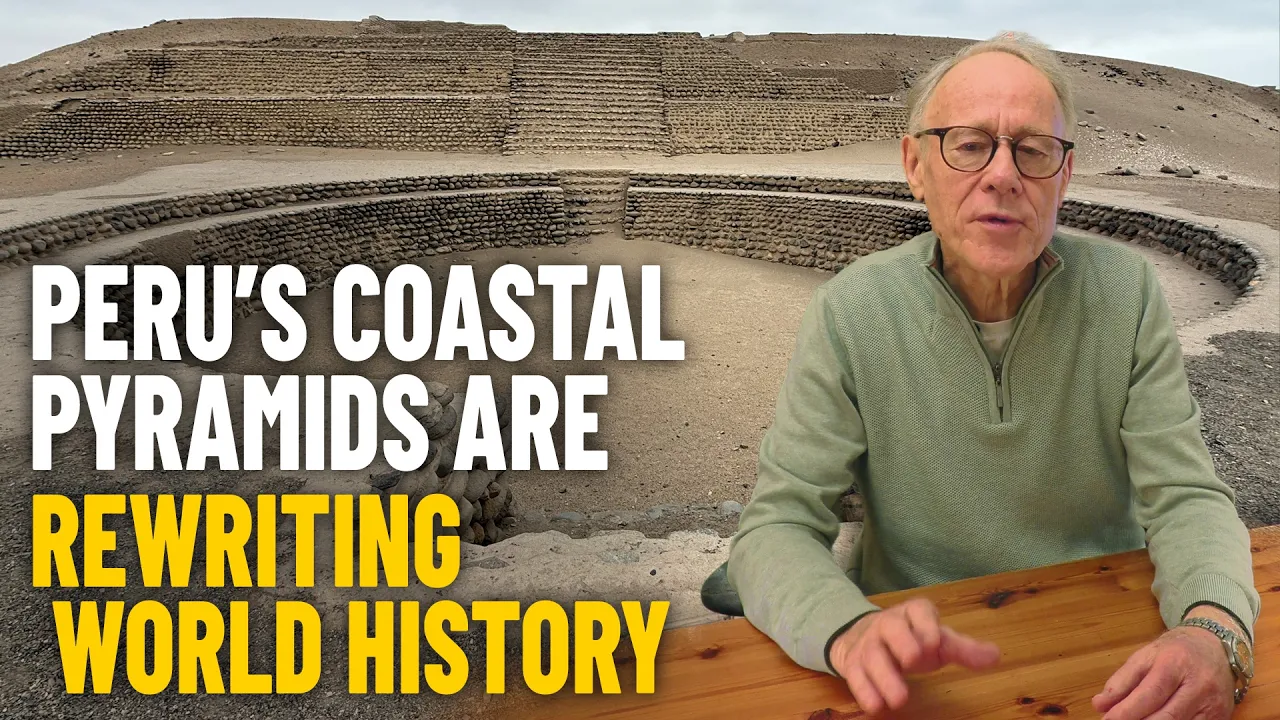
Welcome to my writing room. The short video that follows, filmed by my wife Samantha on our recent research trip to Peru, is intended to give only a first quick glimpse of Peru's extraordinary coastal pyramid cities. Four of them are featured here, Bandura and Karal, both with drone footage, and Pine and Asparero. When Santa and I first visited Asparrow in 1993, it was still almost completely covered under the municipal rubbish dump of the nearby city of Sup.
Today, thanks to the work of brilliant Peruvian archaeologist Ruth Shady Solace and her team, Asparero has been largely cleared and excavations continue. Among the four sites featured in the video, Pineo is thought to be the youngest, dated to roughly 3,600 to 3,900 years ago. However, Bandura, Karal, and Asparrow are significantly older. Radioarbon dates place their earliest monumental constructions between approximately 5,700 and 4,600 years ago.
The step pyramids of Keral, Bandura, and Asparrow are thus as old or older than the officially accepted dates for the oldest of the Egyptian pyramids, as old or older than the oldest ziggurats of ancient Mesopotamia, and roughly contemporaneous with the rise of early urbanism in the Indis Valley. What's being discovered in Peru is rewriting world history, which is precisely why these mysterious coastal cities alongside equally mysterious sites in Egypt, Iraq, India, and China will have an honored place [music] in the new book I've been researching and writing for the past year.
I'll be posting further [music] updates as the work continues. Heat [music] up [music] >> [music] [music] >> Heat. [music] Heat. Hey. [music] [music] >> [music] [music] >> Woo! Heat. Heat. >> [music] [music]
The words are the caption track's own and nothing is reworded or re-transcribed. Paragraph breaks are placed between sentences so the text reads as prose.
Free tools for your own script: paste a draft and see where it stands before you record it.
Paste your draft and see where viewers are likely to drop off, with a rewrite for each weak line.
Paste the first 30 seconds of your own draft for a hook score and rewrites.
Check your draft against YouTube's advertiser-friendly guidelines before you record it.
Read this channel's public videos and transcripts, and download a writing brief for it.
The guides behind the choices this video already made, from the opening line to the length of the script.
What the Intro metric measures, and how to build an opening that earns the next minute.
Opening lines you can copy, grouped by type, with a note on when each one works.
What audience retention measures and how to read the graph in YouTube Studio.
The benchmark ranges for a good retention rate, by video length and format.
Word counts by video length, measured from the videos Prepublish has stored.
What YouTube Help says about Shorts retention, and how to fix a low rate.