Getting the transcript
Reading the captions from YouTube. A video nobody has opened here before takes 10 to 30 seconds; this page fills in on its own.
Reading the captions from YouTube. A video nobody has opened here before takes 10 to 30 seconds; this page fills in on its own.
Half as Interesting · @halfasinteresting
Where viewers went back to watch this video again, from YouTube's public Most replayed graph, lined up with what was said at that moment.
Most replayed moment #1
5:112.3x the video's typical replay level
larger ground team showed up to cut down the tree, shortly met with hundreds of North Korean troops who began to set up machine guns. Then, the commander of the convoy queued all the jets and helicopters to appear over the horizon, and the properly spooked North Koreans stood down, because, you know, what else are you
Said at 5:05
Most replayed moment #2
2:122.1x the video's typical replay level
troops from both the North and South Korean armies, as well as US soldiers with the UN Command. And even here, in a place that ostensibly exists to allow peace talks, there's a military demarcation line holding the two sides back [music] from physically fighting each other all the time. That's not a
Said at 2:06
Most replayed moment #3
3:081.9x the video's typical replay level
Korean men of unknown height, that went to trim a 40-ft tall poplar tree within the JSA on August 19th, 1973. The tree was blocking the view between the UN Command checkpoints, among other things, and both of the team's prior attempts to trim it had failed. The first because the North Koreans didn't agree to the
Said at 3:02
The graph counts replays. It does not show where viewers stopped watching.
Words
1,654
Runtime
7:50
Speaking pace
211wpm
Reading time
7min
211 words per minute, above the 201 75th percentile of 349 measured videos. That distribution comes from the 349-video hook study.
Opening (first 30 seconds)
On August 21st, 1976, the United States military, in conjunction with the South Korean army, assembled one of the biggest, most dramatic peacetime shows of force in its history. Fighter jets, helicopters, aircraft carrier battle group, trucks, guns, 813 men, plenty more on standby. And for what? What did this lethal fighting force do? They cut down a tree. To be more specific, a poplar tree, a species that this woodworking blog describes as, quote, one of the softest hardwoods available. So, why do you need a whole war machine to cut it down? Well, because, to put it lightly, the earlier attempts to trim the
106 words, the words spoken in the first 30 seconds at 211 words per minute.
Free, no signup. See how the first 30 seconds hold attention, with rewrites.
What this transcript is
Every word below is the caption track YouTube publishes for this video, pulled from the video itself and reproduced unchanged. It is not Prepublish's writing, not a summary, and not a re-transcription: it is the video's own published captions. English captions, generated automatically by YouTube, in the video’s original language. Source: the video on YouTube. A channel that would rather this page did not exist can ask for its removal through the contact page, and it is removed.
On August 21st, 1976, the United States military, in conjunction with the South Korean army, assembled one of the biggest, most dramatic peacetime shows of force in its history. Fighter jets, helicopters, aircraft carrier battle group, trucks, guns, 813 men, plenty more on standby. And for what? What did this lethal fighting force do? They cut down a tree. To be more specific, a poplar tree, a species that this woodworking blog describes as, quote, one of the softest hardwoods available.
So, why do you need a whole war machine to cut it down? Well, because, to put it lightly, the earlier attempts to trim the tree hadn't gone very smoothly. This is the story of Operation Paul Bunyan, one of the lesser discussed moments where the Cold War almost got very hot. And, as you could have assumed based on the fact that you're watching Half as Interesting, a thing that involved North Korea. Operation Paul Bunyan was a direct response to what's known as the Korean Axe Murder Incident, but to understand either that incident or the events that followed, we need to talk about the DMZ, aka the buffer zone between North and South Korea.
In 1953, just over 20 years before the axe murders and the tree operation, the North Korean army, the United States led UN Command, and the Chinese People's Volunteer Army signed an armistice that formally ended the fighting of the Korean War. It also created the DMZ, or demilitarized zone. While North and South Korea had previously been divided by a clean borderline right along the 38th parallel, the DMZ [music] was, well, a zone.
About 2.5 miles, or 4 kilometers wide, not just dividing the two countries, but giving them some much needed space from each other. The zone, demilitarized on the inside, is still pretty fortified. There's razor wire all around the edges, and plenty of minefields. It's also always been pretty tense. Until 2018, both countries blasted audio propaganda over the edge of the zone and into the other country, with North Korea playing messages about how great they were, and how the South was depraved, and South Korea playing, among other things, K-pop.
Tell me, which one would you defect to? But, not all the tension is saved for the edges. Plenty of it happens right here, in the Joint Security Area, or JSA. It's a small village of sorts in the middle of the DMZ, where there are offices and troops from both the North and South Korean armies, as well as US soldiers with the UN Command. And even here, in a place that ostensibly exists to allow peace talks, there's a military demarcation line holding the two sides back [music] from physically fighting each other all the time.
That's not a joke. Prior to the line, there were countless incidents of JSA violence, including people beating each other up, breaking arms, kicking throats, threatening with sticks. You get the picture. In fact, threats and violence were so common in the JSA that there were strict rules about what weapons were even allowed inside. An early deal in 1953 said each side could only have one gun, and while that number has gone up over the years, the number and type of weapons allowed, and who's allowed to carry them and when, has always been strictly limited.
Hence, threatening with sticks. Hence also, a US policy [music] that all the soldiers we sent there would be at least 6 feet tall. Because, hey, if you can't carry the gun, your next best weapon is the confidence of a very tall American man. It was a group of 10 such very tall American men, along with five South Korean men of unknown height, that went to trim a 40-ft tall poplar tree within the JSA on August 19th, 1973.
The tree was blocking the view between the UN Command checkpoints, among other things, and both of the team's prior attempts to trim it had failed. The first because the North Koreans didn't agree to the trim, and the second because of rain. The third time, despite seemingly having approved the trim, about 15 North Korean soldiers showed up and watched for about 15 minutes, then demanded they stop, in part because they claimed Kim Il Sung had planted the tree himself.
The team ignored them and kept going, then about 20 more North Korean soldiers showed up with crowbars and clubs, and the lieutenant leading them ordered them to kill the tree cutters. The attack and the ensuing fight were short, but awful. Two of the Americans, including the one leading the team, were brutally murdered with their own tree trimming tools, and many of the rest were badly injured. Once everyone retreated, Kim Il Sung tried to spin the story as an unprovoked attack on the North Korean army, but grainy film footage from nearby proved otherwise.
President Ford knew he wanted to retaliate, but it took a couple of days for the administration to figure out how. Secretary of State Henry Kissinger, obviously, was desperate to draw blood, but Ford was like, "Hold your horses, Kissy. What can we do [music] that's just short of a war?" And so, Operation Paul Bunyan was born. The idea was simple: cut down the tree. But, do so in a way that, one, kept everyone doing it safe from further attack, and two, sent a loud and clear message to Kim Il Sung that we're not messing around over here.
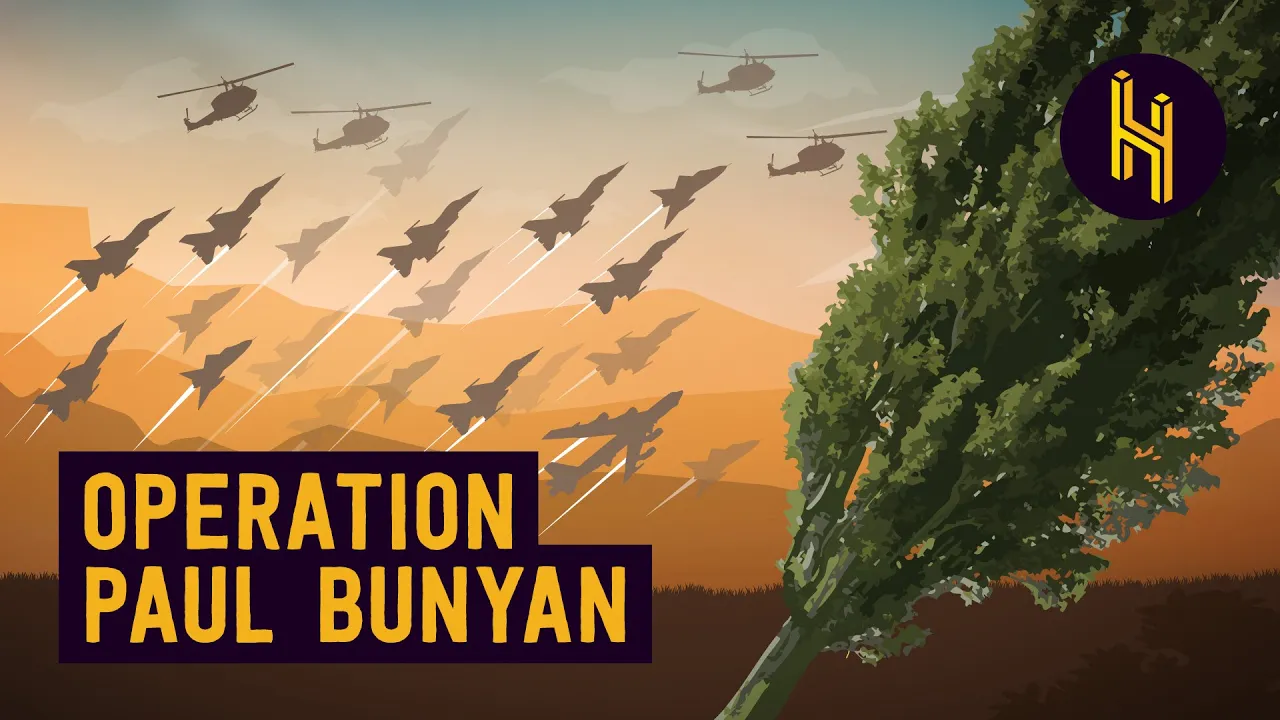
So, along with sending 16 US engineers to cut down the tree, defended by 60 South Korean special forces guys bearing pistols and axe handles, they also brought along some AH-1 Cobra gunships, F-111 fighter bombers, B-52 Stratofortresses from Guam, dozens of F-4 Phantom II jets, some of South Korea's F-5 and F-86 jets, 27 American helicopters, 23 [music] trucks, some not so loud in the JSA heavy weapons and Claymores hidden under sandbags in the trucks, and a partridge in a pear tree, which [music] they also cut down.
In all, there were 813 guys on the scene for this, even though only 235 US and South Korean troops were even stationed in the JSA. Here's how it played out. At 7:00 a.m., the new, larger ground team showed up to cut down the tree, shortly met with hundreds of North Korean troops who began to set up machine guns. Then, the commander of the convoy queued all the jets and helicopters to appear over the horizon, and the properly spooked North Koreans stood down, because, you know, what else are you going to do?
About 40 minutes later, all that remained of the tree was a 20-ft tall stump, and all the people walked away unharmed. Easy breezy. But, the Americans and South Koreans were prepared for it to go much worse. One of the reasons it took 40 minutes was that they opted for chainsaws over heavier, more efficient tree cutting equipment, because chainsaws are easier to drop and run if things go sideways. And at the ready if things went sideways, an aircraft carrier battle group off the coast, and all 41,000 US troops in Korea, were to put at DEFCON 3, the same DEFCON they later used after 9/11.
They also rigged up nearby Camp Liberty Bell, outside the JSA, with a bunch of explosives, so if North [music] Korea attacked or captured it, they could blow the place to smithereens. Luckily, it never came to any of that, and Kim Il Sung released a rare for North Korea statement of regret about the axe murders. The military demarcation line went down in the JSA to tamp down continued hand-to-hand hostility between the opposing sides, [music] the poplar stump got replaced with a memorial to the two axe murdered soldiers, and the planet got to keep the day since a World War ticker climbing up.
So, if you hadn't heard of Operation Paul Bunyan before today, be grateful, because, while it's a YouTube fun fact fodder in our universe, there's a parallel one not so far from here where it's Franz Ferdinand famous. [music] And if you're not familiar with Franz Ferdinand, you are really not going to like what happened to him. Now, before we go, if you're into very elaborate approaches to seemingly trivial tasks, you may want to check out our new docu-series, Scav.
Earlier this year, our whole team headed to the University of Chicago to film their annual scavenger hunt, which is sort of like a normal scavenger hunt, except with helicopters, popes, whatever this is, and a guy named Danger who threw knives at my writer Amy's head, which usually only I'm allowed to do. We're so, so proud of Scav. And the good news is, you can watch the entire season right now on this video sponsor, Nebula.
It's a streaming service I was involved in starting alongside [music] a few of my favorite creators back in 2018, and it's now the exclusive home of tons of my projects, like Scav, a comedy debate show called Abolish Everything, and a twisty, road-trippy competition show called The Getaway. But, it doesn't stop there. Tons of creators have some of their best work on Nebula, whether it's The Dinner Plan, Patrick Willems' short film about the horrors of the office dinner party, Bobby Broccoli's mind-bending doc about the scandal known as Scientific Watergate, or, well, any of these tons and tons of things.
It's all waiting for you on Nebula. And good news, in the month of December, you can get 50% off an annual subscription. And if you're not sure whether Nebula's right for you, we're currently offering a 3-day free trial. So, head to the link in the description right now and sign up for Nebula, check out Scav, and see what else we've got going on. See you there.
The words are the caption track's own and nothing is reworded or re-transcribed. Paragraph breaks are placed between sentences so the text reads as prose.
Free tools for your own script. No signup, no login.
Paste your draft and see where viewers are likely to drop off, with a rewrite for each weak line.
Paste the first 30 seconds of your own draft for a hook score and rewrites.
Check your draft against YouTube's advertiser-friendly guidelines before you record it.
Read this channel's public videos and transcripts, and download a writing brief for it.
Sentence shape
| Measure | This transcript |
|---|---|
| Sentences | 73 |
| Average words per sentence | 22.7 |
| Longest sentence | 90 words |
| Questions asked | 6 |
| Sentences containing a number | 20 |
Most used terms
Filler phrases
6 in total: like 4 · sort of 1 · you know 1.
A literal whole-word count of the same phrase list the Prepublish browser extension uses, so a phrase inside another word is not counted and a phrase used in its ordinary sense still is. It is a count and not a judgement.