Getting the transcript
Reading the captions from YouTube. A video nobody has opened here before takes 10 to 30 seconds; this page fills in on its own.
Getting the transcript
Reading the captions from YouTube. A video nobody has opened here before takes 10 to 30 seconds; this page fills in on its own.
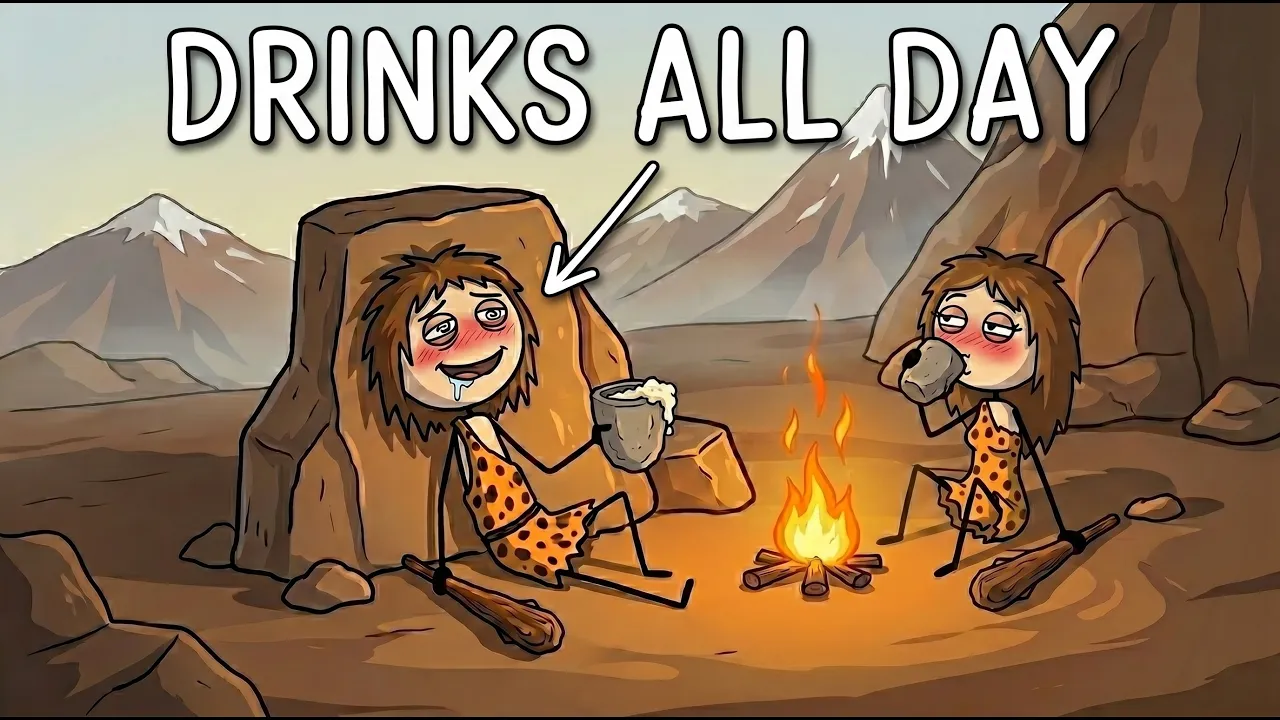
Ink Explainer · @Inkexplainer96
Where viewers went back to watch this video again, from YouTube's public Most replayed graph, lined up with what was said at that moment.
Most replayed moment #1
1:241.8x the video's typical replay level
called the Natufians about 13,000 years ago. Inside, they found stone mortars carved directly into the bedrock. When they analyzed the residue left in those mortars, they found traces of wheat and barley that had been soaked, germinated, and left to ferment. That's beer, brewed
Said at 1:18
Most replayed moment #2
5:491.8x the video's typical replay level
drink, you're continuing something that started before your species had a name for itself. The process changed, the ingredients improved, the cups got fancier, but the impulse is the same one that made a small primate reach for a piece of overripe fruit on a forest floor 10 million years ago. We just learned how to
Said at 5:43
Most replayed moment #3
3:531.7x the video's typical replay level
found pottery jars containing residue from a fermented drink made of rice, honey, grapes, and hawthorn berries. Chemical analysis confirmed the ingredients and the fermentation process. This is the oldest confirmed recipe for alcohol anywhere in the world, and it wasn't crude, it was a blend. Multiple ingredients
Said at 3:45
The graph counts replays. It does not show where viewers stopped watching.
How this video opens and how it is built, beat by beat, as a template you can reuse for your own topic. The quotes are the video's own words.
Checking for a template
Words
1,214
Runtime
6:03
Speaking pace
201wpm
Reading time
5min
201 words per minute, above the 201 75th percentile of 349 measured videos. That distribution comes from the 349-video hook study.
Opening (first 30 seconds)
Right now, you're probably drunk or about to get drunk. And the last time you had a drink, beer, wine, whatever, you probably just drank it and forgot about it. But what you did is one of the oldest things a human being can do. It's older than writing, older than farming. It actually predates humans beings entirely. Because our relationship with alcohol doesn't start a few thousand years ago with the invention of wine or the first brewery. It starts about 10 million years ago on a forest floor in Africa with a small primate picking up a piece of
101 words, the words spoken in the first 30 seconds at 201 words per minute.
Free, no signup. See how the first 30 seconds hold attention, with rewrites.
Sentence shape
| Measure | This transcript |
|---|---|
| Sentences | 95 |
| Average words per sentence | 12.8 |
| Longest sentence | 37 words |
| Questions asked | 4 |
| Sentences containing a number | 16 |
Most used terms
Filler phrases
3 in total: actually 2 · like 1.
A literal whole-word count of the same phrase list the Prepublish browser extension uses, so a phrase inside another word is not counted and a phrase used in its ordinary sense still is. It is a count and not a judgement.
Free, no account. See where attention is likely to drop, with a rewrite for each weak line. The free check shows the scores and the one issue costing the most. Or run it on the words above first.
Free · No login · See a sample audit first if you prefer.
What this transcript is
Every word below is the caption track YouTube publishes for this video, pulled from the video itself and reproduced unchanged. It is not Prepublish's writing, not a summary, and not a re-transcription: it is the video's own published captions. English captions, generated automatically by YouTube, in the video’s original language. Source: the video on YouTube. A channel that would rather this page did not exist can ask for its removal through the contact page, and it is removed.
Right now, you're probably drunk or about to get drunk. And the last time you had a drink, beer, wine, whatever, you probably just drank it and forgot about it. But what you did is one of the oldest things a human being can do. It's older than writing, older than farming. It actually predates humans beings entirely. Because our relationship with alcohol doesn't start a few thousand years ago with the invention of wine or the first brewery.
It starts about 10 million years ago on a forest floor in Africa with a small primate picking up a piece of fruit that had been sitting on the ground for too long. In 2014, a biologist at UC Berkeley named Robert Dudley published a book called The Drunken Monkey. His argument was simple. When fruit falls from a tree and sits on the ground, the natural sugars inside it start breaking down. Yeast gets in, fermentation begins, and the fruit starts producing small amounts of ethanol.
And when primates ate that fruit, the ethanol inside it made them feel a little drunk. They had no idea why, but it felt good. So, they kept coming back for more. Over millions of years, our ancestors didn't just tolerate alcohol. They evolved to look for it. So, by the time ancient humans actually showed up, the taste for it was already built in. It was there long before anyone figured out how to make it on purpose.
The question is, when did they figure that out? In 2018, archaeologists were excavating a cave near Haifa, Israel. The cave is called Raqefet, and it was used by a group called the Natufians about 13,000 years ago. Inside, they found stone mortars carved directly into the bedrock. When they analyzed the residue left in those mortars, they found traces of wheat and barley that had been soaked, germinated, and left to ferment.
That's beer, brewed in a cave 13,000 years ago. Now, here's what makes that finding so important. The Natufians were not farmers. They hadn't invented agriculture yet. They were still collecting wild grain by hand and hunting animals for meat. They didn't grow the barley, they found it. But somehow, making beer was important enough that they figured that out first. Think about that. Because up until this discovery, the story goes like this.
Humans settled down, started farming, built villages, and then eventually discovered fermentation and started making drinks. Alcohol came after civilization, but Roc de la Cave says the opposite. These people were brewing while they were still nomadic, and they aren't the only ones. About a thousand years later, someone in southeastern Turkey built something enormous. At a site called Göbekli Tepe, massive stone pillars, some weighing over 10 tons, were arranged in careful circles and carved with images of animals.
The whole structure was deliberate and complex, and it was built before farming, before pottery, before anyone in the region had a permanent home. These were still hunter-gatherers. For years, archaeologists couldn't explain why nomadic people would organize the labor needed to move 10-ton stones up a hill and carve them with precision. What would motivate that? Then they found large stone vats at the site. When they tested the insides, they found chemical traces of fermented grain.
People were brewing at Göbekli Tepe, not small amounts, enough for large gatherings. The current theory is that this site wasn't a home. It was a gathering place for ritual and feasting. People traveled from across the region, came together, and drank. And this raises a question that's been debated for decades. Why did humans start farming? An archaeobotanist named Patrick McGovern, the leading expert on ancient alcohol in the world, has spent decades arguing that humans didn't start farming to make bread.
They started farming to make beer. And I couldn't agree more. He says that bread requires grinding, kneading, and baking. It's a complex process. Beer is simpler. You soak grain in water, leave it alone, and fermentation happens by itself. And the desire to drink would have been a stronger motivator than the desire to eat grain in a slightly different form. If he's right, then alcohol isn't something that showed up after humans settled down.
It might be the reason they settled down in the first place. By 7000 BCE, the evidence gets more precise. In a Neolithic village called Jiahu in central China, archaeologists found pottery jars containing residue from a fermented drink made of rice, honey, grapes, and hawthorn berries. Chemical analysis confirmed the ingredients and the fermentation process. This is the oldest confirmed recipe for alcohol anywhere in the world, and it wasn't crude, it was a blend.
Multiple ingredients carefully chosen and combined. Whoever made this knew exactly what they were doing. From there, it only grew. By the time ancient Egypt came around, beer wasn't something people made for fun. It was woven into everything. Workers who built the pyramids were paid in beer, about 4 to 5 L a day. That was their actual salary, not coins, not grain, but beer. And it made sense because the water from the Nile was often contaminated and unsafe to drink straight.
But beer, because of the brewing process, was cleaner. So it kept people alive in a way water couldn't. Honestly, if you were working in the desert heat and someone gave you a choice between a bag of coins or 5 L of cold beer, what are you picking? >> [clears throat] >> Yeah, same. And on top of that, the brewing process added calories and nutrients. For a laborer dragging limestone blocks in the desert heat, those extra calories mattered.
Beer wasn't just a drink, it was lunch. And then there was the religious side. The Egyptians believed beer was created by Osiris and given to humans as a gift. It showed up in temple offerings, burial rituals, and medical prescriptions. Doctors would mix herbs into beer and prescribe it for everything from stomach problems to infections. So one single drink was doing the job of a paycheck, a water filter, a meal, a medicine, and a prayer all from the same cup.
So here's the full picture. 10 million years ago, your ancestors were drawn to fermented fruit because it helped them find food. 13,000 years ago, they were deliberately brewing in caves before they knew how to farm. 12,000 years ago, they were possibly building the first monuments in human history just to have a place to drink together. 9,000 years ago, they had recipes. 5,000 years ago, entire civilizations were running on it.
Alcohol didn't come after we built the world we live in. There's a real possibility that it's the reason we built it at all. Every time you have a drink, you're continuing something that started before your species had a name for itself. The process changed, the ingredients improved, the cups got fancier, but the impulse is the same one that made a small primate reach for a piece of overripe fruit on a forest floor 10 million years ago.
We just learned how to make it on purpose. If you want to dig deeper into any of this, all the research is linked down in the description.
The words are the caption track's own and nothing is reworded or re-transcribed. Paragraph breaks are placed between sentences so the text reads as prose.
Free tools for your own script: paste a draft and see where it stands before you record it.
Paste your draft and see where viewers are likely to drop off, with a rewrite for each weak line.
Paste the first 30 seconds of your own draft for a hook score and rewrites.
Check your draft against YouTube's advertiser-friendly guidelines before you record it.
Read this channel's public videos and transcripts, and download a writing brief for it.
The guides behind the choices this video already made, from the opening line to the length of the script.
What the Intro metric measures, and how to build an opening that earns the next minute.
Opening lines you can copy, grouped by type, with a note on when each one works.
What audience retention measures and how to read the graph in YouTube Studio.
The benchmark ranges for a good retention rate, by video length and format.
Word counts by video length, measured from the videos Prepublish has stored.
What YouTube Help says about Shorts retention, and how to fix a low rate.