Getting the transcript
Reading the captions from YouTube. A video nobody has opened here before takes 10 to 30 seconds; this page fills in on its own.
Reading the captions from YouTube. A video nobody has opened here before takes 10 to 30 seconds; this page fills in on its own.
BTODtv · @btodtv
Where viewers went back to watch this video again, from YouTube's public Most replayed graph, lined up with what was said at that moment.
Most replayed moment #1
7:463.7x the video's typical replay level
quieter than those two. The Sparx takes that up another notch. The Walking Pad Z1 is a little too frustrating to move around for me. After testing all five, the Sparx pad is the one I've already been recommending to friends and family. I strongly recommend you check out my
Said at 7:39
Most replayed moment #2
5:412.3x the video's typical replay level
the feet up and for more height, you add the small red risers underneath. It works, but it's a bit clunkier than some of the other systems I'll show later. This pad also has the highest listed weight capacity in the group. I would take that with a little bit of grain of salt, though, cuz it doesn't look any
Said at 5:34
Most replayed moment #3
0:192.0x the video's typical replay level
my standing desk. This video will help you understand why you'd choose one over another. The Sparex was the walking pad I was most excited to test, not because of something it had, but because of something it didn't have. There's no front frame, and as I expected, this
Said at 0:13
The graph counts replays. It does not show where viewers stopped watching.
Words
1,688
Runtime
8:00
Speaking pace
211wpm
Reading time
7min
211 words per minute, above the 201 75th percentile of 349 measured videos. That distribution comes from the 349-video hook study.
Opening (first 30 seconds)
If you've been shopping for a walking pad, you've probably noticed they all look almost identical. The same horsepower claims, similar speeds, and sizing. I spent real time using five highly rated walking pads on Amazon with my standing desk. This video will help you understand why you'd choose one over another. The Sparex was the walking pad I was most excited to test, not because of something it had, but because of something it didn't have. There's no front frame, and as I expected, this makes a big difference. On paper, it actually has the shortest walking surface of the group at about 36 and
106 words, the words spoken in the first 30 seconds at 211 words per minute.
Free, no signup. See how the first 30 seconds hold attention, with rewrites.
What this transcript is
Every word below is the caption track YouTube publishes for this video, pulled from the video itself and reproduced unchanged. It is not Prepublish's writing, not a summary, and not a re-transcription: it is the video's own published captions. English captions, generated automatically by YouTube, in the video’s original language. Source: the video on YouTube. A channel that would rather this page did not exist can ask for its removal through the contact page, and it is removed.
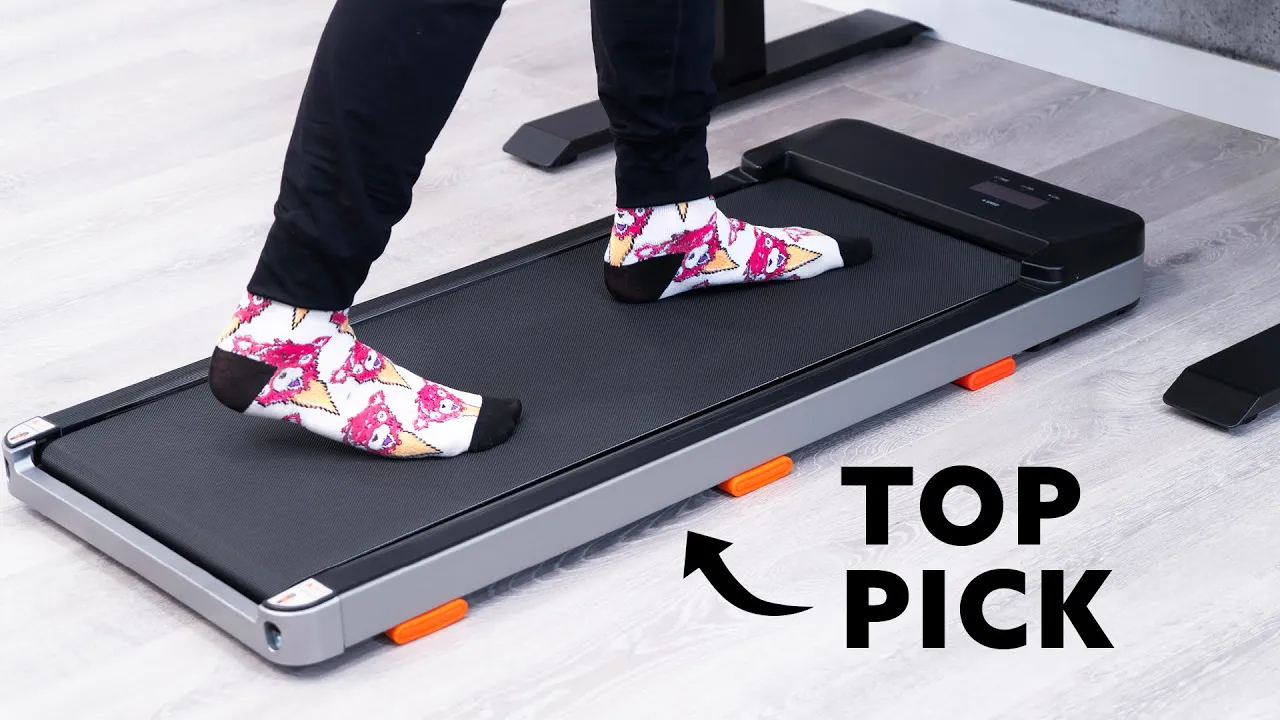
If you've been shopping for a walking pad, you've probably noticed they all look almost identical. The same horsepower claims, similar speeds, and sizing. I spent real time using five highly rated walking pads on Amazon with my standing desk. This video will help you understand why you'd choose one over another. The Sparex was the walking pad I was most excited to test, not because of something it had, but because of something it didn't have.
There's no front frame, and as I expected, this makes a big difference. On paper, it actually has the shortest walking surface of the group at about 36 and 3/4 in, but there's nothing at the front, so I can stand further forward on the belt without worrying about kicking anything. So, this makes the pad feel longer. I'm about 6'2 with a long stride, and the length was never an issue. Out of the box, the belt was far too loose, so it would slip when I stepped down too hard.
Now, these pads are all easy to adjust, so a quick adjustment, and it was ready to walk on. This is the lightest pad I tested, and that matters more than you'd think. If a walking pad is easier to move and reposition, you're just more likely to use it. In terms of feel, this was the quietest pad in the group with softer footfalls and a slightly grippier walking surface than the others. After you're done walking, it runs a short cool down cycle, which I expect improves its longevity.
Along with the remote, Sparex also has an app for control and tracking. Plus, it has vibration modes. I'm not an expert on the health effects of vibration, but the lower settings felt nice to me. For me, walking was really the focus. It doesn't have wheels, but because it's so light, I can usually just pick it up and move it where I want it. Early on, this feels like it might end up being my new daily driver. But we've still got four more walking pads to go, including one that's a much more premium option.
The Yagood is the one that convinced me to buy a walking pad a year ago. I borrowed this model from my mother-in-law, used it under my desk for a while, and that was enough to sell me on the idea. Now, it does have a front frame, so after using the Sparax, I noticed myself kicking the front edge a little, but I adjusted pretty quickly, moving to the correct spot on the pad. But if you're not careful, that front edge is something you'll occasionally kick.
One thing here I really liked is the walking modes. You can set how long you want to walk based on time, distance, or calories, or you can just hit start and stop whenever you want. Anything that makes getting an extra exercise a little easier is a big plus. The Yagoot has small wheels at the front, something you'll see in most of the models. They make a big difference in the day-to-day use. The wheels let you roll the pad out of the way, push it up against a wall, or even roll it under furniture.
This makes storage way easier than having to pick it up every time since some of these are heavier. In terms of feel, this is very much in line with the others on the list with some slight differences. At the same speed settings, it felt a little bit faster to me, and also my footfalls sounded a little louder compared to some of the other pads. Overall, there's not a lot of fluff here, and that's what helps keep the price so low.
It's simple, works well, and it does exactly what it needs to do. Looking for the most comfortable chair to pair with your setup? Check out our office chair buying guide where we rank the most popular chairs. I wanted to include a walking pad that was at the other end of the spectrum, highlighting whether it's worth it to spend three times as much. The foldable walking pad Z1 has some features that you won't see in any other models on this list, but that also brings some big concerns.
This pad was ready to use right away. Just unfold it and hit start. I was concerned when I saw a fold in the belt, but when it was extended, the fold seems to disappear. You do need to make sure the belt is centered when you open the pad, otherwise it won't land perfectly centered on its own. In actual use, I found this to be one of the most pleasant walking pads. It has an additional belt length at about 48 in long, so I had zero concerns about centering myself on the tread.
The Z1 has an easy to use app where you can not only control your unit with preset speeds, but also set up a plan and even see your history. For taller users, these pads with a longer tread are a must. It also came with the most premium feeling remote and a very bright and fast scrolling screen. The folding feature is a mix of good and bad. The space savings are real and they cut the footprint down by roughly 40%. But even that comes with some trade-offs.
The pad is very heavy and you really need to fold it up to use the wheels at all. Even then, it's awkward to move and the wheels are hard to get rolling. These negatives left me thinking that for my personal use, this might not be the pad I would choose as my long-term solution, even without the cost being considered. The angle of this video is really for using the walking pads at your desk, but I wanted to include one with a handle for anyone who wants to use theirs away from their desk.
This one also pushes the limits of what a walking pad can do in terms of speed and weight capacity. By including a handrail, Loctite makes this the more practical option for away from a desk. It is on the short side though, so I can only reach down and touch it with a finger. It's more of a reference point than something you'd actually hold on to. It does include a tablet holder, but I'd consider this more for storage cuz it's pretty low and I'm not sure I'd trust my tablet on it.
Under foot, this pad feels very similar to the Yagud and the tray flow that we'll talk about later. The red center line is a little bit loud visually, but again, it works as a nice cue to help keep you centered while walking. Where the Loctite really separates itself is its speed and incline. This is the only unit that has a top speed fast enough to put you in a jog. Add incline and this has the hardest workout potential of the group.
To use the incline, you can flip the feet up and for more height, you add the small red risers underneath. It works, but it's a bit clunkier than some of the other systems I'll show later. This pad also has the highest listed weight capacity in the group. I would take that with a little bit of grain of salt, though, cuz it doesn't look any more solidly built than the others. For me, the high speed and the incline isn't as helpful at the desk.
But again, if you like the idea of pushing yourself hard when you're not actively working, this one makes sense. Remember when I said I bought a walking pad about a year ago? This is the one I ended up going with. I've tried to be conscious of my bias here, but I'll be upfront. I do have a bit of a soft spot for this one. When I first got it, I did need to tighten the belt slightly. I ran into a similar issue as the Sparx, just not nearly as extreme.
Once I made that adjustment, it's been solid ever since and hasn't needed further adjustment, just an occasional lubrication. I originally picked the Trey Flow because of the clean look and the walking size surface. At the time, it was one of the longer pads I could find. Now, most of these walking pads are right around the same 37in length. Like the Yagood and Loct, this one is easy to roll around on its wheels. The incline is rated at 8% and raises the front up by about 3 in.
It's simple and feels plenty stable. I strongly prefer this style over the lockex flip and riser setup. I don't use the incline that often though because I'm just not trying to turn my desk walking into a full workout. One interesting thing I noticed is that even though the Loctite advertised a higher incline number, my measurements had the tray flow actually rising slightly higher when you compare them versus their starting points.
In terms of noise and feel, this sits right in the middle. It's a little softer and a little quieter than the Yagud and Loct, but it's not quite as quiet as the Sparx. Not that it really matters, but after the Sparex, this unit seemed to be the most stylish and sleek. Also, the internals look a little more well-built than similarly priced options. Blindfolded, I honestly don't think I could tell the difference between the Yagud and the Loct.
The Trey Flow feels slightly softer underfoot and a little quieter than those two. The Sparx takes that up another notch. The Walking Pad Z1 is a little too frustrating to move around for me. After testing all five, the Sparx pad is the one I've already been recommending to friends and family. I strongly recommend you check out my video, Don't Buy a Walking Pad until you watch this video before you decide to buy one of these.
The words are the caption track's own and nothing is reworded or re-transcribed. Paragraph breaks are placed between sentences so the text reads as prose.
Free tools for your own script. No signup, no login.
Paste your draft and see where viewers are likely to drop off, with a rewrite for each weak line.
Paste the first 30 seconds of your own draft for a hook score and rewrites.
Check your draft against YouTube's advertiser-friendly guidelines before you record it.
Read this channel's public videos and transcripts, and download a writing brief for it.
Sentence shape
| Measure | This transcript |
|---|---|
| Sentences | 99 |
| Average words per sentence | 17.1 |
| Longest sentence | 38 words |
| Questions asked | 2 |
| Sentences containing a number | 9 |
Most used terms
Filler phrases
6 in total: actually 3 · like 3.
A literal whole-word count of the same phrase list the Prepublish browser extension uses, so a phrase inside another word is not counted and a phrase used in its ordinary sense still is. It is a count and not a judgement.