Biogeochemical Cycles transcript
Bozeman Science · @Bozemanscience1
Words
1,740
Runtime
8:34
Speaking pace
203wpm
Reading time
7min
203 words per minute, above the 201 75th percentile of 349 measured videos. That distribution comes from the 349-video hook study.
Opening (first 30 seconds)
Hi. It’s Mr. Andersen and this is environmental science video 11. It is on biogeochemical cycles. This is a picture of George Rhoads. You have probably never seen him before but you may have seen his work. If you have ever seen a giant kinetic sculpture at a museum where billiard balls are lifted up and then they move down again, he invented that and has installed lots of those around the world. Here is a planning document. In this one he is trying to show how energy from the sun or within the earth can drive things like the water cycle
102 words, the words spoken in the first 30 seconds at 203 words per minute.
Sentence shape
| Measure | This transcript |
|---|---|
| Sentences | 152 |
| Average words per sentence | 11.4 |
| Longest sentence | 37 words |
| Questions asked | 20 |
| Sentences containing a number | 11 |
Most used terms
- cycle27
- nitrogen23
- carbon18
- atmosphere16
- sulfur15
- water14
- plants12
- move11
- nutrients11
- phosphorus11
- planet9
- bacteria8
Filler phrases
5 in total: like 4 · kind of 1.
A literal whole-word count of the same phrase list the Prepublish browser extension uses, so a phrase inside another word is not counted and a phrase used in its ordinary sense still is. It is a count and not a judgement.
What this transcript is
Every word below is the caption track YouTube publishes for this video, pulled from the video itself and reproduced unchanged. It is not Prepublish's writing, not a summary, and not a re-transcription: it is the video's own published captions. English captions, published by the channel, in the video’s original language. Source: the video on YouTube. A channel that would rather this page did not exist can ask for its removal through the contact page, and it is removed.
Transcript
Hi. It’s Mr. Andersen and this is environmental science video 11. It is on biogeochemical cycles. This is a picture of George Rhoads. You have probably never seen him before but you may have seen his work. If you have ever seen a giant kinetic sculpture at a museum where billiard balls are lifted up and then they move down again, he invented that and has installed lots of those around the world. Here is a planning document.
In this one he is trying to show how energy from the sun or within the earth can drive things like the water cycle and the rock cycle. And it is a really good model for how nutrients move around on our planet. The carbon and the nitrogen that we have is set and it just moves around between the living and nonliving world. #00:00:41-4# And so the matter on our planet is conserved. We have a set amount and it moves between the biotic, or living, and abiotic world.
The living world is called the biosphere on our planet. And the nutrients that we need are best remembered in this mnemonic, CHNOPS. Carbon, hydrogen, nitrogen, oxygen, phosphorus and sulfur. If we look at the abiotic factors, that is going to be the atmosphere, lithosphere and hydrosphere. And so these biogeochemical cycles are going to be how the nutrients move between the living and nonliving. Now why is it such a long word?
Bio, geo and chemical are the biological, chemical and geological processes by which the nutrients move around. You are probably most familiar with the water cycle. We will start there. Then talk about the carbon cycle and following that the nitrogen cycle. One thing you are probably not familiar with with the nitrogen cycle is the importance of bacteria and how they can nitrogen fix or take nitrogen out of the atmosphere and put it into the living world.
We will then move to the phosphorus, one of the slowest turning cycles. It involves rock but no atmosphere. Now both nitrogen and phosphorus are what are called limiting nutrients. That means life really needs them and is waiting for them. And once it gets those nutrients then it grows really really quickly. It is a good thing but sometimes can lead to eutrophication. And then finally we will finish with the sulfur cycle. #00:01:57-7# And so the energy on our planet remember starts in the sun, moves through producers to consumers, other consumers and eventually is lost as heat.
But as we move to matter everything on the planet is conserved. There is no sun anymore. And so how do the producers get the nutrients that they need? It is from their environment. From the atmosphere, from the hydrosphere, from the lithosphere. How do consumers get the matter they need? By eating plants or eating consumers that ate plants. How does the matter go back into the environment again? Through these biogeochemical cycles. #00:02:30-8# And so what are the nutrients that life needs?
What are the billiard balls of life? Well a good mnemonic is CHNOPS. Carbon, hydrogen, nitrogen, oxygen, phosphorus and sulfur. If we organize that into the five cycles we have the water cycle, carbon cycle, nitrogen cycle, phosphorous cycle and sulfur cycle. So why do we need all of this matter? We are filled with water. We also use the oxygen to release energy and transfer energy with the hydrogen. We are built out of macromolecules.
That is what carbon is the building block of. The nitrogen and the sulfur are both big components in the proteins that make us up. And then the phosphorous is found in DNA, RNA and the ATP. And so if we do not have these nutrients, if we do not have these atoms then life cannot exist. So we need to pull them out of our environment. #00:03:17-8# So let’s start with the water cycle. How do plants get water? They are going to take it in through their roots.
What about a cow? They are simply going to drink the water. But how does it move through the abiotic parts of our planet? First of all we are going to have evaporation off of oceans, lakes and streams. And then we are going to have evapotranspiration. So it is evaporating but also it is being transpired through the leaves of a plant. It is now moving from a liquid to a gas. What eventually happens is that we are going to have condensation in the clouds.
We have precipitation. And then we have run off over the surface and through ground water. And the whole thing begins again. #00:03:49-4# If we start with carbon, how does a plant get carbon? It is going to be through photosynthesis. Both in plants on land and then phytoplankton that are going to be found in the ocean. What about an animal like this cow, it is simply gets the carbon through its diet. It eats the plant.
Or if something eats a cow, like you, you are taking the carbon from the meat of the cow. So what happens to that carbon? It is eventually released through cellular respiration. It goes back into the atmosphere again as carbon dioxide. So a lot of that carbon is going to be in the atmosphere as carbon dioxide. Now we can also take that carbon and it can be covered by rock and we can create coal and oil, fossil fuels.
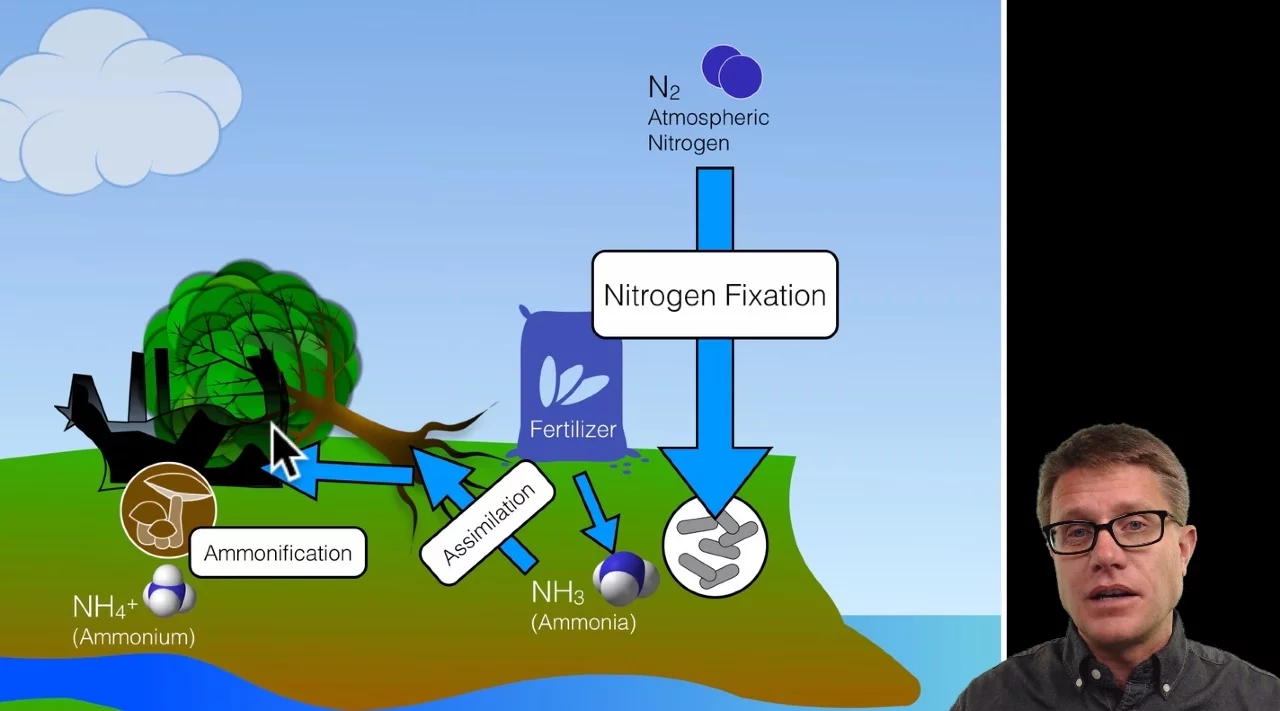
So we are storing that carbon in the rock. We can extract it again by digging a well. And then we can have combustion where a factory releases that carbon dioxide back into the atmosphere and the whole cycle continues again. #00:04:37-8# The nitrogen cycle is a little different. Most of the nitrogen is going to be found in the atmosphere as nitrogen gas. And to get it into the living systems we have to do nitrogen fixation.
So there are bacteria that live lots of times on the roots of plants in these nodules and they are converting the nitrogen in the atmosphere into usable ammonia. We could also put ammonia on our fields as fertilizer. And then it is going to be assimilated. In other words plants are going to take it in through their roots and we are going to get it from plants simply by eating them. Now how does it get returned back to the atmosphere?
It is kind of complex. What happens is we have death. We then have decay. And so bacteria or fungi are going to convert that nitrogen into ammonium. And then we have other bacteria, nitrifying bacteria that are going to convert that ammonium into nitrites and then nitrates. Now the nitrates can be leached. They can move into the water supply of our planet. Remember nitrogen is a limiting nutrient. Plants, life, is just waiting for nitrogen to be there.
And once we get nitrogen, for example in this stream, you will get an algae bloom. We will get a bunch of algae growing really, really quickly. Now that seems like a good thing but all of those algae are going to quickly die. And eutrophication is this process by which they die and then other bacteria have to break them down through respiration and it consumes all of the oxygen. So it is not healthy for that water supply.
But let’s keep watching the nitrogen. How does it get back into the atmosphere? We will have denitrifying bacteria that are going to return it back into the atmosphere. And so the whole thing can begin again. #00:06:05-4# Now the phosphorus cycle is going to turn more slowly. It starts by having rock that have phosphorus being uplifted. We then have weathering and erosion and that is going to move the phosphorus into the soil, into the water supply.
We could also add fertilizers. That is going to have phosphorus. And the whole thing, since it is limiting can promote eutrophication. What happens to the phosphorus? We then have assimilation where it is taken into plants. We can eat the plants and we get it. What eventually happens is we die. So through excretion and decay we return that phosphorus into the water supply. It eventually works its way to the ocean. And then it eventually settles out in these sediments.
And so it never goes to the atmosphere. It becomes part of these phosphate rocks which are then uplifted again. And so it takes a long time for this cycle to turn because we do not include the atmosphere. #00:06:49-0# And then finally we have the sulfur cycle. Sulfur cycle is going to move from the oceans, the sulfur. We have bacteria that are going to convert that into dimethyl sulfide which eventually becomes sulfur oxide or sulfur dioxide.
We can also increase sulfur dioxide through volcanism. So volcanoes are releasing hydrogen sulfide which becomes sulfur dioxide. And then factories are going to release sulfur dioxide as well. It is in the atmosphere now. How does it get back to the planet? It is going to rain down as sulfuric acid and sulfates. We can then assimilate that, take it into the living materials, same way, into plants and then into consumers.
And finally it works its way back through the water supply and now it is going to be sulfur in the oceans. So the cycle can continue again. But we can also have that rock cycle forming some of that into fossils fuels which can be extracted again and the cycle continues. #00:07:41-2# And so for each of these cycles you should be able to figure out how do plants get it? How do animals get it? And then how does it recycle back through the atmosphere, hydrosphere and lithosphere. #00:07:51-4# So did you learn the following?
Could you pause the video right now and fill in the blanks? Remember matter is conserved on our planet. We have a set amount. It moves through the biotic and abiotic spheres. A good way to remember the nutrients we need is CHNOPS. The biogeochemical cycles are how we move it through abiotic and biotic. It is the water cycle, carbon cycle, nitrogen cycle, which requires nitrogen fixation. Remember nitrogen and phosphorus are limiting nutrients which can lead to eutrophication.
The last cycle is the sulfur cycle. And I hope that was helpful.
The words are the caption track's own and nothing is reworded or re-transcribed. Paragraph breaks are placed between sentences so the text reads as prose.
Use this transcript
Three free tools that work on the material around a video like this one. No signup, no login.
Hook Analyzer
Paste the first 30 seconds of your own draft for a hook score and rewrites.
Policy Pre-Flight
Check your draft against YouTube's advertiser-friendly guidelines before you record it.
Channel Skill Generator
Read this channel's public videos and transcripts, and download a writing brief for it.