Getting the transcript
Reading the captions from YouTube. A video nobody has opened here before takes 10 to 30 seconds; this page fills in on its own.
Getting the transcript
Reading the captions from YouTube. A video nobody has opened here before takes 10 to 30 seconds; this page fills in on its own.
Lenny's Podcast · @LennysPodcast
Words
3,993
Runtime
18:32
Speaking pace
215wpm
Reading time
17min
215 words per minute, above the 201 75th percentile of 349 measured videos. That distribution comes from the 349-video hook study.
Opening (first 30 seconds)
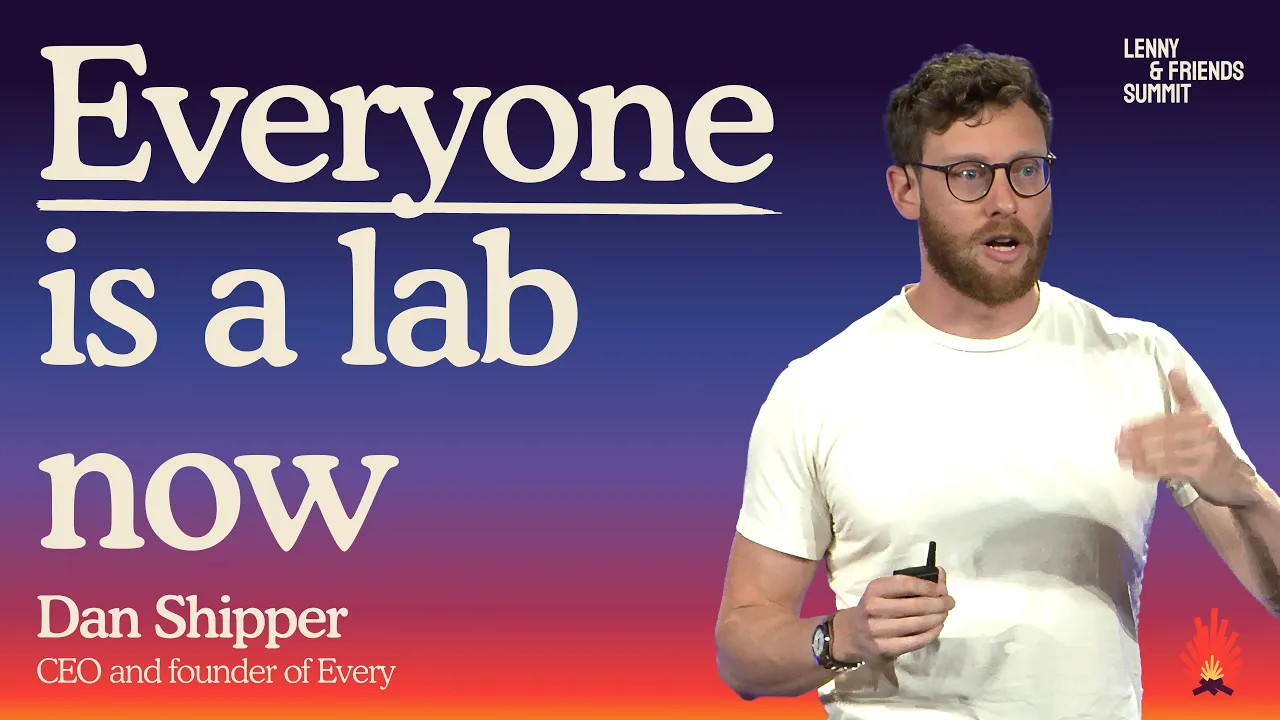
Okay. So, I'm going to talk about how to build products on a moving frontier. Um, or as I like to call it, the unreasonable ineffectiveness of business as usual during technology revolutions and what to do about it. So, the world just changed. The world just changed again. Uh, we had Fable 5.1 launched last week. We had Astra 6 launched last week. And these are [ __ ] sick models. Like look at this. This I made this like battle of waterlue 3D like historical re reproduction that's historically accurate with like a single prompt and it just churned for like four hours and then I
108 words, the words spoken in the first 30 seconds at 215 words per minute.
Free, no signup. See how the first 30 seconds hold attention, with rewrites.
Sentence shape
| Measure | This transcript |
|---|---|
| Sentences | 229 |
| Average words per sentence | 17.4 |
| Longest sentence | 73 words |
| Questions asked | 21 |
| Sentences containing a number | 17 |
Most used terms
Filler phrases
161 in total: like 61 · uh 45 · um 21 · actually 14 · kind of 8 · sort of 7 · you know 3 · literally 2.
A literal whole-word count of the same phrase list the Prepublish browser extension uses, so a phrase inside another word is not counted and a phrase used in its ordinary sense still is. It is a count and not a judgement.
What this transcript is
Every word below is the caption track YouTube publishes for this video, pulled from the video itself and reproduced unchanged. It is not Prepublish's writing, not a summary, and not a re-transcription: it is the video's own published captions. English captions, generated automatically by YouTube, in the video’s original language. Source: the video on YouTube. A channel that would rather this page did not exist can ask for its removal through the contact page, and it is removed.
No Script X-ray for this video: YouTube shows a Most replayed graph only once a video has enough views.
Okay. So, I'm going to talk about how to build products on a moving frontier. Um, or as I like to call it, the unreasonable ineffectiveness of business as usual during technology revolutions and what to do about it. So, the world just changed. The world just changed again. Uh, we had Fable 5.1 launched last week. We had Astra 6 launched last week. And these are [ __ ] sick models. Like look at this. This I made this like battle of waterlue 3D like historical re reproduction that's historically accurate with like a single prompt and it just churned for like four hours and then I got that like that's crazy.
That is crazy. Someone else on my team made this uh sim agent simulation where he fed it a scientific paper about how agents interact and and how they get simulated together. And then he had like a thousand agents all running on his computer and like visualized by this after like just a couple prompts and putting a paper in. It's also now starting to do our video editing. We do a lot of videos and like Astra is actually good enough to go into Premiere and like do a bunch of editing and uh also fun fact the all of the animations in this deck and a lot of this deck was made by Astra.
Like I did not touch a lot I didn't touch the animate tab at all and we'll get into that in a sec. So this is crazy. What should you do? Do you keep your head down and focus if you're a product leader and you have a product team? That might work for a little while. Uh do you ask your customers what they want? Like maybe, but most your customers are not familiar with this stuff. They're actually looking to you uh to tell them what to do.
Do you turn your B2B SAS app into a 3D multiplayer strategy game? Maybe. Maybe. But it's hard. This is this is hard. This is a this is a big problem that I think everyone in this room faces. I face it. So the first thing to know, rule number one is never make any major life decisions within 30 days of a meditation retreat, a psychedelic experience, or your first encounter with a frontier model. All right, we're settled.
We're settled. That's rule number one. So let's get into the problem, though. So what's the core problem? Why is this so hard? It feels like if you're running a product team, it feels like it's everyone's job to execute the road map at a high level and to stay at the frontier at the same time. And that's really really hard because these are very opposed ways of working. Uh if you want to explore the frontier, you're exploring.
That's divergent. You're doing lots of different things. You're probably going to throw a lot of this stuff out. You're you're trying all these new models. You're doing demos. Exploiting is very different. You're converging. You are focusing. You're saying no to things. You're trying to execute against a road map that you've like you've planned out. And doing both of those. Uh you're you're pulling in the opposite direction.
Um so what should we do? Well, the thing I want to talk about in this talk is I my contention that you should run your product or like a research lab or you should add some research lab lab elements to your product or we're going to go through why you should make a lab, how to run a lab, and then what what like how to bring what works from the lab back into your main product. We're going to use examples from stuff we do at every and from some of the uh best companies in AI and how they do it.
So let's start. Why should you make a lab? The problem is as we said before right now everyone in your product or is doing both exploration and execution. The yellow circles are the execution, exploration is purple. You can see everyone in your or is doing both. And uh what what's really interesting though is there are some people in your or I guarantee it there are some people in your org who are doing way more exploring than others.
And that's the really important to identify um because if you identify these people, they are your early adopters. We are your early adopters. And by the way, that animation and this whole all this stuff all built by Astra. Round of applause for Astra. Inc. incredible. Incred. I did not do any of this. So we are your early adopters. Um we love new things. We're already running Astra and Fable on the weekends to do our own personal projects or do things that are similar to uh to to explore things that we might bring to work.
And because of that, there's a lot of things we might be excited about that aren't useful, but because of that, we're going to have a really good sense of what might what might your product become? Because we're like living in the future already. The problem is that we can be a massive [ __ ] distraction. And um the so the the key question to to ask yourself if you're running a product or is how do I harness the early adopters in my team on my team and maybe even uh some of my some of my customers who are early adopters without distracting everybody else.
And the solution that uh we found at every and that I think a lot of big a lot of really great companies are starting to do is make a labs team. On a labs team what you've started to do is separate concerns. Some people are in charge of improving and scaling what already works. They're they're on the product team. And some people are in charge of exploring what what what comes next, exploring the frontier, doing all these demos, trying these new models, all that kind of stuff.
That allows you to get the best of both worlds. And I'll explain how that works and why. And if you're looking at this and you're thinking, "Oh, that's really expensive and I don't have the resources for that and all that kind of stuff." What is amazing about AI is it allows you to have a labs team of one. uh you can just have one person on your team whose job it is maybe even like right when a new model comes out to go explore all that stuff and come back and tell you what they learned.
It actually does not require a lot of resources because all the people on your team are now so they have so many superpowers because they can just go off and have Astra and Fable do a bunch of stuff that it doesn't require a huge investment to do this. So again to sort of pull apart the difference between a labs team and a product team on a labs team your job is you're going to explore capabilities especially when new models drop to see what's now possible.
You're going to run a ton of experiments in parallel and we'll get into that. But crucially, the expectation for a labs team is very different. On a labs team, you're going to expect to dispose of like 90% of what you make. You try it and you throw it away. Product team is very, very different. Your job on a product team is you're going to improve and scale the product. You want to deliver for existing customers. You want to make sure that they feel like they understand the product.
It's coherent. You're not just throwing a bunch of garbage at them. So for a product team, you want to expect to adopt about 10% of what the labs team makes or tries. And this is how they sort of start to work together. And there's a lot of really good examples of this starting to work in AI in a way that like we've had labs teams for a long time, but it's starting to work in a way that it has never ever worked before because of this technology.
So a really good example is Enthropic Labs. Um, I'll be talking with uh some people at Enthropic a little bit later about this, but Enthropic Labs, Claude Code, like one of the biggest, most successful productivity products of all time, came out, came out of Enthropic Labs, a separate little group in charge of doing lots of experiments. MCPS, Skills, Claw Design, all of these things came from a small group of people inside of Enthropic experimenting with things and then Enthropic investing more and more into the winners and the ones that worked. and there's like a thousand experiments that you never you've never seen.
Let's say you're convinced now that this sort of structure gets the best gets you the best of both worlds. It it helps you to unleash your uh your early adopters without distracting the people on the product team who need to actually deliver on the road map. The question is like how do you run a lab well? So the first thing that I've started to come to is you really want to use very very very small teams. For a long time, the uh the standard for team size was the the two pizza team.
So that's like eight to 10 people. That's what Jeff Bezos came to. I think in the AI age, I I call it a two slice team. Like you want one or two people max. You can get so far so fast with one or two people that anything more, there's a lot of coordination overhead and there's differing visions and it just doesn't work. One or two people is really really great. And I think the the composition that works for us and I I think is starting to work for other people is I call them pirates and architects.
So, one person on the team is the pirate. They are slop cannons who are absolutely obsessed with with finding value. That's that's me. Like, I'm just out there just doing lots and lots of stuff and I'm throwing it away and it's all messy, but I'm going to find something really interesting. And then architects are people who are like looking at a messy system, like maybe something that I built that's completely viodated and trying to help shape it into something that's valuable and beautiful and extensible.
And pairing those types of people together, I think, is very, very powerful in AI. Um, the next best practice that I think is really important is dog fooding. The biggest thing that that matters on a labs team is making the feedback loop as tight as possible between making something and knowing if it's good. And the tightest feedback loop is making something for yourself. If you can do that, I would do it. If you can't, then it's really important to get a couple of early customers or early adopter type customers uh to help help you test with a tight feedback loop so you can iterate really really fast.
Um and to use the the stuff you're building all the experiments ideally should be used for actual work that you actually have so you can tell is this useful or is it just new. It's a big thing you need to differentiate. Another best practice which I think is quite different from how you should probably run a product team is you should be building many experiments in parallel even if those experiments are trying to do the same thing.
Try competing approaches to the problem. Uh it might look like a mess and sort of like a lack of coherence but everybody's going to have a little bit of a different take on how to solve a particular problem. And when capabilities move the frontier becomes very unknown. And so having people try the same thing from different perspectives helps you map that frontier and decide what's valuable and what's not. And then the last thing that I think is really important for doing labs is to figure out ways to make your experiments net positive in terms of ROI.
So we're going to throw out 90% of what we make. How do we make even that 90% even the even the 90% that doesn't make it into the product eventually, how do we make that actually useful for us? So, one thing that we've done a lot at every that has worked really well is we turn them into external content. People love to see here's all the things that that we tried, here's what worked, here's what didn't. And then that brings customers to to use to read our stuff, use our products, all that kind of stuff.
If that's possible, I highly recommend it. Another thing to do is use these experiments to feed an early adopter program. there are probably a lot of uh customers that you have that want to be closer, want to be in the fold, who are early adopters and this can be a value ad for them to get to work with you more closely. And then the last thing is like at base the labs team should be sharing what they learn about capabilities and what's now possible with the product team.
So the product team can take that into account uh as they build things without getting distracted by having to go, you know, explore the frontier themselves. So let's say you've done that. you're uh you've decided to make a lab. You're starting to figure out uh like all the all the little best practice. Now, how do you get the stuff that you're making into from the lab into your product? The thing you need to do is make a research pipeline where ideas start on the left and they start out as lab only and there are lots of little experiments and then you move them progressively from the left to the right and at some point you have a handoff with your product team where they start to get incorporated into the product.
So to give you a sense of what this looks like, you've got the the labs team. They're running lots of lots and lots of experiments. Um, and most of them are not good, but a few of them might work. And those become things that you start to test in real work. One of the things that we do all the time internally is we just let other people on the team adopt it and see if they like it. Uh, there are different configurations that work depending on what kind of customers you serve, but the first step for us is do other people on the team start to use it?
If that's the case, it's often then ready to put in front of early customers and ready for the product teams to like really take a look at it and figure out where does this fit in our road map and um how might we use this? And uh and even there not everything makes it but like at at some point uh the thing that you do will be ready to scale and release to customers. And we'll go through some examples of how that works.
That's the uh the research pipeline. And I'll give you like a little bit of a concrete example. This is Kate, our editor-inchief, who I've been trying to automate for the last 3 years. um very lovingly. Um and Kate Kate is fantastic at a lot of things, but one of the things she's really good at is she has a very good taste for copy edits. Um but as the team has grown, we're about 30 people now. Uh she can't do all of the copy edits herself.
Um and we could hire someone, but it's really hard to get someone who has the level of taste that she has and train them and all that kind of stuff. So, what I've been trying to do is like figure out how do we make how do we make AI like help her with this so she can expand her impact in the or without having to spend additional time doing copy edits really late at night. And so Kate often wakes up to messages like this from me saying not important, but I downloaded every single one of your copy edits over the last 3 years and had Fable try to do a copy edit on the latest piece.
Um, and I've literally been doing stuff like this for a couple years and it just it just started to work where the capabilities are good enough that it's it's actually like uh Kate ready for Kate to actually use. So we move from we we call it Kate bench. So we're starting to move from okay we've done a bunch of experiments now there's one that's like starting to work now let's push it out into the or see if we can get some internal use.
So we may we have a we have an every agent. It's a it's a it's a single agent for your entire company. It helps your company get AI filled and use all of all of uh AI workflows. Agents every.TO. But uh we use it internally. And what what happens now is Kate is starting to be like okay at every do a Kate pass of this draft and it'll go in and it will literally file suggested changes like she would based on her historical edits and then improve over time.
And this is something that I built just in my spare time that just it just sort of works. But it's like now we're starting to see that there's some value for the organization cuz she's starting to adopt it and starting to spread to other people and that's a really good sign. So when we get to this um internal use stage, this is the time where I would then bring in an architect and I have one in particular who I work with on my team.
His name is Yannik. He's fantastic. Um and Yannik is going to Yanuk goes and takes this like messy thing that kind of works and makes it really great. So now we have a whole dashboard of okay like for each document how many uh how many suggestions were were accepted and then how much work is remaining uh for Kate to do after uh after we go in and do it. So it checks what are the edits she does after the the agent goes and does the edits.
And you can see we're improving. We did uh she does 12% less work uh on these types of edits than she did uh the month before. and his job is to make it like a real system that we can improve and compound uh in an ongoing way. Now it's starting to work well enough that we're starting to think about okay how do we put this in front of early customers. Does this sort of process work for things beyond copy editing? I think it does but uh you know we've sort of taken it from it's only an experiment in the lab to something that we're ready to be like okay I think we can give this to customers.
So a few best practices for how to continually push things uh through your lab pipeline. One thing that we do that I think is very important is we review the pipeline regularly. We have I have a tracker in notion. Every week on our all hands, everyone talks about what's going on in our pipeline. And I think that's crucially important because what you want to be able to do is you want your product team, the rest of the product team who's not playing around with everything to know here's what we think is interesting. here's what's starting to move up the pipeline so that you can start to think about okay if this does actually prove out what are the implications for the product without having to then go like scramble to like do your own experiments and all that kind of stuff.
It helps keep uh the lab and the pip and the product uh orgs in sync. Another really important thing is defining clear decision criteria for moving an idea through the pipeline and really making it an event when you do it. So some of the decision criteria like our big one is are people using it and are they coming back? Because what you're trying to what you're trying to do is use uh internal use as a proxy for value.
The second big question is it 10x better than what currently exists. And this is actually a really interesting one a really interesting filter because what is new feels very exciting but the question is when it's a month later is it actually any better? It's hard to know unless you use time and usage over time as a filter. Um, and also is it affordable? Like maybe this works now, but is it could we actually serve it at scale for our customers?
Another really big big question. And and having that clear criteria allows you to make sure that you're you're being rigorous about how you do this. But the ultimate goal is that you um merge the winners into the main product. And this is this is this full cycle of labs to merging winners is something that is starting to happen really really well. Like we've had labs for a long time, but the and the idea of doing a self-d disruption of building something that then disrupts your own product has been around for a while, but it is actually starting to work now in AI because you can move so fast.
I think a really good example is Codex. So, um, Codex built by a small team working outside of the main app. There were a bunch of different teams inside of OpenAI who were working on the future of coding at the same time as Codex was. They had a they did a bunch of different iterations on different form factors for what the future of coding would look like. Is it inside an IDE? Is it a CLI? All that kind of stuff. Um, but they launched their desktop app which uh I think is fantastic.
They launched it in February 2026 and it it grew so fast that they eventually just merged it into chatbt and it became the foundation of chatbt. they the this small little codeex team then just uh took over this 800 million daily active user app because they were so successful with this this way of experimenting. So I think that's the promise of doing something like this is that you can actually build the next version of your product while scaling the one that you already have and you can do it without going crazy.
The way that you know this is working is you will welcome moments when new models drop and be excited about them instead of dreading them. And that is my talk. Uh I'm Dan Shipper. I'm the co-founder CEO of Every You should check out Everywhere, the only subscription you need to say at the edge of AI. Thank you very much.
The words are the caption track's own and nothing is reworded or re-transcribed. Paragraph breaks are placed between sentences so the text reads as prose.
Free tools for your own script. No signup, no login.
Paste your draft and see where viewers are likely to drop off, with a rewrite for each weak line.
Paste the first 30 seconds of your own draft for a hook score and rewrites.
Check your draft against YouTube's advertiser-friendly guidelines before you record it.
Read this channel's public videos and transcripts, and download a writing brief for it.