Getting the transcript
Reading the captions from YouTube. A video nobody has opened here before takes 10 to 30 seconds; this page fills in on its own.
Getting the transcript
Reading the captions from YouTube. A video nobody has opened here before takes 10 to 30 seconds; this page fills in on its own.
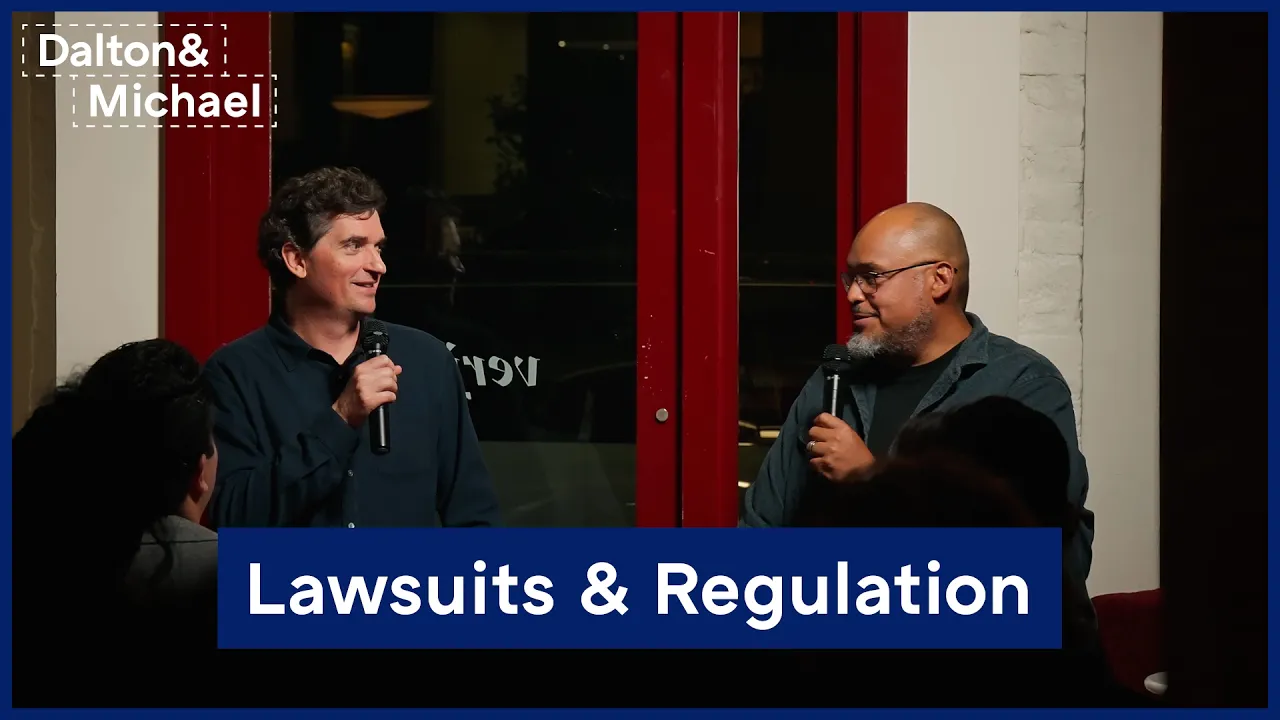
Dalton + Michael · @daltonplusmichael
This video has no Most replayed graph yet: YouTube shows one only once a video has enough views. These are the moments viewers replayed most in Dalton + Michael's most watched videos.
Most replayed moment at 9:40
2.3x that video's typical replay level
a company is winning, you might not understand the value they create for their customers, but don't dismiss it to zero. >> Well, that's the classic thing of um dismissing a product because the design is bad. >> Yeah, man. This HRS looks like crap.
Said at 9:33
Most replayed moment at 9:46
2.1x that video's typical replay level
of founders is, "What do you think is the failure rate for a series B company?" Because like I think in their minds before I ask the question, they think every series B company wins. And then after I ask it, they're like, "I guess mathematically that wouldn't work."
Said at 9:40
Most replayed moment at 14:24
2.8x that video's typical replay level
it is hard to feel like you're working on something where a lot of people think it's a bad idea. That's hard. And I like talking about this because you should brace yourself for that. Like, that is 100% the experience of
Said at 14:17
The graph counts replays. It does not show where viewers stopped watching.
Words
4,064
Runtime
20:44
Speaking pace
196wpm
Reading time
17min
196 words per minute, between the 181 median and the 201 75th percentile of 349 measured videos. That distribution comes from the 349-video hook study.
Opening (first 30 seconds)
I remember being in New York and like it was with Warner Music Group during the litigation and we spent the whole day negotiating and they're like, "Hey, you want to go to the Knicks game tonight?" And so I went to the Knicks game with the people. >> you? >> I don't think they thought it was a big deal. That's how normal that's they were just so used to suing people. They're like, "Oh, you're a good guy. Let's go see the Knicks." >> Hello. Hello. All right. All right. Hello. Our advice on lawsuits and
98 words, the words spoken in the first 30 seconds at 196 words per minute.
Free, no signup. See how the first 30 seconds hold attention, with rewrites.
Sentence shape
| Measure | This transcript |
|---|---|
| Sentences | 284 |
| Average words per sentence | 14.3 |
| Longest sentence | 94 words |
| Questions asked | 45 |
| Sentences containing a number | 10 |
Most used terms
Filler phrases
189 in total: like 116 · um 22 · you know 20 · kind of 7 · right? 6 · uh 6 · actually 5 · basically 5 · literally 2.
A literal whole-word count of the same phrase list the Prepublish browser extension uses, so a phrase inside another word is not counted and a phrase used in its ordinary sense still is. It is a count and not a judgement.
Run the check on the words above: where attention is likely to drop, with a rewrite for each weak line. The free check shows the scores and the one issue costing the most.
What this transcript is
Every word below is the caption track YouTube publishes for this video, pulled from the video itself and reproduced unchanged. It is not Prepublish's writing, not a summary, and not a re-transcription: it is the video's own published captions. English captions, generated automatically by YouTube, in the video’s original language. Source: the video on YouTube. A channel that would rather this page did not exist can ask for its removal through the contact page, and it is removed.
I remember being in New York and like it was with Warner Music Group during the litigation and we spent the whole day negotiating and they're like, "Hey, you want to go to the Knicks game tonight?" And so I went to the Knicks game with the people. >> you? >> I don't think they thought it was a big deal. That's how normal that's they were just so used to suing people. They're like, "Oh, you're a good guy. Let's go see the Knicks." >> Hello.
Hello. All right. All right. Hello. Our advice on lawsuits and regulation and dealing with the government. I think we've got decent credentials on the subject. >> Yeah, you got to tell them what our credentials are. >> Yeah, why why don't you, sir? What are your lawsuit credentials? >> My first company that I started in 2003 was called Imeem and it was a music streaming site and it um And many of my early employees formerly worked at a company called Napster and um not kidding and there's a lot of overlap with the DNA.
It was like the thing after Napster and needless to say we eventually cut deals with the music industry and that's a whole long story. But in the process we definitely were in a lot of litigation and so a lot of my life for a couple of years as a startup founder was uh dealing with that stuff. And so sadly I have credentials here. I represented the other end of the spectrum. So I worked at a company called Twitch and when it started it was called Justin.tv and I remember this moment where someone in Ohio decided to stream the Super Bowl live on our website and I remember watching that part in the beginning that says like this can't be rebroadcasted, retransmitted.
And I'm like watching this on my own website and I was like, Huh. Um >> Michael, to be honest, I I definitely at least once watched the Super Bowl on your website. >> We were pitching a VC and he's like, "Oh, I wanted to go to the Masters." And I was like, "You can just watch it on our website." Did not invest. So in the process we got sued by the UFC, NBC, and then we got called in front of Congress to testify about sports piracy by the major major league baseball. >> It was you?
You had to go in front of Congress to talk about piracy? >> Yeah. >> Oh, man. >> I think maybe what I would start with is what was your experience of being sued and kind of the speed of startups versus the speed of lawsuits? >> The way I would frame this as it pertains to current modern startup advice is the following. New technologies often are encumbered, for better or worse, by laws that were created way before the technologies existed.
And so, dealing with copyright law, there's all this stuff about mechanical reproduction, which was the physical reproduction of records, and that's codified in the law. Again, I I became an expert on this stuff. And trying to translate law that was about physical media to digital media was like totally dumb. I I I don't know. I can use other more colorful terms, but it it it was really hard. And the way I think this is relevant to right now is the attempts to regulate AI.
In addition, a lot of our startups, our portfolio companies, have experienced tremendous change in the regulatory environment over the past few years. Fortunes are being made and lost based on what kind of laws are being passed and the sophistication ability for founders to navigate these things. Um just to throw out a couple of of examples here. Um Anyone here hear of Kashi? You know the company? A few people. So, look, they're they're doing extremely well.
Michael funded them from YC. That's his company. You're on the board or something, right? Michael's on the board of that company, and they basically spent years suing the government. Why don't you tell them Why don't you tell them about >> They only started suing the government recently. I think this is one of the only companies I've ever worked with that is so regulated that they had to have a government strategy pre-product.
And they basically had to get licensed before they could do anything. Counterintuitively, funding two MIT CS kids right out of college where the first thing they have to do is get a license from some Is it >> CFTC >> So, they chose to be regulated by CFTC, right? Is that was it >> Well, they they chose not to go to jail immediately. The fun part of their story is they tried to get a law firm to represent them in applying for this license.
And no law firm would work with them cuz they were like, "You are two MIT kids who are not qualified to do anything." And so, um similar to a lot of companies we funded, I think about the Brex founders, they're like, "We're just going to read the law and fill the paperwork ourselves." And in about a year and a half, they got their license. And then what was really funny is like the law firms that rejected them said, um "When your company fails cuz it's not going to work still, we'll hire you." And they're like, "What do you mean?
Like, we're not lawyers." They're like, "You're fine. Like, we'll just hire you. Like, if you could do this, the legal stuff is not a problem." More recently, during the last election, they were prohibited from listing elections on their prediction marketplace. And so, that's when they sued the government. I was in this great board meeting where they're like, "We want to sue the government." I was like, "I don't even know how to give you advice on this.
You know government stuff. So, good luck." And then they emailed like 2 months later, like, "We won. We get to run elections." And then I'm like, "Okay." And then they did it again to be able to have sports. And so, one of the very, very few cases where I've seen a startup have an offensive legal strategy against the government and uh it's won great. Most of the time, I think people just kind of sulk in the background like us or Airbnb or I think >> low sophistication was more normal back then.
But, the folks that we're seeing that are good at this are higher sophistication on their strategy around this. Um one one of my super recent things is you guys see the new bank that Palmer Lucky started that got a De Novo banking charter? So, the actual CEO of that is a guy I funded at YC. This is his next startup. I can't believe they did it. Again, I would argue this is a different um an example of understanding the regulatory environment and reacting to it quickly because the idea of being able to get a new banking charter to do crypto for all, you know, crypto rails is totally nuts.
Imagine telling your lawyer that a few years ago. >> They would have laughed you out of >> that tried to get a banking license and it took 5 years and they had to buy a small bank. Like a physical bank. And so again, high sophistication founders like the guy that I know that the CEO of it, he was doing a heavily regulated crypto thing before. And so, very high sophistication on this stuff. And so I think that would generally be the advice I would give to founders. >> Would you go so far as to say whereas historically we might have been a little bit more afraid of companies attacking regulation, now we might be more like, "Hey, the government's open for business." >> I think you want to watch out tying yourself too much to any one administration, but in general, high sophistication people taking high risk is often a really good bet.
The higher the sophistication, the more you can take very high risk. >> So maybe let's switch topic. Where do we see founders maybe misunderstanding how to use lawyers or misunderstanding how they get value out of lawsuits. >> Well, okay, there's a few things. Um number one, it is the job of someone in that role to never be wrong. Um I would argue that malpractice is when they tell you that's wrong, right? Therefore, you are always going to get the most cautious advice such that they can't be disproven.
And so often our advice to founders on how to work with lawyers is say what you want to accomplish first. First is asking, "Can I do X?" Do you see how there's a difference? You you want to say I want to do X, what should I be thinking about? Cuz the lawyer will go to you like, "No, don't do it." if you ask for permission. So, that was a $4 million swing in my first company. We were streaming video and we asked our lawyer, "Can we run ads?" And he said, "Absolutely not.
That'd be a violation of the DMCA." We didn't know what that meant, but that sounded really scary. And then I remember we talked to our friends who instead of stealing copyrighted video, they were stealing copyrighted textbooks. And they were running tons of ads and they were profitable. And we were like, "What is going on?" And literally one of the founders was like, "Oh, just ask your lawyers like how to do it." And then and then we asked our lawyer, we're like, "How do we do this?" And the guy was like, "You know, actually, now that I think about it, if you're in trouble, monetizing this content doesn't get you in that much more trouble.
So, go to town." And we were like, "Wow." We clicked a button in that area and made $4 million before. We made $0. Of course, we did get sued, so. But I think we would've gone sued regardless. That is correct. I think num- number two is like in a negotiation, like we I'm we're involved in lots of financings in my in my current role, I'm involved in lots of financings and I have to coach the founders, which is to just tell their lawyers, "Hey, uh we want to we do want to do this deal.
Um Does that make sense? Cuz otherwise they'll just like do lawyer stuff and like, "Oh, here's my red lines. Um And you're going to be like, "No, like just don't please don't do that." And they'll be like, "Okay." There's an extension of this that actually I remember we talked about Nicole and I talked about, which is like your lawyer should know whether you're in a high leverage or low leverage negotiation. And like it's not something that occurred to me.
And like, "Oh, isn't this just like a machine?" It's like, "Well, you know, if you have six term sheets, there's certain things you can ask for. And if you have one verbal, there may be other things you you can't." And so, I think that that was another piece of advice I ended up giving a lot of founders. Like, clue your lawyers in on how much leverage you have, and you might be surprised at the things that they say you could ask for.
And we see YC companies get crazy things in financings, right? Like, absolutely not things. Yeah. >> I think the other vector to think about is understanding what are minor speed bumps on the way to building a good company versus existential issues. This comes up a lot advising companies. So, for instance, if you run certain types of businesses, you're inevitably going to get sued for stuff. Like, if you're running like a DoorDash, you know, there's going to be some litigation.
And um you just have to learn to not freak out about it if you want to run that kind of business. And there's some things where if you if you run into legal issues, it's a real problem, and you got to, you know, financial crime, payroll. Yeah, you're going to go to jail. And so, I I would always try to have founders get sophisticated around understanding how common and how much it's just part of business to deal with certain types of legal friction versus extremes.
Um what something that would happen a lot is sometimes people would get letters from their former employer that were mad that they started a startup. >> Have you >> Do you guys know what I'm saying? And so, they were like, "Oh my god, like, what what's going to happen?" And like, "Yeah, don't worry about it." Generally, they were, you know, empty threats and unenforceable non-compete kind of stuff. And so, a lot of our job was to tell people, "Don't worry about it." But sometimes there were things like financial crimes, where we'd be like, "You should definitely look into this immediately and drop everything." Yeah, and I think founders don't know the difference between those two things at at the beginning. >> Just to extend that, I think that one of the things I realized working at so many companies is how many BizDev deals start with a C&D letter.
A founder will be like, "I'm under threat." Oh god, I got to like put up the defenses. And I'm like, "No, I think they just want to talk to you." And the way they talk to you, and it works. Like, send you a C&D letter. And it's like, it does get your attention. And I I I did office hours literally 2 days ago where, you know, the guy was like, "We know BMW sent us a C&D letter. And like, our lawyers say we can fight." And I'm like, "First of all, you're not going to beat BMW.
But second of all, don't you want them to be a customer?" And and he's like, "Yeah." And I'm like, "Well, this is the game. When you here you go." And he's like, "But they sent us a C&D." And I was like, "No, that that they just want to talk." >> That's just the beginning of the relationship. >> Yeah, they just want to talk. That's fine. Like, they could have just sent you a lawsuit. Like, they sent you a a letter is the least they could do.
And so, I think that comes up so many times. Like, "Oh god, we got this letter. Aren't we fucked?" And No. One other vector for this, too, that I sometimes would say to people in office hours is that a lot of startups, their entire reason for existence is to absorb risk, to absorb legal risk. Um so, to go on a path down memory lane. So, OpenAI was started as part of Y Combinator. It was called Y Combinator Research. And we were part of what that was at that stage in time.
And the genesis by which it was created, this is all public information, was that um Ilya, which is the researcher who was doing all the good work, wanted to build stuff at Google and he was not allowed because of lawyers. And um I actually interviewed him for the job of co-founder of what became OpenAI, believe it or not. And the entire reason he left Google to build it was because he wanted to get away from the lawyers at Google.
And when you think about the ability to actually ship LLMs, you needed to absorb a lot of risk to crawl. Think about all the stuff they crawled without permission. Think about the stuff that they ship that you would never be able to do in dig big tech. And so, the entire industry basically only existed because someone was willing to absorb a great deal of legal risk that their GC would have not allowed at a big tech company.
Now it is a big tech company, hilariously. And so, when you think about it, I think a lot of economic value is created by just warehousing all the risk in these entities. And like, you know, a lot of times it doesn't work, but often that's where most of the value is created. >> Well, I think that's a perfect example because I think the lawyers were right in both cases. >> Totally. >> I think the lawyers at Google were absolutely right saying, "We're if you do what you're about to do." >> It's true. >> And the lawyers at OpenAI were exactly right saying, "Well, what's the worst they can do to you?" And I think that this is where the founders have to understand the risk-reward ratio.
How many founders do you talk to? I talk to so many founders that are making a couple million in revenue. And I swear they sound like they're running public companies with like shareholders and with like a hostile board. They have like, you know, projections down to the quarter cent. And I'm like, "You're on the risk side. You're You're You're not supposed to be safe." And they're like, "Oh, aren't we going to win by being safe?" I'm like, Uh again, if you look, what's the number one app in the App Store right now?
Anyway, Sora. Why is it the number one app in the App Store? Because you can make famous people do embarrassing things. Um they're definitely violating all sorts of name and likeness stuff. And they're going to lock it down, but that's why that's popular. And I think you can view a lot of innovation in technology as basically well-thought-out, calculated risks and being willing to deal with it. Uh last thing I was going to say, this was This was the main reason um my recollection uh from their investors of why YouTube sold to Google is basically Google was willing to deal with all the copyright stuff.
As a standalone company, they weren't able to absorb it. And again, as as humans, aren't you glad YouTube exists? Like I am. Like it's a really cool thing for the world. But the way they got that from zero to one was to absorb some risk, I think is one way to say it, right? And it's easy to forget that that was the entire original usage of the thing. Just like your company, you know, these days it's a whole different medium than what they bootstrapped it off of.
Justin Bieber was on today. >> It's funny cuz I was having this conversation with somebody who was like, you know, Airbnb screwed up their whole like legal thing. And I was like, "It's an interesting interpretation of what happened, right? You know, certainly Airbnb's relationships with cities could be better. But like on average, I would say that worked. And I would say that like having the insight that helping people in the city or anywhere make money from their property was probably a good play and that the regulations would probably end up changing or allowing it if they helped enough people.
And I kind of feel like Uber was same way. It's like if we help enough people, the regulations can change. I think so many times when I talk to founders, they assume that these laws are like written like in the Bible and you know, judgment will be passed down in the form of death. And they don't realize that it's just the guidelines we've all come up with to try to explain how we should deal with the world that used to exist.
And like that's it. It's the best we can do. There's no sacredness from man-made laws. Um they're not sacred at all. And um whereas as opposed to like if your startup hurts people, that's bad. Like even if there's no law about it. Like it's really bad. So I think I find when founders are on the fence, I often ask them like, are they making people's lives better? Are they are they helping people? And then I I'm way more push them on the risk side.
And like when they're not helping people I'm like why are you even doing this? Like why are we debating the law? Before we wrap up, do you have any funny lawsuit stories you want to share? Like stories that at the time made you want to die but in hindsight over 10 years later you can laugh at. >> I remember being in New York and like it was with Warner Music Group during the litigation. And we spent the whole day negotiating and they're like, "Hey, you want to go to the Knicks game tonight?" And so I went to the Knicks game with the people who were suing me. >> I don't think they thought it was a big deal.
That's how normal that's they were just so used to suing people. They're like, "Oh, you're a good guy. Let's go see the Knicks." How about you, man? >> It was 20 days before the Beijing Summer Olympics and NBC had spent don't quote me on this but I think it was like 9 billion dollars for the online streaming rights or something. I got a phone call on a Friday on my cell phone and this extremely polite woman was like, "I'm the outside counsel for NBC and we're going to go to court on Monday and have the judge shut your website down for the entire time of the Olympics and I'm just calling to let you know." Which is I think is like and it's super polite.
It was like it was it was a great and I'm to be honest, I'm really happy she called. And so you know, we had copyrighted site content on our site for a while and we would have had the Olympics for sure. I I remember being like one, no copyright owner has ever asked us for anything in this way. Like this is a very motivational ask. You know, everyone's sending us letters, we're ignoring that So I said, "Hey, is there anything we could do so you won't shut our website down and kill our company on Monday?" And she's like, "You know, I don't even want to say it cuz if you you couldn't ever do anything like this over a weekend.
I was like, just try us. She's like, well, if you built us a whole separate website where we could have our team of 100 people who are monitoring sites all over the internet have access to every one of your live streams and can one click file a DMCA takedown and in real time that stream will be taken over and if they could have usernames and passwords and the legal team could get every single one of those DMCA filings and if you could have that by Sunday, we might consider not shutting your website down on Monday.
And I was like, you know what I thought? I was like, that's actually not that hard. It's way harder to stream all the Olympics to the whole world than it is to build that website. And so I said, okay, what number can I call you on the Sunday? And she gave me a phone number. And then I went to the team who was like getting ready to go into the weekend and I was like, guess what we're going to work on. We built this whole thing for them.
I called her on Saturday and Sunday showed her how to use it. She never called back. She never said we're not going to sue you. She just kind of ghosted me and we lived. And it was great. Good work, Mike McDowell. Best lawyer I've ever interacted with. With that, thank you so much. This is a lot of fun. Thanks, everybody.
The words are the caption track's own and nothing is reworded or re-transcribed. Paragraph breaks are placed between sentences so the text reads as prose.
Free tools for your own script: paste a draft and see where it stands before you record it.
Paste your draft and see where viewers are likely to drop off, with a rewrite for each weak line.
Paste the first 30 seconds of your own draft for a hook score and rewrites.
Check your draft against YouTube's advertiser-friendly guidelines before you record it.
Read this channel's public videos and transcripts, and download a writing brief for it.