Getting the transcript
Reading the captions from YouTube. A video nobody has opened here before takes 10 to 30 seconds; this page fills in on its own.
Getting the transcript
Reading the captions from YouTube. A video nobody has opened here before takes 10 to 30 seconds; this page fills in on its own.
vidIQ · @vidIQ
This video has no Most replayed graph yet: YouTube shows one only once a video has enough views. These are the moments viewers replayed most in vidIQ's most watched videos.
Most replayed moment at 23:09
3.7x that video's typical replay level
opens up a web app tool from VidIQ all about the search terms related to your channel where there are opportunities. This is high search terms on YouTube with low video supply and that means that you can create content that fills
Said at 23:01
Most replayed moment at 10:24
6.4x that video's typical replay level
niche rates your paycheck, not your view count. A 100,000 finance video can actually out earn a 2 million view fact video. So, pick a niche that pays and build something of your own, a product, a list, a brand, all before you need it. And speaking of monetization, rather
Said at 10:16
Most replayed moment at 7:19
5.7x that video's typical replay level
tried a whole bunch of different things, meditation, uh gone to the doctor, medications, uh all sorts of things, and nothing really works. And so, I was on YouTube watching some physics lectures, and I was learning so much, and I was loving it, but I noticed that I kept falling
Said at 7:12
The graph counts replays. It does not show where viewers stopped watching.
Words
2,200
Runtime
11:35
Speaking pace
190wpm
Reading time
9min
190 words per minute, between the 181 median and the 201 75th percentile of 349 measured videos. That distribution comes from the 349-video hook study.
Opening (first 30 seconds)
So, I'm finding videos on YouTube right now that are getting 5, 10, even 100 times more views than normal. And rather excitingly, I've discovered what they all have in common so that you can trigger the same results on your channel. Oh, and do make sure to stick around for the final rule because this is the easiest one for small channels to copyright. Oh, now I'm able to discover all of these videos thanks to VidIQ over here. Think of it a bit like a sniffer dog at an airport, except for instead
95 words, the words spoken in the first 30 seconds at 190 words per minute.
Free, no signup. See how the first 30 seconds hold attention, with rewrites.
Sentence shape
| Measure | This transcript |
|---|---|
| Sentences | 151 |
| Average words per sentence | 14.6 |
| Longest sentence | 36 words |
| Questions asked | 6 |
| Sentences containing a number | 12 |
Most used terms
Filler phrases
17 in total: like 11 · actually 3 · literally 1 · sort of 1 · you know 1.
A literal whole-word count of the same phrase list the Prepublish browser extension uses, so a phrase inside another word is not counted and a phrase used in its ordinary sense still is. It is a count and not a judgement.
Free, no account. See where attention is likely to drop, with a rewrite for each weak line. The free check shows the scores and the one issue costing the most. Or run it on the words above first.
Free · No login · See a sample audit first if you prefer.
What this transcript is
Every word below is the caption track YouTube publishes for this video, pulled from the video itself and reproduced unchanged. It is not Prepublish's writing, not a summary, and not a re-transcription: it is the video's own published captions. English captions, generated automatically by YouTube, in the video’s original language. Source: the video on YouTube. A channel that would rather this page did not exist can ask for its removal through the contact page, and it is removed.
So, I'm finding videos on YouTube right now that are getting 5, 10, even 100 times more views than normal. And rather excitingly, I've discovered what they all have in common so that you can trigger the same results on your channel. Oh, and do make sure to stick around for the final rule because this is the easiest one for small channels to copyright. Oh, now I'm able to discover all of these videos thanks to VidIQ over here.
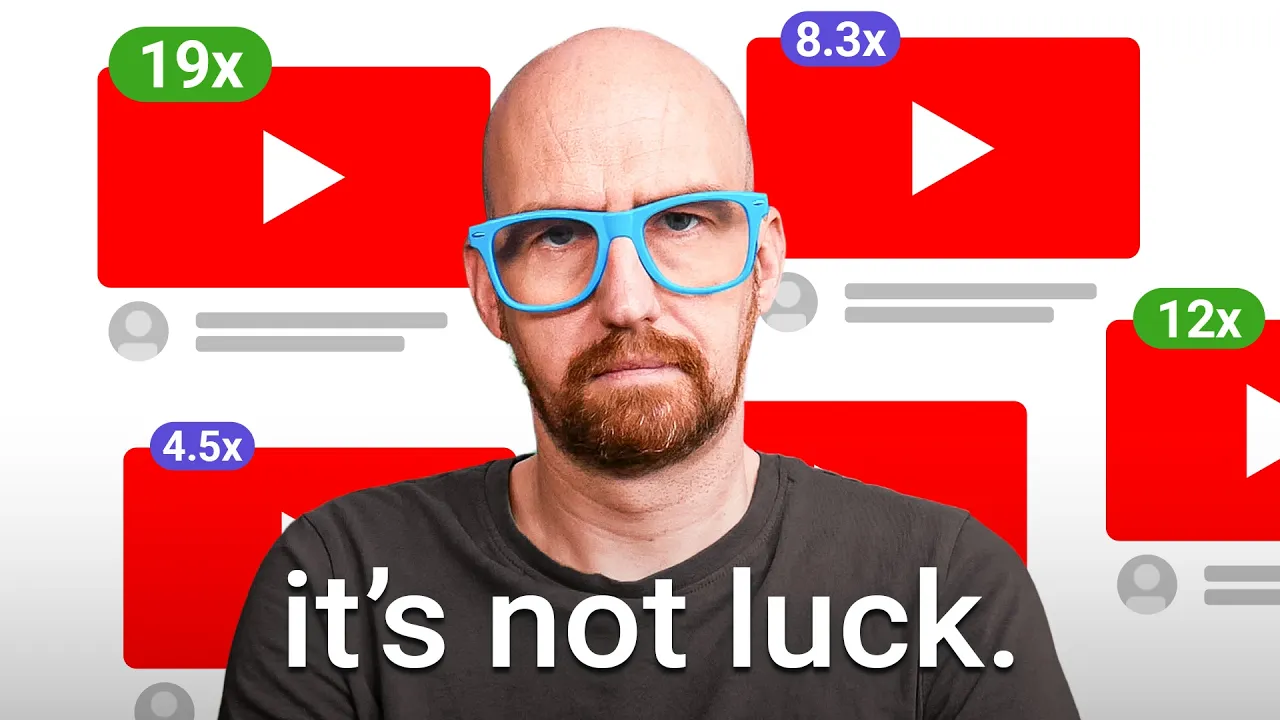
Think of it a bit like a sniffer dog at an airport, except for instead of contraband, it's hunting down viral videos. Now, I wanted to call this feature tail waggers, but branding intervened. So, instead we've called them video outliers. It's a number that sits under the thumbnail next to the title and tells you how well the video performed against the channel's average. The higher the number, the better. It is free to use, the link is here.
Happy researching. Now, I've studied hundreds of these videos from all sorts of niches. Cooking, finance, gaming, travel, even a man passionately ranking toilets. Naturally, that was a 100 times outlier. Channels with 200 subscribers all the way up to 2 million hunting for the same thing they all share, outlier success. But here is the intriguing and somewhat slightly uncomfortable part of it all. The most successful videos I found had little to do with the camera they used, the amount of editing the videos had, or how often they posted.
The first couple of seconds on a video operate on a short list of rules that barely change from niche to niche. So, it's pretty simple. Learn these rules and you'll never have to guess how successful videos work ever again. So, let's start with rule number one. Recognition beats novelty. I want you to picture the classic YouTube homepage. Thumbnails and titles galore, and yet your brain is able to process all of it within a matter of seconds.
It's a bit like speed dating for content. >> Hey guys, welcome to my channel. Don't forget to like and subscribe. In this video >> Nope. And that's because despite the time, effort, and pain you as a creator went through making those thumbnails and titles, the viewers aren't really assessing the packaging in any sort of detail. Instead, what viewers are typically doing is pattern matching, Hunting for something that they recognize and they trust.
And anything that does match earns a brief moment of attention. In essence, a format that the viewer has never seen before feels like a risk. But, a format they've watched a hundred times over, a tier list, a blind taste test, a 30-day challenge, those all feel safe to the viewer before they've even needed a moment to think about anything. It's why I'm currently on episode 251 of History of World War II. The Allies have just invaded Normandy.
It's getting pretty intense. Now, psychologists, yeah, you knew boffins were going to get involved at some point, call this the mere exposure effect. Repetition breeds preference. The more we feel something is familiar, the more we like it. I should add that this is not a flaw of the viewer, by the way. It is merely the default factory setting of every brain that visits YouTube. In fact, it's the same default setting that compels some users to comment first for no reason whatsoever.
So, here is the tactical maneuver for more views and it's called the outlier method. I wanted to call it poodle fetch, but that was my second argument with the marketing team, which I also lost. Anyway, for the outlier method, you don't dream up a new video format. Instead, you go out and find a video that's performing well above everything around it and then pour your topic into that pre-made mold. Let me show you a really simple and obvious example.
Family at Sea is a small YouTube channel that vlogs about cruises. Most of their videos do a few thousand views, which is very respectable. But then, what they did is borrow a video format that has nothing to do with cruising, but everything to do with YouTube culture. Ranking things from worst to best. That video pulled in over 175,000 views, almost 10 times their typical average. It is the same channel with the same cruises, but the ranking format was the doorway, one that audiences already knew how to walk through and understand.
So, a recognizable format can earn the click, but holding onto that click is an entirely different challenge. And it starts the instant the viewer opens a video. Open a loop the viewer has to close. Watch how many videos on YouTube start with something like, "In today's video, I'm going to show you how to break down a budget." Which is perfectly reasonable, but potentially fatal. The moment the human brain knows what's coming, it loses a pretty big reason to keep on watching.
So, the alternative is to always leave something unfinished in a video. There's a quirk of memory which is called, and I'm still going to pronounce this wrong, the Zeigarnik [music] effect. We can't stop thinking about a task that we haven't yet completed. This effect is literally the reason I put my life on pause for 34 hours and 48 minutes the moment I started playing Lego Batman. Those damn percentages get me every time.
An unanswered question or open loop is like an itch that must be scratched, and yet you are not in control of when that happens. The video is. Raise a question worth closing and stall the answer. Let me introduce you to Barry's Economics. It's a UK YouTube channel where Barry, a comedian, explains economics. Right now, we are living through the most documented era of success advice in the history of the human race. Why do I feel like I'm being directly called out here?
Now, he put out a video recently titled Diary of a CEO is making you less successful. And here's the thing, the video doesn't give you an immediate answer as to why that is. It simply opens up a curiosity loop. How can something be so popular that's trusted by millions of people actually be making me less successful? So, you the viewer have to click on it to effectively get the answer. The video has now done over a million views, which is eight times the channel's normal average.
In the weeks leading up to the release of that video, the channel had cooled off somewhat and was doing 130 subscribers a day. But, on the day that video was released, 7,000 subscribers in a single day, 35,000 subscribers over the next couple of weeks. So, raise a question in your title and the opening sentence of a video when it starts. If you execute well enough on those two things, the viewer will be locked in until the answer is paid off.
But, in saying that, the sharpest video hooks do more than just dangle a question. They hint at a bigger one that the viewer never says out loud. Who could I become if I stay? Nobody subscribes to a topic. They subscribe to a version of themselves. And the version of you, right now, wants to get more views. And so, yeah, most channels never get beyond the topic itself. For example, a finance channel might make how-to videos about spreadsheets.
But, does anybody wake up in the morning desperately needing spreadsheets in their lives? What they actually want is a result of what those spreadsheets can do for them. For example, taking control of their own finances. So, there is one question worth asking about every single video that you make. Who does the viewer get to become if they watch the video until the end? you to take a look at how this channel, Laura BC, framed that idea.
She is a creator who used to live in the UK and then moved to Bali. Now, the video of this event on her channel titled along the lines of what are the living costs in Bali or how to move to another country. To be honest, those are the educational, sterile versions of this content. Instead, she went with I left London for Bali alone 2 years ago. This is my life now. And so, obviously, you as a viewer are not going to click on that to learn the logistics of it.
Instead, you're clicking on it for the emotions that it conjures up. You're clicking on it because some part of you wants to be that person in the video. >> going to tell you my very honest experience because there are so many things people don't tell you. My life has changed like crazy. I've changed as a person in ways I didn't expect it. >> That's a video. It is the same underlying topic, moving abroad, but it is now sold as an identity.
And again, just like the other examples we've already explored, this was a great outlier for that channel. A video that's got nearly 10 times what they will typically expect from a video on their channel. When the videos start to reflect who the audience wants to be, they no longer feel like viewers. They feel as if they're the main character in the video. And so, representing that identity earns the viewers attention.
But, as we all know, attention is fleeting and fragile. The next thing the viewer has to decide is whether you are worth trusting. In the first few seconds of a video, especially if it's a new channel, there is a question silently running through the viewer's mind. Why should I give my precious time to this person and their video? Now, if you, the creator, do not answer this question fast, the viewer subconsciously will, and it's typically no reason and abandon the video.
So, the fix to this is a shortcut the brain is built to take. Now, again, we're back to the psychologists and they have a name for this. It's called authority bias. Often, and especially when it comes to YouTube videos, viewers do not independently verify whether someone is worth listening to. Instead, what we tend to do is scan for competence. Now, this might be a number, a result, or a track record. For example, it might be mentioning in the first 20 seconds of a video that I've shot over 300 weddings or I've worked 12 years in a Michelin star kitchen.
And what the brain does is read these signals, tag the person as worth the risk, and then settles into the video. And this isn't a trick if what you say as the creator and the expert in this field is true. And you can watch this happen in real time with this channel. Chad Kubanoff is a US food blogger and one of his most recent videos on his channel is a real chef takes over a street food cart. >> So if you don't know, I used to have a restaurant in Philadelphia called Same Same, where we were very famous for our caramelized pork sandwich.
Today, we are taking the banh mi that was born on the streets of Philly and we're bringing it here to the streets of Saigon. >> So the entire hook of this video is in the credential a real chef. They were dropped into a humble setting and a title even teases that the credentials were the point of the video. People noticed. Now this creator has made well over a thousand videos on his channel already. But this time, he led with a very reason to trust his content.
It's the same creator on the same daily grind. What changed was putting the credibility first instead of not mention it at all. That is four, count them, four strategies outlier videos have in common. And again, notice what's not on this list. Fancy video equipment, posting every single day, and that fabled YouTube excuse. Look, [music] the examples I've shown you today are from very different topics from very different channel sizes.
But what moved every single one of them was how the videos connected with the viewer's brain >> [music] >> more than what the topic was about. And that is quite a critical distinction to make. You're not really competing on the topic of the video. You're actually competing on how well you know the viewer who is browsing through this topic. And you don't have to guess who's already winning in your niche. This is what the outlier method comes down to and VidIQ hands it over to you with the outlier tool.
But all of this is just one of the many strategic rules that have changed and evolved in this modern YouTube world. So if you want to have and maintain that competitive edge that helps you grow your YouTube channel, then check out this video where we have even more new rules of YouTube. I'll see you in there.
The words are the caption track's own and nothing is reworded or re-transcribed. Paragraph breaks are placed between sentences so the text reads as prose.
Free tools for your own script: paste a draft and see where it stands before you record it.
Paste your draft and see where viewers are likely to drop off, with a rewrite for each weak line.
Paste the first 30 seconds of your own draft for a hook score and rewrites.
Check your draft against YouTube's advertiser-friendly guidelines before you record it.
Read this channel's public videos and transcripts, and download a writing brief for it.