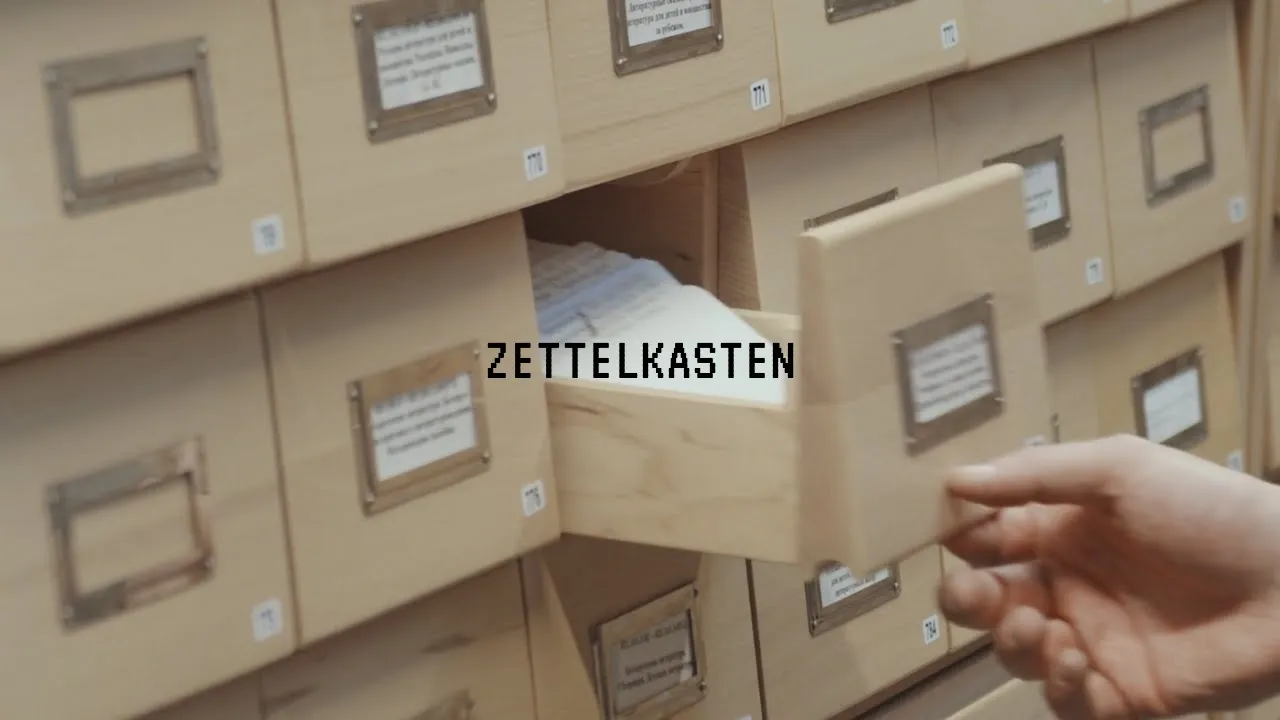
Zettelkasten Method Explained: A Beginner's Guide transcript
Vicky Zhao · @VickyZhaoBEEAMP
Words
1,658
Runtime
9:21
Speaking pace
177wpm
Reading time
7min
177 words per minute, between the 160 25th percentile and the 181 median of 349 measured videos. That distribution comes from the 349-video hook study.
Opening (first 30 seconds)
Let's talk about Zettelkasten. This is the efficient note-taking system that is going to help any knowledge worker out there leverage what they already know and learn new information, and be able to see the connection between the two. Hi, everyone, it's Vicky. Welcome back to my channel. If you're new here, I talk about mental models and frameworks for clear thinking and clear communications. So let's go into what is Zettelkasten, how do we use it, and what benefits you'll get out of this! What is Zettelkasten? First,
89 words, the words spoken in the first 30 seconds at 177 words per minute.
Sentence shape
| Measure | This transcript |
|---|---|
| Sentences | 103 |
| Average words per sentence | 16.1 |
| Longest sentence | 48 words |
| Questions asked | 5 |
| Sentences containing a number | 9 |
Most used terms
- notes35
- zettelkasten16
- ideas15
- note12
- literature11
- fleeting10
- literature notes10
- permanent10
- idea9
- system9
- box8
- fleeting notes8
Filler phrases
8 in total: actually 4 · like 2 · I mean 1 · you know 1.
A literal whole-word count of the same phrase list the Prepublish browser extension uses, so a phrase inside another word is not counted and a phrase used in its ordinary sense still is. It is a count and not a judgement.
What this transcript is
Every word below is the caption track YouTube publishes for this video, pulled from the video itself and reproduced unchanged. It is not Prepublish's writing, not a summary, and not a re-transcription: it is the video's own published captions. English captions, published by the channel, in the video’s original language. Source: the video on YouTube. A channel that would rather this page did not exist can ask for its removal through the contact page, and it is removed.
Transcript
Let's talk about Zettelkasten. This is the efficient note-taking system that is going to help any knowledge worker out there leverage what they already know and learn new information, and be able to see the connection between the two. Hi, everyone, it's Vicky. Welcome back to my channel. If you're new here, I talk about mental models and frameworks for clear thinking and clear communications. So let's go into what is Zettelkasten, how do we use it, and what benefits you'll get out of this!
What is Zettelkasten? First, Zettelkasten means slip box in German. Zettel is slip, which usually refers to a slip of paper or index card, and Kasten means crate, which is like a box that you put the index cards in. Niklas Luhmann, a German sociologist, used this unique note-taking system in order to track all his research and to be able to produce 70 books and hundreds of articles in just 30 plus years. That's an average of more than two books a year, as well as all the academic articles.
So how did he do this? It's with the Zettelkasten method, and the method is very simple. All you need are 3 things: you need a Zettel, which is the pieces of paper. You need Kasten, which is the box or the crate, and then you just need a pen. Of course, this is the analog version of Zettelkasten, and I'll share with you the digital version of it as well. But let's start from the basics of how Luhmann did it. 3 Types of Zettel (notes) There are three types of Zettel, three types of notes.
They are fleeting notes, literature notes, and permanent notes. First, fleeting notes. These are the thoughts that come through our head as we go on our daily lives, whether it's shower thoughts, thoughts that you have when you're taking a long walk, when you're talking to friends and all of a sudden you have an epiphany. These are thoughts that disappear very quickly, so we must capture them first. The second type of notes are literature notes.
This is what we write down when we are consuming content, whether it's reading a book or an article, listening to a podcast, watching a YouTube video, watching a movie, listening to songs, it doesn't matter what it is. When you're consuming content, you want to write down literature notes, and these capture: 1. one atomic idea each. So it has to be brief, no more than three to five sentences. 2. It also has to be re-described in your own words so that you internalize what is being said. 3.
You also want to be able to note down the references so you know exactly where it came from, and you can always go back to reference it. So now we have fleeting notes from everyday life. We have literature notes from when we consume content and when we are learning. Then the third type of notes are permanent notes. We create permanent notes by reviewing what we have written in fleeting notes and in our literature notes.
So the input is the literature notes and the fleeting thoughts they've had, and the output is the permanent note. As researcher Sankar Ahrens says, the productivity of a knowledge worker should be tracked by how many permanent notes you produce a day and the rules for writing a permanent note are: 1. One atomic idea per note. 2. Express the idea clearly, assuming the reader does not have context. 3. Connect them with the other notes in your system.
The rationale behind these rules is simple. First, you want one idea per note because these are building blocks. Each note is a building block where you can rearrange and connect with new ideas, old ideas, things that seemingly are not connected. So you want to be able to remove complexity and be able to rearrange these ideas. Then you want to assume that the reader doesn't have any context, and this is because you are trying to make the system future-proof.
I'm sure this has happened to so many of us where in the moment we jot something down thinking, I know exactly what I'm saying, and the next day you go back to this note and you have no idea what you wrote. So to avoid that and to be able to articulate your ideas properly, we want to make sure that it is expressed clearly without needing a lot of context. So that not only your current self can use this, future self can use this as well.
And then, we want to connect them within the system. And this is really where the crux of the Zettelkasten method comes in. The connections is what makes your knowledge usable. I'm sure most of us have this experience in school where we have all these isolated ideas that we've memorized, but we don't know how to use them We don't know how to piece them together. What is the bigger picture here? And so the Zettelkasten method, it really is to help you think about the big picture and to see the interconnections between different ideas and how they may relate to each other.
Setting up Kasten (boxes) Which brings us to the next point of how to set up the boxes. The Kasten of the Zettelkasten. The way Luhmann set this up was using only two boxes or two kastens. The first one is reference, which had all of his literature notes categorized by a unique ID, and the other box is ideas, which stored all the permanent notes that were based on the literature notes, as well as fleeting notes. Now, the fleeting notes weren't actually categorized.
Instead, what you would do is review it on a regular basis with the literature notes and then, if appropriate, he would elevate it to a permanent note. Why Zettelkasten? The most important aspect of Zettelkasten is that it is not a top-down organizing system. So what I mean by that is, we don't create folders named psychology, sociology, math, science, and then we try to slot our notes into the categories. We're not trying to force our ideas into a folder.
Instead, it's a bottom-up approach where we have all the notes and we keep them there. And over time, we try to see what comes out of these notes, elevating our original ideas into permanent notes, which dictate what topic they are, what the ideas are about. This way, you can have more of a multidisciplinary approach. You can see connections, intersections between ideas without abstractly limiting yourself by putting things into folders.
I'm a huge proponent of intersectional thinking - this idea that the connection between ideas, the intersection, is where creativity happens is where innovation happens. It's where we realize how the world actually works. And that's why Zettelkasten for me is a really important system. Customizing your Zettelkasten Now, I want to caveat by saying that the way Luhmann set up his Zettelkasten might not make sense to you per se.
Depending on how you think, you might need to tweak things a little bit. For example, with the boxes, some people actually prefer to just have one box to put all ideas in: fleeting notes, literature notes, and permanent notes all into one place, and because they are digitized it, it is easier for them to go in and search for things. For others, it might be chronological. That they think in time. So they think, OK, last week I had this idea and I think it connects to my idea now.
And so instead, they would organize things by time. Or if you're a spatial thinker, I am one of those, I need to think about things in, OK, this is the fleeting note box. This is the literature box. And this is my ideas box. And to be able to know which idea belongs where, and I know exactly how to retrieve them and how to connect them together. So there's a lot of flexibility in Luhmann's system because it is so simple.
If you're interested, I walk through my setup of Zettelkasten in Obsidian. I actually write a lot of my notes by hand, so I'll also show you how you can digitize your notes so you can still have everything in one place and also how to sync it between different devices. Because as I've talked about, fleeting notes are the ones that you need to capture immediately. And sometimes all you have is your phone, but you do most of your note-taking on your computer.
So how do you sync things between devices? I'll cover all of that in this video here. Let me know in the comments if you're currently using Zettelkasten, or if you're getting into it now, or if you're still on the fence. Because ever since I started this, my creativity has increased, my productivity has increased. It's so much easier for me to write my newsletter on intersectional thinking, so much easier to produce YouTube content.
I have a huge list of things I want to write about, talk about, and the best part is that you can start anywhere and over time you have that satisfaction of seeing ideas emerge, especially if you're using Obsidian like I am, in the graph. It will visually show you what the connections are and that is so powerful. Not something that my measly mind can come up with by itself. So if you're not building a second brain, you should really consider it.
And with that, if you found this video helpful, please give it a thumbs up. Subscribe if you haven't already. I'll talk about more of how to create your personal knowledge management system in the future videos. So stay tuned for that and I'll see you in the next video. Bye!
The words are the caption track's own and nothing is reworded or re-transcribed. Paragraph breaks are placed between sentences so the text reads as prose.
Use this transcript
Three free tools that work on the material around a video like this one. No signup, no login.
Hook Analyzer
Paste the first 30 seconds of your own draft for a hook score and rewrites.
Policy Pre-Flight
Check your draft against YouTube's advertiser-friendly guidelines before you record it.
Channel Skill Generator
Read this channel's public videos and transcripts, and download a writing brief for it.