Getting the transcript
Reading the captions from YouTube. A video nobody has opened here before takes 10 to 30 seconds; this page fills in on its own.
Getting the transcript
Reading the captions from YouTube. A video nobody has opened here before takes 10 to 30 seconds; this page fills in on its own.
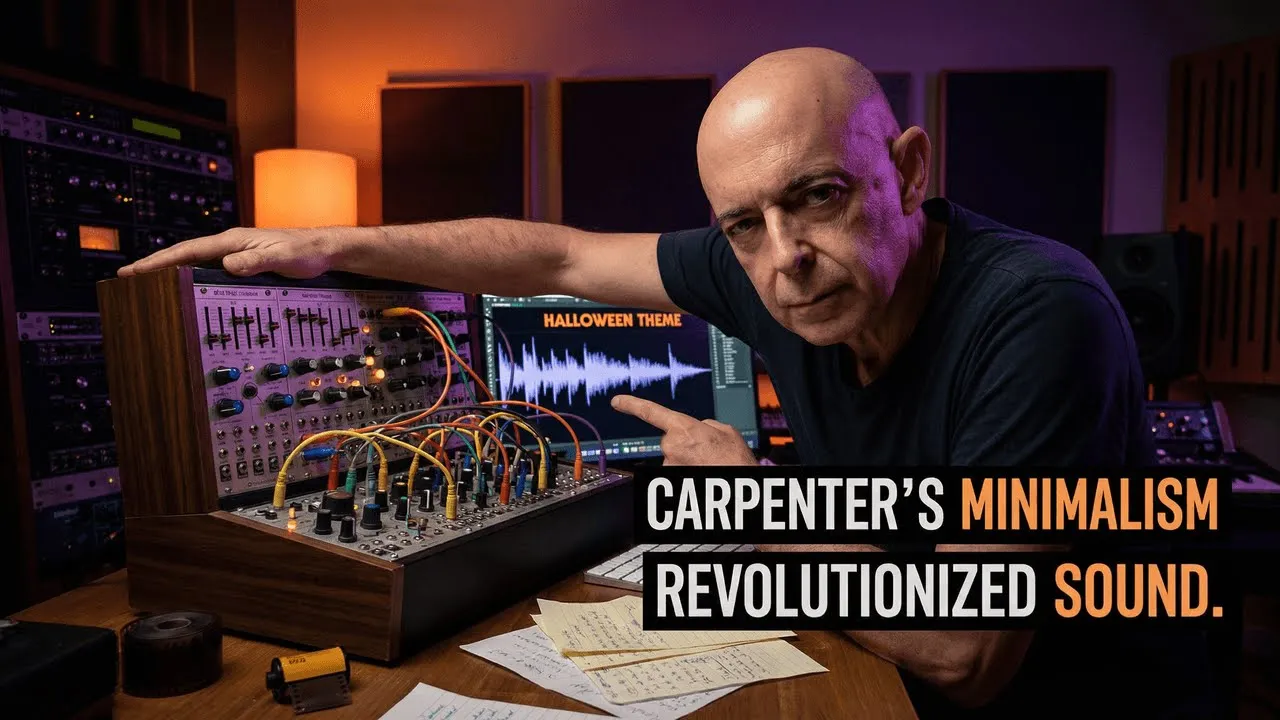
Sir Joe - The Nostalgic Futurist · @TheNostalgicFuturist
Words
1,052
Runtime
8:26
Speaking pace
125wpm
Reading time
4min
125 words per minute, below the 160 25th percentile of 349 measured videos. That distribution comes from the 349-video hook study.
Opening (first 30 seconds)
Everyone knows this sound, but very few know that it wasn't born from a brilliant artistic vision. It was born from panic. John Carpenter didn't sit down to invent a new genre. He was just trying to save a be movie that without music wasn't scary at all. One of the most influential sounds in electronic music history didn't come from a state-of-the-art
63 words, the words spoken in the first 30 seconds at 125 words per minute.
Free, no signup. See how the first 30 seconds hold attention, with rewrites.
Sentence shape
| Measure | This transcript |
|---|---|
| Sentences | 99 |
| Average words per sentence | 10.6 |
| Longest sentence | 39 words |
| Questions asked | 4 |
| Sentences containing a number | 6 |
Most used terms
Filler phrases
11 in total: like 8 · kind of 2 · actually 1.
A literal whole-word count of the same phrase list the Prepublish browser extension uses, so a phrase inside another word is not counted and a phrase used in its ordinary sense still is. It is a count and not a judgement.
Free, no account. See where attention is likely to drop, with a rewrite for each weak line. The free check shows the scores and the one issue costing the most. Or run it on the words above first.
Free · No login · See a sample audit first if you prefer.
What this transcript is
Every word below is the caption track YouTube publishes for this video, pulled from the video itself and reproduced unchanged. It is not Prepublish's writing, not a summary, and not a re-transcription: it is the video's own published captions. English captions, generated automatically by YouTube, in the video’s original language. Source: the video on YouTube. A channel that would rather this page did not exist can ask for its removal through the contact page, and it is removed.
No Script X-ray for this video: YouTube shows a Most replayed graph only once a video has enough views.
Everyone knows this sound, but very few know that it wasn't born from a brilliant artistic vision. It was born from panic. John Carpenter didn't sit down to invent a new genre. He was just trying to save a be movie that without music wasn't scary at all. One of the most influential sounds in electronic music history didn't come from a state-of-the-art studio. It came from a man with no money, no time, and absolutely no other options.
[music] To understand why this simple tone was so radical, you have to understand the world that Carpenter was living in. Before Halloween, electronic horror usually sounded like science fiction. It was the alien beeps and boobs of movies like Forbidden Planet. It was abstract, experimental, [music] distant. But in Europe, something very different was happening. Carpenter deeply admired the Italian horror scene, especially the films of Dario Arento.
And that meant one thing, Goblin. Just one year before Halloween, Goblin scored Dario Arento's Susperia. It was a masterpiece. complex, tribal, layered, a wall of sound designed to overwhelm you with sheer power. Goblin proved that an electronic nonchestral score could create pure cinematic dread and showed that the old rules were broken. But Carpenter [music] had a problem. He didn't have a band. He didn't have a studio full of session musicians. and he definitely didn't have the budget to create a barack maximalist soundtrack like Susperia.
He had to take that idea of relentless hypnotic dread and strip it down to the bone where Goblin added layers to create fear. Carpenter had to remove them. He took the maximalism of 70s Prague rock and almost by accident invented a new kind of minimalism. The budget for Halloween was around $300,000. The movie wasn't working. There was no money for an orchestra. So, Carpenter sat down with Dan Wyman, a professor at USC, in a room full of early synthesizers, massive walls of knobs, patch cables, and unstable oscillators.
He had three days. In a normal film production, you can spend three days just to get the drum sound right. But Carpenter had three days to score an entire movie. And this limitation dictated the style. He couldn't write complex core changes that required weeks of orchestration. And he couldn't program long, intricate sequences either because the technology was primitive, slow, and unreliable. He needed something he could play live, something he could record in one or two tapes.
He needed a pattern. The synthesizer wasn't chosen because it was the instrument of the future, but because it was the only instrument that could sound big enough to fill a theater while being played by just one guy in a small room. [music] Now, let's look under the hood. Why does this simple sequence work? So, well, [music] it's the time signature. The main Halloween theme is in 54, while most pop music and most comforting music is in 44. 1 2 3 4.
It's a square. It's stable. Your body knows exactly where the next beat will fall. 54 is different. [music] It's unstable. It keeps you slightly off balance. Count it. [music] One, two, three, four, five. One, two, three, four, five. [music] Human brain is a prediction machine. It constantly tries to guess the next beat, the next [music] pattern. When you hear a five or four rhythm, your brain expects the loop to resolve in four.
And that extra step forces a tiny reset every bar. The loop restarts before your brain is comfortable. And this creates a subtle subconscious anxiety. You might not be able to explain it, but you feel it. This is why the Halloween theme doesn't just sound like music. It feels like a warning. While an orchestra tries to manipulate your emotions with big swelling strings, this pulse behaves like a machine. It doesn't care if you're scared.
It doesn't react to you. It just keeps going. And that emotional indifference is exactly what makes Michael Myers so terrifying. He doesn't speed up. He doesn't slow down. He doesn't bargain. And the music mirrors that cold, relentless, mechanical. [music] And here is the twist. That cheap sound didn't stay trapped inside the horror genre. It escaped. When producers and young musicians saw the success of Halloween, a crucial idea took root.
You didn't need an orchestra or a giant studio or a massive budget. An entire commercially viable project could rest on the raw emotional impact of a few simple electronic sounds. This was the real spark. Halloween [music] didn't just scare audiences. It legitimized the synthesizer as a lead emotional instrument in popular culture. The synth was no longer just a science fiction sound effect box. It became the center of the narrative.
And this was a huge shift. It was the democratization of production. The same freedom born from Carpenters's [music] desperation is what allowed artists like Gary Newman, Depes Mode and the Human League to emerge. They took that cold mechanical pulse and gave it a melody. They kept the emotional power of those simple electronic textures but pointed them at the dance floor instead of the knife. So while the exact 54 rhythm of Halloween stayed mostly in the realm of suspense and horror, the texture of that sound that row icy synthesizer cutting through the mix became one of the defining colors of the 80s.
The tools of fear became the tools of euphoria. You might think the story ends there, but this creates a paradox we are still living in today. We now have unlimited plugins, unlimited tracks, unlimited time, and yet modern music often struggles to find this kind of row identity. Carpenter proved something uncomfortable. The wrong gear often creates the right sound and panic is a better producer than perfectionism. He didn't succeed despite the limitations.
He succeeded because of them. So this forces us to ask a difficult question about the music we listen to right now. Who is actually brave enough to work like this today? Is it the Stranger Things composers? Or is the real innovation hiding deeper in the underground? Tell me in the comments who you think carries this torch best. And remember, if you're waiting for the perfect gear to make your masterpiece, you are missing the point.
The words are the caption track's own and nothing is reworded or re-transcribed. Paragraph breaks are placed between sentences so the text reads as prose.
Free tools for your own script: paste a draft and see where it stands before you record it.
Paste your draft and see where viewers are likely to drop off, with a rewrite for each weak line.
Paste the first 30 seconds of your own draft for a hook score and rewrites.
Check your draft against YouTube's advertiser-friendly guidelines before you record it.
Read this channel's public videos and transcripts, and download a writing brief for it.