Getting the transcript
Reading the captions from YouTube. A video nobody has opened here before takes 10 to 30 seconds; this page fills in on its own.
Getting the transcript
Reading the captions from YouTube. A video nobody has opened here before takes 10 to 30 seconds; this page fills in on its own.
Sharbel A. · @sharbelxyz
This video has no Most replayed graph yet: YouTube shows one only once a video has enough views. These are the moments viewers replayed most in Sharbel A.'s most watched videos.
Most replayed moment at 13:32
3.9x that video's typical replay level
built-in memory, which is great. Here is how I would think about memory providers. Memo is interesting if you want a dedicated memory layer for personalized AI agents. It focuses on extracting, storing, linking, and retrieving memories efficiently. Their
Said at 13:25
Most replayed moment at 6:37
5.8x that video's typical replay level
trading strategy. Tests it. If it's better, it keeps it. If it's worse, it discards it and tries again. So, that's exactly what I built. Okay, here's the system we have at play. I gave it two years of crypto data,
Said at 6:31
Most replayed moment at 1:53
3.7x that video's typical replay level
let's install it together. Okay, so for step one, we need to actually start by installing Bullpen's CLI so that we can actually do everything that we want to do. And for that, let's first open Claude and put in the dangerously skip
Said at 1:47
The graph counts replays. It does not show where viewers stopped watching.
Words
4,110
Runtime
26:40
Speaking pace
154wpm
Reading time
17min
154 words per minute, below the 160 25th percentile of 349 measured videos. That distribution comes from the 349-video hook study.
Opening (first 30 seconds)
Installing Hermes agent is the easy part. The hard part is knowing what workflows to actually build with it. Because when you first open Hermes, it immediately feels powerful. It has tools, memories, skills, sub agents, scheduled jobs, files, and it can talk to you from places like Telegram. It feels pretty powerful, but if you do not give it a system, you end up using it like a slightly cooler chatbot. You ask a random question,
77 words, the words spoken in the first 30 seconds at 154 words per minute.
Free, no signup. See how the first 30 seconds hold attention, with rewrites.
Sentence shape
| Measure | This transcript |
|---|---|
| Sentences | 339 |
| Average words per sentence | 12.1 |
| Longest sentence | 51 words |
| Questions asked | 24 |
| Sentences containing a number | 23 |
Most used terms
Filler phrases
94 in total: uh 28 · like 24 · literally 19 · actually 12 · I mean 5 · um 4 · you know 2.
A literal whole-word count of the same phrase list the Prepublish browser extension uses, so a phrase inside another word is not counted and a phrase used in its ordinary sense still is. It is a count and not a judgement.
Free, no account. See where attention is likely to drop, with a rewrite for each weak line. The free check shows the scores and the one issue costing the most. Or run it on the words above first.
Free · No login · See a sample audit first if you prefer.
What this transcript is
Every word below is the caption track YouTube publishes for this video, pulled from the video itself and reproduced unchanged. It is not Prepublish's writing, not a summary, and not a re-transcription: it is the video's own published captions. English captions, generated automatically by YouTube, in the video’s original language. Source: the video on YouTube. A channel that would rather this page did not exist can ask for its removal through the contact page, and it is removed.
Installing Hermes agent is the easy part. The hard part is knowing what workflows to actually build with it. Because when you first open Hermes, it immediately feels powerful. It has tools, memories, skills, sub agents, scheduled jobs, files, and it can talk to you from places like Telegram. It feels pretty powerful, but if you do not give it a system, you end up using it like a slightly cooler chatbot. You ask a random question, it gives a good answer, then the next day you start again from zero.
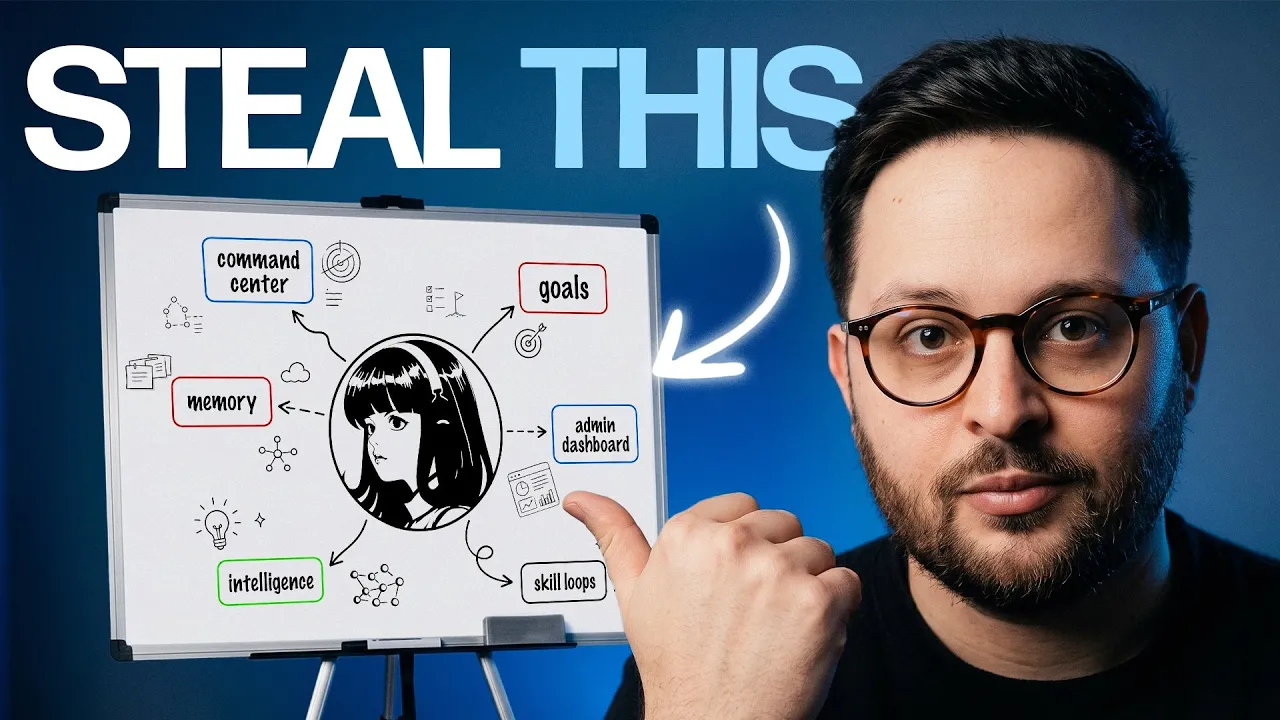
That is not how Hermes gets useful. Hermes gets useful when you turn repeated work into workflows. So, in this video, this is exactly what I'm going to show you. I'm going to go through six Hermes workflow I would build first. A morning command center, a memory wiki, a content intelligence workflow, a long-running goal workflow, [music] a computer administrator dashboard or a mission control, and the skill building loop that makes Hermes better every single time you correct it.
These are not random feature demos. These are the workflows that turn Hermes from something cool into something [music] that can actually help you every day. The first workflow I would set up is a morning command center. This is the daily loop that makes Hermes feel alive. Every morning, Hermes should ask you one simple question. What is your number one priority today? But, the important part is what happens after you answer.
Hermes should not just say, "Cool. Good luck." It should connect your answer to the work it can actually help with. If I say my priority is filming, Hermes should suggest title checks, competitor research, script polishing, or upload prep. If I say my priority is operations, it should suggest follow-ups, reminders, summaries, or SOP work. If I say my priority is coding, it should suggest bug triage, test runs, documentation, so on and so forth.
The workflow is simple here. Hermes asks your priority, you answer, Hermes suggests what it can help with. You approve the useful tasks, then Hermes creates the task list, Kanban cards, reminders, or agent work, and you live happily ever after. That gives you a clean separation between human work and agent work. You keep the parts that require judgment, taste, relationships, or you know, just things you would want to approve yourself, and Hermes handles the grunt work, the research, the the the drafts, the repeatable work.
It is 9:07 a.m. And just 7 minutes ago at 9:00 a.m., Hermes sent me my morning check-in, which is literally the simple morning, "What's your number one priority today?" To schedule this, to have exactly the same thing running, just put in this prompt. Create a morning check-in workflow for me. Every morning at 9:00 a.m., or whatever time you would like, ask me what my number one priority is today. After I answer, do four things.
Summarize what I'm trying to accomplish, look at my delegation map and suggest three useful ways you can help today, ask if I want you to start any of those tasks. If my answer reveals a durable preference or recurring responsibility, suggest a memory update, but only save it if it will still matter later. Keep the check-in short, do not overwhelm me. The goal is to help me start the day with useful leverage, not create more work.
So, that is literally the prompt I've used, the exact same prompt I've used to schedule this. But, from here, you'll start receiving these morning check-ins every single day. Let me go ahead and answer mine. Hermes, uh my number one priority today is create a Telegram bot that I will add to all of our client chats and for it to be able to read the client chats and keep track, keep tab, or has it been a while since we've checked in with a client?
How is communication going? How is sentiment going? Uh just to have a better pulse and sense of our client satisfaction score and also mostly for quality control purposes. And that's it. I send it to it and let's wait for its response back. By the way, a pro tip, grab yourself a coffee your morning coffee while Hermes is doing this. I just finished mine, so I'm going to role play as though this is my morning coffee. Pretty good coffee.
Come on, Hermes, I'm making a video. Let's go. What in the world happened here? This message is not supported in your version of Telegram. Please update to the latest version. Oh my, this has literally never happened and I'm warning a brief, but hey. It happens sometimes and yeah, let me go ahead update this this little bouncer right here. Wow. This new version of Telegram looks a lot cleaner. But anyway, uh besides the point, uh it replied to me.
For some reason, I can't see it from the older version of Telegram. I I've no idea what happened in this in this demo where I'm trying to look cool, but here you go. It replied, "The bot now supports reading client Telegram chats, uh storing messages, discovering unknown Telegram groups, automatically mapping each Telegram chat." It literally just helped me create this whole thing. And now all I I to do is just link a to it, an actual Telegram bot.
This is insane because wow, I mean, it took time, but it literally just did the whole thing. My number one priority of the day is now literally done, or 99% done. This is the first workflow because it creates the daily loop. But the daily loop creates a second problem. If Hermes is making decisions every day, you need a place where those decisions do not disappear. The second workflow is a memory wiki. This is the one that makes Hermes feel less like a session and more like a real operating layer.
The problem with agent work is that a lot of the value disappears into chat history. I mean, if you ask for research or ask for a direction, you create a process, Hermes learns something useful, then a week later you ask, "What did we decide again about that?" And now the answer is buried in a transcript, a file, uh a Notion page, or some random folder you have. A memory wiki fixes that because it allows for a much smaller context window.
You don't need to bloat your Hermes context window through the roof every single time you ask it something pertaining to the past. It does not need to dump every private detail into a public dashboard. It should keep durable pointers, recent sessions, decisions, daily logs, skills. The point is not infinite memory. The point is searchable continuity. That's right. I coined this term searchable continuity. For example, if I search YouTube on my memory wiki, I should see things like my YouTube agent scans, my approved ideas, the scripts, the decisions that mattered.
If I search Hermes dashboard, I should be able to find what we built, what failed, what still needs to be fixed. That makes the agent more useful because it stops pretending every conversation is new. And it also makes the workflow showcaseable because you can actually see what Hermes has been doing. In my setup, this lives on my mission control, which I call Hermie HQ, which is the name of my Hermes agent. I know, very original.
The dashboard does not need to expose everything. It just needs to show enough work history that I can answer the question, "Where did we leave this?" Or so that my Hermes agent can find anything it wants or needs whenever it needs it. That is the compounding layer, but memory only matters if it improves the work you repeat. For me, the best example is content. The third workflow is content intelligence. This is where Hermes stops being a general assistant and becomes a specialist.
The weak version of this is asking an AI, "Give me YouTube ideas." This is how you get genuinely generic slop. The useful version starts with evidence. For my YouTube workflow, for example, Hermes should first check what I have already posted so that I don't do the same video five million times. Then it should check what is already filmed or sitting in my Notion pipeline. Then it should scan competitors. Then it should look for outliers.
Then it should check uh apps like VidIQ. Then it should pull transcripts where possible, so on and so forth. And only after that should it pitch ideas. That matters because content ideas are only useful if they're connected to demand. A random idea can sound good and still be a waste of filming time. A good content intelligence workflow tells you, "This topic has demand. Uh this competitor angle is working. This title promise is super strong.
Or this part of the source video is weak." That is the difference between AI brainstorming and an actual content system. Hermes is not inventing ideas from nothing. It is collecting evidence, filtering it through your taste, and turning it into decisions. But research is only one side of the system. Sometimes you need Hermes to actually work on something for a while and come back with an artifact. The fourth workflow is for long-running goals, aka {slash} goal.
This is where Hermes stops feeling like chat and starts feeling like an agent. The mistake is running a big task with a tiny prompt. Something like, "Hey, build me an app. Make no mistake." That's right, Susan. This is not a good prompt. I mean, sometimes those prompts can work and be one-shotted if you're using like Fable 6.9, but they usually leave too much room and too much undefined. The better workflow is to meta prompt first.
Here's what that means. Before you run the goal ask Hermes to help you design the goal. Here's what that prompt looks like. "I want to run a {slash} goal with you, but first I want you to help me design the perfect {slash} goal prompt. Ask me any clarifying questions you need. Then write a detailed {slash} goal prompt with success criteria, constraints, files to inspect, tools to use, deliverables, safety rules, and how you should verify the result.
That's it. Let's go ahead and run it. All right. It has literally given me all the questions that it wants me to answer. So, I'm going to go ahead and record a voice message for it uh to answer all of these. >> All right, for the main outcome, question number one, uh do you want {slash} goal to focus on shipping the Telegram bot fully into production? Yes, I do. Yes for all the questions. So, option number four, all the above and phases.
Uh absolutely. Question number two, deployment target, should the bot run inside the existing Max HQ Versel app uh or separate always-on service? Actually, I'd love it to be on a separate always-on service if we could. And number three, Telegram bot token, uh I don't have a bot already created. Uh so, I will have to create one and provide you with the token for that bot. Uh number four, read-only versus action taking.
Yes, for phase one, the bot should be strictly read-only, and it should nudge me actually. Number five, uh digest date estimation. Where should alerts go? Actually, no. Yeah, let's put alerts in my personal Telegram DM uh instead of And if I want to change it later, then we can change it later. Number six, client source of truth, should {slash} goal require pulling active clients PM owners statuses and services from Notion?
Yes, it should. That's where it would know like what clients are active, what clients are inactive. So, we should map out also which database you should look at. And number seven, quality score, do you want a formal per client score like zero to 100? Yes, I would like that, a formal score. Number 10, internal team identification, to detect unanswered client's messages, the system needs to know which Telegram users are internal team members.
Yes, I agree. Number 11, cadence rules, what default default check-in SLA should we enforce? I don't know what you mean by that. Unanswered client message, uh I would say if a client message is unanswered for 14 hours, then flag it. And if we haven't checked in with a client in 48 hours, or actually in 72 hours, then also flag it. Should different services have different rules? Yes, Founder Funnel, for example, uh it's a monthly subscription.
Every day they should be posting. Uh for Spaces, for example, it's every week we have a space, so cadence of chat is a bit slower. For clipping, it's somewhere in in the middle between spaces cadence and founder funnel chat cadence. Number 12, dashboards. Do you want a max HQ page for this one? Can we create a separate page just like we discussed earlier? Number 13, cron digest should slash all crates schedule daily digest.
I don't know what that means. And what do you suggest? Number 14, safety privacy. Should the bot ever quote client messages and alerts or only summarize evidence? Yes, that would be helpful. Uh to quote them privately to me. Number 15, definition of done. What would make you think say this is working by end of goal for it to have all of the uh scores for clients like accurate scores for client sentiment. Maybe it would need to use an LLM for that.
So maybe we need to connect an LLM to it. >> And that's it. Literally 5 minutes of a voice note. But this is what guarantees that I've literally given it every ounce of information it needs. And if it has more questions, it literally will ask me more questions. Uh but with that, we'll just leave the goal running and come back to it later. Holy moly guacamole. Look at the mammoth of a prompt that it gave me. This is literally the entire prompt.
Just keeps going and going and going. Now all I need to do is copy paste it. One by one and just run it. That's it. This simple. All right. And after a while, we finally finished with our job. Hermes is done. I went, got started with some work, and came back and saw that it had finished. As you can see, it built everything I asked for and more, which is a system where I add a Telegram bot onto all of our clients' chats.
And it scans sentiment. It sees whether it's been a while since we've replied if any of our client success managers have taken a lot of time to reply. And I haven't added that bot to all the groups. So, the sentiment analyzer is a bit wonky, but if I go to the group that I did add it in as a test group, here you can see it has analyzed it. Here you can see it's a test it's the test group. It has scored it on sentiment, on cadence of back and forth of our response speed, our renewal risk, how likely the client is to renew, and an overall score.
That is amazing. That is literally what I needed to get done today. And I got it done while filming this video. This is the best of both worlds cuz now I can get to enjoy making the rest of this video without having to worry like, "Oh my god, I still have this massive thing I need to do today." It just did it in under 1 hour. But, once Hermes starts producing outputs across different workflows, you need one place to manage the system.
This is where the dashboard or mission control comes in. The fifth workflow is a computer administrator dashboard, aka a mission control. This is Think of it as a command center for your Hermes agent. Not because everything needs a fancy UI, but because you have enough workflows running, chat alone becomes very hard to manage. You want a place to see recent outputs, current tasks, your memory wiki entries, your scheduled jobs, how's your content doing, what are your different agents doing, and just everything that you need on a day-to-day basis at a click of a button.
And just a place that you can log on anywhere you are in the world on any device you're using. Now, for me, that is Hermi HQ. It's a Vercel dashboard that can show the useful parts of the system without exposing private files or secret. The important word is safe. Because a dashboard like this should not dump your entire computer onto the internet. It should be Google-gated so that you can only be the only one signing into it.
I have mine literally pinned to my home screen. Once I click it, it prompts me to use Google to sign in. Once I do that, boom. I'm signed in. It's going to take a moment to load. There you go. It started loading. And I have everything that I need for it. I can go onto my YouTube tab. I can go onto my X tab. I can go onto my dashboard and literally watch it load in real time. With a mission control, especially if you decide to use Vercel, um since it's fast, free, it does the job, do keep in mind to avoid putting on secrets on the website.
It should make risky actions approval only. And it should make Hermi's easier to supervise. Essentially, that's the whole point. This is what makes the whole system feel real. The morning command center creates tasks. The memory wiki keeps continuity. Content intelligence makes better decisions. Long-running goals produce artifacts. The dashboard lets you see and manage the work. But the final workflow is what makes the system improve.
Every correction should become reusable. The sixth and final workflow is the skill building loop. This is the part people underestimate a lot. Hermes should not make the same mistake twice. If it does a task well, turn the process into a skill. If you correct it, update the skill. If a workflow keeps repeating, document the steps and turn it into a skill. If a prompt consistently works, turn it into a reusable skill.
I hope you get the point. This is how Hermes gets better in a way that normal chatbots just simply don't. This is literally the superpower of Hermes. It's an agent that grows and improves with you. For example, if Hermes learns how I want YouTube ideas researched, that should not live only in one chat. It should become a YouTube skill. Uh read posted videos first, check the notion pipeline, use VidIQ, pull transcripts, pitch only the strongest ideas.
And when I correct the process, the skill gets better. That is the loop. Do task, get correction, update skill, run better next time. The point is not that Hermes magically remembers everything. The point is that you can turn working procedures into durable operating knowledge. That is how the system compounds. Let me show you this example. The best way for me to showcase to you why skills are so damn important is doing this test.
I'm going to run the same exact prompt on ChatGPT and on Hermes. Now, I use ChatGPT to power my Hermes, hence why I chose ChatGPT for this comparison. And the difference is ChatGPT doesn't have the skill, the YouTube skill, that Hermes has, that I've developed with Hermes. So, let's do I need to film a YouTube video today. Give me the best one. And I'm going to copy this. I'm going to put it on ChatGPT, and I'm going to go to my YouTube topics with Hermes and give it the same exact prompt.
Let's see the difference. There you go. Hermes instantly saw the request was a YouTube video, and it loaded my YouTube agent skill Nova, which by the way, I've open-sourced. It's free for you to download. You can take the link, send it to your Hermes, ask it to install it if YouTube is a thing you care about, and it will literally install that skill for you, and you'll have the same exact skill. Uh but anyway, look at this.
It's using the skill in the same exact way. It's doing exactly what I would have done manually, except Hermes is doing it for me. Versus ChatGPT, if I go and check in on it, >> [snorts] >> all right. Look at this. I read my first 100 tweets and wanted to What? What is this video? Is that it? Oh, and it gave me a hook, a structure, a thumbnail. So, I think the way it came up with the suggestion was mostly by trying to guess what I would like instead of, you know, doing research, checking for uh the analytics, for our competitor data, for outlier data, vidIQ, so on and so forth, blah blah blah.
And it came up with the street. Versus Hermes with the skill that we've developed, it's still working because I've given it a long list of things to check because the last thing you want as a YouTube creator is to spend hours filming a video that has no basis or no search hunger for it. No one actually wants to watch it. That's what I'm trying to say. You don't want to spend time filming a video no one wants to watch.
So, that is so important to me that there's actual demand there for me to film it, for it to justify me putting in the time. I'll let it run. I'll come back to it in 5 minutes and we'll see what it gives us. There you go. Actually, I didn't need to come back in 5 minutes. Uh literally, it just finished and this is what it gave us. Six Hermes Agent workflows that make it actually useful, which is funny because that is literally what I'm filming right now.
Um wow. I mean that will tell you how much I like it. I'm literally filming it right now. Your latest Hermes video, 100 days with Hermes Agent at 21 minutes, open strong. So, it verified our channel's data. It verified on VidIQ that this is something people search for and people want. It it verified this is something I'm interested in. It verified that our competitors have also been doing well in this topic and it gave us a strategic judgment along with six workflows it thinks we should put.
This is not bad. And a lot of them are very close to to our content intelligence system, morning command center. Um skill building workflow. This is why I love Hermes so much, but this is also why I use it with YouTube. I mean, if if I had to turn this video, it would have 50% been the same exact video you just watched right now. This is insane. Versus again, let's go back to this. ChatGPT, I wrote my first 100 tweets.
Holy molly. These are the six workflows I would build first. The morning command center, the memory wiki, the content intelligence, long running goal {slash} goal, computer administrator dashboard or mission control, and the skill building loop. If you only use Hermes as a chat window, it will still be useful, but if you build workflows around the work you repeat, it becomes something different, something special. It becomes a system that asks what matters, remembers what changed, works on real goals, and shows you the state of the work, and improves while you correct it.
That is when Hermes starts feeling less like a chatbot and more like a 24/7 assistant. Comment workflow. By the way, if you want me to make a part two to this video with six more useful Hermes workflows that I use every day, and make sure to like this video if you enjoyed it. And if you're new to my channel, make sure to subscribe because I have a ton more content coming your way. Oh. Who is that? Hello? Uh-huh. Okay.
Um the algorithm gods just called me, and they said that you are very likely to enjoy this video, apparently. I don't know. That's just what they told me. Don't shoot the messenger. Anyway, I'll see you there.
The words are the caption track's own and nothing is reworded or re-transcribed. Paragraph breaks are placed between sentences so the text reads as prose.
Free tools for your own script: paste a draft and see where it stands before you record it.
Paste your draft and see where viewers are likely to drop off, with a rewrite for each weak line.
Paste the first 30 seconds of your own draft for a hook score and rewrites.
Check your draft against YouTube's advertiser-friendly guidelines before you record it.
Read this channel's public videos and transcripts, and download a writing brief for it.