Getting the transcript
Reading the captions from YouTube. A video nobody has opened here before takes 10 to 30 seconds; this page fills in on its own.
Getting the transcript
Reading the captions from YouTube. A video nobody has opened here before takes 10 to 30 seconds; this page fills in on its own.
Gabe Bult - The Process · @GabeBultTheProcess
This video has no Most replayed graph yet: YouTube shows one only once a video has enough views. These are the moments viewers replayed most in Gabe Bult - The Process's most watched videos.
Most replayed moment at 9:14
3.0x that video's typical replay level
subscribers. Again, 1300 videos. And these are mostly him just talking, not really doing anything, not much editing, not much B-roll. Anybody could make this video. Literally, anybody could make this video. You can edit this yourself. You can hire out an editor. He's not really editing them. Again, either it is
Said at 9:07
Most replayed moment at 8:54
7.1x that video's typical replay level
will make. So, there's generally a four-step method that will work for this strategy. Number one is strategic YouTube content. And do not post short-form videos. Other creators might tell you to do that, but if your goal is to make money and especially like evergreen income, don't start with that, please. I've seen it
Said at 8:46
Most replayed moment at 6:57
4.0x that video's typical replay level
but averaging 50 to 100,000 views per video. If you see, they're all just screenshots of him talking about something that he knows, something that he does personally, investing in options trading. [music] And he showed me his analytics. He's making 50 to 100,000 per month in AdSense and another minimum
Said at 6:50
The graph counts replays. It does not show where viewers stopped watching.
Words
2,124
Runtime
8:56
Speaking pace
238wpm
Reading time
9min
238 words per minute, above the 201 75th percentile of 349 measured videos. That distribution comes from the 349-video hook study.
Opening (first 30 seconds)
I just spent a couple days networking and kind of at this little conference in Puerto Rico talking with some of the top finance creators and just people doing really, really interesting things. And there's people on like every level of the spectrum making money on all different platforms [music] and all different ways. And I felt really privileged to be able to get in this room. So, I wanted to break down some things that I learned from this conference [music] from people doing very well so that you can get the benefits even though you weren't able to go. I think a side note would be I did get to swim with the dolphin. No video of
119 words, the words spoken in the first 30 seconds at 238 words per minute.
Free, no signup. See how the first 30 seconds hold attention, with rewrites.
Sentence shape
| Measure | This transcript |
|---|---|
| Sentences | 127 |
| Average words per sentence | 16.7 |
| Longest sentence | 119 words |
| Questions asked | 10 |
| Sentences containing a number | 10 |
Most used terms
Filler phrases
65 in total: like 42 · actually 9 · kind of 6 · you know 4 · literally 2 · right? 2.
A literal whole-word count of the same phrase list the Prepublish browser extension uses, so a phrase inside another word is not counted and a phrase used in its ordinary sense still is. It is a count and not a judgement.
Run the check on the words above: where attention is likely to drop, with a rewrite for each weak line. The free check shows the scores and the one issue costing the most.
What this transcript is
Every word below is the caption track YouTube publishes for this video, pulled from the video itself and reproduced unchanged. It is not Prepublish's writing, not a summary, and not a re-transcription: it is the video's own published captions. English captions, generated automatically by YouTube, in the video’s original language. Source: the video on YouTube. A channel that would rather this page did not exist can ask for its removal through the contact page, and it is removed.
I just spent a couple days networking and kind of at this little conference in Puerto Rico talking with some of the top finance creators and just people doing really, really interesting things. And there's people on like every level of the spectrum making money on all different platforms [music] and all different ways. And I felt really privileged to be able to get in this room. So, I wanted to break down some things that I learned from this conference [music] from people doing very well so that you can get the benefits even though you weren't able to go.
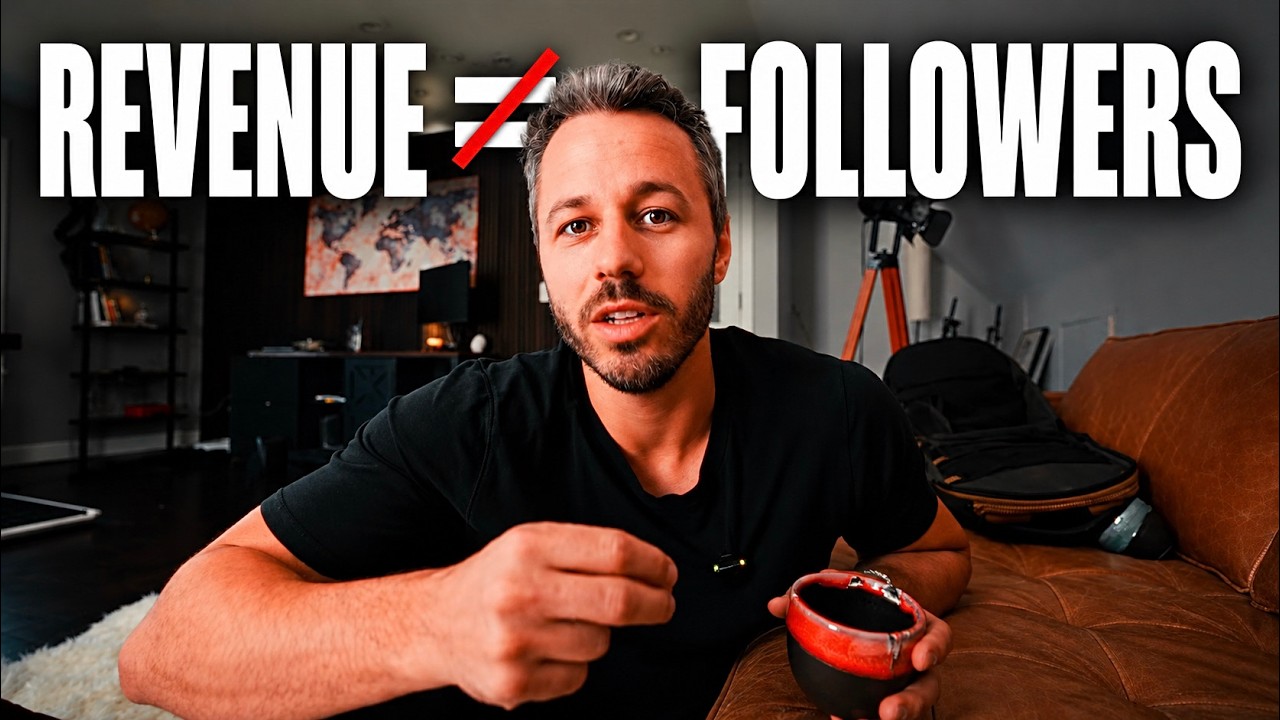
I think a side note would be I did get to swim with the dolphin. No video of that, but it was epic. Number one takeaway that I have talked to you about before, but revenue does not equal followers. This is the mindset shift from the creator to an entrepreneur. That is that chasing views, that making videos, that all that stuff that we talk about as YouTubers, that we think about, that we obsess about, if it doesn't have a really solid way to make money, it doesn't super matter.
So, if you're stuck in this creator mindset, which another thing I noticed there, there's like creators, then there's entrepreneurs. There's these business people who are very analytical. Actually, a lot of the creators there hated making videos. Like, they're top creators, they're doing really well. They're like, I like making money, I like the business side, but the videos are just suck. I hate it. And then there's me kind of on the other spectrum where it's like the business side, well, it's you know, it it is actually fun, too.
But like, I like making videos. That's what I'm like, I'm a creative person, a creator. I'm also an entrepreneur, so I have more of the blend, but I enjoy both sides of it and I think I enjoy the creation side more than probably most of the people there. But that is just something that's important that if you're just a creator only, the chances that you ever make money are really low. If you're just focusing on how many views your video gets, that's totally the wrong thing to look at.
You should be really looking at how much money am I making? When I post a video, how many clicks am I getting? Can you quantify those clicks? Is one video with 100 views getting 20 clicks making me more money than video with 1,000 views making 10 clicks? Like, that is what we should really be focusing on. And I know it's not as sexy and I know that a lot of people, including myself, get caught up in this trap of let's get as many views as possible, but I'm just telling you views don't pay the bills.
I think this is a really good example. Let me screen record here. On Facebook, we tried some things that are going to get us views, right? So, we tried making some faithless real type things. We got 9.5 million views this week on Facebook, which is really good. However, it equated to almost no more money because the views weren't leading to us getting emails, they weren't leading to selling any products. They didn't make much money in AdSense.
So, it was actually probably would have been better to get 1 million views, but get more clicks cuz they the views don't matter. So, just saying that views are strictly a vanity metric. We should really be focusing on making money. That's even the same thing I'm doing with this channel. I'm no longer just chasing the outliers, just chasing getting a bunch of views. I'd rather have depth. I'd rather have a quality conversation with you.
I'd rather like build a relationship with you and have like a much deeper connection than just be broad, kind of fluffy, worthless stuff, but yeah, it gets views. Next up is to niche down until it feels a little bit scary. So, everybody's going to have their own thing. I realized that every single person in that room, every talk that we heard, they all were personal finance creators. I'm in a room with 80 personal finance creators or something like that.
And none of us did the same stuff. A little few crossovers, but for the most part, everybody had their own thing. And that's what you need to find. You need to find your own unfair advantage. This is something we have like a whole module on this idea of finding what makes you different. There's one person that's whole thing was like helping African-Americans get out of consumer debt, like hyper-specific. There's another one that was faith- based financial freedom.
There's people who only teach women who are in debt how to build freedom in their lives, who are like moms. Like, there's very, very specific, hyper-targeted. We're all in the financial freedom space, but what's your own unique story? Who can you relate with? What makes you different than the other people? When you can find that, when you find who you're talking to, you know the avatars you're talking to, you know the problems that they have, their fears, their struggles, you know what they need help with, right?
And And then you've been in that same position. Maybe it's the place where you were 5 years ago and you came past that. That's who you can speak like when I talk to you on this channel, I talk about the time where I had 6 months of not gaining any subscribers, losing subscribers every time I posted, the 3 years of not making money on YouTube, and then finally figuring it out and now being at the point where I've created some systems where I can copy and paste and I can start new channels that are going to make money and have been able to start now four channels that are six-figure channels simply by copying and pasting the same method, whether it be in a different niche or even on a different platform, the same things kind of work.
But everything I talk about is very specific to me and I'm not trying to appeal to everybody. I'm trying to appeal to very specific people who have the same goals and dreams and and want freedom in their lives and want to make an impact and they want to teach people and share their their passion and their knowledge. Like it's very specific and each and every person there had something very specific. And so whatever you think your disadvantage is, it's probably your advantage.
Maybe if you're young and let's say you're a finance creator, you have the advantage of like you're actually budgeting, you're actually frugal living, you're actually like going through the whole process and you can share that. Whereas opposed to someone who's kind of reached freedom and become a millionaire and stuff, a lot of those people in the room, they're super unrelatable now. They're at a totally different stage of life.
They start talking to different people. So like your disadvantage of not being at that level yet is your advantage and you need to find out how you can use that. Next up is you need a system to make money and it doesn't have to be yours. There were people in there doing daily live streams on TikTok and they're making a lot of money and that's mostly through like affiliate marketing. It's super specific and niche, but that was their system that like just works and they're just printing money.
There's other people who launch a different product every single week. They're just on this continual launch mode. There's people with evergreen webinar funnels. There's people making literal six figures a month with affiliate marketing. There's cohorts, there's courses, there's AdSense, there's sponsors. Like everybody has their own method of making money, and all of them work. The thing is, like you're going to find one that really works for you.
It's important to know how to do all these, to test all these, and then you're going to find one that clicks more, and you just funnel everything into that until you are amazing at that, till you are the best at that one specific thing. And most everybody in that room who's making a lot of money, they found one thing that worked really well. Sometimes it's a little bit of mix of like two or three things, but there's one thing that carries most of it.
For me, it took a lot of experimenting to find different things that work. And one of my favorite right now is affiliates, cuz I have no fulfillment on that. There's infinite upside, like I talked about. I met people doing like six figures a month with just affiliates, and it it's totally scalable, and you don't have to build anything, you don't have to teach anything, you don't have to sell anything. You're just like a middleman with people.
So, that's one of my favorites right now. But, there are so many different ways to make money. And I'm actually going to be holding a workshop next weekend breaking down some of the methods, especially affiliate marketing, on YouTube specifically, and how I kind of run my channels in like 5 hours a week. So, if you're interested in that, I'll leave a link down below. Totally free. But, it's important that you understand all these options are out there, and then you test each one in a provable format to see if it's going to be a good fit for your audience.
I think this one might actually be the most important, and that is to own your audience. There was a time when TikTok almost went away, YouTube algorithm changes, you get burned out, but it is incredibly important to own your own audience. So, how do you own your own audience? That's going to look different for everybody. For some people, it is having a community, it's having your income diversified across platforms.
But, ultimately, it also is about owning emails. If YouTube goes away, your only revenue stream is to either start over on a different platform or on the same platform, or to monetize your email list better. And a lot of creators focus so much on the videos that they don't focus on the other ways to monetize, like your email list. We created this whole funnel through Facebook, which it's like a whole different business.
It's not even related to this. But, the emails are how we make money. We don't make any money from Facebook. We we a couple hundred bucks a month. We make tens of thousands of dollars from the email marketing side of that very specific affiliate marketing funnel that works through Facebook. But that's the thing, most people focus on the videos, on the content itself, and they miss the thing that could literally make them like 20 times more money or 10 times more money, which is the email marketing end of this because that's traffic you actually own.
It's not like a view that comes and goes. It's traffic that you own. You can repeatedly offer to solve people's problems and get paid to do it, whether it's a course. You don't even have to do courses. That's all affiliate marketing. But like, you could do it with courses, you could do it with products, you could do it with coaching, you could do it with moving people to another platform. Once you own that email, then you have a chance to make money for a really long time.
That's like a whole 'nother skill to learn. Maybe I'll do something breaking that down. But yeah, that's mostly what I learned from this room. It's really cool to learn from other people who are at the top of their game. If you do want to work with me, there's a waitlist for the 5-hour YouTuber down below. It's literally everything I've learned from the past 7 years of YouTube crammed into one course, along with like working with me directly, getting your channel checked out, all that type of stuff.
But mostly we focus on using YouTube as a monetization tool, not to get you a bunch of views, but to make you money from like day one, because as fun as YouTube is, I personally think it's more fun to like make money and scale that side of things. And then YouTube can just be fun. So, yeah, that's what I got. I'll see you.
The words are the caption track's own and nothing is reworded or re-transcribed. Paragraph breaks are placed between sentences so the text reads as prose.
Free tools for your own script: paste a draft and see where it stands before you record it.
Paste your draft and see where viewers are likely to drop off, with a rewrite for each weak line.
Paste the first 30 seconds of your own draft for a hook score and rewrites.
Check your draft against YouTube's advertiser-friendly guidelines before you record it.
Read this channel's public videos and transcripts, and download a writing brief for it.