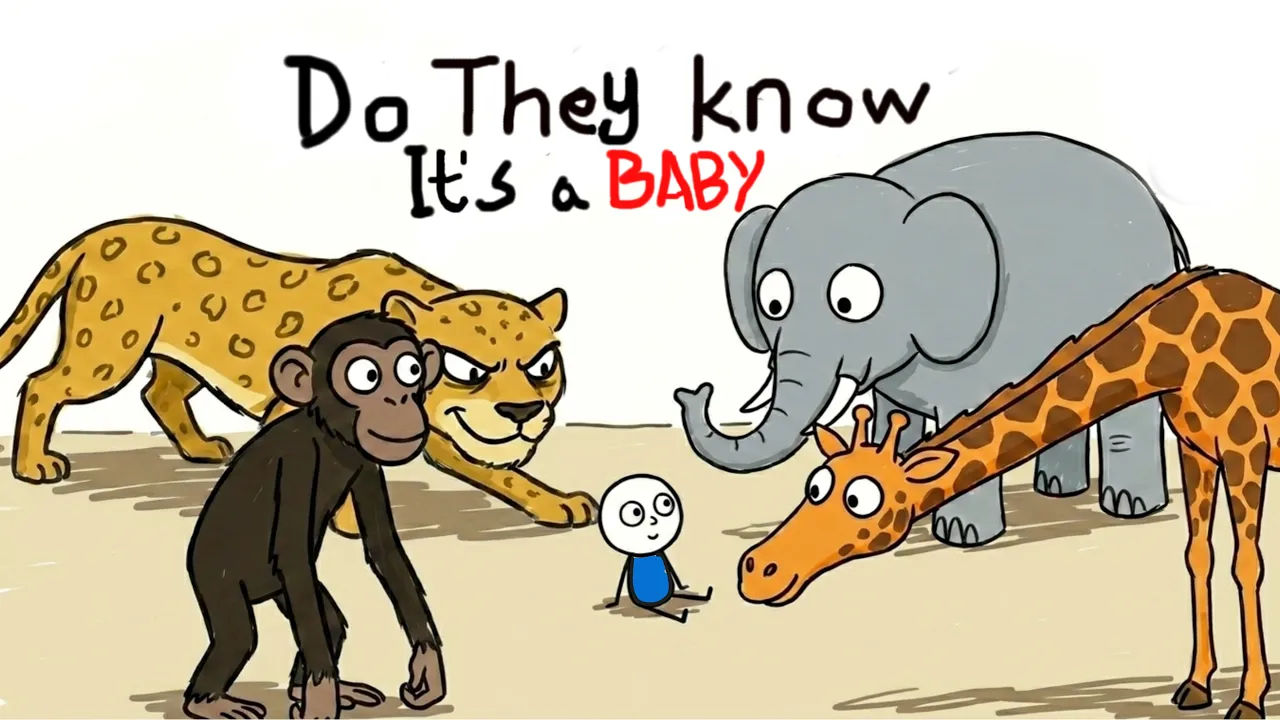
Do Animals Know When Another Animal is a Baby? transcript
Ink Explainer · @Inkexplainer96
Words
1,743
Runtime
8:07
Speaking pace
215wpm
Reading time
7min
215 words per minute, above the 201 75th percentile of 349 measured videos. That distribution comes from the 349-video hook study.
Opening (first 30 seconds)
A research team placed a 3 week old kitten in front of a Rottweiler. The dog had never encountered a cat before. It had not been socialized with smaller animals, but what the dog did next was unexpected. The dog lowered its head and it lay down and began licking the kitten in slow, careful strokes. The kitten crawled between its front legs and fell asleep. So, does he know it's a baby? So, they tried it again. This time with a baby rabbit, then a duckling, then an orphaned fawn. Every time results came out the same. The dog relaxed its body, softened its posture, and did
108 words, the words spoken in the first 30 seconds at 215 words per minute.
Sentence shape
| Measure | This transcript |
|---|---|
| Sentences | 154 |
| Average words per sentence | 11.3 |
| Longest sentence | 33 words |
| Questions asked | 5 |
| Sentences containing a number | 6 |
Most used terms
- baby23
- brain10
- species10
- infant9
- leopard8
- baboon7
- dog7
- across6
- infants6
- parent6
- animals5
- bird5
Filler phrases
8 in total: like 7 · actually 1.
A literal whole-word count of the same phrase list the Prepublish browser extension uses, so a phrase inside another word is not counted and a phrase used in its ordinary sense still is. It is a count and not a judgement.
What this transcript is
Every word below is the caption track YouTube publishes for this video, pulled from the video itself and reproduced unchanged. It is not Prepublish's writing, not a summary, and not a re-transcription: it is the video's own published captions. English captions, generated automatically by YouTube, in the video’s original language. Source: the video on YouTube. A channel that would rather this page did not exist can ask for its removal through the contact page, and it is removed.
Transcript
A research team placed a 3 week old kitten in front of a Rottweiler. The dog had never encountered a cat before. It had not been socialized with smaller animals, but what the dog did next was unexpected. The dog lowered its head and it lay down and began licking the kitten in slow, careful strokes. The kitten crawled between its front legs and fell asleep. So, does he know it's a baby? So, they tried it again. This time with a baby rabbit, then a duckling, then an orphaned fawn.
Every time results came out the same. The dog relaxed its body, softened its posture, and did something gentle with a mouth that could kill in a single reflex. The dog was not trained to do this. It was not rewarded. The question no one on the team could answer clearly was how it knew. How a dog with no exposure to any of these species could look at each of them and arrive at the same conclusion that it's a baby and I should not hurt it.
And here's the explanation to this. Almost every infantile feature looks the same across every species, whether it's a puppy, a human infant, or a baby seal. The eyes sit too large for the head, the head too large for the body, the forehead pushes outward, and these proportions are not a coincidence. They are signals. So, what's actually going on inside the brain when this happens? Researchers at the University of Oxford put people inside a brain scanner and showed them photos of baby faces.
Within 140 milliseconds before the person even fully processed what they were seeing, the reward center of the brain lit up. The brain was treating baby faces like something to move toward, protect, take care of, and it was doing it before the person had any say in the matter. The decision to care was being made before the subject was fully aware of what they were looking at. And the key part, the response didn't require the baby to be human.
The proportions alone were enough. You can't put a wild leopard in a brain scanner, but the way animals behave is the same. This system isn't just in us. It runs possibly in every mammal alive. A female leopard in Kruger National Park killed a baboon in a marula tree. Normal hunt, but when the body fell, something came with it. A baboon infant, about 2 weeks old. A safari guide named Ryan Sobey recorded what happened next over several hours.
The leopard came down, walked to the infant, and picked it up in her jaws, but not the way she'd bite prey. She used the carry bite, just enough pressure to hold, not enough to break skin. She carried the baboon infant into a thicket, set it down, and began grooming it, licking its fur in long, slow strokes. The infant crawled toward her belly and attempted to nurse. The leopard allowed it. By morning, the infant had died of exposure.
Baboon infants need near constant warmth in the first weeks of life, and the leopard's body couldn't give it that. But, she stayed beside it through the night. When hyenas came close, she picked it up and moved it further away. This wasn't the first time. Leopards in the greater Kruger region have done this with baboon infants on at least three separate occasions. The baboon isn't her offspring. It doesn't share her genes.
It can't return the favor. Every calorie she spent protecting it was, by every biological metric, wasted. And yet, she keeps doing it. Something about the infant, the way it moves, is hitting something deep enough in the leopard's brain to override the predator that was working perfectly minutes earlier. It's not just how babies look, it's also how they sound. Baby distress cries across mammal species are shockingly similar.
High-pitched, short, repeated bursts. The pitch rises at the end. In 2014, researchers at the University of Winnipeg ran a simple test. They hid speakers in the wild and played recordings of baby cries, but not from the species living there. They played baby fur seal cries to deer, human baby cries to marmots, animals that had never heard these species in their lives. Every time, the adults came to the speaker. Every single time.
They'd never even encountered the species making the cry, but something about the sound, the pitch, the rhythm, the desperation in it was close enough. The mammal brain isn't asking, "Is this my baby?" It's just asking, "Is this a baby?" But, listen to this. Recognizing a baby and caring about it are not the same thing. Now, here's the disturbing part. Male langur monkeys commit infanticide at rates that have been documented across populations in India for over 50 years.
When a new male takes over a group, he systematically kills the existing infants. Not because he fails to recognize them as babies, because he does. The infants are not his. As long as they are alive and nursing, the females are reproductively unavailable. Killing the infants brings the females back into estrus. The male can then sire his own offspring. He knows exactly what a baby is. He understands what killing it means.
The detection system is working perfectly. The difference is what happens after that recognition. In the leopard, recognizing a baby triggers protection. The animal becomes gentle, careful, almost nurturing. But in the male langur, that same recognition leads somewhere completely different. It triggers reproduction. Same recognition, but opposite results. And it's not just langurs that do this. Male lions have been documented killing cubs after taking over a pride.
Dolphins have been seen attacking and killing calves. Bears do it, too. In some chimpanzee populations, females have even been observed killing and eating the infants of rival females. This only works because they can accurately recognize an infant in the first place. But instead of triggering care, that recognition can also trigger competition. And here's something even more interesting. A primatologist named Jill Pruetz once watched a group of chimpanzees in Senegal take in a young chimp from a completely different group.
But they did something different. They groomed him, fed him, kept him close, almost like he already belonged there. But he didn't. He had no relation to any of them. He came from another group entirely. And yet, the females still accepted him. He was too young to be a threat. Even though nothing in their biology said he should matter to them, something about him still registered as baby. And they responded to it anyway.
There are even documented cases of this happening across completely different species. We've seen dogs nursing kittens, cats raising rabbits, and even hens incubating duck eggs and caring for the ducklings after they hatch. Every one of these animals can tell the baby isn't theirs, and they care for it anyway. Part of that comes down to hormones. In nursing mammals, baby-like features can trigger a caregiving response almost instantly.
And then one animal learned how to exploit all of it, the common cuckoo. This bird sneaks its egg into another bird's nest. When the chick hatches, the first thing it does is push the host's real eggs and babies out of the nest, so it gets all the food for itself. And it works. The host parent keeps feeding it like nothing happened. Day after day, the cuckoo grows. Within a week or two, it's three or four times bigger than the bird feeding it.
It looks nothing like the parent's own young. There is no way to look at this chick and think it belongs there. And yet the parent bird keeps feeding it. And the reason behind this is how they cry. Researchers at Cambridge found that a single cuckoo chick produces a begging call that sounds like an entire nest full of hungry chicks screaming at once. The parent's brain is wired to respond to how loud and desperate the begging gets.
The more intense it is, the more food it brings. The cuckoo figured out exactly how loud it needs to be. It didn't trick the parent by looking convincing. It found the exact point where the parent's brain stops questioning and starts caring. A safety instinct turned into a weapon. Every mammal carries this system. It reads the face, the sound, the movement. It works across species. It's older than most of the animals running it.
But all of this leads to one question. Do they know it's a baby? And yes, they know it's a baby. What happens after depends on the animal. Some see a baby from another species and every instinct to protect it kicks in. Others see the same thing and exploit it. Same detection, completely different response. It comes down to the animal, its biology, and millions of years of evolution shaping what it does in that moment.
So, yes, they know it's a baby. The evidence is clear. They see it, hear it, respond to it across species lines in ways that cost them something. The real question was never whether they recognize it. It's what they choose to do once they do. And that, it turns out, looks a lot more like us than we expected. And maybe that's the most unsettling part of all of this. We built entire philosophies around the idea that compassion is uniquely human.
That empathy, that instinct to protect something small and helpless, was proof of something higher in us, something special. But a leopard sat in the dark next to a dying baboon infant and never left. A dog with no training, no reward, no reason, looked at a duckling and went gentle. A bird's brain gets hijacked so completely by a cry that it feeds a creature three times its size for weeks without stopping. A predator goes gentle, A a competitor goes protective.
Something that should trigger one response triggers the opposite. The detection is reliable. What follows it isn't. And that might be the most honest thing the research has produced so far. If you noticed a gold coin with the face of Socrates hidden somewhere in this video, drop the timestamp in the comments. One random person who gets it right wins a $20 gift card. I'll announce the winner in the next video. Thank you for watching.
The words are the caption track's own and nothing is reworded or re-transcribed. Paragraph breaks are placed between sentences so the text reads as prose.
Use this transcript
Three free tools that work on the material around a video like this one. No signup, no login.
Hook Analyzer
Paste the first 30 seconds of your own draft for a hook score and rewrites.
Policy Pre-Flight
Check your draft against YouTube's advertiser-friendly guidelines before you record it.
Channel Skill Generator
Read this channel's public videos and transcripts, and download a writing brief for it.