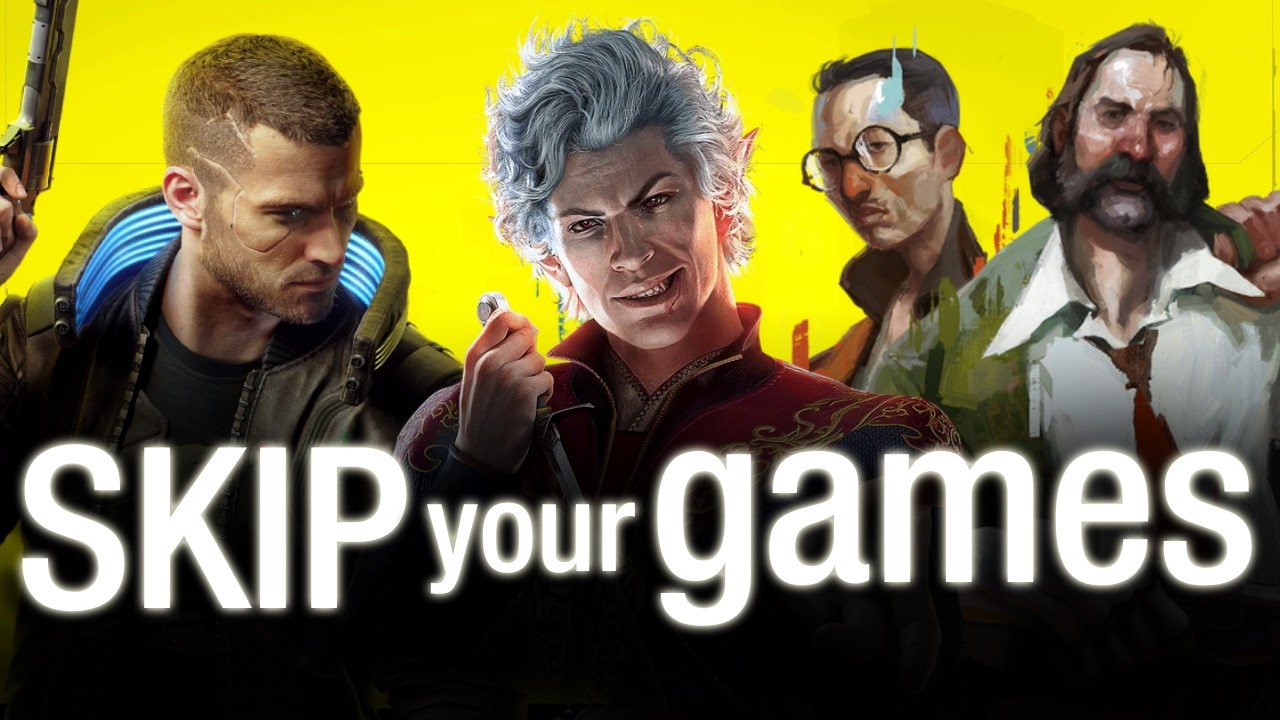
The Director's Cut Method Saved My Hobby transcript
Load Bearing Ribbon · @LoadBearingRibbon
Words
1,934
Runtime
10:34
Speaking pace
183wpm
Reading time
8min
183 words per minute, just over the 181 median of 349 measured videos. That distribution comes from the 349-video hook study.
Opening (first 30 seconds)
I spread my gaming dollar too thin. Game Pass, PS Plus, Steam sales, key shops, EA Play, Ubisoft Plus. Okay, I was kidding about that last one, but I play a lot of games, so I feel all of these platforms and their offerings are worth it, particularly when wonderful video essays about the illusion of choice in Cyberpunk or the unexpected cosiness of Starfield inspire me to hop into games without outright buying them. It's convenient, very convenient. Too convenient. This accessibility is suffocating me. I play 10 hours of Starfield
92 words, the words spoken in the first 30 seconds at 183 words per minute.
Sentence shape
| Measure | This transcript |
|---|---|
| Sentences | 123 |
| Average words per sentence | 15.7 |
| Longest sentence | 56 words |
| Questions asked | 10 |
| Sentences containing a number | 10 |
Most used terms
- game33
- games25
- music24
- experience13
- play12
- control7
- enjoy6
- ensure6
- agency5
- backlogs5
- cut5
- director5
Filler phrases
16 in total: like 11 · actually 2 · basically 1 · kind of 1 · right? 1.
A literal whole-word count of the same phrase list the Prepublish browser extension uses, so a phrase inside another word is not counted and a phrase used in its ordinary sense still is. It is a count and not a judgement.
What this transcript is
Every word below is the caption track YouTube publishes for this video, pulled from the video itself and reproduced unchanged. It is not Prepublish's writing, not a summary, and not a re-transcription: it is the video's own published captions. English captions, generated automatically by YouTube, in the video’s original language. Source: the video on YouTube. A channel that would rather this page did not exist can ask for its removal through the contact page, and it is removed.
Transcript
I spread my gaming dollar too thin. Game Pass, PS Plus, Steam sales, key shops, EA Play, Ubisoft Plus. Okay, I was kidding about that last one, but I play a lot of games, so I feel all of these platforms and their offerings are worth it, particularly when wonderful video essays about the illusion of choice in Cyberpunk or the unexpected cosiness of Starfield inspire me to hop into games without outright buying them. It's convenient, very convenient.
Too convenient. This accessibility is suffocating me. I play 10 hours of Starfield and they add Disco Elysium. I play a little bit of that and they add Resident Evil 7. Well, I almost bought that last week, so I've I've got I've got to play that one. I race through Resident Evil 7 to ensure I get back to Disco Elysium, but then they add Modern Warfare. Apparently, the campaign of this is pretty good and it's kind of short, so I'll I'll just play that and then I can get back to Starfield.
Wait, no, Resident Evil. Hang on, did did I finish Disco? I've played more games than I ever have in the last 12 months, but I've finished very few. Of those few, I either rushed the final act or deliberately chose to play them because they're short all to ensure I got back to some other game I'd banished to the backlog for no reason. Now, I'm not alone. Online discourse around completing backlogs, conquering backlogs, curating backlogs, and just bloody staring at backlogs has exploded recently.
Why do we all feel this way? How we value, focus on, and experience games [music] is degrading at an alarming rate and we must make efforts now to reverse this. We need to rewire our approach. We need to take control. I'm advocating that for each game we play, we make our own director's cut. Is media properly valued in the age of subscription services? [music] No, no, it isn't. We're in this wonderful age of access, not ownership.
It's been said to death, but when accessing [music] movies, music, and now games through a subscription model, something happens psychologically. Rather than owning and living in these worlds, we approach them merely as tourists. We dip in and dip out and don't properly allow ourselves to live in and digest the experience because some other new and shiny game or TV show or album has been added to the platform. We are bewildered by an onslaught of choice and don't really ever spend the time to value media properly.
A recent game that comes to mind for me is Tunic. I failed this game spectacularly. It's a deep world with rich, subtle storytelling that refreshingly largely leaves you to your own devices. It allows you to figure out the game mechanics through finding in-game manuals and other secrets along the way. Unfortunately, when I downloaded Tunic from Game Pass, I had a [music] quick try and didn't allow myself to truly be immersed in that experience.
It's a game I know I'd love if I gave it a proper chance, but due to the fact that I essentially rented the experience, I treated it as a tourist. I dipped in, saw that it required some actual dedication to enjoy, and just dipped out. I have not yet returned to Tunic, and when I see it brought up in gaming discussion, I feel like I failed it. So, like it or not, these platforms and their rampant accessibility rapidly devalues our games and the experiences we have within them, and we are worse off for it.
We are tourists, not residents, in our digital worlds and slowly lose the ability to respect, enjoy, and curate our games in a truly considered way. How have we got here? The removal of barriers like saving up money for a game or finding a copy physically has destroyed the sunk cost that once compelled us to finish them. A pretty strong motivating factor for us boneheaded humans to continue on with a project that might not be working or a game we might not be enjoying is the prior investment of resources into it.
In other words, if I've bought a game or had to line up for it or had to do anything more than just bloody download the thing, then I'm much more likely to finish it. The resources and effort I've sacrificed to get this game are unrecoverable, so I may as well enjoy and complete the thing. A key recent example for me was Baldur's Gate 3. I was hesitant to play this. It seemed a little overwhelming from the outset, but with so many people singing its praises, [music] I bit the bullet and bought it.
The game is not available on any subscription services, very rarely goes on sale, and cheap keys are basically impossible to get. So, I just bought it. $89.95 or so in Australia, it wasn't cheap. I played for a good 10 hours or so and really began to feel the friction. I wasn't understanding it. It wasn't clicking with me, but I was beyond the refund stage. So, with a decent sunk cost, I decided to take it upon myself to actually learn the game.
Due to all the money I spent, I was compelled to do so. I watched countless explainers, studied my build, Tiefling Bard in case you're wondering, and read countless breakdowns of how D&D worked. Suddenly, it all fell into place, and 84 hours later or so, I finished my first play-through, and I'm raring for another. Baldur's Gate 3 is now an all-timer for me, and that's only because I had a sunk cost to anchor me within that experience.
I took the time to learn to be a resident of that world. I made the effort to meet the game where its vision demanded I meet it. Without an anchor like this, we jump around from game to game accessible on Game Pass or PS Plus or for next to nothing on Steam, and never truly get a complete, considered, and cherished experience. So, how do we take steps to value games properly? How do we ensure we are getting the most out of our experiences in a world where ease of access tarnishes every game we try to play?
Earlier, I mentioned that we rush through games just to get back to the next one in our backlog. This is a rush born of guilt and indecision. Instead, we should curate our games through individualism and agency. Take control. It may seem a little counterintuitive, but to get the most out of a game, you need to skip more of it. Intentionally curate your experience. Make a director's cut. Every game I've ever played has had a section I don't enjoy as much as the rest.
Think the ship section in Resident Evil 7 or Eva's escort mission in Snake Eater. These are both short sections in games I love, but if something like this in a slightly worse game I'm bound to drop the game completely. In abandoning titles because of these sections, I'm neglecting the very feature of video games that defines the medium. Control. The beauty of games is that we are given an extra dimension of control over the story and pacing.
Through navigation and gameplay, we can elongate the bits we like and truncate or outright avoid the bits we don't. We are the directors of our own individualized experience, and we need to start acting like it. In modern games, we very rarely use this power effectively. Somewhere along the line, as games became more cinematic, we started treating them more like films. We now approach them as passive experiences we have to sit through from start to finish, despite how much it might be boring us to tears.
On top of this, modern games pile map markers and lists of tasks on us to ensure that we don't skip even the smallest bits. We spend too much time in locations or levels that don't really appeal to us just to ensure we're not missing anything. We've got to check every nook and cranny and speak to every NPC, despite the fact that this part of the game feels like a slog. >> [music] >> Ironically, in actively trying to see everything, we are becoming a passive audience.
The agency, the [music] player freedom, is actually in the cut. Our control is defined by what we miss out on. I adore Disco Elysium, but on my first playthrough, I abandoned it completely. I was searching every nook [music] and cranny of Martinaise and just burned myself out completely. Instead of taking agency and being the director, the curator of my own experience, I fell into the [music] trap of passively letting this game wash over me in its entirety.
I didn't employ the role-playing component of the role-playing game and viewed the map as a suffocating checklist. I exhausted every dialogue option I could. I clicked everywhere on the screen just for the sake of doing it. This totally [music] neglects that wonderful dimension of control that is unique to the medium. Now, I should allocate my time in game to the locations and people [music] that I'm most drawn to whilst minimizing my time in the sections I don't like.
Only then, when I'm essentially skipping the parts of the games I don't enjoy, will I truly be getting the most out of the experience. This just isn't possible across other mediums like books and films. We need to be empowered by the control granted to us in games >> [music] >> and make our own director's cut. Only when we dare to miss out on parts of our games, will we truly get the most out of them. We need to miss out to realize [music] a game's full potential.
By elongating the bits we enjoy more and dismissing [music] any guilt we might feel for rushing or outright skipping the parts we don't, >> [music] >> we will experience these titles as they were intended, as video games, as stories we have a hand in [music] curating. Game Pass isn't going anywhere. Neither are our suffocating backlogs or overwhelming slew of great games. Woe is me, right? Too many great games to play.
But, we can [music] make intentional changes to our approach to ensure we're getting the most out of all these wonderful experiences we can access [music] now. When you find yourself in a section of a game that's not really very compelling to you or isn't inspiring or motivating you all that much, stop and think. Ask yourself, if I was the game director, would this section be here? Would this mission be this long? Would I task the player with this arbitrary task?
Then take action to implement your change. If possible, [music] skip that section. Cheese that boss. Hell, kill that character. I did that to Shadowheart in Baldur's Gate. She honestly annoyed me beyond belief. These are all powers that only video games can afford us. >> [music] >> We may have forgotten it, but this is why we love this medium. Not because we can experience these stories as everyone else has, but because we can experience [music] them as we want to.
Video games afford us agency, and that agency is in >> [music] >> the cut. Don't squander that, and you might just finish more games. Thanks for watching. [music]
The words are the caption track's own and nothing is reworded or re-transcribed. Paragraph breaks are placed between sentences so the text reads as prose.
Use this transcript
Three free tools that work on the material around a video like this one. No signup, no login.
Hook Analyzer
Paste the first 30 seconds of your own draft for a hook score and rewrites.
Policy Pre-Flight
Check your draft against YouTube's advertiser-friendly guidelines before you record it.
Channel Skill Generator
Read this channel's public videos and transcripts, and download a writing brief for it.