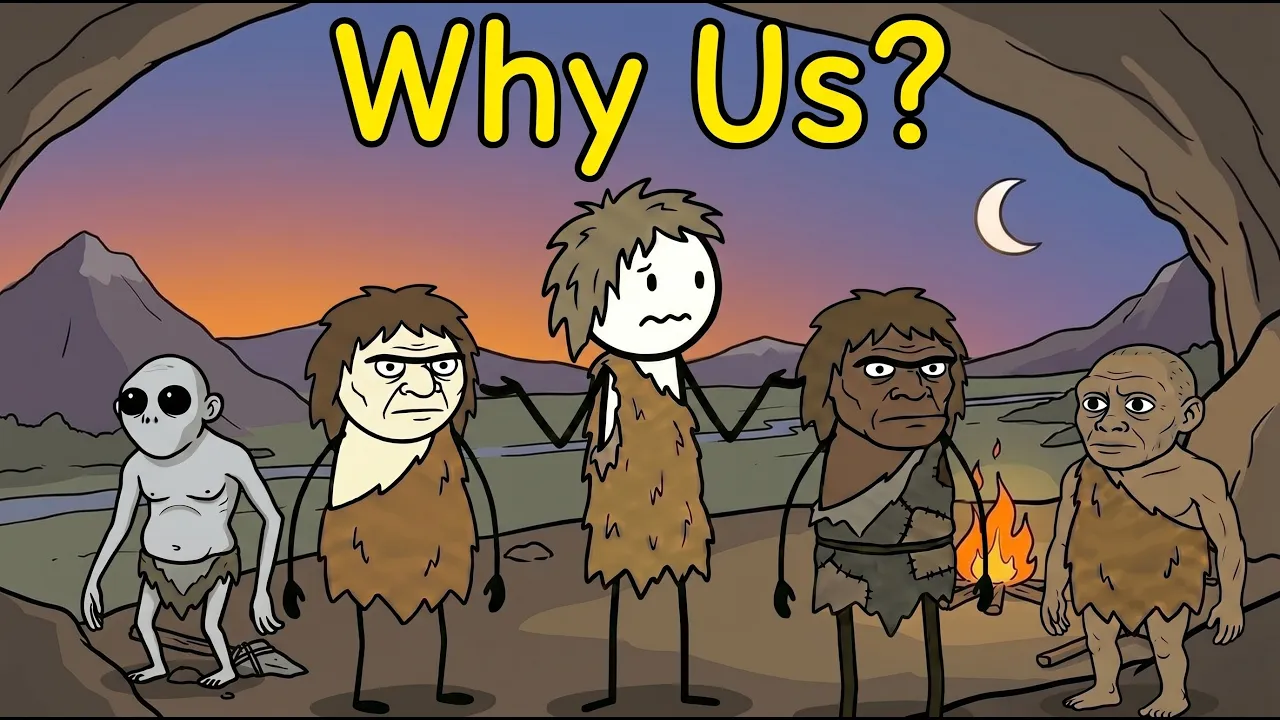
Why Are We the Only Human Species Left? What happened to others... transcript
Ink Explainer · @Inkexplainer96
Words
1,537
Runtime
8:05
Speaking pace
190wpm
Reading time
6min
190 words per minute, between the 181 median and the 201 75th percentile of 349 measured videos. That distribution comes from the 349-video hook study.
Opening (first 30 seconds)
For most of human history, we were not alone. If you could travel back 50,000 years, you'd find a planet where several different kinds of humans existed at the same time. Some looked a lot like us. Others were built completely differently. Shorter, heavier, shaped by climates and landscapes that would break a modern person. One species lived on a remote island and evolved to be barely 3 ft tall. Another is so mysterious that nearly everything we know about them comes from a single finger bone. And then there was us, Homo sapiens. Today,
95 words, the words spoken in the first 30 seconds at 190 words per minute.
Sentence shape
| Measure | This transcript |
|---|---|
| Sentences | 101 |
| Average words per sentence | 15.2 |
| Longest sentence | 37 words |
| Questions asked | 2 |
| Sentences containing a number | 14 |
Most used terms
- species19
- homo16
- years15
- human14
- neanderthals9
- homo sapiens7
- modern7
- sapiens7
- erectus6
- homo erectus6
- human species6
- humans6
Filler phrases
6 in total: actually 3 · like 3.
A literal whole-word count of the same phrase list the Prepublish browser extension uses, so a phrase inside another word is not counted and a phrase used in its ordinary sense still is. It is a count and not a judgement.
What this transcript is
Every word below is the caption track YouTube publishes for this video, pulled from the video itself and reproduced unchanged. It is not Prepublish's writing, not a summary, and not a re-transcription: it is the video's own published captions. English captions, generated automatically by YouTube, in the video’s original language. Source: the video on YouTube. A channel that would rather this page did not exist can ask for its removal through the contact page, and it is removed.
Transcript
For most of human history, we were not alone. If you could travel back 50,000 years, you'd find a planet where several different kinds of humans existed at the same time. Some looked a lot like us. Others were built completely differently. Shorter, heavier, shaped by climates and landscapes that would break a modern person. One species lived on a remote island and evolved to be barely 3 ft tall. Another is so mysterious that nearly everything we know about them comes from a single finger bone.
And then there was us, Homo sapiens. Today, we are the only human species left. Not because we were the strongest, or the smartest, or the ones who'd been here longest. Just the ones who are still here, which raises a question that doesn't have a clean answer. What happened to everyone else? What actually happened was slower and messier. To understand how that played out, you have to start with the species that lasted the longest, which is Homo erectus.
Homo erectus showed up around 2 million years ago. And to put that number in perspective, everything modern humans have ever accomplished, every city we've built, every war we fought, every language we've spoken, all of it fits inside the last few thousand years. Homo erectus was on this planet for a stretch of time so long that our entire history looks like a footnote next to theirs. Their bodies were the first to look recognizably human.
They have long legs, shorter arms, a frame designed for walking and running over open ground. They were almost certainly the first human species to leave Africa and spread into other parts of the world, which means they figured out how to survive in environments they'd never evolved for. Their brains were smaller than ours, but significantly larger than anything that came before them, and they developed stone tools that barely changed over hundreds of thousands of years.
That sounds like a lack of imagination, but it's actually the opposite. What they made worked so well that there was no pressure to improve on it. But by their final chapter, the world had left them behind. Their last populations ended up on the island of Java in Indonesia, cut off from the mainland, with no way to reach other groups, and no new territory to move into. The forests they'd always hunted in started shrinking.
The animals they depended on became harder to find. And without enough people or enough space to recover, a species that had survived for close to 2 million years slowly ran out of options. Their last fossils date to around 110,000 years ago. After outlasting everything the planet had thrown at them, Homo erectus was gone. Let's talk about the Neanderthals, probably the most misunderstood species in human history. For decades, they were written off as dim, brutish cavemen.
That image was always wrong, and the more we learn about them, the more wrong it becomes. Neanderthals were built for survival in ways that are hard to overstate. Their bodies were compact and powerful. Wide chests, thick bones, strong arms. Their faces had heavy brow ridges and large noses that warmed cold air before it reached their lungs. Their brains were on average slightly bigger than ours. They hunted large dangerous animals at close range, which is why their skeletons show injury patterns similar to modern rodeo riders.
They know how to control fire, made sophisticated tools, and there's growing evidence that they buried their dead with care. Neanderthals lived across Europe and Western Asia for more than 300,000 years. But around 45,000 years ago, Homo sapiens began moving into the same regions. For a few thousand years, both species lived side by side, and DNA evidence shows they even had children together. But living alongside Homo sapiens created new challenges for Neanderthals.
Both species hunted many of the same animals and relied on the same land for survival. Homo sapiens lived in larger groups and had wider social networks, allowing them to share resources, knowledge, and support over greater distances. However, Neanderthals generally lived in smaller, more isolated groups, making it harder for them to share resources and recover from difficult times. At the same time, the climate kept changing.
Cold periods and warmer periods constantly reshaped the environment, making survival even more difficult. Neanderthal populations became smaller and more isolated, and their DNA shows very low genetic diversity, suggesting their numbers were already declining. By around 40,000 years ago, Neanderthals disappeared from the fossil record. They weren't wiped out by a single event. Instead, a combination of competition, climate change, and shrinking populations gradually pushed them toward extinction.
Now, let's talk about the Denisovans. They were different from every other species on this list because we can barely see them. The entire discovery began with a single finger bone pulled from a cave in the Altai Mountains of Siberia. A fragment so small it could sit in the palm of your hand. But, when scientists extracted DNA from it, the results didn't match any known human species. Not Neanderthals, not Homo sapiens, and not anything else scientists had seen before.
It was something else entirely, a previously unknown branch of the human family that had been hiding in the genetic record all along. Since that discovery, only a handful of additional remains have turned up, which include some teeth, a piece of jawbone found high on the Tibetan Plateau, and not much else. And yet, their genetic shadow is enormous. Denisovan ancestry shows up in modern populations across parts of Asia and Oceania, with some Melanesian groups carrying as much as 6% Denisovan DNA.
Tibetans inherited a Denisovan gene called EPAS1, that allows them to function at extreme altitudes where most people's bodies would start to fail. A species we can barely find in the ground is still shaping how living humans survive in thin air. But, as a living population, the Denisovans faded out somewhere around 30,000 years ago. Their range may have been vast, but their numbers were likely thin, and thin populations rarely hold on when the world starts shifting underneath them.
And then there's one of the strangest chapters in human history. In 2003, on the Indonesian island of Flores, researchers discovered the remains of a human species unlike anything seen before. They stood only about a meter tall and had brains roughly the size of a grapefruit. At first, many scientists were skeptical. Some argued the bones belonged to modern humans with a disease or developmental disorder. But, as more evidence was uncovered, it became clear that these remains belonged to a completely separate species, Homo floresiensis.
This tiny human lived on Flores alongside Komodo dragons, giant storks, and dwarf elephants. Islands often drive evolution in unusual directions. When species are isolated for long periods, they can change dramatically. Large animals may become smaller, while small animals can grow larger. Homo floresiensis may be one of the most remarkable examples of this process in the entire human family. Their fossils date from about 100,000 to 60,000 years ago, and stone tools suggest they may have survived until around 50,000 years ago.
What's interesting is that modern humans were arriving in the region at roughly the same time. We don't know exactly what happened, but on a small island, a species doesn't need a massive catastrophe to disappear. Sometimes a small population facing new pressures simply runs out of time. So, why are we the only human species left? The obvious answer is intelligence, but that falls apart quickly because Neanderthals were intelligent, Denisovans adapted to extreme environments, Homo erectus outlasted us many times over, and Homo floresiensis survived conditions that would terrify a modern person.
What may have actually separated us was something harder to measure, the way we built connections across distance. Homo sapiens didn't just live in groups, we built networks. Tools, techniques, and knowledge moved between communities in ways that don't seem to have happened for other species at the same speed or scale. When one group faced a crisis, the things they'd learned didn't die with them. That knowledge had already traveled.
When the climate shifted, and entire regions became unlivable, our species had the flexibility to reorganize because we weren't locked into any single place or any single strategy. But even that only explains part of it. Luck, geography, and being in the right place with enough numbers at the right moment all played a part, too. We weren't destined to be the last one standing. We just happened to be. The other human species weren't early versions of us, and they weren't simply stepping stones on the way to become Homo sapiens.
They were their own kinds of humans, each with a different way of surviving in the world. Homo erectus survived for nearly 2 million years and still disappeared. Neanderthals endured hundreds of thousands of years of ice age climates and still vanished. The Denisovans left behind almost no fossils at all, yet traces of their DNA still exist in people today. For most of human history, we were just one branch of a much larger family.
Now, we're the only one left.
The words are the caption track's own and nothing is reworded or re-transcribed. Paragraph breaks are placed between sentences so the text reads as prose.
Use this transcript
Three free tools that work on the material around a video like this one. No signup, no login.
Hook Analyzer
Paste the first 30 seconds of your own draft for a hook score and rewrites.
Policy Pre-Flight
Check your draft against YouTube's advertiser-friendly guidelines before you record it.
Channel Skill Generator
Read this channel's public videos and transcripts, and download a writing brief for it.