Getting the transcript
Reading the captions from YouTube. A video nobody has opened here before takes 10 to 30 seconds; this page fills in on its own.
Getting the transcript
Reading the captions from YouTube. A video nobody has opened here before takes 10 to 30 seconds; this page fills in on its own.
Ben Felix · @BenFelixCSI
Where viewers went back to watch this video again, from YouTube's public Most replayed graph, lined up with what was said at that moment.
Most replayed moment #1
8:524.3x the video's typical replay level
being recommended to them at least sometimes. And 23% of representatives were unable to correctly identify the definition of a management expense ratio or me, one of the most important attributes of a mutual fund. This also lines up with academic research. The 2021 paper, the misguided beliefs of
Said at 8:45
Most replayed moment #2
1:023.3x the video's typical replay level
adviser in the branch. I also want to mention that the information in this video does not mean that there are not some good financial adviserss working at bank branches. I know they do exist because my firm PWL Capital has hired some of them. The incentive structure and sales culture within banks rather than the
Said at 0:54
Most replayed moment #3
10:172.6x the video's typical replay level
that how an adviser is registered does matter. A discretionary portfolio manager in Canada is generally held to a higher legal standard with a deemed common law fiduciary duty to their clients than a non-discretionary mutual fund representative. My hunch is that many consumers assume that financial
Said at 10:10
The graph counts replays. It does not show where viewers stopped watching.
Words
2,341
Runtime
12:51
Speaking pace
182wpm
Reading time
10min
182 words per minute, just over the 181 median of 349 measured videos. That distribution comes from the 349-video hook study.
Opening (first 30 seconds)
If you're investing through one of the big Canadian banks, you will want to watch this video. Investigative journalism, research from Canadian regulators, and academic research all suggest that banks are more focused on selling products that are good for the bank than on giving advice in the best interest of their customers. The result is that Canadians taking advice from their banks, as many Canadians do, are often being sold suboptimal, high fee products by salespeople with limited expertise in portfolio management and financial planning. This is a problem worth
91 words, the words spoken in the first 30 seconds at 182 words per minute.
Free, no signup. See how the first 30 seconds hold attention, with rewrites.
Sentence shape
| Measure | This transcript |
|---|---|
| Sentences | 107 |
| Average words per sentence | 21.9 |
| Longest sentence | 52 words |
| Questions asked | 0 |
| Sentences containing a number | 21 |
Most used terms
Filler phrases
7 in total: like 5 · basically 1 · kind of 1.
A literal whole-word count of the same phrase list the Prepublish browser extension uses, so a phrase inside another word is not counted and a phrase used in its ordinary sense still is. It is a count and not a judgement.
Free, no account. See where attention is likely to drop, with a rewrite for each weak line. The free check shows the scores and the one issue costing the most. Or run it on the words above first.
Free · No login · See a sample audit first if you prefer.
What this transcript is
Every word below is the caption track YouTube publishes for this video, pulled from the video itself and reproduced unchanged. It is not Prepublish's writing, not a summary, and not a re-transcription: it is the video's own published captions. English captions, generated automatically by YouTube, in the video’s original language. Source: the video on YouTube. A channel that would rather this page did not exist can ask for its removal through the contact page, and it is removed.
If you're investing through one of the big Canadian banks, you will want to watch this video. Investigative journalism, research from Canadian regulators, and academic research all suggest that banks are more focused on selling products that are good for the bank than on giving advice in the best interest of their customers. The result is that Canadians taking advice from their banks, as many Canadians do, are often being sold suboptimal, high fee products by salespeople with limited expertise in portfolio management and financial planning.
This is a problem worth addressing. I'm Ben Felix, chief investment officer at PWL Capital, and I'm going to tell you how the sales culture at Canadian banks may be affecting the advice bank financial adviserss provide to Canadians. [Music] I do want to be clear that we are talking about retail bank branches. Think about walking into a bank branch and asking to meet with a financial adviser in the branch. I also want to mention that the information in this video does not mean that there are not some good financial adviserss working at bank branches.
I know they do exist because my firm PWL Capital has hired some of them. The incentive structure and sales culture within banks rather than the advisers themselves seem to be a big part of the problem that I'm going to highlight in this video. In a March 2024 investigation, CBC News found that customers at Canada's big five banks, TD, RBC, Scotia Bank, Beimo, and CIBC were being pressured to buy financial products they did not need.
And the bank employees were being told to push those products and services to meet sales targets or risk losing their jobs. The result is that bank employees were found to be giving questionable advice like telling people to invest in the bank's mutual funds or GIC's instead of paying off highinterest debt, misrepresenting the importance of mutual fund fees to expect investment outcomes, and upselling customers on more expensive financial products.
Bank employees really don't seem to be malicious based on the CBC investigation. Some of them who are interviewed by CBC News are stressed out by the pressure to sell at all costs. Based on some of the comments by bank financial adviserss on mutual fund fees and expected returns, I suspect that beyond conflicts of interest, a lack of education contributes to the quality of advice. Some of the bank financial adviserss captured by CBC's investigation did not seem to know how mutual fund fees work or had unrealistic return expectations for mutual funds.
One adviser even said that mutual fund fees are nothing to worry about, which is of course not true. This CBC investigative reporting is based on a relatively small sample and one could argue that it may not be representative of typical bank financial advice. In November 2024, in response to CBC's reporting, the Ontario Securities Commission and the Canadian Investment Regulatory Organization teamed up to coordinate a more systematic review of the sales practices at bank affiliated mutual fund dealers.
They conducted a voluntary anonymous survey sent to all mutual fund dealing representatives working in one of the bank branches at five of Canada's bank affiliated mutual fund dealers in Ontario. The survey asked bank mutual fund representatives about the sales environment, sales pressure, and product availability in their bank branches and also asked questions designed to assess the knowledge of the representatives.
It was completed by 2,863 respondents, offering a much broader cross-section than CBC's reporting. The results did not show significant differences across banks or regions, leading the study's authors to suggest that the results and implications of the analysis are applicable across Ontario and across all five of the big bank affiliated mutual fund dealers. You can basically assume that the research applies to most bank financial adviserss.
An interesting aspect of the report is that it details the average bank mutual fund representative. Based on the survey sample, on average, they hold one professional designation or credential, commonly the Canadian Securities Course or an equivalent, which is the bare minimum to sell mutual funds in Canada. They have six years of work experience as a mutual fund representative. 10% of their total compensation is variable, including things like bonuses and profit sharing.
And they typically offer other financial products, including mortgages, lines of credit, credit cards, bank accounts, and GIC's in addition to mutual funds. Only 9% of representatives hold other credentials, most often the CFP, and those representatives are more likely to offer planning based services. The main results of the survey are wild. 32% of representatives agree that the way representatives are compensated places more value on sales volume than on the quality of advice given to clients.
About half of representatives, 47%, strongly disagree that the way they are compensated could create an incentive to prioritize sales goals over client interests. Well, 34% agree. One in three representatives agree that the way they are compensated could create incentives for representatives to prioritize sales and revenue targets over client interests. And 35% of representatives agree that the way they are compensated may increase the risk that recommendations made to clients are not suitable for those clients.
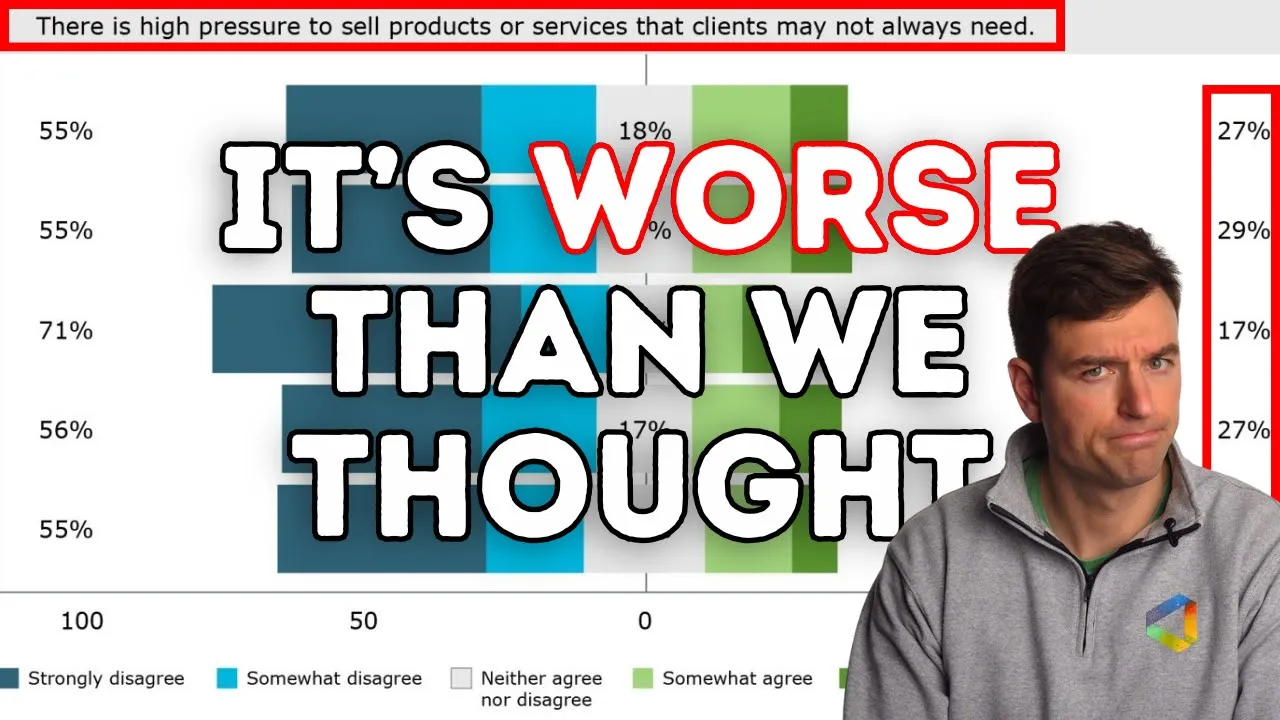
I think most people would expect this type of incentive system when buying a car, but not for financial advice. 68% of representatives say they experience sales pressure at least sometimes and 35% experience it often or always. 44% agree that there is a fear of job loss due to not being able to meet sales, revenue, client or asset targets. 23% agree that there is high pressure to sell potentially unneeded products or services to clients.
And 25% indicate that clients have been recommended products or services that are not in their interests at least sometimes. If you're a consumer of bank financial advice, that is a scary statistic. 25% of bank mutual fund representatives surveyed said that clients have been sold products that are not in the client's best interest, at least sometimes. The study does also find an unsurprising relationship between sales pressure and advice not in the client's best interest.
Representatives who reported experiencing higher levels of sales pressure were more likely to agree that clients have been recommended products or services that are not in their interests. A majority, 55% of respondents reported having concerns related to sales pressure at least sometimes, while 25% reported having these concerns often or always. A large portion of these concerned representatives are reluctant to raise their concerns at their workplace due to the fear of reprisal.
And of those that have raised concerns, 43% of them indicated that their concerns were addressed rarely or never. All things considered, the results show that most of the mutual fund representatives working for one of the big five banks have at minimum some concerns related to sales pressure in their roles. Many of them are reluctant to raise these concerns in the workplace. And among those who have voiced their concerns, nearly half of them feel that their firm has not appropriately address their concerns.
Sales pressure is definitely one thing that bank customers should be deeply concerned about. But even in the absence of sales pressure, many bank mutual fund representatives are simply limited in the investment products they can offer. Bank advisers are often limited to using bank funds. This makes sense for the bank, but not necessarily for their clients. 78% of representatives surveyed say that their existing range of product meets the needs of their clients, but almost half of them do agree that clients would benefit if they could be offered a broader range of mutual funds, including mutual funds from providers other than the bank.
This just makes sense. A bank's mutual funds, which are often going to be high fee actively managed funds, might be useful in some cases maybe, but it's hard to argue that limiting the available products to the bank's funds is a good thing for clients. This Canadian regulatory study is supported by past academic research. A 2018 paper in the Review of Financial Studies uses data from a large retail bank to analyze how banks and their financial advisers generate profits from customers.
The authors find that transactions initiated by bank advisers earn the bank higher profits than independently executed trades placed by the same client. Unsurprisingly, the bank's own mutual funds and structured products are the most profitable products for the bank. Bank profits increase with trade size and bank advisers recommend transactions that are profitable for the bank. If these profitable transactions were also making clients better off, it would be easy to argue that there is no issue here.
But the research finds that bank advised clients have worse performance than unadvised clients, suggesting again that advisers put the bank's interests before the clients. I want to mention again that these issues are more with the incentive structure and the sales culture at the banks than with the advisers themselves. I don't think bank financial advisers are malicious even if they are affected by conflicts of interest.
Their knowledge levels may also be affecting their ability to identify the conflicts and other issues with their advice. About 80% of representatives in the regulatory study believe that their peers are sufficiently knowledgeable on a variety of financial topics, but onethird of representatives reported that clients have been provided with incorrect information about products or services being recommended to them at least sometimes.
And 23% of representatives were unable to correctly identify the definition of a management expense ratio or me, one of the most important attributes of a mutual fund. This also lines up with academic research. The 2021 paper, the misguided beliefs of financial adviserss, published in the journal of finance, finds in a Canadian sample of financial adviserss and their clients, that advisers typically make the same mistakes personally as they do in their client accounts.
They trade too much. They chase past returns. They prefer expensive, actively managed mutual funds and they underdiversify their portfolios. The advisers's personal accounts underperform just as poorly as their clients. The study also shows that advisers continue to make these mistakes after they leave the financial services industry, suggesting that they weren't just putting on a show to convince clients to buy higher fee products.
They really believed in the bad advice that they were selling. This again suggests that conflicts of interest are only part of the problem and highlights the importance of raising the educational bar for financial adviserss. Solving where that bar should be across the industry from a regulatory perspective is a big job. I do think some things are moving in the right direction here in Canada, but investors seeking advice can still look for advisers with more than the bare minimum regulatory credentials.
Credible credentials with rigorous credentiing programs, ethical standards, and enforcement for professional and ethical conduct like the CFA and CFP are good places to start. It is also worth noting that how an adviser is registered does matter. A discretionary portfolio manager in Canada is generally held to a higher legal standard with a deemed common law fiduciary duty to their clients than a non-discretionary mutual fund representative.
My hunch is that many consumers assume that financial advisers are required to act in their best interest, but that is not always the case. The good news for consumers is that there are non-bank firms that employ portfolio managers, use lowcost investment products, and limit their conflicts of interest. Acknowledging my own biases here, as the chief investment officer at PWL Capital, I think that PWL is a great example.
PWL's clients work with portfolio managers whose compensation is not tied to product sales. We require our adviserss to have advanced credentials like the CFA and CFP, and we promote and pay for ongoing education for our adviserss. It's part of our culture. PWL even takes all this a step further by getting independently certified as placing our clients interests first by the center for fiduciary excellence. I've been part of that annual audit and it is no joke.
I'm not saying that PWL is good because I work for PWL. I work for PWL because I think that the way this firm operates is exactly how financial advice should be provided to Canadians. I started out in financial services with a commission-based job selling insurance and mutual funds. I had to sell high fee actively managed products or insurance if I wanted to eat. I feel for the bank advisers in a similar position, but that doesn't make raising awareness about the problems with bank financial advice any less important.
What's important for consumers to understand is that CBC News investigative journalism and a recent survey conducted by the OC and CRO suggests that financial advisers at branches of Canada's big five banks are under heavy pressure to sell financial products that are often not in the best interest of their clients. One in four representatives in a regulatory study report that clients have been recommended product or services that are not in their interests.
The study suggests that this may be tied to the sales environment within the five bank affiliated dealers, including compensation incentives and performance metrics used. A high degree of pressure to meet sales targets and the frequent use of scorecards to track, compare, and emphasize those sales targets. That kind of sales culture and incentive structure might be appropriate at a car dealership, but at least in my opinion, financial advice deserves a much higher bar.
Consumers should be looking for adviserss with credentials like the CFA or CFP who are employed by firms that put their clients interests first, encourage education for their adviserss, and incentivize highquality advice over product sales. Thanks for watching. I'm Ben Felix, chief investment officer at PWL Capital. If you found this information useful, please share it with someone who is still taking advice from the bank.
The words are the caption track's own and nothing is reworded or re-transcribed. Paragraph breaks are placed between sentences so the text reads as prose.
Free tools for your own script: paste a draft and see where it stands before you record it.
Paste your draft and see where viewers are likely to drop off, with a rewrite for each weak line.
Paste the first 30 seconds of your own draft for a hook score and rewrites.
Check your draft against YouTube's advertiser-friendly guidelines before you record it.
Read this channel's public videos and transcripts, and download a writing brief for it.