Getting the transcript
Reading the captions from YouTube. A video nobody has opened here before takes 10 to 30 seconds; this page fills in on its own.
Getting the transcript
Reading the captions from YouTube. A video nobody has opened here before takes 10 to 30 seconds; this page fills in on its own.
vidIQ · @vidIQ
This video has no Most replayed graph yet: YouTube shows one only once a video has enough views. These are the moments viewers replayed most in vidIQ's most watched videos.
Most replayed moment at 23:09
3.7x that video's typical replay level
opens up a web app tool from VidIQ all about the search terms related to your channel where there are opportunities. This is high search terms on YouTube with low video supply and that means that you can create content that fills
Said at 23:01
Most replayed moment at 10:24
6.4x that video's typical replay level
niche rates your paycheck, not your view count. A 100,000 finance video can actually out earn a 2 million view fact video. So, pick a niche that pays and build something of your own, a product, a list, a brand, all before you need it. And speaking of monetization, rather
Said at 10:16
Most replayed moment at 7:19
5.7x that video's typical replay level
tried a whole bunch of different things, meditation, uh gone to the doctor, medications, uh all sorts of things, and nothing really works. And so, I was on YouTube watching some physics lectures, and I was learning so much, and I was loving it, but I noticed that I kept falling
Said at 7:12
The graph counts replays. It does not show where viewers stopped watching.
Words
3,584
Runtime
15:18
Speaking pace
234wpm
Reading time
15min
234 words per minute, above the 201 75th percentile of 349 measured videos. That distribution comes from the 349-video hook study.
Opening (first 30 seconds)
There's YouTube creators starting from zero and getting themselves monetized in 30 days or in some cases even less time than that. Meanwhile, most creators find themselves stuck almost immediately. So, what is it that these other channels are doing differently? Well, with the 30-day plan I'm about to give you, you're going to know what to post and when to post it. And that plan does not include uploading one video every day for 30 days. Believe me, I've done that and you will burn out. And this is a good time to watch a video like this one because starting February of 2027, YouTube's monetization requirements in terms of watch time for long-form videos are
117 words, the words spoken in the first 30 seconds at 234 words per minute.
Free, no signup. See how the first 30 seconds hold attention, with rewrites.
Sentence shape
| Measure | This transcript |
|---|---|
| Sentences | 204 |
| Average words per sentence | 17.6 |
| Longest sentence | 47 words |
| Questions asked | 16 |
| Sentences containing a number | 35 |
Most used terms
Filler phrases
31 in total: like 19 · actually 5 · kind of 4 · I mean 1 · literally 1 · you know 1.
A literal whole-word count of the same phrase list the Prepublish browser extension uses, so a phrase inside another word is not counted and a phrase used in its ordinary sense still is. It is a count and not a judgement.
Free, no account. See where attention is likely to drop, with a rewrite for each weak line. The free check shows the scores and the one issue costing the most. Or run it on the words above first.
Free · No login · See a sample audit first if you prefer.
What this transcript is
Every word below is the caption track YouTube publishes for this video, pulled from the video itself and reproduced unchanged. It is not Prepublish's writing, not a summary, and not a re-transcription: it is the video's own published captions. English captions, generated automatically by YouTube, in the video’s original language. Source: the video on YouTube. A channel that would rather this page did not exist can ask for its removal through the contact page, and it is removed.
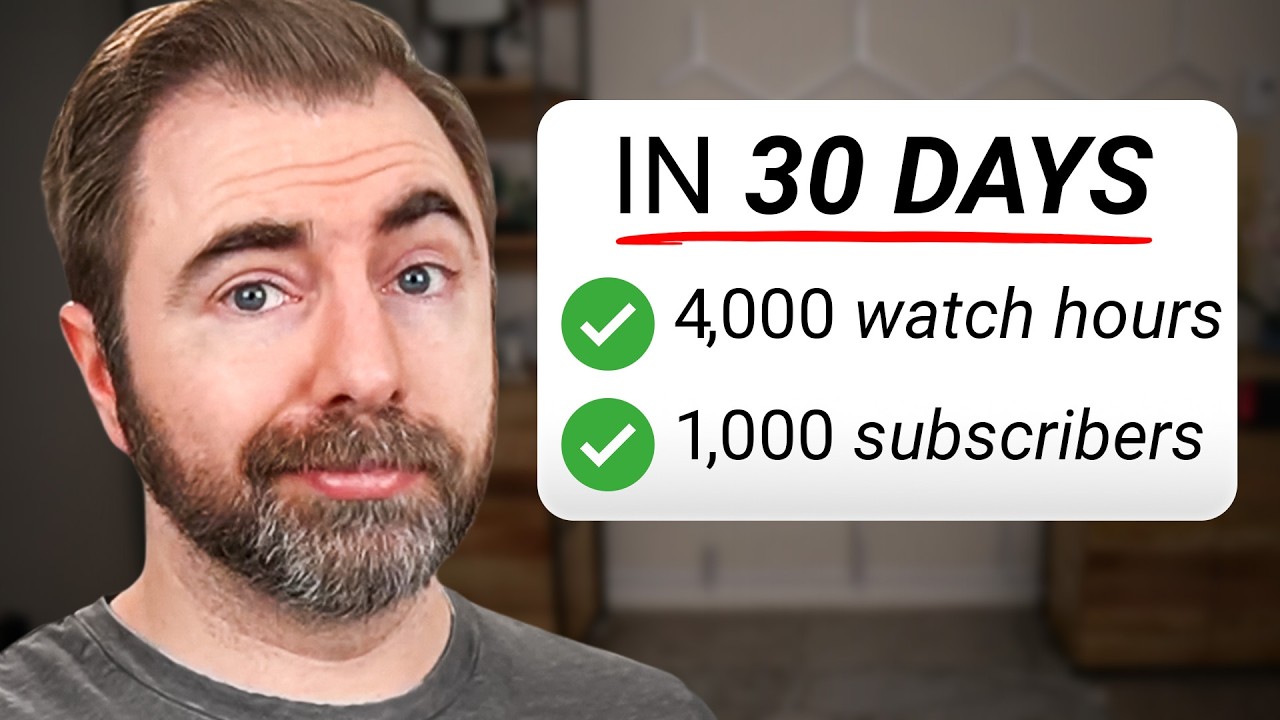
There's YouTube creators starting from zero and getting themselves monetized in 30 days or in some cases even less time than that. Meanwhile, most creators find themselves stuck almost immediately. So, what is it that these other channels are doing differently? Well, with the 30-day plan I'm about to give you, you're going to know what to post and when to post it. And that plan does not include uploading one video every day for 30 days.
Believe me, I've done that and you will burn out. And this is a good time to watch a video like this one because starting February of 2027, YouTube's monetization requirements in terms of watch time for long-form videos are doubling from 4,000 hours to 8,000 hours. That means you have about 5 months to get yourself monetized and this plan will only take one of them. Those are the basics and again, we go over it in way more depth in other videos, but the real thing to highlight here is now the difference between a short-form creator and a long-form creator.
Previously, you were able to get monetized as a long-form creator and then your shorts would be monetized as well. It didn't matter how many views they had, they would also make a little bit of money. But starting next year, it's almost as if shorts creators and longs creators are like in kind of separate camps. You can actually upload shorts to your monetized long-form channel and not get any money at all because your shorts are not maintaining that threshold of 10 million views in the last 90 days.
Meanwhile, your long-forms are doing fine and they can still be monetized. It wasn't like this before. This is leaving creators who make maybe primarily long-form content with the occasional short in a bit of a lurch. It means for creators like us, we're going to have to think if monetization is important to us, should we just focus on one lane over the other? If you want to get monetized quickly in the next 30 days, my advice to you is to focus on one lane or the other.
Obviously, for shorts creators, you have the 90-day window, but you're going to need to make some changes if your shorts are not anywhere near the millions of views they need to be at to get monetized. All that to say, pick a lane. The YouTubers growing the fastest are the ones who stay the most focused. And it's difficult to focus when you're making two entirely different types of content on your channel. Pick a lane.
You can always go back later and try out the other thing that you didn't originally choose. The goal of this video is to get you monetized in 30 days and it's a lot easier to do that if you focus. Once you answer that question for yourself, the next question you need to focus on is what's your channel about? And not all YouTube channels pay the same. Some pay $3 per 1,000 views, some pay 14, heck, some even pay 21. If you want $100 per video, that's 33,000 views with one audience and maybe under 5,000 views with another audience.
But make this choice purely based on the amount different niches pay out and you will burn out very quickly. The real filter here is overlap. Picking a topic that pays decently well while also being one that you're so interested in you could make hundreds of videos on it without becoming resentful of it. Then you need to get specific. Don't just think, well, I'm going to make a fitness channel, make a fitness channel specifically about maybe training with kettlebells.
I'm not going to have a tech channel, I'm going to have a channel about budget handheld consoles. Specificity is what's going to have people choosing your channel over the larger ones when they're covering those topics, you know, but just not going as deep. But there's something you want to watch out for. You want to narrow your topic without narrowing your ceiling. Handheld gaming is a narrow topic with millions of people searching for it every month.
Handheld gaming for left-handed people is going to be a narrow ceiling. What that means is there might be some people out there looking for that specific type of video, but there's just not going to be a lot. Mainly because I don't think they make consoles like that for left-handed people, but correct me if I'm wrong. So, ask yourself this question of your first five video ideas. Is it plausible that 100,000 people would find themselves interested in these ideas?
If yes, then cool, you're specific. If no, you might have narrowed a bit too much. You need to have a high enough ceiling so that you can do this in 30 days. And then, just a bit of a side tangent. If you're considering making a complete departure from what you're already doing on your channel with the goal of getting monetized in 30 days, I would encourage you to maybe start fresh. When you upload a video, YouTube shows it to your existing subscribers and regular viewers first.
Those early impressions coming from people who already know who you are are measured pretty heavily. YouTube is going to be able to determine a lot in terms of how successful this video is or not based on your regular viewers wanting to watch it. If they ignore that video completely, that's a signal to YouTube that maybe people don't want to watch this. I've seen videos like that eventually find their audience, but I find it to be kind of an uphill battle.
It could take 30 days alone for those new ideas to find the right audience and you're trying to do this quickly. So, take everything you learn maybe start a new channel and try out this new topic. It might feel like you're throwing away a perfectly good head start by abandoning your 300 subscribers, but those 300 subscribers subscribed for something else. But, okay, now that your channel and your niche are set and ready to go, it's time to make things.
Let's break down how these next 30 days are actually going to go for you. In the first 2 weeks, you're going to be doing two things on repeat. Number one is you're going to model what's already working and the biggest mistake you can make at this stage is guessing. That's because everything that works on YouTube is already publicly available information. All you have to do is find it. Now, one way to do this is to make a dummy YouTube account with no watch history whatsoever and you're going to search for a bunch of videos within the niche that you're hoping to also enter into.
What you're doing here is simulating what it will be like to be one of the viewers who will eventually find and watch your channel. When you fill your watch history with like 10 to 15 of these videos, you can go back to the homepage and see, "Okay, cool. What types of videos does YouTube recommend to a user like this?" Another way you can do this is using our outlier tool. All you have to do is type in the keywords for your niche and it surfaces videos that are outperforming for their channel's average size.
You can sort by date posted, how big of a breakout video it is, channel size. This is a really great way to see what's working for smaller channels and conversely, what can work for you as a small channel. And if you really want to research like a pro, you can use the outlier tool to research adjacent niches. What's an adjacent niche? Well, think about it like a content neighbor. I'm starting my handheld gaming channel and I want to find breakout videos that I can learn from.
Go to the research tab on vidiq.com and type in handheld gaming in the keyword section. Scroll down and you see there's retro gaming and that's an adjacent niche to mine. So then we just type in retro gaming to find outlier videos for that niche. I like to use the filters to search for channels that are under 50,000 subscribers, maybe over the last 3 months, and look for videos that have titles or formats that could be relevant for my handheld gaming niche.
In this case, I see the title the truth about blank showing up over and over again. And voila, I found the topic for my next video. The truth about handheld gaming in 2026. Now that is assuming I have a take on that particular topic without even looking at the video. I can see the packaging and go, I actually do have some thoughts about this. Because on YouTube the name of the game is packaging. If you can find a title and thumbnail format that's working well for audiences that are similar to yours, then don't be afraid to use your own version of that format for your own ideas.
Think of it as the bun to your hot dog. And just to be super clear, the goal is to make your own version of this packaging. Put something together yourself and put your personality into it. But know that this type of packaging is working for people. People are clicking on this type of format. From there, you're going to build on what you've borrowed. You have your bun, now how do we make what's inside of it better than the original thing?
Even though a video might be breaking out and seem really successful, there's always something missing. And the best place to identify where that something is is the comment section of those successful videos. If there's a question that keeps coming up over and over again in the comment sections of these videos, then that shows there's an appetite for this content. So go to the breakout videos in this niche and check the comment sections and see what people are saying.
What's the next thing they're asking for because you can deliver on that. Gosh, there's so many comments on these videos. I kind of wish there was a way to read them all quickly so I don't have to keep scrolling past the people that just keep saying first. Unless yeah, you better believe we have a tool for that too. If you have our Chrome extension installed, you can just hit analyze at the top of a comment section on a video.
It'll scan through every single comment and our plugin will tell you the comment section sentiments, themes, and most importantly, the most commonly asked questions from the viewers of the video. When I said earlier you shouldn't have to guess what people want to watch, this is just one of the things I was talking about. But now we need to talk about the first 30 seconds of your video because none of this matters if nobody sticks around.
Look at any retention graph from even the largest channels on the platform. The first 30 seconds always represents the steepest decline in viewers. YouTube themselves specifically highlights that first 30 seconds. So, if you can get someone past that point, they're way more likely to stick around for the rest of the video. So, your job is to straighten out that hockey stick. The hook itself is really the first 5 to 10 seconds of a video and it has two jobs.
One, it needs to deliver on what the title and the thumbnail promised. And two, it has to tease what's coming up in the video without giving it all away. And both of these things matter because one, if you don't deliver on what someone just clicked, they're going to leave. And two, if they got their answer in that short amount of time, then why would they stick around for the rest of the 10-minute video? That's for long form, of course.
For shorts, you have about 3 seconds to do all those things. And don't try to fake your way out of this, either. Viewers aren't dumb and YouTube themselves knows what's in your video. Not just from the packaging itself, but literally their systems can see what's in your video. If what you promised isn't being delivered upon, then everyone's going to know and your video won't get pushed nearly as much as you were hoping.
Also, pro tip, and this is a hard one because I still do it all the time, try to remove "in this video" from your vocabulary because it's always a signal that there's a good chance you're about to start rambling instead of getting to the point. Now, I think I've made it clear that the first 30 seconds matter, but so do the last 20 seconds of your video. What most people tend to do is slap on an automated end screen. Usually, they let YouTube kind of just pick a video or they put their most popular video and they don't even reference it.
And it makes sense. This is the most popular video and it's performing well. But let's think about this for just a second because yes, while this might be your most popular video, is it the one that makes the most sense when you relate it to the thing that they just watched? Perhaps the the they just watched leads them down a different rabbit hole, one that you might already have a video for. Let's go back to the handheld gaming example from earlier, okay?
If someone just watched The Truth about handheld gaming, their next question might not be whatever your most popular video's about. It might be, well, okay, what handheld console should I buy? Is that a video that's already on your channel? Is it one you're about to make? In either case, it should be your end screen. They're simply more likely to click that video, and when they do, that means they just watched two videos within one session on your channel.
That is a much more powerful thing that it might sound like. That is more watch hours from one viewer. That is someone starting to become really invested in not just the thing you talked about in that one video that one time. They're becoming invested in your whole channel, potentially in you as a person. So, for the first 2 weeks, stay within that niche, but continue to try out different topics within it. This is your experimental phase, and you're going to want to take some swings, because otherwise, your data is just not going to mean much.
So, now you're 2 weeks in, you have several videos on the channel. They're all within the same niche, but they're all different swings as well. Now, it's time to find out which ones connected. For long-form videos, start with impressions click-through rate. For shorts, start with stay to watch. You can find your channel average right at the top, and then check each video against it. Anything well below your average click-through rate could be a packaging problem, so test a new thumbnail and title, and see if it helps performance.
You can start an packaging A/B test on a video's details page, but it's important to remember that a low click-through rate could also be an idea problem. The best title and thumbnail in the world won't do anything if the video idea itself is just not good enough. There's an old saying, you can't polish a turd, and that is relevant when it comes to making YouTube videos. But in certain cases, it can be worth it to change a video's packaging if the click-through rate is low, but you believe in the idea.
Next, look and see how people watched your content. Go back to the same analytics page from earlier, hit the plus sign, and select average view duration and average view percentage. Why both? Well, if a 30-minute video gets a 6-minute average view duration, that's nowhere near as good as an 8-minute video getting a 6-minute average view duration. If a video has lots of watch time and good view duration or view percentage, that's a sign that the videos are really engaging to the viewers.
If you want to go one step further, you can click on a video from this tab, select analytics, and switch to the engagement tab. Scroll down and you'll see exactly where and when your audience dropped off. When this graph is flat, that's a good sign. When there's spikes, that's a great sign. It means the people are rewatching various moments from the video. And if it dips, look and see what happened in that moment in the video because people are leaving and they're not coming back.
This data will help guide you when you make your next video. And related to this, I have another tool I want to show you, and I know it's a lot with the tools today, but if you hit control K on your keyboard while you're on YouTube, our AI coach will pop up. From here, you can go ahead and just ask our tool where the best moments in terms of retention are for your videos. This only works for your channel, by the way.
It won't work for channels that are not connected to your account. This all might seem like a lot of data, but it's important, and the reason is because it tells you exactly what's working and why it's working. It's also what the next 2 weeks of this plan are built on. By now, one of these videos you've made has likely beaten your channel's average, maybe through click-through rate, view duration, ideally both. This is where we're going to stop experimenting for a bit with new things and try to double down on something that's worked in the past.
And I mean, we're doubling down. The same structure, the same title formula. We're going to do the same thumbnail style, and we're going to make the video the same length with a similar opening. The key here, of course, is we're going to make a video on a different topic. But everything else about it, structurally, is the same. Now, I know you're thinking, "Won't people get bored of watching the same video five times in a row?" The truth is, you're going to get sick of it long before they do.
You're seeing all of them because you're only looking at your channel, but your viewers are seeing one of them, and they might see one of them days or weeks apart with 40 other videos in between. And the drop-off comes way later than it feels like it should. Most creators bail on a working format only three or four videos into it because on the inside it feels repetitive, but the one that broke out sometimes can go forever.
An employee here at VidIQ used to be a strategist for Smosh, and they're definitely not the person who helped write this video. What happened was they had a breakout series, the try not to laugh challenge. And by video seven or eight, an internal conversation happened where they asked themselves, "Is this getting old for our viewers?" It's natural to think, "People must be sick of this by now." And the short answer is, no, they are not.
I just spilled water on myself. >> I'm thinking of >> starting a series called the try not to spill water on myself challenge. >> If it's still working, it's not old to your audience yet. So, keep doubling down until it stops. By day 30, a lot of you following this formula will have met those requirements, and a lot of you will not have. But, that's okay because there'll still be four more months for you to continue iterating, testing new ideas, and trying to find those things that become repeatable for you.
And even after getting monetized, this is the formula that so many channels, even with millions of subscribers, are putting to practice so they can continue YouTube is just a difficult journey, whether it's a hobby or a job for you. So, it's good to learn this stuff now and put it to practice because you're going to need it. Before I let you go though, there is one more thing that's worth knowing here. All the monetization we've been talking about today is actually a full tier above the first level of monetization.
At 500 subscribers and three videos in the last 90 days, with a total of 3,000 watch hours or 3 million shorts views, you can become monetized with at the fan funding level. The first level of monetization actually unlocks fan funding. The requirements look like this. If you reach these metrics, they unlock things like super chats, super thanks, memberships, but not ad revenue. But, it allows an audience that already knows who you are to begin supporting you financially if they'd like, and these requirements are not changing in February.
If you want to dive a little bit deeper into shorts monetization specifically, then I'm going to recommend you go watch this video next.
The words are the caption track's own and nothing is reworded or re-transcribed. Paragraph breaks are placed between sentences so the text reads as prose.
Free tools for your own script: paste a draft and see where it stands before you record it.
Paste your draft and see where viewers are likely to drop off, with a rewrite for each weak line.
Paste the first 30 seconds of your own draft for a hook score and rewrites.
Check your draft against YouTube's advertiser-friendly guidelines before you record it.
Read this channel's public videos and transcripts, and download a writing brief for it.