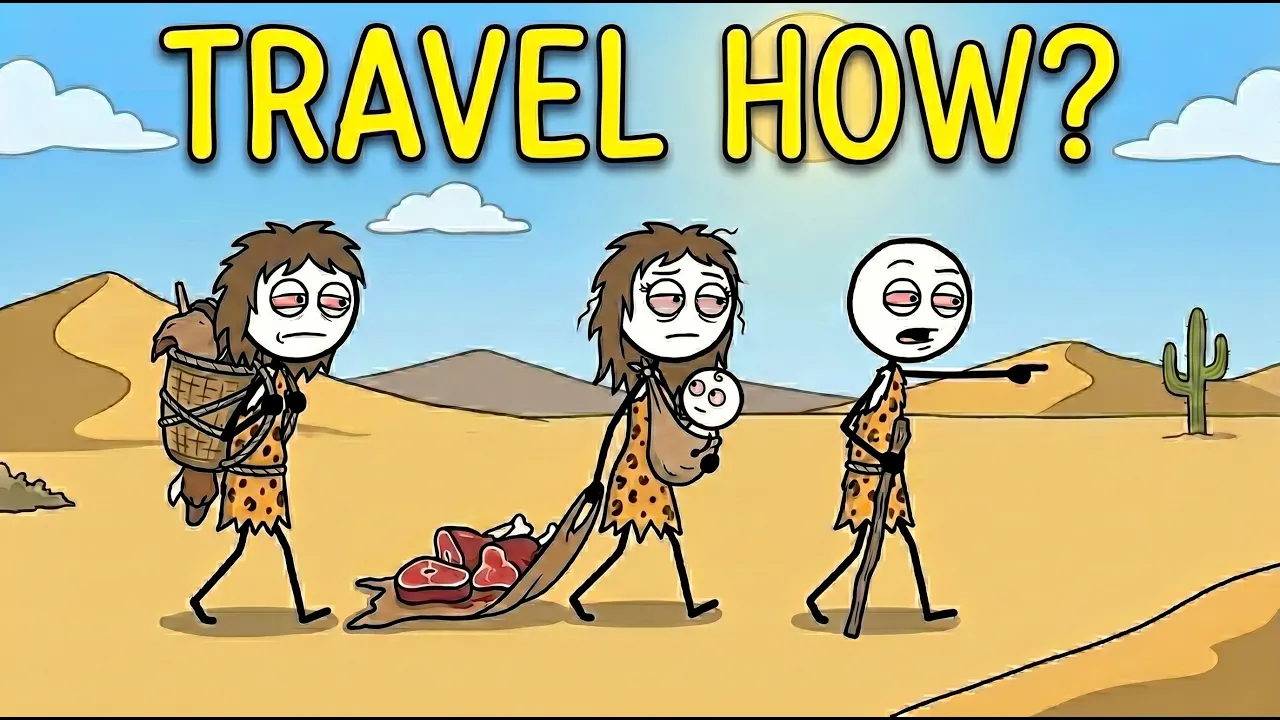
How Did Ancient Humans Travel the World? transcript
Ink Explainer · @Inkexplainer96
Words
2,053
Runtime
9:22
Speaking pace
219wpm
Reading time
9min
219 words per minute, above the 201 75th percentile of 349 measured videos. That distribution comes from the 349-video hook study.
Opening (first 30 seconds)
You got in your car this morning, turned the key, pressed the pedal, and moved 40 miles an hour without using a single muscle. 100,000 years ago, that same trip would have taken two full days of walking, barefoot, through territory that could kill you. No road, no path, no sign telling you what's ahead. For almost all of human history, getting anywhere meant risking everything, and you had nothing to carry you there except your own two feet. Today, you can fly across the planet in a day. You can order something from the other side of the world, and it shows up at your door. Movement is so
110 words, the words spoken in the first 30 seconds at 219 words per minute.
Sentence shape
| Measure | This transcript |
|---|---|
| Sentences | 165 |
| Average words per sentence | 12.4 |
| Longest sentence | 45 words |
| Questions asked | 1 |
| Sentences containing a number | 39 |
Most used terms
- years24
- miles15
- humans13
- across10
- found10
- walking10
- horse9
- built8
- human7
- water7
- animal6
- ocean6
Filler phrases
5 in total: like 3 · basically 2.
A literal whole-word count of the same phrase list the Prepublish browser extension uses, so a phrase inside another word is not counted and a phrase used in its ordinary sense still is. It is a count and not a judgement.
What this transcript is
Every word below is the caption track YouTube publishes for this video, pulled from the video itself and reproduced unchanged. It is not Prepublish's writing, not a summary, and not a re-transcription: it is the video's own published captions. English captions, generated automatically by YouTube, in the video’s original language. Source: the video on YouTube. A channel that would rather this page did not exist can ask for its removal through the contact page, and it is removed.
Transcript
You got in your car this morning, turned the key, pressed the pedal, and moved 40 miles an hour without using a single muscle. 100,000 years ago, that same trip would have taken two full days of walking, barefoot, through territory that could kill you. No road, no path, no sign telling you what's ahead. For almost all of human history, getting anywhere meant risking everything, and you had nothing to carry you there except your own two feet.
Today, you can fly across the planet in a day. You can order something from the other side of the world, and it shows up at your door. Movement is so easy now that it's basically invisible. But, for roughly 300,000 years, every single journey a human being ever took happened at walking speed. And that one limitation shaped everything about how we lived, what we ate, who we married, and how much of the world we ever got to see.
So, let's start at the beginning. Your feet. Humans are the best long-distance walkers on the planet, but definitely not the fastest. A cheetah can hit 70 miles an hour. A horse can sustain 30 for miles. You top out at maybe 15, and only for a few seconds before you're gasping. Speed was never the point, though. You can walk 20 miles in a day, sleep, and do it again tomorrow, and the next day, and the next. You can do this for weeks.
No other animal on Earth can do that. Your feet have arches that act as springs, and your Achilles tendon stores and releases energy with every step, so your muscles don't carry the full load. There's a ligament running up the back of your neck that keeps your head stable while your body moves underneath it, and you have about 2 million sweat glands cooling you down while every other large mammal on the savanna overheats and has to stop.
You're not built to be fast. You're built to never stop. In 1978, paleoanthropologist Mary Leakey discovered a trail of footprints in Laetoli, Tanzania. They were pressed into volcanic ash 3.6 million years ago. Two individuals walking upright, side by side. The oldest evidence of bipedal walking ever found. And they look almost exactly like yours. For millions of years, that was the only transportation technology humans had.
And somehow, it was enough to take us further than any species has ever gone. Starting roughly 70,000 years ago, humans began walking out of Africa. Not in one march. This happened over thousands of years, generation by generation, small groups pushing a little further into territory which no human had ever seen. They crossed the Middle East, they spread across Asia, they reached Europe, they walked into Siberia, crossed a land bridge into Alaska, and kept going south through the Americas.
That's roughly 15,000 miles without knowing the destination even existed. And the thing that doesn't get talked about enough is that they weren't walking randomly. Archaeologists have found obsidian tools hundreds of miles from the nearest volcanic source, shells found far inland, amber traded across mountain ranges. These people were covering massive distances on purpose, to trade, to connect with other groups, to find specific resources they knew existed because someone had told them about it.
This wasn't wandering, this was networking on foot. The problem is, walking works great until something gets in the way. You can walk across a desert, you can walk over a mountain pass, but a river, a river stops you in your tracks. And rivers were everywhere. They cut through every migration route, every hunting ground, every trade path. For hundreds of thousands of years, a body of water was basically a wall. You either found a shallow crossing or you turned around.
And then, somehow, humans figured out something no other land animal ever has, how to cross water on purpose. In 2003, archaeologists working on the island of Flores in Indonesia found stone tools dating back roughly 800,000 years. The problem is that Flores has never been connected to the mainland. Even during the lowest sea levels of the ice ages, there was always at least 12 miles of open ocean between the island and the nearest land, which means one thing, someone made the crossing.
We don't know what they used. Wood rots, bamboo decomposes. Whatever they floated on is long gone. But the tools are there, which means the crossing happened. The first boats were probably nothing, a fallen log, a bundle of reeds tied together, not designed, discovered. Someone grabbed a floating log to cross a stream and didn't drown. That was the breakthrough. But what happened next was deliberate. Around 65,000 years ago, humans crossed from Southeast Asia to Australia.
That crossing meant sailing at least 60 miles of open ocean. You can't see Australia from the other side. You can't drift there by accident. Someone built something that could float, pointed it toward water they couldn't see across, and paddled. Think about that for a second. They left solid ground with no idea if there was anything on the other side. The oldest boat we've ever found is the Pesse Canoe from the Netherlands, about 10,000 years old, just a hollowed-out log.
But the technology goes back way further than that. People were already living on islands they had no way of reaching on foot tens of thousands of years before that canoe was ever carved. And then the Polynesians did something insane. Starting around 3,000 years ago, they crossed the Pacific Ocean, the largest body of water on Earth. They built double-hulled canoes, loaded them with food and animals and entire families, and sailed thousands of miles reading nothing but the stars, the direction of ocean swells, the way birds flew, and the color of clouds near land.
No compass, no map, just observations so precise it still impresses modern navigators. They reached Hawaii, Easter Island, New Zealand, every habitable island in the Pacific. Some of those voyages covered over 2,500 miles of open water with nothing in between. Walking conquered land, boats conquered water, but there was still a problem nobody had solved. You can walk 20 miles, but you cannot walk 20 miles carrying a 200-lb animal you just killed.
For most of human history, the limit on transportation wasn't distance, it was weight. You could only move what your body could carry. And your body can handle maybe 40 to 60 lbs before it starts breaking you down. So, humans started cheating. First thing they tried was dragging. You kill something big, throw it on a hide, and drag it back to camp. We know they did this because archaeologists have found wear marks on ancient hides that only show up when something heavy has been dragged a long way.
Then someone had a better idea, the travois. Two long poles tied together in a V shape with a platform slung between them. You drag the narrow end, the wide end carries the load. It spreads the weight out, and just like that, one person could move 100 lbs or more. Here's what's wild about that. The travois might be one of the oldest ways humans ever moved anything, but it's made of wood and leather, so almost none of them survived.
The only reason we know it existed is because people were still using it when Europeans showed up in the Americas thousands of years later. But the real breakthrough in moving weight wasn't something you could build, it was something you could befriend. Around 15,000 years ago, humans domesticated dogs, first animal we ever partnered with. And one of the first jobs we gave them was hauling weight. In the Arctic, dogs pulled sleds across ice and snow.
A single dog can move about 45 lb. A team of six could carry a family's entire camp. But dogs are small. We needed something bigger. About 5,500 years ago, on the steps of what is now Kazakhstan, humans figured out the horse. We know this because of a group called the Botai. Archaeologists found wear marks on horse teeth from bits. Somebody had been putting something in that animal's mouth to control it. They found mare's milk baked into pottery.
These weren't people who hunted horses. They rode them and milked them and built their entire lives around them. And the horse changed everything. For 300,000 years, roughly 5,200 years old, the fastest a human could travel was about 4 mph, walking speed. On a horse, you could hit 30. In a single generation, the human world got eight times smaller. Suddenly, you could cover in days what used to take weeks. Messages moved faster, trade routes stretched further, and warfare changed forever because an army on horseback could reach you before you even knew they were coming.
Donkeys hauled goods through deserts. Camels made it across the Sahara. Reindeer dragged sleds through Arctic snow. Llamas carried cargo over the Andes. Wherever humans showed up, they found whatever animal fit and put it to work. But we weren't done. There was one more invention coming, and it took an absurdly long time to show up. Here's something that doesn't make sense until you think about it. Humans crossed every ocean on Earth before anyone invented the wheel.
The oldest known wheel turned up in the Ljubljana Marshes of Slovenia, roughly 5,200 years old. That's it. Boats go back at least 10,000 years and probably way further. Horses were tamed 5,500 years ago. Humans had already sailed to Australia 65,000 years before that. The wheel was one of the last major transportation inventions, not the first. And it didn't even start as transportation. The first wheels were for pottery, a spinning disc to shape clay.
At some point, somebody looked at that disc and turned it on its side. What if you put something on top of it? The first wheeled vehicles were slow, solid wood wheels, heavy. They cracked on rough ground and got stuck in mud. A horse without a cart was honestly faster than a horse with one. But around 2000 BC, someone figured out the spoked wheel. Lighter and stronger and way faster. And now you had chariots. Speed and cargo at the same time.
Roads came after that. The first paved road we know of went down in the city of Ur around 4000 BC. And once you had wheels and roads and horses all working together, you finally had something that looked like a real transportation system. Trade exploded. Empires became possible. You could move armies and supplies hundreds of miles without everything falling apart. The wheel, the horse, the road. That combination is what built every civilization you've ever heard of.
So, here's the full picture. For 300,000 years, humans had nothing but their legs and they walked across the entire planet. They hit water and figured out how to float. They needed to carry more so they learned to drag. Then they built frame. Then they partnered with animals. They figured out the horse and the world got smaller overnight. They invented the wheel and it got smaller again. Every one of those breakthroughs took thousands of years and every one was built on top of what came before it.
Solving problems that would have seemed impossible to anyone who came before. Now you sit in a metal box on a paved road doing 70 and you call it a commute. You fly 3000 miles across an ocean in 6 hours and you're annoyed the Wi-Fi is slow. You've got a machine in your pocket that can summon a car to your exact location in 4 minutes and you're irritated it takes five. Your ancestors walked barefoot for 15,000 miles across continents they couldn't name to reach places they'd never seen.
And they did it because they had to. Because staying still meant dying. We solved the problem of distance so completely that we forgot it was ever a problem. Every highway, every airport, every set of train tracks on this planet exists because 300,000 years ago someone looked at the horizon and started walking. They didn't know where they were going. They went anyway. And that's the most human thing there is.
The words are the caption track's own and nothing is reworded or re-transcribed. Paragraph breaks are placed between sentences so the text reads as prose.
Use this transcript
Three free tools that work on the material around a video like this one. No signup, no login.
Hook Analyzer
Paste the first 30 seconds of your own draft for a hook score and rewrites.
Policy Pre-Flight
Check your draft against YouTube's advertiser-friendly guidelines before you record it.
Channel Skill Generator
Read this channel's public videos and transcripts, and download a writing brief for it.