Getting the transcript
Reading the captions from YouTube. A video nobody has opened here before takes 10 to 30 seconds; this page fills in on its own.
Getting the transcript
Reading the captions from YouTube. A video nobody has opened here before takes 10 to 30 seconds; this page fills in on its own.
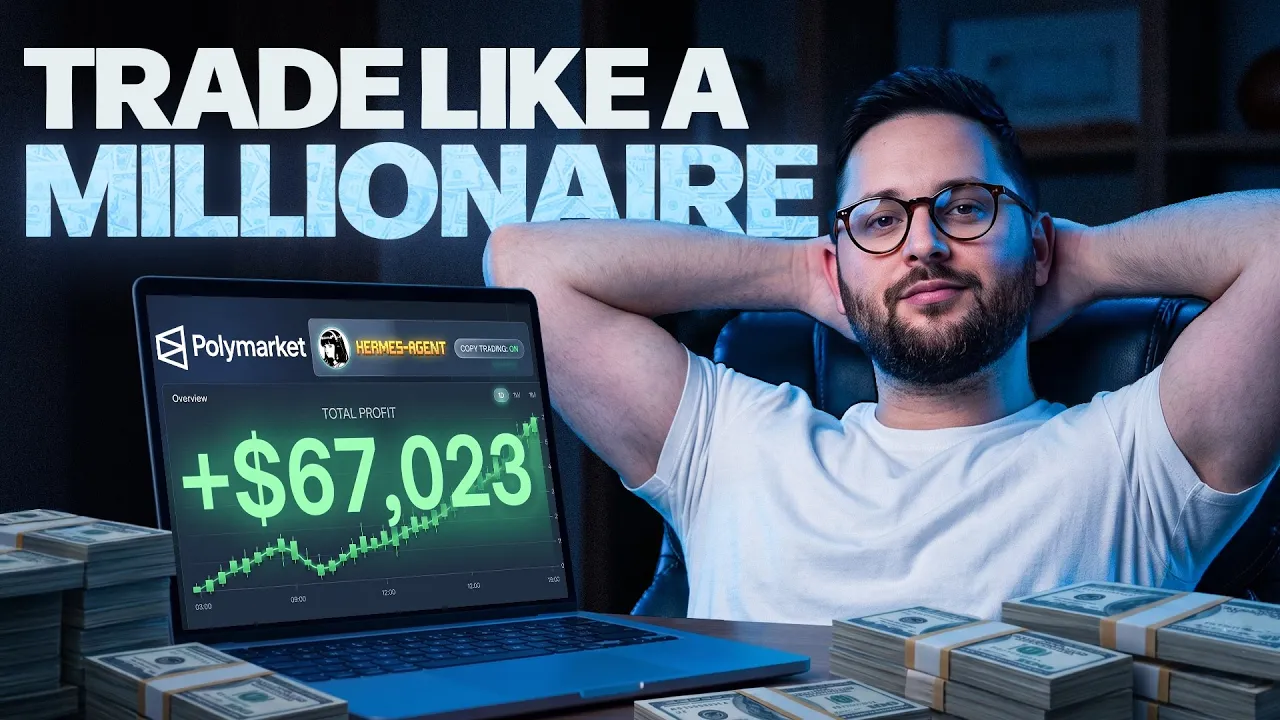
Sharbel A. · @sharbelxyz
This video has no Most replayed graph yet: YouTube shows one only once a video has enough views. These are the moments viewers replayed most in Sharbel A.'s most watched videos.
Most replayed moment at 13:32
3.9x that video's typical replay level
built-in memory, which is great. Here is how I would think about memory providers. Memo is interesting if you want a dedicated memory layer for personalized AI agents. It focuses on extracting, storing, linking, and retrieving memories efficiently. Their
Said at 13:25
Most replayed moment at 6:37
5.8x that video's typical replay level
trading strategy. Tests it. If it's better, it keeps it. If it's worse, it discards it and tries again. So, that's exactly what I built. Okay, here's the system we have at play. I gave it two years of crypto data,
Said at 6:31
Most replayed moment at 1:53
3.7x that video's typical replay level
let's install it together. Okay, so for step one, we need to actually start by installing Bullpen's CLI so that we can actually do everything that we want to do. And for that, let's first open Claude and put in the dangerously skip
Said at 1:47
The graph counts replays. It does not show where viewers stopped watching.
Words
3,503
Runtime
23:13
Speaking pace
151wpm
Reading time
15min
151 words per minute, below the 160 25th percentile of 349 measured videos. That distribution comes from the 349-video hook study.
Opening (first 30 seconds)
I've built hundreds of Polymarket trading bots, but the easiest bot to build is actually [music] not a prediction bot. It's a copy trading bot. But, the version I want to teach you how to build here today does not just find a whale and blindly follow whatever they do because that breaks too fast. A wallet can show massive profit and still be a terrible copy target. Maybe all the profit came from one lucky
76 words, the words spoken in the first 30 seconds at 151 words per minute.
Free, no signup. See how the first 30 seconds hold attention, with rewrites.
Sentence shape
| Measure | This transcript |
|---|---|
| Sentences | 267 |
| Average words per sentence | 13.1 |
| Longest sentence | 44 words |
| Questions asked | 23 |
| Sentences containing a number | 27 |
Most used terms
Filler phrases
42 in total: uh 13 · like 11 · actually 10 · literally 3 · right? 2 · you know 2 · basically 1.
A literal whole-word count of the same phrase list the Prepublish browser extension uses, so a phrase inside another word is not counted and a phrase used in its ordinary sense still is. It is a count and not a judgement.
Free, no account. See where attention is likely to drop, with a rewrite for each weak line. The free check shows the scores and the one issue costing the most. Or run it on the words above first.
Free · No login · See a sample audit first if you prefer.
What this transcript is
Every word below is the caption track YouTube publishes for this video, pulled from the video itself and reproduced unchanged. It is not Prepublish's writing, not a summary, and not a re-transcription: it is the video's own published captions. English captions, generated automatically by YouTube, in the video’s original language. Source: the video on YouTube. A channel that would rather this page did not exist can ask for its removal through the contact page, and it is removed.
I've built hundreds of Polymarket trading bots, but the easiest bot to build is actually [music] not a prediction bot. It's a copy trading bot. But, the version I want to teach you how to build here today does not just find a whale and blindly follow whatever they do because that breaks too fast. A wallet can show massive profit and still be a terrible copy target. Maybe all the profit came from one lucky trade or a few lucky trades.
Maybe the wallet is only good in one category. Maybe the markets are too illiquid. Maybe by the time you see [music] the trade, the price has already moved way too far. So, this bot starts one step earlier because before it copies trades, it finds [music] the wallets worth copying. It pulls the Polymarket leaderboard, scans the top 500 wallets, studies the last 30 days, scores each by ROI, consistency, and copyability.
[music] Then, it trades the best signals with simulated 5 to $20 positions. The whole thing runs through Hermes Agent, and the performance shows up in a dashboard inside of my own mission control. Hermes scans the leaderboard, updates the wallet profiles, watches new trades, and basically runs [music] almost everything for us and then sends us an end-of-day report. Look, I've had strategies make me thousands a month, and I've had strategies lose me thousands a month.
By the end of this video, you should have yourself a strategy that improves with time on its own without you having to do anything but monitor it every once in a while. If you keep watching this video till the end, I'll also be giving you the full prompt to build out everything I'm about to [music] outline in this video. So, this is not just a trading bot. It's a copy trading research system that to prove the edge before it earns autonomy.
And the first problem is not how to place trades, the first problem is figuring out who is actually worth copying. Let's get started. The beginner mistake is thinking the leaderboard tells you who to copy because it doesn't. The leaderboard tells you who made the most money. And that is very useful information, but that's not enough. A wallet can make money in a way that is impossible for you to follow. If one wallet made most of its profit from one massive trade or from like three big trades, that is not a repeatable signal yet.
If one wallet trades tiny markets with no liquidity, the return might look amazing for that wallet, but copying it could be impossible. And if one wallet enters early and moves the price too high, you might always arrive late. Something very important, if one wallet is great at say politics, but terrible at crypto, copying every trade from that wallet including the trades or the categories it sucks at is just a recipe for disaster.
So the first part of the bot that I recommend you build out is a leaderboard scanner that pulls the top 500 wallets from Polymarket, then it does not ask who made the most money. It asks who is copyable. Here's the difference, let me explain. For every wallet, the bot should calculate three main scores: ROI, consistency, and copyability. ROI tells us whether the wallet made money. Consistency tells us whether the wallet seems repeatable or whether the results came from just a few lucky hits.
Copyability tells us whether we can realistically follow the wallet without getting wrecked by late entries, bad spreads, or just category mismatch. That score is the real starting point for any of your bots. Because of the wallet universe is bad, the rest of the system is just >> beautifully organized chaos. >> The bot should also rank wallets by category, politics, crypto, sports, macro, so on and so forth. A wallet should not get treated as universally smart just because it was right in one lane.
That is where a lot of copy trading systems get sloppy. They treat a wallet like a genius when the wallet might only have edge in one specific market type. So, before the bot watches trades, it creates wallet profiles and whether blind copying that wallet would have worked over the last 30 days because you always want to have comparison, a baseline. That gives the bot a better foundation. But, once we know which wallets are worth copying, we still should not blindly copy every trade.
That is the next mistake. The dumb version of copy trading is simple. Wallet bought yes, so I buy yes. That's not a strategy. That is outsourcing your bad decisions to someone else's wallets. A better copy trading bot starts with a better question. Is this trade still worth copying right now? That means every new wallet trade gets scored before anything happens. Who made the trade? What category is this wallet actually good for?
What price did they get in? What price can we get in now? How far has the market moved since their entry? How soon does this market resolve? And is this wallet usually early enough to copy? Or is this a real thesis, not just signal? The decision labels that your wallet uses should be simple. Copy, watch list, or skip. Copy means the trade is strong, the category is a fit, the market is liquid enough, and the entry is not too late.
It passes all the checks, so we copy. Watch list means the signal is interesting, but the entry is not clean yet. So, the bot watches it. It does not copy it, but it places on its watch list to see how it's done later on. Should we have copied it? Was it a good decision not to copy it? So on and so forth. Skip, the last one, means the trade is too late, too illiquid, too noisy, or just outside that wallet's proven edge.
This is where the bot becomes super useful. Not because it predicts everything, because it refuses most of the bad copies. A good skip is as important as a good entry. Trust me when I say this. If the bot stops you from chasing a wallet after the market already moved like 25%, that is valuable. If it ignores a high ROI wallet because the wallet only made money from a few small trades, that is valuable. If it says a wallet is interesting, but only in crypto markets, that is valuable.
But filtering one trade is still not enough. The real edge comes when the bot tracks whether its filters actually work. That is why the next layer is paper trading. Okay, hear me out when I say this. As someone who's done this hundreds of times before. The first version of your copy trading bot should not place real trades. As much as you want it out in the wild making you as much money as early as possible, it should paper trade first.
Paper trading means the bot acts as it is placing real money, but it does not actually execute anything. It just simulates that it is. If a high-scoring wallet enters a market and the trade passes the filter, the bot creates a simulated position. It assumes as though it's placed money on it and then it tracks by the time of closing. It sees that we make money, that we lose money. Was it a good bet, a bad bet? The way I typically place my copy trading wallets is the following.
I have three tiers. It places $5 bets for a decent signal, $10 bets for a strong signal, and $20 bets for the highest confidence signals. This mitigates the risk so that you're not just $20, $20, $20 and you end up wrecked after a couple of uh not days, hours. Then Hermes updates the paper P&L every single hour. The bot should not only ask did we make money on paper, it should ask did our filtering improve the strategy? >> [snorts] >> If blind copying the leaderboard beats our bot, then the bot is not adding value.
If the filtered strategy beats blind copying, now we have something worth studying. I also want the bot to track missed winners and avoided losers because those are both lessons that it can use to learn and improve. If the bot skips a trade because liquidity was bad and that trade later loses, that was a good skip. If the bot skips a trade because the entry looked late or bad and the market keeps running for some reason, maybe the late entry rule we have is a bit too strict.
The point is that paper trading creates evidence. And without evidence, the bot is just confident for no reason. With evidence, however, the bot can improve. And the evidence lives inside the decision journal. This is the soul of your system. Every signal needs a decision journal entry. Not just what happened, why the bot made the decision. For example, wallet A bought yes on a crypto market at 42 cents. The current price is 45 cents.
The spread is 3 cents. The wallet has a strong crypto track record, market resolves in 2 hours, liquidity is acceptable. Decision, copy. That is what a journal entry should look like. Along with a reason, this wallet was strong, good category fits, still early enough, price movement is not too far. Your bot should place its reasoning for copying the trade. That journal is what lets your bot get better. Later, when the market moves or resolves, the bot can review all of its previous decisions.
Did paper copy trades actually improve after the signal? Did watch-list traders become better entries later? Did skips save us from bad trades? This is where the self-improvement part of this video actually happens. Maybe the bot learns not to paper copy if the price has already moved more than 12 cents. Maybe it learns that a certain wallet is only copyable for crypto-related events. >> [snorts] >> Maybe it raises the minimum liquidity threshold.
This is what self-improving should mean. Not the agent magically becomes a genius overnight. Decision loop that tracks its own reasoning and gets less stupid over time, or smarter over time. However you want to see it. And because this is paper trading, I recommend the rule updates to happen automatically. Again, the bot is not trading real money at this stage yet. So, it should not ask you before changing a paper trading threshold.
It should just log what changed and why. Rule version one becomes rule version two. Uh the dashboard shows the old rule, the new rule, and the evidence, and the reason Hermes changed it. That is the difference between a notification bot and an agent. A notification bot tells you what happened. An agent changes how it decides based on what happened. Now, the question is what we actually need to build onto step five. I recommend you build this in nine parts.
And again, as I promised at the end of this video, I'm going to give you the full prompt so that you can build this out yourself. But, when I say I recommend you build this in nine parts, it's me saying I recommend that you check each of those nine parts work step by step chronologically. So, don't fix step five before step one works. That being said, let's start with one. First thing is the leaderboard scanner. It should pull the top 500 wallets and create a wallet universe.
It's just, you know, a universe where wallets exist and are being tracked. Second is the wallet profiler. It scores ROI, consistency, copyability. It takes every single thing you would want to take a look at, and it gives it a score. So, that you minimize copying traders that are one-hit wonders, or that make just a few good trades, or that impossible to copy because they trade at the very last second of a market. Third is a trade monitor.
This should watch selected wallets and detect new trades. The fourth would be the trade scorer. It should check whether the new trade should be paper copied, watched, or skipped, right? Copy, watch, skip. Fifth would be the decision journal. This is again where it records the score, the reason, the risks, and the rules that it changed every time it decides to adapt. Sixth is the paper trading engine. It should create simulated positions.
That's up to you whether you want it to be like mine where it trades between $5 to $20 if you want to just yolo and go straight to $100. It's paper trading anyways, so really you can choose whatever you want. I recommend you simulate it as though it is real and say you want to place $100 inside your wallet once it goes actually live and starts trading actual money, then you know, don't simulate $100 per trade. Simulate as though the wallet has $100 in total.
So, simulate reality. Seventh would be the hourly P&L updater, profit and loss updater. Uh you should have a system that checks prices and updates your P&L every single hour. Eighth would be the outcome reviewer. This should check what happened after 1 hour, after 6 hours, after 24 hours, and the final resolution. And ninth, [snorts] finally, the rule updater. It reviews performance and automatically updates scoring rules with version history.
AKA how your bot improves with time. That is the actual system and Hermes is the operating layer sitting on top of all of that. But if Hermes is running the loop, chat is not enough to supervise it. That is why we move on to one of the most important pieces of the puzzle, the dashboard. I want my copy trader to live inside my Hermes agent's mission control. I call mine Herme HQ. Telegram is good for summaries, don't get me wrong.
Hermes is good for doing the work, but performance needs visualization. We're visual creatures. It Her my Hermes could send me a block of text and I could be like, "Okay, cool." But just seeing that P&L go up is what signals to my ape brain that oh my god, this is working. The dashboard should answer three questions immediately. Are we profitable on paper? Which wallets are worth copying? And what did the bot learn today?
That's it. You shouldn't get analysis paralysis by looking at thousands of different things on your screen. There shouldn't be a giant wall of text or charts that makes you feel smart, but does not change the decision. The overview page should show paper P&L, win rate, open paper positions, active tracked wallets, copy candidates today, latest rule changes, and an end-of-day report status. It's your dashboard, so if there's something that you prefer to see or something that you prefer not to see, then feel free to change that.
This is where you can get creative. This is where I recommend you get creative because the dashboard really should be something you enjoy looking at, you enjoy watching, you enjoy opening up and seeing whether you've made money or lost. For the actual build, I literally asked Hermes to refine my initial copy trading agent, and this is what it gave me. Build me a Hermes-powered self-improving polymarket copy trading bot with a Vercel dashboard that can be added to Max HQ.
This is my mission control, but for you, I would change it added to my mission control. Or if you don't have a mission control, here's where I recommend you just remove that. With uh dashboard Versi- Vercel, doesn't matter. So, feel free to customize this depending on your situation. Uh and then, as you can see, this is a very very very [clears throat] very long prompt. It will take, hence why at the beginning of the video I said an hour of back and forth because there was a lot to build uh and focus on.
That being said, uh what I did, I took this and I copied it onto my Hermes agent so I could build one out for you guys. Literally here, you can see me pasting that massive mammoth of a prompt and then it literally running through and building it out. And this is what it looks like now that it's done. It started trading at 9:00 a.m. today. It's currently 11:00, so it's been 2 hours exactly that it's been live. And as you can see, it just started and it's updating its positions accordingly.
Uh it's currently negative $5 in profit, but again, uh this is paper trading right now. This is where it starts developing its uh thesis. It starts improving every single day, every single week. And at this point, you just want to let it run. Let it improve. Let it find a profitable strategy or profitable strategies, plural. And then, you can start running it. This is essentially what it can look like once it is completely uh live, once it's learned a lot more.
Once it's developed its own strategies, uh essentially. And as you can see, it can start improving so on and so forth and scoring itself after every uh improvement. And as you can see, not only should it show you your P&L, it should show you your win rate, should show you which version it's on and what it has learned with every single version, with every single new version that it implements. And that's pretty much it.
That's what it should look like. By the way, quick update here. Just before I go to sleep, I wanted to quickly check on our copy trading bot and this is where we are at. We are $27 in profit with a 57% win rate. It's only copied six positions today. Yesterday, just exactly when we set it up, it was at seven. Just right before we sleep. So, it's been 24 hours and as you can see, right? Started $5 negative, then went up to eight, went back to break even, then boom.
All of a sudden, almost $30 in profit. I went ahead and asked my Hermes agent what was up, what was driving that and it's mostly some of these trades, which are USA versus Australia. The match just happened today and our bet won, which won us $15. Again, this is paper trading money, so we don't actually make anything yet, but just goes to show the strategy is on a good turn. Our bot is currently self-updating and on version three.
So, yeah, this is just version three. The long-term goal for you should be autonomy, for the bot to be able to run on its own. But, autonomy has to be earned. I would not let this place real trades just because the dashboard looks cool. I would want at least 30 days of paper trading. Positive paper trading. At least 100 paper trades, clear win over blind leaderboard copying, no major data failures, and a drawdown profile that does not look insane.
Until then, this is a research agent. And that is not a limitation, by the way. That is the point. If the paper version proves the edge, then real execution becomes a separate problem. If [snorts] the paper version fails, then the bot saved us from automating a losing strategy. And that, my friend, is also a win, as well. Because the goal is not to make an agent gamble. The goal is to build an evidence layer before money is involved.
Look, a good Polymarket copy trading bot is not a whale following bot. It's a filtering system. That is the part most bots skip. They chase signals, but they do not review their own decisions. And if you do not review decisions, your bot simply can't improve. So, the system you should follow for any copy trading bot is very simple. A leaderboard scanner, a wallet profiler, a trade scorer, a decision journal for self-improvement, a paper trading engine for testing validation, a rule updater, and a dashboard for ease of access.
If you want to build this yourself, I will put the full build prompt in the description. But please, please, please, make yourself a favor, do yourself a favor. Start with paper trading first. Make the bot prove the edge, then decide whether it deserves real money. If you enjoyed this video, make sure to leave a thumbs up. And if you're new to this channel, make sure to subscribe, because I have a ton more videos like this on my channel, and a ton more coming just like it on your way. >> Oh, would you look at that.
The algorithm gods seem to think that you will really enjoy this video. I'll see you there? Question mark?
The words are the caption track's own and nothing is reworded or re-transcribed. Paragraph breaks are placed between sentences so the text reads as prose.
Free tools for your own script: paste a draft and see where it stands before you record it.
Paste your draft and see where viewers are likely to drop off, with a rewrite for each weak line.
Paste the first 30 seconds of your own draft for a hook score and rewrites.
Check your draft against YouTube's advertiser-friendly guidelines before you record it.
Read this channel's public videos and transcripts, and download a writing brief for it.