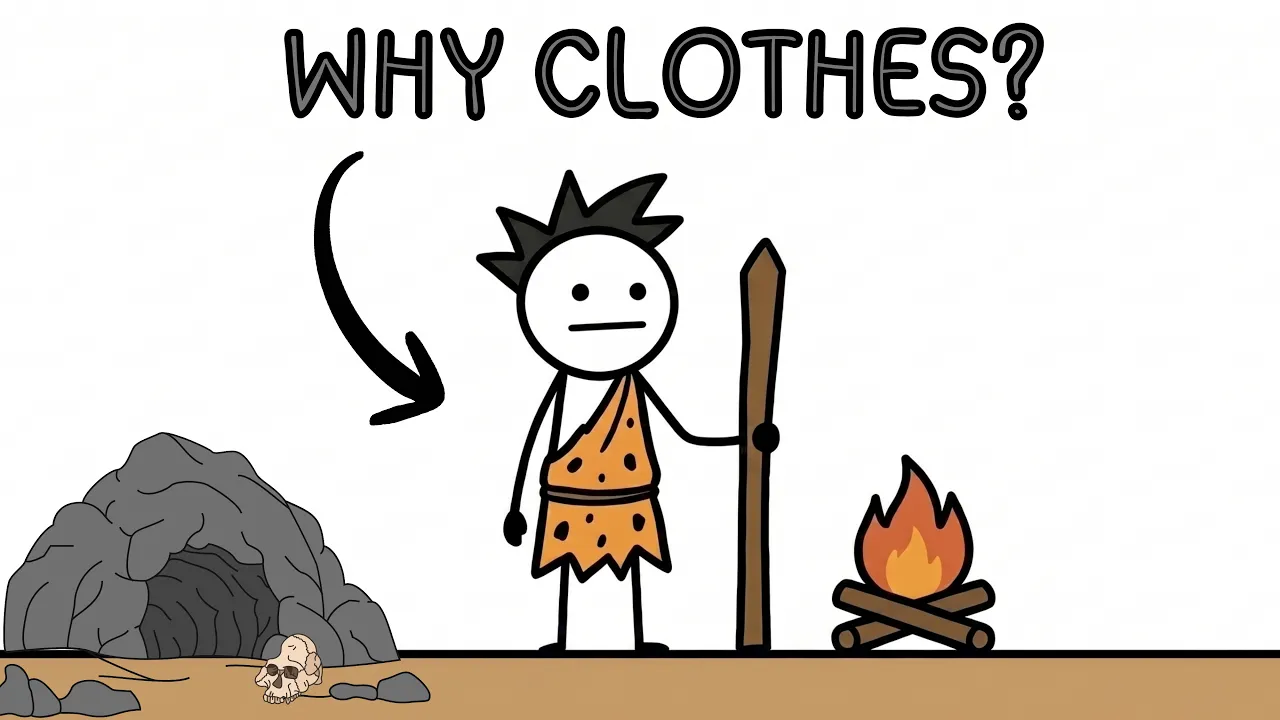
The Real Reason Humans Started Wearing Clothes transcript
Ink Explainer · @Inkexplainer96
Words
1,289
Runtime
6:43
Speaking pace
192wpm
Reading time
5min
192 words per minute, between the 181 median and the 201 75th percentile of 349 measured videos. That distribution comes from the 349-video hook study.
Opening (first 30 seconds)
Right now, you're wearing something. You probably didn't think about that decision for more than a few seconds this morning. Maybe you grabbed whatever was closest. Maybe you checked the weather. Either way, you put something on before you walked out the door, because that's what humans do. We cover ourselves. Every culture on Earth, in every climate, across every era of recorded history, wears clothes. You might think early humans started wearing clothes for simple reasons: modesty, protection, warmth. Except none of those are the real reason we started covering ourselves. And when you find
96 words, the words spoken in the first 30 seconds at 192 words per minute.
Sentence shape
| Measure | This transcript |
|---|---|
| Sentences | 99 |
| Average words per sentence | 13.0 |
| Longest sentence | 45 words |
| Questions asked | 0 |
| Sentences containing a number | 6 |
Most used terms
- clothing20
- humans10
- started9
- lice8
- body7
- wearing7
- clothes6
- years6
- actually4
- cover4
- deeper4
- protection4
Filler phrases
12 in total: actually 4 · like 4 · kind of 3 · literally 1.
A literal whole-word count of the same phrase list the Prepublish browser extension uses, so a phrase inside another word is not counted and a phrase used in its ordinary sense still is. It is a count and not a judgement.
What this transcript is
Every word below is the caption track YouTube publishes for this video, pulled from the video itself and reproduced unchanged. It is not Prepublish's writing, not a summary, and not a re-transcription: it is the video's own published captions. English captions, generated automatically by YouTube, in the video’s original language. Source: the video on YouTube. A channel that would rather this page did not exist can ask for its removal through the contact page, and it is removed.
Transcript
Right now, you're wearing something. You probably didn't think about that decision for more than a few seconds this morning. Maybe you grabbed whatever was closest. Maybe you checked the weather. Either way, you put something on before you walked out the door, because that's what humans do. We cover ourselves. Every culture on Earth, in every climate, across every era of recorded history, wears clothes. You might think early humans started wearing clothes for simple reasons: modesty, protection, warmth.
Except none of those are the real reason we started covering ourselves. And when you find out what actually drove early humans to cover their bodies, it changes how you think about fashion, culture, language, and what it means to be the kind of creature that looks in a mirror and feels the weight of being seen. Let's look at the timeline. Anatomically modern humans have been around for roughly 300,000 years, but when you look at the actual evidence, you'll find things like bone needles and hide scraping tools only showing up around 120,000 years ago.
And even that estimate is generous. Most textile historians place the widespread adoption of clothing at around 75,000 years ago, which means for the first half of our existence, we were mostly naked under the same African sun, dealing with thorns, insects, and cold nights with nothing but our naked bodies. Which immediately rules out the most common explanation: warmth. Yes, humans eventually moved into colder climates where clothing became essential.
But clothing shows up before that, while we were still in the tropics. So warmth matters later. The next explanation people reach for is protection: thorns, rocks, insect bites. And sure, that's part of it. But here's the issue. If protection were the main reason, clothing would have started on the parts that actually took the most damage: feet and hands. Instead, the earliest clothing in almost every culture covered the torso and groin first, the areas least exposed.
That's not purely practical. It points to something else. Then there's the lice theory, and this one's actually fascinating. Back in 2003, a group of geneticists looked at something unexpected: lice. Not just any lice, but the split between head lice and body lice. Head lice live in hair, body lice live in clothing. They literally can't survive without fabric. So, scientists traced when these two types split from each other, and that gives a clue about when humans started wearing clothes consistently enough for a whole new species to depend on it.
The answer, approximately 170,000 years ago. That's the oldest hard biological timestamp we have for clothing. Not some bone needle or a scraping tool, but because of a parasite. And that gives a clue when humans started wearing clothes, partly because something evolved specifically to live in them. But that date still doesn't tell us why. It tells us when the behavior was already established. The actual origin goes back further than we can currently measure.
The reason lies somewhere deeper than fabric and needles and lice. Here's what researchers have started to argue. Clothing wasn't a practical invention, it was a symbolic one. In 2009, archaeologist Ian Gilligan published a detailed analysis about clothing and how we think. He suggested that choosing to cover the body isn't just practical. It reflects a deeper kind of thinking that sets humans apart from other animals.
To wear clothing, you have to imagine a future version of yourself. You look at an animal hide, picture yourself wearing it later, plan how to turn it into something usable, and then actually do it. That might sound simple, but it's not. It involves memory, planning ahead, and thinking about the future. The same kind of mental ability we use to keep promises, plan our days, or worry about things that haven't even happened yet.
No other animal does this. A chimpanzee doesn't look at a leaf and think about how it could be useful tomorrow, but we did. And the moment we started clothing our bodies, we weren't just protecting skin. We were demonstrating for the first time that we could think ahead. Clothing is one of the earliest physical artifacts of the modern human mind. But there's something even deeper underneath that. Something most evolutionary biologists don't talk about when this topic comes up, which is shame.
And not in the religious sense. Shame in the neurological sense. The awareness of being perceived. The feeling that your body is being observed and evaluated by others. This is a uniquely human experience. It requires what psychologists call theory of mind, the ability to step outside yourself and imagine what you look like through someone else's eyes. Dogs don't have this. Crows don't have this. Even our closest relatives, chimpanzees, barely show traces of it.
But somewhere along the way, humans developed something deeper, the ability to see ourselves through other people's eyes, and once that clicked, everything shifted. It wasn't just about surviving anymore. It became about how you looked, how you were perceived, what you signaled to others. From that point on, clothing wasn't just about covering up. It became a way to shape identity, a way to control your image. The first person who wrapped animal skin around themselves wasn't just trying to stay warm.
They were, in a sense, choosing how they wanted to be seen. And once that idea took hold, it never really went away. You can see it across cultures all over the world, even in places where clothing wasn't needed for warmth at all, like parts of the Amazon or the Pacific Islands. People still decorated themselves. Beads, paint, feathers, simple fibers, tattoos, something was always there, because the body was never just a body.
Because researchers studying clothing across different cultures have found something consistent. The impulse to dress seems to accelerate during periods when human social groups are becoming more complex. As tribes grew larger, as hierarchies formed, as strangers started interacting with strangers, clothing became a social technology, a system of instant communication. Before you could speak to someone, their clothing told you who they were, what group they belonged to, whether they were a threat or an ally, whether they ranked above or below you.
Clothing is language, one of the oldest forms we have. And here's the part that should make you stop for a second, because it applies to you right now. You get dressed every morning without thinking much about it, but your brain is doing something ancient and deeply social every time you do. You're not just picking fabric. You're constructing a version of yourself that you want to project into the world. You're negotiating between who you are, who you want to be seen as, and what the situation requires.
That anxiety you feel when you show up to something overdressed or underdressed, or when you realize you're wearing the wrong thing for the moment, that's 170,000 years of social cognition activating. That's your brain running the same calculation your ancestors ran around the fire. We solved the basics, cold, survival, protection, but we didn't stop. Our clothing became more detailed, more intentional, because it was never just about the body.
It was about the mind. The part of us that knows we're being watched. Clothing didn't just cover us, it created a version of us. We didn't start wearing clothes because we were cold. We started because we became aware. Aware that others could see us, and that never stopped. Tomorrow you'll get dressed like always, but underneath that routine something ancient is still there. You're not just picking clothes, you're choosing how to be seen.
The same instinct humans have had for thousands of years.
The words are the caption track's own and nothing is reworded or re-transcribed. Paragraph breaks are placed between sentences so the text reads as prose.
Use this transcript
Three free tools that work on the material around a video like this one. No signup, no login.
Hook Analyzer
Paste the first 30 seconds of your own draft for a hook score and rewrites.
Policy Pre-Flight
Check your draft against YouTube's advertiser-friendly guidelines before you record it.
Channel Skill Generator
Read this channel's public videos and transcripts, and download a writing brief for it.