Getting the transcript
Reading the captions from YouTube. A video nobody has opened here before takes 10 to 30 seconds; this page fills in on its own.
Getting the transcript
Reading the captions from YouTube. A video nobody has opened here before takes 10 to 30 seconds; this page fills in on its own.
Gabe Bult - The Process · @GabeBultTheProcess
This video has no Most replayed graph yet: YouTube shows one only once a video has enough views. These are the moments viewers replayed most in Gabe Bult - The Process's most watched videos.
Most replayed moment at 9:14
3.0x that video's typical replay level
subscribers. Again, 1300 videos. And these are mostly him just talking, not really doing anything, not much editing, not much B-roll. Anybody could make this video. Literally, anybody could make this video. You can edit this yourself. You can hire out an editor. He's not really editing them. Again, either it is
Said at 9:07
Most replayed moment at 8:54
7.1x that video's typical replay level
will make. So, there's generally a four-step method that will work for this strategy. Number one is strategic YouTube content. And do not post short-form videos. Other creators might tell you to do that, but if your goal is to make money and especially like evergreen income, don't start with that, please. I've seen it
Said at 8:46
Most replayed moment at 6:57
4.0x that video's typical replay level
but averaging 50 to 100,000 views per video. If you see, they're all just screenshots of him talking about something that he knows, something that he does personally, investing in options trading. [music] And he showed me his analytics. He's making 50 to 100,000 per month in AdSense and another minimum
Said at 6:50
The graph counts replays. It does not show where viewers stopped watching.
Words
1,548
Runtime
6:52
Speaking pace
225wpm
Reading time
6min
225 words per minute, above the 201 75th percentile of 349 measured videos. That distribution comes from the 349-video hook study.
Opening (first 30 seconds)
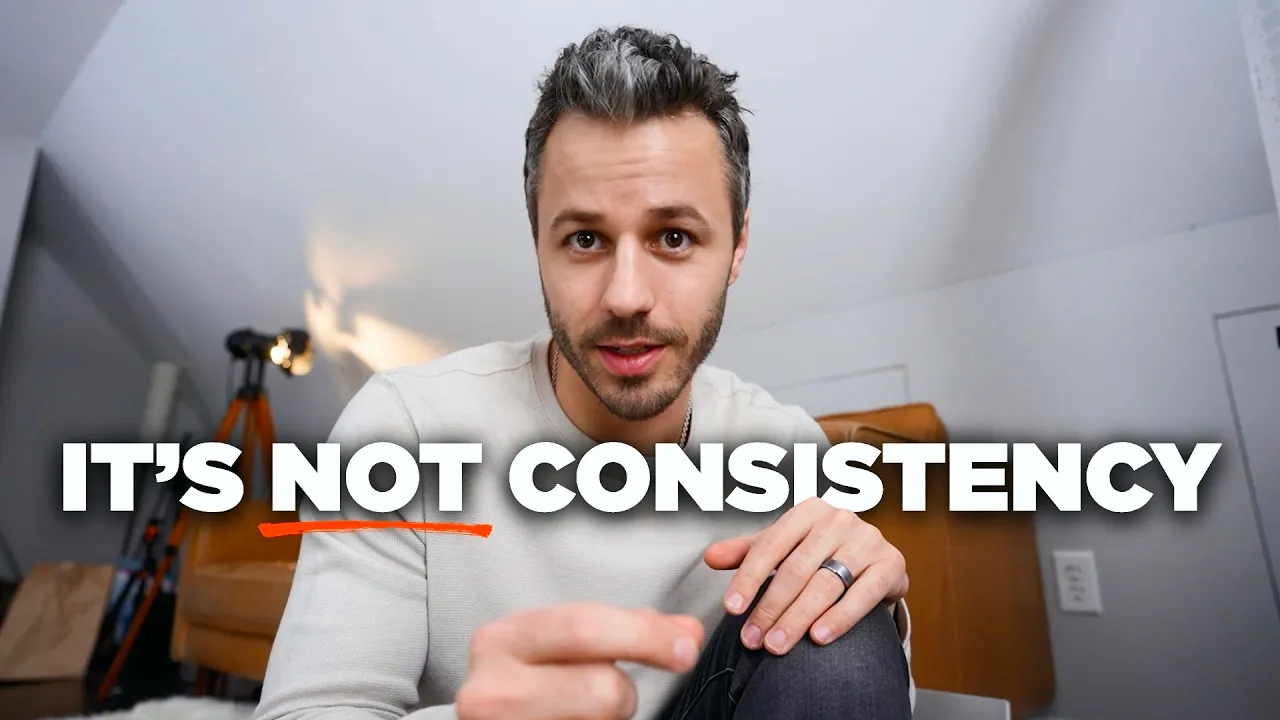
People think YouTube is all about consistency, but that is not actually true. Look, I've been making YouTube videos for 7 years and for the first three, I actually lost money. I was posting every single week and without paying anybody just on like buying >> [music] >> little bits of camera gear, I was losing money. And then, something changed. And it wasn't my work ethic. I put in the same or less amount of hours. It wasn't my consistency. I continued to post once a week. What changed was I started to understand something that most creators miss. You don't grow from being consistent. You grow from consistently taking shots. And
113 words, the words spoken in the first 30 seconds at 225 words per minute.
Free, no signup. See how the first 30 seconds hold attention, with rewrites.
Sentence shape
| Measure | This transcript |
|---|---|
| Sentences | 103 |
| Average words per sentence | 15.0 |
| Longest sentence | 53 words |
| Questions asked | 4 |
| Sentences containing a number | 6 |
Most used terms
Filler phrases
32 in total: actually 13 · like 12 · kind of 2 · right? 2 · literally 1 · uh 1 · you know 1.
A literal whole-word count of the same phrase list the Prepublish browser extension uses, so a phrase inside another word is not counted and a phrase used in its ordinary sense still is. It is a count and not a judgement.
Run the check on the words above: where attention is likely to drop, with a rewrite for each weak line. The free check shows the scores and the one issue costing the most.
What this transcript is
Every word below is the caption track YouTube publishes for this video, pulled from the video itself and reproduced unchanged. It is not Prepublish's writing, not a summary, and not a re-transcription: it is the video's own published captions. English captions, generated automatically by YouTube, in the video’s original language. Source: the video on YouTube. A channel that would rather this page did not exist can ask for its removal through the contact page, and it is removed.
People think YouTube is all about consistency, but that is not actually true. Look, I've been making YouTube videos for 7 years and for the first three, I actually lost money. I was posting every single week and without paying anybody just on like buying >> [music] >> little bits of camera gear, I was losing money. And then, something changed. And it wasn't my work ethic. I put in the same or less amount of hours. It wasn't my consistency.
I continued to post once a week. What changed was I started to understand something that most creators miss. You don't grow from being consistent. You grow from consistently taking shots. And what you need to realize is it only takes one video. If you're not posting with intentionality and taking shots throughout that process, you're probably going to be in the exact same boat. That's probably why you've posted so many times and nobody's watching your video, nothing is really happening.
You're staying stagnant with views that aren't where you want them to be. And that is because you don't have an overall strategy behind what you're doing. You're working really hard, you're being really consistent, but you have almost zero chance of success. If we look at this video right here, how to actually retire in 7 [music] years, that one video probably did more for my channel than another like 50 videos put together.
And this one about frugal living, same thing, one video. And this is actually where Riley comes in because he understands thumbnails [music] and strategy better than pretty much anybody else that I know. >> Thanks, Gabe. Okay, so here's the thing about thumbnails that most people don't get. The key is you do not want to make [music] the perfect thumbnail, you just want to focus on making a thumbnail that someone will click on.
That is the most important part. And the only way to figure out what works is to take shots and a lot of them. We AB test almost every single thumbnail. Sometimes the one we think is going to perform best doesn't and sometimes a thumbnail we've put together last minute becomes the winner. But the only way to really figure that out is to take a lot of shots. >> And that's the thing. I used to be scared to try different things because I thought it would, you know, mess up my brand, mess up my my image, it wouldn't match all my other stuff, right?
But the videos that actually worked, that actually popped off, changed the trajectory of my life and my channel were the ones where I was experimenting. [music] I was trying something new. It was something that I was genuinely passionate about and interested in, not just analytically I thought it would perform well, but I was doing something different. So, let me show you something that completely changed how I think [music] about this.
This right here is David Moss Jr. He is a friend of mine. Uh we actually [music] met at a conference. But look at his oldest videos. Dude's making videos about his chicken coop 4 years ago, random stuff. He raised money and he's like putting stuff in, best birthday gift, just random stuff, right? But then he had one video about making a DIY cold plunge, just something that he was interested in, he was genuinely passionate about, he was experimenting, didn't know where he wanted to go with stuff.
That one video completely took off. And so, he made more videos on those topics. He made this video and this video and just tons of other ones. He kept exploring new things, but he realized that people were interested about his cold plunges. If we fast forward to today, he still doesn't get a ton of views on his videos, as you can see. He's posting very often, but generally getting 1,000 views [music] with a few outliers.
But this channel is currently making more than the average person's full-time [music] income monthly. I don't want to throw his numbers out there, but take that how you will. The reason it got there, it wasn't because it was consistent with the same type of content, it's because he continued to take shots, see what worked adapt his strategy based on what was working. He didn't like force his [music] chicken content to be the thing because that's what he started with.
He followed curiosity. He he followed his interests and he continues to try new things, new things, new things and random stuff clicks. And when it does, he doubles down on it. Now, this brings us to editing. From an editing perspective, I can tell you specifically which videos are going to be performing well before we even upload them. It's the ones where Gabe is genuinely engaged, where he's telling a real story and not just following a script like everybody else.
And the videos that pop off, they usually come from a place of authenticity and you can feel that while editing. That's something that you cannot fake and you have to actually care what you're making. And Gabe's right. The videos where I'm just going through the motions, a lot of times they they don't work that well. And that's because the algorithm can tell. And when I say the algorithm, I really mean the audience. The audience is the algorithm.
You, right now, are the the algorithm. If you're interested in something, if you can tell that I'm genuinely passionate about something, you're going to engage with the video more than if you just can tell that I don't I don't really care that I'm not putting any any effort or [music] any thought. So, here's what I wish I had done differently and what would have helped me grow a lot faster. And that is to stop waiting for the perfect video and just do take more shots on more topics, new formats, new storytelling techniques, new thumbnail styles, not just go with the same thing over and over and expect different results, but try new things, try more new things.
Don't just assume that I actually know what works. I don't know everything and this is literally all I've obsessed about for the past 7 years. I still don't know everything. And so, if you're new, you don't know everything. Riley tests like five different title options every single video. And the one that ends up performing the best is generally not the one that we assume will when we're making the video. I'm very rarely right.
And three, when something works, double down on it. A lot of times we don't want to like repeat ourselves or we don't want to like be known for just one thing. If something's working, double down, ride that wave and then you can always move on and expand to new things later on. But if people love a video, just give them more of what they love. Serve your audience. And four, give yourself permission to pivot. When I started my channel, I really thought it would be about real estate investing.
I never talk about that anymore. Because I actually pivoted and moved to new things and explored new things, my channel has looked very different over the years. It's gone from real estate investing to full-on minimalism to frugal living stuff and now personal finance. Like it's shifted all over the place because I keep pivoting and adjusting to what my audience is interested in and what I'm interested in. And I know this can be scary, I know it can be stressful and very annoying when your videos don't perform you the way you want them to, but that is kind of the game.
You're not trying to go viral with every single video. You're trying to take shots, find that thing that is going to [music] connect with people and when you find that thing of the combination of what you're interested in, what the the people who watch connect with, sometimes it's not what you think, but that one video can change your entire life. A quick example of this is one of my students. He ended up making a video about frying pans.
Now he has a frying pan channel. Started out as personal development and habits and things like that. Nowhere near where he thought he was going to be, but now he is close to leaving his job to make content about cast iron frying pans because he followed the strategy. Anyways, in every video I'm asking myself, am I actually interested in this? Or am I just making this because I should? Because that's what actually matters.
And if you enjoyed this video, feel free to drop a like and subscribe. We're trying to hit 100k on this channel this year, which sounds kind of crazy, but I think it's actually possible. Going for the second play button. So, yeah, hopefully this helps. There's a lot of resources down below you can check out, including if you want to work with my team or get some free resources or anything like that. Thank you for watching.
The words are the caption track's own and nothing is reworded or re-transcribed. Paragraph breaks are placed between sentences so the text reads as prose.
Free tools for your own script: paste a draft and see where it stands before you record it.
Paste your draft and see where viewers are likely to drop off, with a rewrite for each weak line.
Paste the first 30 seconds of your own draft for a hook score and rewrites.
Check your draft against YouTube's advertiser-friendly guidelines before you record it.
Read this channel's public videos and transcripts, and download a writing brief for it.