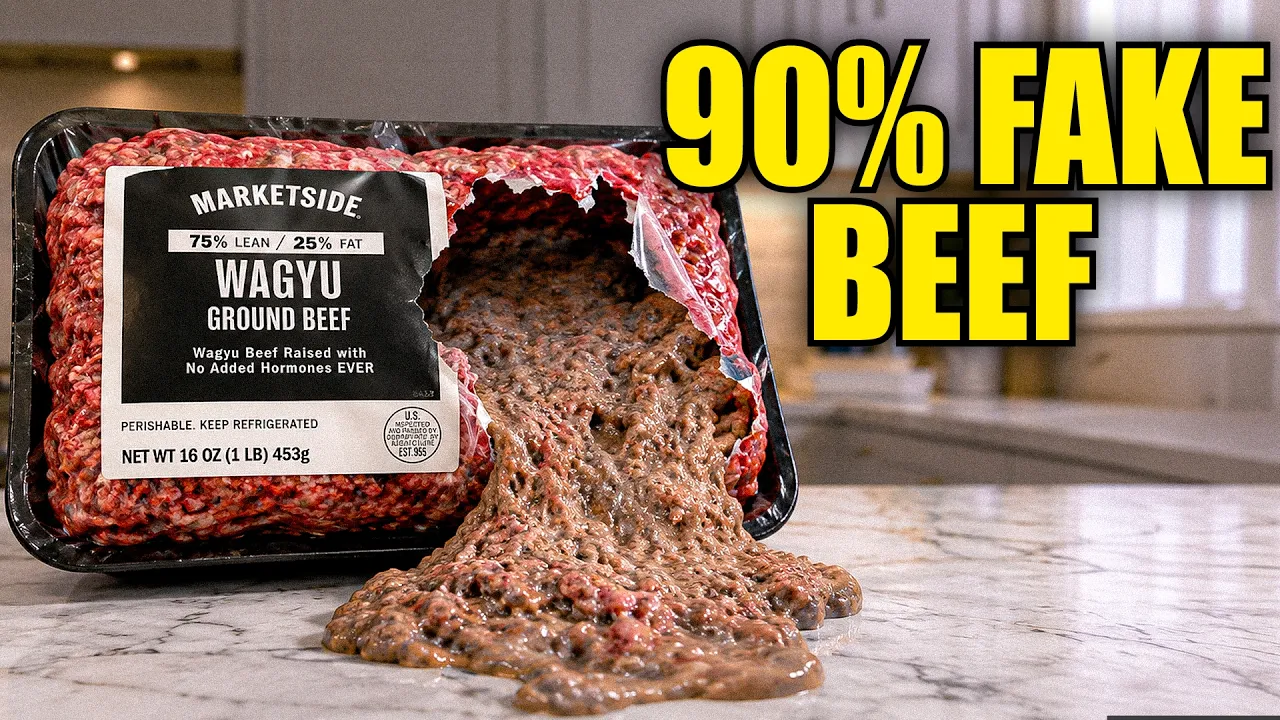
10 US Ground Beef Brands That Don’t Use 100% BEEF (And 8 That Do) transcript
Consumer Exposed · @ConsumerExposed-ghz
Words
4,378
Runtime
29:07
Speaking pace
150wpm
Reading time
18min
150 words per minute, below the 160 25th percentile of 349 measured videos. That distribution comes from the 349-video hook study.
Opening (first 30 seconds)
Ground beef is one of the most purchased foods in America. And most people buying it this week have no idea what's actually inside the package. In December 2018, the federal government quietly reclassified a product made from beef trimmings spun through a centrifuge and gassed with ammonia. And legally called it ground beef. No label change, no announcement. The package looked [music] exactly the same the next day. This video covers 10 ground beef
75 words, the words spoken in the first 30 seconds at 150 words per minute.
Sentence shape
| Measure | This transcript |
|---|---|
| Sentences | 340 |
| Average words per sentence | 12.9 |
| Longest sentence | 39 words |
| Questions asked | 0 |
| Sentences containing a number | 78 |
Most used terms
- music128
- beef76
- ground45
- ground beef41
- number27
- company26
- label21
- product21
- jbs17
- chain16
- organic16
- store16
Filler phrases
24 in total: actually 11 · like 9 · kind of 4.
A literal whole-word count of the same phrase list the Prepublish browser extension uses, so a phrase inside another word is not counted and a phrase used in its ordinary sense still is. It is a count and not a judgement.
What this transcript is
Every word below is the caption track YouTube publishes for this video, pulled from the video itself and reproduced unchanged. It is not Prepublish's writing, not a summary, and not a re-transcription: it is the video's own published captions. English captions, generated automatically by YouTube, in the video’s original language. Source: the video on YouTube. A channel that would rather this page did not exist can ask for its removal through the contact page, and it is removed.
Transcript
Ground beef is one of the most purchased foods in America. And most people buying it this week have no idea what's actually inside the package. In December 2018, the federal government quietly reclassified a product made from beef trimmings spun through a centrifuge and gassed with ammonia. And legally called it ground beef. No label change, no announcement. The package looked [music] exactly the same the next day. This video covers 10 ground beef brands you might want to reconsider.
And eight that actually held up. We start with the worst offenders and finish with the ones worth buying. The first brand on the avoid list might already be in your freezer. Number 10, Bubba Burgers. It's been in the freezer aisle since 1995. The name alone does something, Bubba. It sounds like a backyard, a charcoal grill, a cookout with people you actually like. >> [music] >> That feeling is engineered and it's working on most shoppers without them realizing it.
But look at the actual wording on the front of the box, not the logo, not the burger photo, the product name itself. Bubba Burgers are sold as beef patties, not ground beef. [music] Two different words with a specific legal consequence most people never think about. Under title nine of the Code of Federal Regulations section 319.15, any product calling itself ground beef cannot legally contain added water, phosphates, binders, or extenders.
The moment a company switches to beef [music] patties, every one of those restrictions disappears. Partially defatted beef, >> [music] >> soy protein isolate, textured vegetable protein, organ meat, all of it becomes legally permissible under that label. Bubba's original product does list beef as the only ingredient, but the company also sells flavored varieties containing modified food starch, soy protein concentrate, and dextrose.
The issue isn't any single product. It's that two words on the front of a package determine what a company is legally allowed to put inside. And almost nobody standing in that freezer aisle knows which two words to check. Number nine, Good & Gather. This is Target's private label launched in 2019 [music] when the company retired Archer Farms and Market Pantry. The packaging is [music] clean, minimal. The kind of design that communicates trust without having to earn it directly.
The label says ground beef [music] and nothing else. One ingredient. That sounds like exactly what you want. Here's the problem. Since the USDA's [music] December 2018 reclassification, a single ingredient ground beef label no longer guarantees the absence of ammonia treated trimmings. It only guarantees the label is technically legal. Those are two very different things and the packaging doesn't help you tell them apart.
[music] Target does not publicly disclose which meat processing facility supply its Good & Gather ground beef. When Consumer Reports tested [music] 351 packages of ground meat from grocery stores across the country in 2022, bacteria levels varied significantly depending on which processor produced the product. [music] The processor is a critical variable here. Target won't tell you who it is. The company has made no public statement about excluding lean finely textured beef from its supply chain.
No transparency report exists for its fresh meat sourcing. For a company worth more than 50 billion dollars, that's a deliberate choice, not an oversight. Clean packaging suggests a promise. An undisclosed supply chain is the company declining to back it up. Number eight, Sam's Club Members Mark. Sam's Club is a Walmart subsidiary. Members Mark is the store label on those 5-lb chubs in the cooler. The processing network behind them [music] is the same one supplying Walmart, Cargill, Tyson, JBS.
Sam's Club has [music] never publicly confirmed or denied whether Member's Mark ground beef contains lean finely textured beef. No transparency report exists for its fresh meat. And because of the 2018 USDA reclassification, there's no legal obligation to disclose LFTB on the label even if it's in every package. The value here is real. A large chub of 80/20 at a price that undercuts most grocery stores [music] is genuinely useful for a family managing a tight budget.
That's not nothing, but that price connects to a supply chain currently under Department of Justice criminal antitrust investigation announced [music] in May 2026 with investigators reviewing over 3 million documents as part of the [music] probe. When beef is priced that aggressively, something in the chain is absorbing the pressure. Sam's Club hasn't publicly answered what that means for what's actually inside the package.
The price is doing [music] its job. The transparency isn't. Number seven, IBP Trusted Excellence. You may have seen this label and assumed it was a regional Midwest brand, independent, rooted in agriculture. >> [music] >> The name IBP stands for Iowa Beef Processors and it sounds exactly like what it implies. It's Tyson. >> [music] >> Tyson Foods acquired Iowa Beef Processors in 2001 for 3 and 1/2 billion dollars. The IBP name stayed on retail products.
The Tyson name didn't come with it to the shelf. Tyson is one of four companies named in the May 2026 Department of Justice criminal antitrust investigation. Those four companies now control roughly 85% of fed cattle purchases [music] in the United States up from about 25% in 1977. That's how concentrated this market has become. In November 2022, Tyson recalled nearly 94,000 pounds of ground beef from its Amarillo, Texas plant after consumers reported finding [music] what the USDA described as reflective mirror-like material in packages they had already purchased.
And there's this. In 1998, [music] Tyson paid $642 million to acquire Hudson Foods after Hudson was forced to close a plant following a 25 million-pound recall. Tyson didn't fix the problem. [music] They bought the company that had it. IBP Trusted Excellence. The word [music] trusted is doing a lot of heavy lifting for a brand that hasn't belonged to an independent company in over two decades. If this investigation is helping you see your grocery store differently, a quick like helps more people find it.
Now, let's keep going. Because the next six [music] entries are where it gets more serious. Number six, Cedar River Farms. The name is doing something very specific. Cedar River Farms, a farm, a river. Somewhere in the American heartland where [music] cattle graze and someone you'd recognize makes decisions about your food. Cedar River Farms is a JBS brand. JBS is the largest [music] meatpacking company in the world, headquartered in São Paulo, Brazil.
In October 2018, JBS Tolleson recalled over 6.9 million pounds of ground beef for salmonella contamination. Two months later, that recall expanded to more [music] than 12 million pounds. Cedar River Farms appeared on the expanded notice. More than 400 people fell ill across 30 states. At least [music] 117 were hospitalized. The strain was multi-drug [music] resistant salmonella Newport, meaning standard antibiotic treatment had no effect on it.
JBS is one of the companies named in the May 2026 [music] DOJ antitrust investigation. USDA Secretary Brooke Rollins called out the foreign ownership of JBS [music] by name as a direct threat to American food security. The pastoral imagery on that package, the farm, the river, the suggestion [music] of somewhere local, exists to create distance from what the company actually is. It works. That's why it's still on every package.
Number five, Kroger store brand ground beef. Kroger is the largest supermarket chain in the United States [music] by revenue, operating under names most shoppers don't connect back to Kroger. Ralphs, Fred Meyer, Smiths, Harris Teeter. If you shop any of those banners, you're shopping Kroger. When Consumer Reports purchased ground beef from a Kroger location in Seattle as part of its national testing investigation, [music] the lab result triggered a federal response.
The sample tested positive for E. coli O157:H7, one of the most dangerous strains of foodborne bacteria. It produces shiga toxin, which causes bloody diarrhea, and in 5 to 10% of cases, a potentially fatal form of kidney damage. Consumer Reports notified the USDA. The agency recalled more than 28,000 pounds [music] of Kroger labeled ground beef across seven western states. Then there's what Kroger said publicly during the 2012 pink slime controversy.
The company acknowledged that its standard ground beef line includes products both with and without lean finely textured beef, and directed customers who wanted the version without it toward private selection Angus or organic options, at a higher price. So the standard product, the one on sale, the one in most [music] carts, is the one Kroger admitted might contain ammonia-treated filler. The cleaner version costs more. >> [music] >> That's two different products at two different price points, and the company confirmed it in public.
Number four, Great [music] Value. This is the most purchased ground beef brand in the United States. Walmart [music] sells more beef than any other retailer in the country, and the label on most of it says Great [music] Value. In May 2024, Cargill Meat Solutions recalled over 16,000 lb of raw ground beef shipped to Walmart stores across 12 states for E. coli O157:H7 contamination. The recalled product [music] carried Cargill's establishment number EST 86P.
Many of those packages were sitting on Walmart shelves under the Great Value name [music] when the recall was issued. That wasn't isolated. In September [music] 2018, Cargill recalled over 132,000 lb of ground beef from its Fort [music] Morgan, Colorado plant connected to an E. coli O26 outbreak that killed at least one person [music] and hospitalized five others across four states. When you buy Great Value, you're buying Cargill processed beef.
Cargill is one of four companies under a DOJ criminal antitrust investigation [music] for possible price-fixing announced in May 2026. Those four corporations together control roughly 85% [music] of the American beef market. The price on that tube is low. The supply chain producing it is under active federal criminal investigation. That's worth knowing before you reach for it. Number three, >> [music] >> Cargill All Natural Ground Beef.
All natural. It's printed right on the package, and it lands [music] as a reassurance. Here's exactly what it covers under federal law. The USDA defines natural as containing no artificial ingredients and being minimally processed. That is the complete definition. It does not restrict antibiotic use. It does not restrict hormone use. It does not exclude lean finely textured beef. It says nothing about how the animal was raised, what it ate, or whether it ever had [music] outdoor access.
Natural is a minimum regulatory threshold that the marketing [music] department has been asked to carry far more weight than it was designed to hold. In 2018, Cargill's Fort Morgan, Colorado plant [music] was connected to an E. coli O26 outbreak that killed at least one person and sickened 17 others [music] across four states. They recalled 132,606 lbs. The label said all natural. In May 2024, Cargill recalled another 16,000 lbs for E. coli O157:H7.
[music] This time from their Hazelton, Pennsylvania facility. That product also said all natural. >> [music] >> Same word. Same package. Bacteria capable of causing kidney failure. Twice. The label didn't protect anyone. It just looked like it should have. Number two. JBS and Swift Premium. JBS is the largest meat processing company on Earth, reaching American grocery shelves through Swift, Pilgrim's Pride, and Cedar [music] River Farms, which you already heard about.
The parent company is headquartered in São Paulo, Brazil. In June 2009, JBS Swift recalled over 420,000 lbs of ground beef [music] after illnesses spread from California to New York. A lawsuit filed on behalf of a 14-year-old boy alleged that JBS failed to share distribution information quickly enough for retailers to pull contaminated product before more people were exposed. Then 2018, JBS Tolleson salmonella recall grew from 6.9 million lbs to over 12 million lbs across 30 states.
More than 400 people ill, over 100 hospitalized, [music] a multi-drug resistant strain that standard antibiotics couldn't treat. In 2017, JBS's [music] parent company in Brazil paid a $3 billion fine to settle corruption charges involving bribes to more than 1,800 politicians, [music] one of the largest corporate penalty settlements in history. In 2026, the [music] DOJ opened a criminal antitrust investigation with acting Attorney General Todd Blanched confirming investigators reviewed over 3 million documents.
Agriculture Secretary Brooke Rollins named JBS specifically. Swift Premium is on your grocery shelf right now. >> [music] >> The company that owns it paid $3 billion for bribing nearly 2,000 politicians. When that's the track record, you are not the priority margin is Number one, >> [music] >> store ground beef from your grocery meat counter. This is the one most people won't see coming. That tray behind the glass. The one that says ground fresh this [music] morning.
The one that feels like the most honest, most local option in the entire store. It may actually be the least traceable product you can buy. When a grocery store grinds beef on site, it draws from trimmings across multiple cuts, [music] multiple animals, and often multiple suppliers. A single tray can contain beef from dozens of animals sourced across several states. The store is not required to disclose which processor [music] provided the raw material.
And there is frequently no USDA establishment number on the label. Federal inspection applies to [music] processing plants, not to a grinding operation running in a retail back room. When a store buys [music] whole primals from an inspected facility and grinds them in house, the finished product doesn't carry the [music] same level of federal oversight as a packaged product with a registered establishment number. >> [music] >> When contamination happens, tracing it through a store grinder is significantly harder than tracing it [music] to a plant with a federal paper trail.
Consumer Reports noted that much of today's packaged ground beef does carry an EST number. In-store ground beef often doesn't. No establishment number means no federal traceability. The fresh tray feels like the transparent choice. >> [music] >> In practice, it's often the one with the least accountability behind it. If there's no EST [music] number on that package, you're trusting the meat counter. And the meat counter is not required to tell you anything.
That's the avoid list. Now, the eight that actually passed. And this is where the investigation gets useful. Best option number eight, 365 by Whole Foods Market organic line only. The 365 label sells ground beef at multiple tiers. The tier that matters is organic, [music] and the reason is structural, not just marketing language. USDA certified organic standards [music] prohibit ammonia as a processing aid. That matters because ammonia treatment is the defining production step in making lean finely textured [music] beef.
Prohibit the treatment, and LFTB is excluded by definition. Not by a company promise, but by the rules of the certification itself. The standard also requires cattle raised without antibiotics, without added growth hormones, and fed 100% organic feed. These are federally audited requirements, not marketing claims. 365 organic ground beef is sourced from multiple suppliers. So, it's not a single origin product. But, the certification acts as a structural wall against the practices that define most brands on the avoid list.
At around $7 to $8 per pound, you're paying for an audited supply [music] chain, not a label. One important note, the conventional 365 ground beef does not carry these protections. Whole Foods has not publicly stated whether it's conventional line [music] excludes LFTB. The organic designation is the meaningful distinction. Without it on the label, you're back to trusting [music] the packaging. Best option number seven, Laura's Lean.
Laura Freeman started this company in 1985 on her family's cattle farm in Kentucky. Four decades later, it's one of the only nationally available ground beef brands that can [music] actually verify what it prints on the label. The beef is sold at 92 and 96% lean. Cattle are raised without antibiotics and without added [music] growth hormones. No preservatives, no additives, no artificial ingredients. The 96% lean variety carries the American Heart Association's Heart Check certification.
One of the only ground [music] beef products in the country that holds that designation. Here's what separates this from a store brand all-natural label. Verification. All-natural, as you've now heard twice, covers almost nothing that matters in practice. Laura's Lean submits to third-party auditing and participates in the USDA's Process Verified program. Someone outside the company checks the claims. The ingredient list is one word, [music] beef.
Not beef patties, not seasoned ground beef, >> [music] >> just beef. Available at most Kroger, Publix, and Whole Foods locations. $6 to $8 per pound. For a brand that's been operating this way since 1985 with external auditing behind it, that price reflects something real. Best option number six, Organic [music] Prairie. Organic Prairie is the meat brand of Organic Valley. A farmer-owned cooperative founded in 1988 [music] in LaFarge, Wisconsin.
Not a corporation managing quarterly earnings. A cooperative, and that structure changes the incentive logic around ingredient decisions in a meaningful way. Every Organic Prairie product is USDA certified organic. No synthetic hormones, no antibiotics, no GMO feed, no lean finely textured beef, excluded through the same certification mechanism that applies to the 365 organic line. >> [music] >> Every farm in the cooperative is independently audited and held to the same standard.
There's no lower grade supplier tier brought in to hit a price point. With over 1,700 farmer members, Organic [music] Prairie reaches shelves at Whole Foods, Kroger, and natural food retailers nationwide without diluting its requirements to scale. That combination is genuinely uncommon in this industry. Ground beef runs about 8 to $10 [music] per pound. No big four processors, no ammonia treatments, no sourcing anonymity.
The transparency here is built into how the cooperative is structured, [music] not applied on top as branding. Best option number five. Grass Run Farms. >> [music] >> Grass Run Farms sells 100% grass-fed, grass-finished beef from family ranches in the Upper Midwest. Cattle receive no antibiotics and no added growth hormones. The product carries American Grassfed Association certification, which requires animals to eat only grass and forage from weaning through harvest.
No grain [music] finishing, no feedlot confinement. With independent farm audits every year. Grass Run Farms supplies Sprouts Farmers Market locations nationally, >> [music] >> meaning all the grass-fed ground beef at Sprouts runs through this single source. That kind of supply chain visibility is genuinely unusual in retail grocery. One disclosure worth being direct about. During the 2018 JBS Tolleson Salmonella recall, a product labeled Grass Run Farms Natural appeared on the recall list.
At that time, JBS was distributing some Grass Run Farms products [music] through its processing network. The company has since ended that arrangement. But when you pick up a package, check the establishment number. If the EST traces to a JBS facility, ask the question. If it doesn't, >> [music] >> this is one of the stronger grass-fed options at a mainstream grocery store. Typically $8 to $9 per pound. The AGA certification is what to look for.
Best option [music] number four, White Oak Pastures. White Oak Pastures is one farm, [music] Bluffton, Georgia. The Harris family has worked that land continuously since 1866. Six generations on the same property. That's not a story a marketing team crafted, it's just the history. Will Harris, the fourth generation owner, converted the operation to a fully regenerative pasture-based system in the late 1990s. Cattle are grass-fed and grass-finished, raised without antibiotics or hormones, and [music] the beef is processed at the farm's own USDA inspected abattoir on the property.
That last [music] detail is what separates White Oak Pastures from nearly everything else on this list. They control the full chain from pasture to package without handing the product off to a Cargill or JBS facility in the middle. The farm is verified by the Savory Institute's Land to Market Program, which independently audits regenerative outcomes, including soil health and biodiversity. A 2019 life cycle assessment found the farm's management practices sequester more carbon than the cattle emit.
One of the only beef operations in the country documented to have a net negative carbon footprint. Ground beef runs $10 to $12 per pound. You're paying for a closed single farm supply [music] chain, independent environmental auditing, and a level of traceability that no warehouse scale processor can offer. For total transparency [music] in grocery available beef, nothing in this investigation comes closer. Best option number three, HEB.
HEB is a privately held grocery chain based in San Antonio, Texas. Over 400 stores. Among Texans, the loyalty runs deeper than brand preference. And on ground beef specifically, the company earned it with something on the record. During the 2012 pink slime controversy, HEB publicly stated that all ground beef sold at HEB is 100% pure with no additives. Not a hedged corporate position, a direct factual claim about a specific product.
HEB processes a significant portion of its [music] meat through its own facilities, giving it operational control that retailers dependent on third-party [music] processors simply don't have. The company has been privately held by the Butt family since 1905. No public shareholders, no quarterly earnings targets, no structural [music] pressure to quietly swap in cheaper processed trimmings to protect a margin. The limitation is geography.
Outside Texas, [music] you can't buy it. But if you live in the state, the answer to where should I buy ground beef is probably already your answer. The store your family has been going to for years. The public record backs that up. Best option number two, Publix. Publix is an employee-owned supermarket chain headquartered in Lakeland, Florida. Over 1,300 stores across the Southeast. And on the lean finely textured beef question, Publix gave the clearest on-the-record answer of any major grocery chain in the country. >> [music] >> During the 2012 controversy, Publix stated directly, "We have never allowed the use of LFTB in our meat.
It's 100% ground beef with no LFTB. Not implied, [music] not qualified. A specific claim about a specific ingredient. Publix [music] processes a significant portion of its ground beef through its own facility in Deerfield Beach, Florida. >> [music] >> That removes dependence on the four processors currently under federal antitrust investigation. [music] When a grocery chain runs its own processing, it steps outside the concentrated market structure [music] that defines most of American beef.
At $4 per pound, [music] Publix ground beef is priced comparably to conventional store brand options from companies with far less transparent sourcing. The cleaner product here isn't a premium tier. It's just what they sell. >> [music] >> Publix made that public commitment over a decade ago and has never reversed it. >> [music] >> In an industry where the default response to sourcing questions is silence, that kind of consistency means something.
For anyone in the Southeast, this is one of the most practical, affordable ways to sidestep everything this investigation covers. Best option [music] number one. Costco Kirkland Signature. When ABC News broke the pink slime story in 2012, most major retailers issued careful statements that committed to nothing specific. Costco responded [music] differently. Craig Wilson, the company's vice president of quality assurance, went on record with ABC News and stated directly that Costco does [music] not use lean finely textured beef.
He said he didn't know how to explain ammonia-treated [music] trim to a customer, and he wasn't going to try. A named executive, a specific claim made publicly while competitors were saying nothing. That's accountable in a way that anonymous corporate policy documents are not, because a named statement can actually be held to. Kirkland [music] Signature ground beef is not certified organic or grass-fed unless the label says so.
[music] What it is, publicly and verifiably, is free of lean, finely textured beef. >> [music] >> Costco runs one of the most rigorous quality assurance programs in retail, sources from multiple suppliers, and has held that public position for over a decade. The price is $3 to $5 per pound. For a warehouse retailer moving millions of pounds of beef every week, removing LFTB from the supply chain was a real cost decision.
They made it and then put a name on the record. No single farm traceability here. No grass-fed certification. No organic seal. What there is is a large, serious company that made a specific public commitment, absorbed the cost, and has held [music] that position consistently for more than 10 years. Affordable price. Named executive on record. No premium charge for the honesty. That combination is why Kirkland Signature is the strongest overall option for most people buying ground beef on a regular grocery run.
Before [music] you head back to the store, here's what to actually look for. If the package says beef patties instead of ground beef, that word difference is legal permission to include fillers that federal law prohibits in ground [music] beef. Most shoppers never catch it. If there's no USDA establishment number on the package, there is no federal paper trail connecting what you're buying to an inspected facility. In-store ground beef frequently doesn't have one.
If the price seems too low for what the label is promising, [music] that's communicating something real about the supply chain behind it. The companies hitting those price points are operating inside the same market structure currently under federal criminal investigation. And if the package says all natural, you now know exactly how little that phrase is required to cover. Every brand that passed this investigation shares one thing.
A specific, verifiable, public commitment about what's in their product through independent [music] auditing or a named person willing to go on record. That's not a high bar. Most of the industry hasn't cleared it. If this changed how you'll shop next time, share it with someone who still grabs the first tube they see. Read the label. Find the EST number. And when a company the size of Costco puts an executive's name on a public statement about what's not in your food, that's the kind of accountability that's actually worth buying.
The words are the caption track's own and nothing is reworded or re-transcribed. Paragraph breaks are placed between sentences so the text reads as prose.
Use this transcript
Three free tools that work on the material around a video like this one. No signup, no login.
Hook Analyzer
Paste the first 30 seconds of your own draft for a hook score and rewrites.
Policy Pre-Flight
Check your draft against YouTube's advertiser-friendly guidelines before you record it.
Channel Skill Generator
Read this channel's public videos and transcripts, and download a writing brief for it.