Getting the transcript
Reading the captions from YouTube. A video nobody has opened here before takes 10 to 30 seconds; this page fills in on its own.
Getting the transcript
Reading the captions from YouTube. A video nobody has opened here before takes 10 to 30 seconds; this page fills in on its own.
AI Engineer · @aiDotEngineer
This video has no Most replayed graph yet: YouTube shows one only once a video has enough views. These are the moments viewers replayed most in AI Engineer's most watched videos.
Most replayed moment at 11:58
4.6x that video's typical replay level
issues. Uh I also invented OS certification. I just close the tracker whenever I want, so I have my life back. So, does this work? Yes, sort of. >> [laughter] >> Which leads me to act three, slow the down. Everything's broken.
Said at 11:52
Most replayed moment at 18:45
4.8x that video's typical replay level
that they're they're changing they're changing things in the database not yet. You want to run them through the ontology first and make sure that works. Okay. I only got an I've got I've got another I've just a short time. I'm going to try to show you some of the things that um that you can
Said at 18:37
Most replayed moment at 16:13
3.6x that video's typical replay level
method signatures, the program layout and the call stacks. So here's some examples. I don't think you'll be able to read this one, but this is like the level of abstraction we're at. It's how we're actually going to lay this stuff out and how these systems are going to interact. Dylan Mulroy from Cloudflare talks a
Said at 16:06
The graph counts replays. It does not show where viewers stopped watching.
Words
2,228
Runtime
15:17
Speaking pace
146wpm
Reading time
9min
146 words per minute, below the 160 25th percentile of 349 measured videos. That distribution comes from the 349-video hook study.
Opening (first 30 seconds)
Hi everyone, thank you for joining me today. I hope everyone is having a great conference so far. Um, so my name is Dylan Kuzan. I am a developer relations engineer at Quadrant. And the title of my talk today is the frontier is coming home. So what do I mean by that? And somewhere in the next few years, something smarter than all of us is going to exist. We've spent years
73 words, the words spoken in the first 30 seconds at 146 words per minute.
Free, no signup. See how the first 30 seconds hold attention, with rewrites.
Sentence shape
| Measure | This transcript |
|---|---|
| Sentences | 192 |
| Average words per sentence | 11.6 |
| Longest sentence | 46 words |
| Questions asked | 8 |
| Sentences containing a number | 10 |
Most used terms
Filler phrases
47 in total: you know 12 · actually 9 · um 9 · uh 7 · like 5 · basically 3 · I mean 1 · kind of 1.
A literal whole-word count of the same phrase list the Prepublish browser extension uses, so a phrase inside another word is not counted and a phrase used in its ordinary sense still is. It is a count and not a judgement.
Free, no account. See where attention is likely to drop, with a rewrite for each weak line. The free check shows the scores and the one issue costing the most. Or run it on the words above first.
Free · No login · See a sample audit first if you prefer.
What this transcript is
Every word below is the caption track YouTube publishes for this video, pulled from the video itself and reproduced unchanged. It is not Prepublish's writing, not a summary, and not a re-transcription: it is the video's own published captions. English captions, generated automatically by YouTube, in the video’s original language. Source: the video on YouTube. A channel that would rather this page did not exist can ask for its removal through the contact page, and it is removed.
Hi everyone, thank you for joining me today. I hope everyone is having a great conference so far. Um, so my name is Dylan Kuzan. I am a developer relations engineer at Quadrant. And the title of my talk today is the frontier is coming home. So what do I mean by that? And somewhere in the next few years, something smarter than all of us is going to exist. We've spent years asking when, but I think when is kind of the boring question.
I think the real one is who it belongs to because there are two versions of this. In one, super intelligence lives in someone else's data center and you pay by the token. In the other, it's yours. It learns from your life. your context stays private and nobody can switch it off, throttle it or take it away from you. That second version is what I want to talk about today. That's the frontier coming home. Quick thought experiments.
What would you build if your assistants actually remembered everything you ever taught it? Every preference, every correction, every dead end for years. That's not a chatbot any anymore. That's a second mind. But the the assistant you're using right now forgets almost all of it the second the conversation ends. Every session starts from zero. We call these things intelligence. And they are they're just geniuses with no long-term memory.
This talk is about fixing that. Not with a bigger prompt with actual memory. That genius used to only exist behind someone's API in a data center you never see. Now it runs on a on hardware that most of us own. Not the absolute frontier, I'm going to be honest, but shockingly close. A machine under $2,500 today can run what was basically last year's frontier. And open weights models are closing on fast. The gap is shrinking every quarter.
You'd expect this to feel like a landmark uh the frontier on your desk for the price of a laptop and yet it doesn't quite land because a model on its own is just a brilliant stranger. It's powerful. It's but it it isn't yours. What make what makes it yours is everything it knows about you and that part hasn't come home yet. So you can run a frontier class model on your own hardware today and yet look at the AI stack that most of us are using today.
The compute is rented, the models is rented, the harness is rented and the part that's supposed to become you, the thing that should compound over the years also rented. If we don't fix that, the most powerful technology any technology any any of us will ever touch ends up owned by whoever holds the lease, not the people it was built for. So let's look at what renting actually costs today. Starts where we starts with where the model leads because when you rent it, you don't really control it.
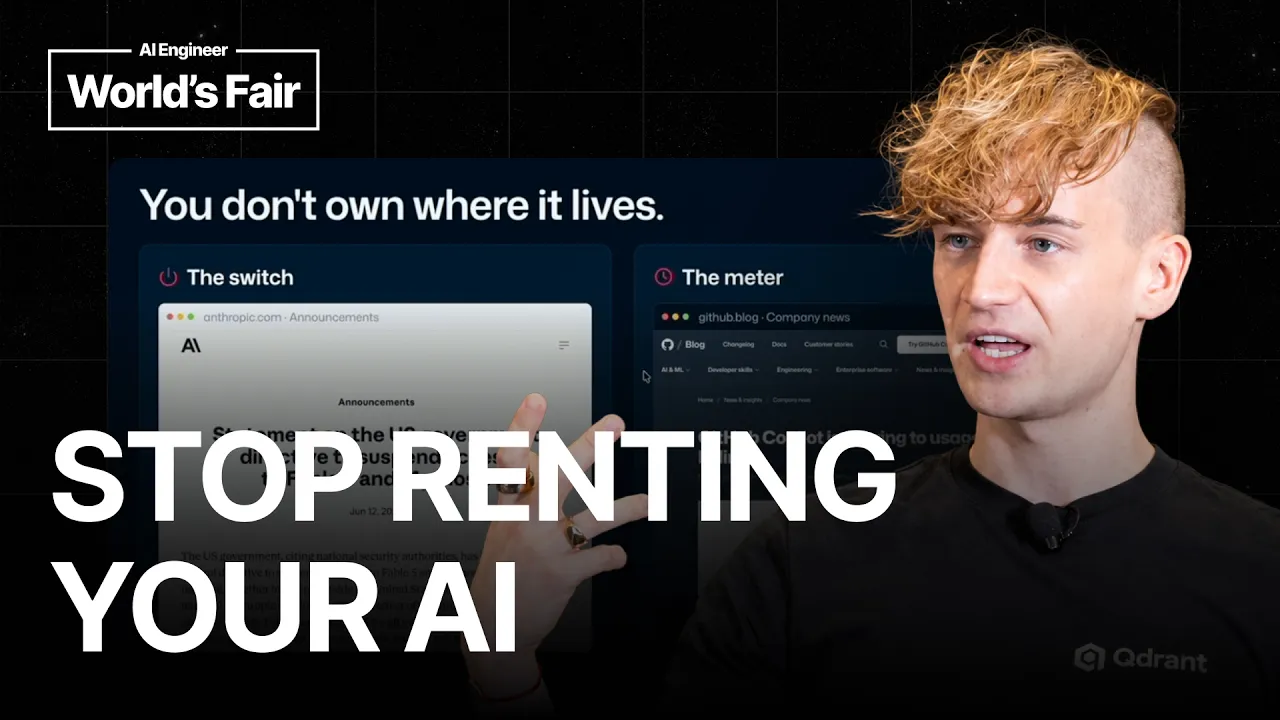
This shows up in three different ways. Last month, a government order pulled access to two flagship models, Fable and Mythos 5 for every single customer. Now, compare that to weights you already that are already sitting on your desk. Nobody can reach into your machine and flip those off. Even when the model the model stays up, it doesn't stay put. Providers retire versions and they throttle what's left. When the economics get gets tight, the model you rely on can quietly get worse or vanish.
Weights your own never change unless you change them. People also don't don't write prompts anymore. They run agents or loops for hours. And one task can burn thousands of times more tokens than a chat message. Some developers burn through over $5,000 a month of of compute on a $200 plan. That's a subsidy. And those subsidies will ultimately disappear. If you own the compute and the weights, the control comes back to you.
But that's still only half the problem. Here's the deeper issue. Owning inference gives you autonomy. Nobody can take the model away. But only memory gives you continuity. And continuity is exactly what every major lab is trying to package up and sell back to you. Look at last year. Every Frontier Lab shipped a memory feature, not because the models got smarter, but because they don't carry anything between sessions.
That gap is the actual product. A system that starts simple and keeps learning you will always feel smarter than one that starts brilliant, but forget everything about you. That compounding is where intelligence starts to feel personal. So what actually is memory? It's not a bigger prompt. It's a systems with three verbs. Write, retrieve, and forget. Same three things your brain actually does. And you know, there's an obvious push back.
Why not just throw everything in a big folder of markdown files. And because retrieving the right memory beats dumping everything and praying the model finds it. Retrieval gives you something a prompt cannot. It is control. You can filter by topic. You can decay by recency and frequency. You can let relevance shift over time. The way human memory actually works. And the infrastructure has been ready for years. HNSW in 2016.
Um, embeddings have been running locally since 2019, long before any any model could really use them at scale. The memory side of super intelligence was never the hard part. We were just pointing it out at ourselves. So today, the memory that actually knows you lands in one of two places. Either it's stuck in an unindexed file you can't really query or it's in someone else's cloud. One terms one terms of service change away from being being reshaped or moved.
Corp Carpathy framed it in a way that really stuck with me. It's the model is the CPU, the memory uh the context window is the RAM and the memory is the disk. RAM is fast but forgets forgets the moment the session ends. The disk is what remembers you across every conversation. And right right now for almost every AI assistant on on Earth, the that disk is in someone else's data center. So, you know, today I'm not going to argue which memory architecture wins or is the best one.
That's definitely a different talk. But the disk, the parts that holds the actual record of you should be yours fully and forever. So, this is the piece that I work on and it's just one way to do it. Um, a ve I work on a vector search engine that embeds directly into your app. It opens look a local store inside your process. You write embeddings with payloads. Then query offline sub millisecond time. Same rust score as quadrant in the cloud just running where you are.
With quantization, a million memories can fit in less than a gigabyte. Small enough to live on a phone or even a Raspberry Pi. Close the app, come back a year later, the memory is intact. Every app gets its own isolated store. And that folder is the thing that actually follows you. So, I'm going to do a quick live demo here. Um, so right now, um, I have a video recording of a drone like going over a house. So, basically that drone, it's it first time starting.
It's it's first time out in the world. It doesn't know anything. And so, this this is actually running live right now fully offline on my laptop. And I'm using yellow which is an object detection model. So it detects the object and creates a um label for every items it sees here. Then we take take that picture, we take that label and we turn that into embeddings to create a live realtime memory for that drone. And and that way we can re the drone can remember everything it has ever seen before.
And so here you can see a 2D representation of that vector space with all the memories inside. And memories that are the most similar will will be the closest to each other. So here you can see that we've already recognized 92 different objects and we have over three 300 vectors. So that's 300 different representations of those 90 objects. And you can see that the entire memory and quadrants engine uh footprints is only 15 megabytes.
And then what we can do uh on those memory? Well, we enable um semantic search over those memories. So, you know, if I click here on the um coffee table, you can see that in less than one millisecond, I was able to pull up every single coffee table that this drone has seen before. And so, you know, we have the image here. We have the first sin time stamp. We have the last s time stamp. We have a definition of that coffee table. and and also we can see how many times that u table has been seen.
So this is all being run and processed locally. There's no network attachment at all. Um but we also have a capability of uh cloud sync. So for example, you know, if you have like a swarm of drones or robots navigating the world, they can have like a hive mind in the in the cloud where I you know, one system uh learns something and they can all learn about it. And you know, this is what this was like an example for a drone, but you can apply that to to everything. just a chatbot, an agent that you call to a code assistant.
And you know, if you create those memories for just a few weeks, the stranger just disappears. It remembers your corrections, your preferences, the dead ends you had to only hit once. And a model that's merely good, but never forgets you and keeps compounding over the years starts to feel super human in practice. Not because the model changed, but because it never stopped learning you. And it's portable. Swap the resulting model, change the hardware, none of it matters.
It all comes with you if you keep the same embedding model and that folder becomes permanent. A lifetime of context fully yours moving from device to device. But we can go even further than that. You know, this can go way past a laptop or a drone. points that same memory at your whole day. Where did I leave my badge? What was her daughter's name again? What was on that whiteboard? And what what was the song that was playing when we met?
Every one of those is just a a retrieval query. And you know, you just watched a drone remember objects. No, extend that to everything you see and everything you hear. And you know, that's not science fiction. Those are the smart glasses that are already shipping today and that we have seen today in this room. It's not a smarter you. It's a you that doesn't forget. And right now, none of those memories share uh none of those devices share a memory that you actually own.
They could on your own terms because Frontier models are already building an index of you today. They have your relationships. They have your habits. They they have your whole inner life. That index is common whether you opt in or not. The only question is whether you own it or if you're renting access to yourself. And one last idea because owning memory doesn't doesn't mean keeping it to yourself. Edge can sync parts of your store to the quad quadrant cloud out of the box when you choose to.
Picture a family, each wearing glasses that record their own day. Separate memories, but they can pull into a hive mind the whole family owns. Mom's day, dad's day, your day, searchable together. Now, scale that up. Instead of one company's super intelligence serving billions of identical people, you get thousands of small private ones, each shaped by a life, a family, a team. But that same mechanism cuts both ways. A memory can be shared without a memory share can be shared with consent or it can be extracted without it.
That's exactly why it has to start local and why sharing should always be optin never the default. You should really decide who gets your continuity and your memories. And this is where I'm going to leave you. You know, every everyone here is going to watch super intelligence show up over the next few years. That's that part is basically settled. What's not settled is who it belongs to. And that's the fight worth having right now.
While the AR while the architecture is still up for grabs. So tonight, don't go home and just try a tool. Take the stranger home and give it memory. Then picture that memory 5 years from now. not a chatbot, a private mind that never forgets you, that nobody can switch off, and that knows knows you better than any system ever has because you were the only one who ever trained it. That's not a that's not a smaller super intelligence.
That's the only one worth wanting. All right, that's all for me. Thank you very much. >> [music]
The words are the caption track's own and nothing is reworded or re-transcribed. Paragraph breaks are placed between sentences so the text reads as prose.
Free tools for your own script: paste a draft and see where it stands before you record it.
Paste your draft and see where viewers are likely to drop off, with a rewrite for each weak line.
Paste the first 30 seconds of your own draft for a hook score and rewrites.
Check your draft against YouTube's advertiser-friendly guidelines before you record it.
Read this channel's public videos and transcripts, and download a writing brief for it.