Getting the transcript
Reading the captions from YouTube. A video nobody has opened here before takes 10 to 30 seconds; this page fills in on its own.
Getting the transcript
Reading the captions from YouTube. A video nobody has opened here before takes 10 to 30 seconds; this page fills in on its own.
LYFE Marketing · @LYFEMarketingAtlanta
Words
1,288
Runtime
6:26
Speaking pace
200wpm
Reading time
5min
200 words per minute, between the 181 median and the 201 75th percentile of 349 measured videos. That distribution comes from the 349-video hook study.
Opening (first 30 seconds)
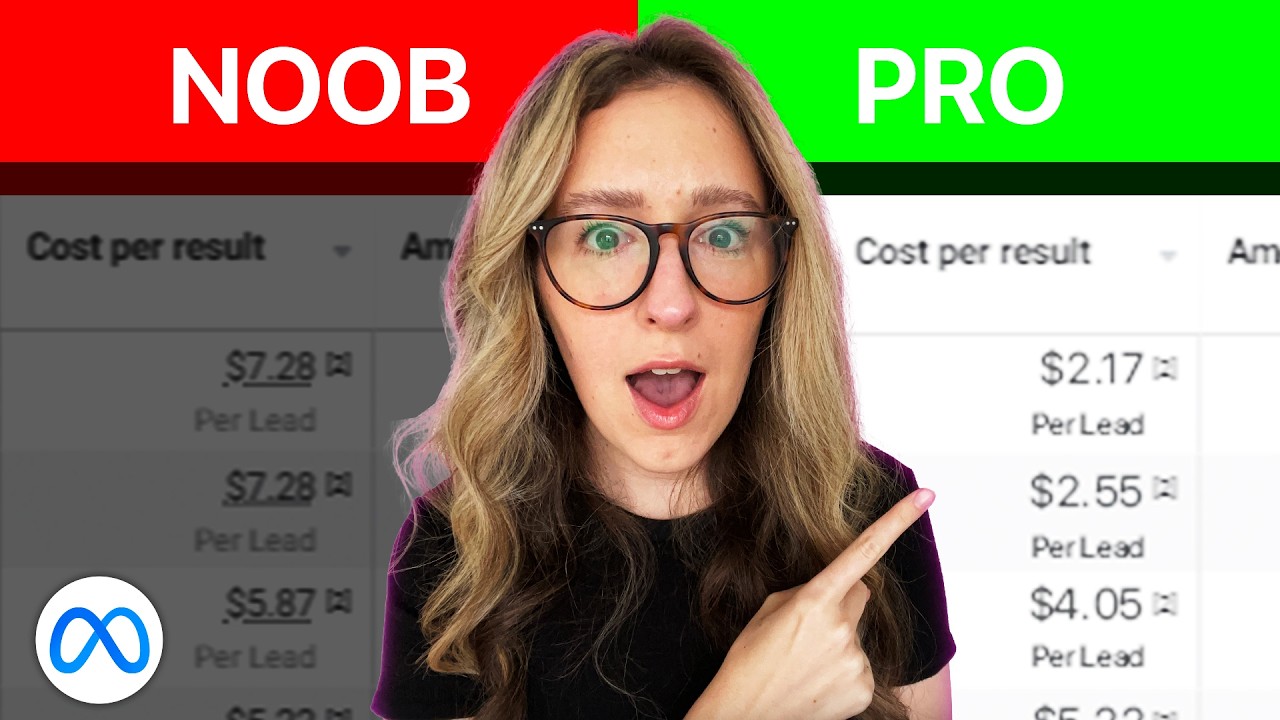
If your Facebook ads are getting results, but it feels like you're paying way too much for each lead or sale, you're not alone. Because right now the biggest problem most businesses face with Meta ads is not getting traffic, it's getting profitable traffic. It doesn't matter if you get a $100 sale if you spent $200 to get it. So, in this video I want to show you how to lower your customer acquisition cost, meaning your cost per lead or cost per purchase by up to 50% using three things that are working right now: broad targeting, custom
100 words, the words spoken in the first 30 seconds at 200 words per minute.
Free, no signup. See how the first 30 seconds hold attention, with rewrites.
Sentence shape
| Measure | This transcript |
|---|---|
| Sentences | 71 |
| Average words per sentence | 18.1 |
| Longest sentence | 55 words |
| Questions asked | 1 |
| Sentences containing a number | 3 |
Most used terms
Filler phrases
11 in total: like 8 · actually 3.
A literal whole-word count of the same phrase list the Prepublish browser extension uses, so a phrase inside another word is not counted and a phrase used in its ordinary sense still is. It is a count and not a judgement.
Free, no account. See where attention is likely to drop, with a rewrite for each weak line. The free check shows the scores and the one issue costing the most. Or run it on the words above first.
Free · No login · See a sample audit first if you prefer.
What this transcript is
Every word below is the caption track YouTube publishes for this video, pulled from the video itself and reproduced unchanged. It is not Prepublish's writing, not a summary, and not a re-transcription: it is the video's own published captions. English captions, generated automatically by YouTube, in the video’s original language. Source: the video on YouTube. A channel that would rather this page did not exist can ask for its removal through the contact page, and it is removed.
No Script X-ray for this video: YouTube shows a Most replayed graph only once a video has enough views.
If your Facebook ads are getting results, but it feels like you're paying way too much for each lead or sale, you're not alone. Because right now the biggest problem most businesses face with Meta ads is not getting traffic, it's getting profitable traffic. It doesn't matter if you get a $100 sale if you spent $200 to get it. So, in this video I want to show you how to lower your customer acquisition cost, meaning your cost per lead or cost per purchase by up to 50% using three things that are working right now: broad targeting, custom audiences, retargeting, and a fourth bonus tool that most small businesses don't even think about.
And more importantly, I'm going to show you how to use them all together in the right order. In case you don't know, I'm Brandy with Like Marketing, the digital marketing agency with a mission to help small businesses grow. We've generated over $272 million in revenue for our small business clients using Facebook and Instagram ads alone. So, if you're interested in having us just handle all of your ads for you, schedule a free strategy call using the link below.
Step one, start with broad targeting. The first thing you need to do is stop over-narrowing your audience because one of the biggest reasons your costs are high is that you're trying to control too much. Most people go into Ads Manager and start stacking interests, narrowing behaviors, building super tiny niche audiences, trying to dial in their perfect customer. And that used to be what worked. But here's the problem with that now.
Meta is better at finding your customer than you are. It has more data than you'll probably ever have, and it uses it. Today Meta looks at your targeting, your ad creative, your copy, your landing page, and your past conversion data, and then it takes that information and combs through the billions of users it has and the data it has on them to find the right people to show your ad to. So, when you over-restrict your targeting, you're actually making it harder for the system to work.
That's why broad targeting works better now. And all that means is keeping things simple and therefore broad in audience size. You only control things that actually matter, like location, where you can serve, age, if there's a real reason to constrict age, like legally or practically, and gender. Again, only if necessary. And that's it. Everything else you leave open because the more room you give Meta, the more efficiently it can find the lowest costing conversions.
And that's the goal. Not just results, but affordable, profitable results. Step two, build custom audiences and retarget them. Now that your broad targeting is in place, the next step is to make sure they convert. And that's where custom audiences come in. A custom audience is usually a group of people who have already interacted with your business in some way. This could be your website visitors, email list, people who engage with your content, video viewers, and so on.
Because these people are not brand new to your business, they're what we call warm audiences. They already know who you are, and that matters because it's almost always cheaper to convert someone who already knows you than someone who's never heard of you before. So, once you have these warm audiences, you need to retarget them. And retargeting is just when you show ads specifically to people who have already interacted with your business, which in this case is going to be the custom audiences you just created.
So, instead of relying only on cold traffic of brand new people who've never heard of you, you're now capturing the people who didn't convert the first time. Because here's the reality, most people don't buy the first time they see your ad. It takes multiple touch points, usually seven on average, before somebody trusts your brand enough to buy from you. So, if you're not retargeting, you're losing out on the easiest, lowest cost conversions available to you.
But there's another thing you need to do with custom audiences that most people don't think about. And when you don't do this one thing, it burns through your ad spend. Step three, exclude custom audiences from your cold campaigns. This is one of the easiest ways to lower your cost, and almost nobody is doing it properly. Once you've built your custom audiences, you don't just use them for retargeting. You also use them to exclude them from your main campaign.
And here's why. If someone has already visited your website, engaged with your content, or even bought from you, they are no longer a cold audience. So, if your main campaign is supposed to be dedicated to bringing in new customers to fuel your funnel, why would you keep showing ads to the same people? That drives your cost up and it creates overlap. And if the nature of your business is not one that warrants repeat purchases, then you don't want to waste ad spend showing ads to people who have already converted.
Instead, you want your main campaign to focus on new people only. So, you take your custom audiences and exclude them from your broad targeting campaign. That way, not only are you not wasting money, your campaign becomes more efficient overall because it can focus on finding new, lower-cost customers instead of recycling the same audience over and over. Now, the last step is one most small business owners either don't know about or get wrong.
Step four, create customer-focused ads that convert. So, even if you do everything we just talked about correctly, your results still ultimately come down to one thing, and that's your ad creative. Because like we briefly mentioned earlier, Meta now uses your ad creative as a signal. It looks at who engages with it, who watches it, who clicks it, who converts from it, and then finds more people like them. So, if your ad is weak, it doesn't matter how good your targeting is, Meta won't have strong enough signals to optimize from.
And as a result, your costs will stay high. So, your ad matters to Meta, but don't forget it also matters to your target customer. Ads that call out a problem the customer is dealing with or goal they want to achieve are going to resonate with them far more than an ad that details your business success, your offerings, etc. Ads that feel relevant to the customer immediately, hold attention, and clearly guide the next step are the ads that we're seeing work best right now.
That's why the best-performing accounts today combine broad targeting, strong custom audiences, and smart retargeting with high-quality customer-focused ad creative. Because when your creative is strong, your click-through rate goes up, your conversion rate improves, and your cost per result goes down. So, So we simplify this into what you actually need to do, it looks like this. Start with a broad targeting campaign where you only control real limitations like location, age, and gender, and only if those are necessary.
Build custom audiences from your data including website visitors, engagement, and customer lists. Run a retargeting campaign to convert that warm traffic, and also use those audiences to exclude warm traffic from your cold campaign and avoid advertising to people who have already converted. And support all of that with strong customer-focused ad creatives, and that's the system. When it's set up correctly, you're not just getting results, you're getting results for cheaper.
That's how you stop overpaying for leads and customers and start scaling profitably.
The words are the caption track's own and nothing is reworded or re-transcribed. Paragraph breaks are placed between sentences so the text reads as prose.
Free tools for your own script: paste a draft and see where it stands before you record it.
Paste your draft and see where viewers are likely to drop off, with a rewrite for each weak line.
Paste the first 30 seconds of your own draft for a hook score and rewrites.
Check your draft against YouTube's advertiser-friendly guidelines before you record it.
Read this channel's public videos and transcripts, and download a writing brief for it.