Getting the transcript
Reading the captions from YouTube. A video nobody has opened here before takes 10 to 30 seconds; this page fills in on its own.
Getting the transcript
Reading the captions from YouTube. A video nobody has opened here before takes 10 to 30 seconds; this page fills in on its own.
Sharbel A. · @sharbelxyz
This video has no Most replayed graph yet: YouTube shows one only once a video has enough views. These are the moments viewers replayed most in Sharbel A.'s most watched videos.
Most replayed moment at 13:32
3.9x that video's typical replay level
built-in memory, which is great. Here is how I would think about memory providers. Memo is interesting if you want a dedicated memory layer for personalized AI agents. It focuses on extracting, storing, linking, and retrieving memories efficiently. Their
Said at 13:25
Most replayed moment at 6:37
5.8x that video's typical replay level
trading strategy. Tests it. If it's better, it keeps it. If it's worse, it discards it and tries again. So, that's exactly what I built. Okay, here's the system we have at play. I gave it two years of crypto data,
Said at 6:31
Most replayed moment at 1:53
3.7x that video's typical replay level
let's install it together. Okay, so for step one, we need to actually start by installing Bullpen's CLI so that we can actually do everything that we want to do. And for that, let's first open Claude and put in the dangerously skip
Said at 1:47
The graph counts replays. It does not show where viewers stopped watching.
Words
1,236
Runtime
8:22
Speaking pace
148wpm
Reading time
5min
148 words per minute, below the 160 25th percentile of 349 measured videos. That distribution comes from the 349-video hook study.
Opening (first 30 seconds)
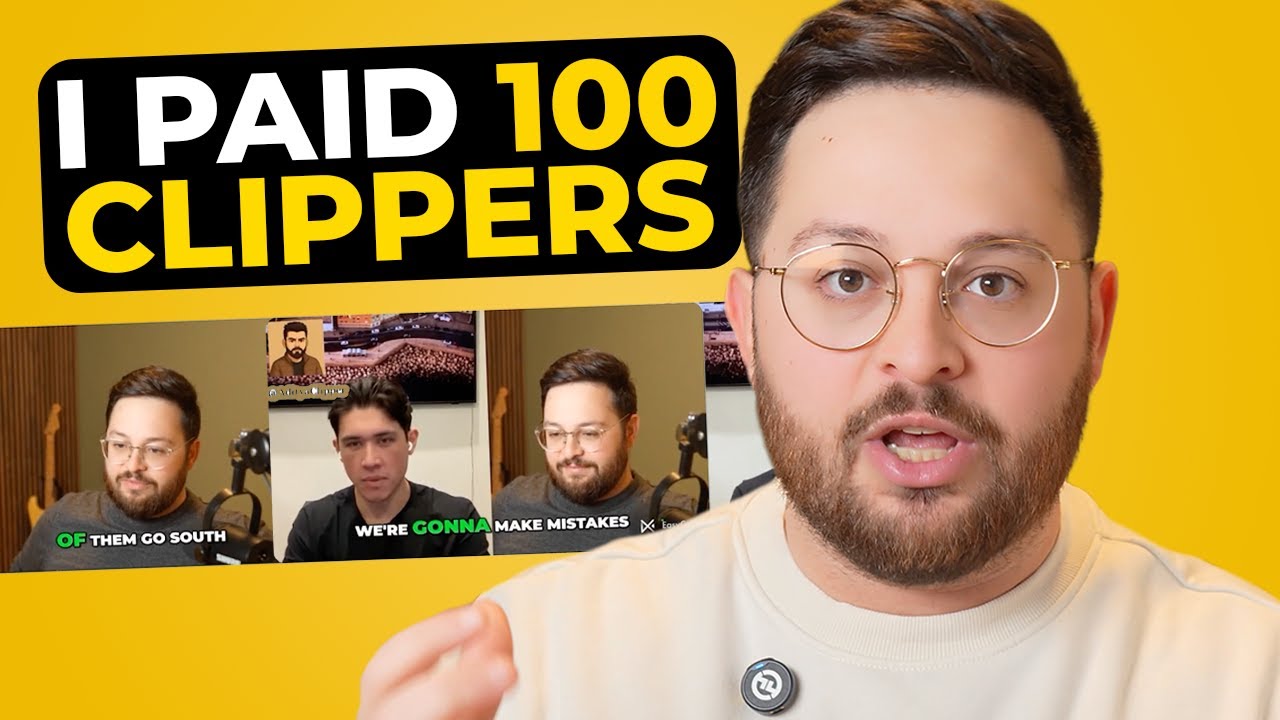
I paid 100 clippers to clip the same exact video and the results I got were actually insane. I've been talking about how big I think clipping is [music] going to become. How creators, founders, brands, and even Fortune 500 companies will eventually have armies of clippers working behind every marketing campaign. But a lot of people didn't get me. Why would clipping be such a big thing? Isn't it just cutting videos? Why
74 words, the words spoken in the first 30 seconds at 148 words per minute.
Free, no signup. See how the first 30 seconds hold attention, with rewrites.
Sentence shape
| Measure | This transcript |
|---|---|
| Sentences | 97 |
| Average words per sentence | 12.7 |
| Longest sentence | 38 words |
| Questions asked | 5 |
| Sentences containing a number | 18 |
Most used terms
Filler phrases
13 in total: I mean 4 · like 4 · actually 3 · literally 2.
A literal whole-word count of the same phrase list the Prepublish browser extension uses, so a phrase inside another word is not counted and a phrase used in its ordinary sense still is. It is a count and not a judgement.
Free, no account. See where attention is likely to drop, with a rewrite for each weak line. The free check shows the scores and the one issue costing the most. Or run it on the words above first.
Free · No login · See a sample audit first if you prefer.
What this transcript is
Every word below is the caption track YouTube publishes for this video, pulled from the video itself and reproduced unchanged. It is not Prepublish's writing, not a summary, and not a re-transcription: it is the video's own published captions. English captions, generated automatically by YouTube, in the video’s original language. Source: the video on YouTube. A channel that would rather this page did not exist can ask for its removal through the contact page, and it is removed.
I paid 100 clippers to clip the same exact video and the results I got were actually insane. I've been talking about how big I think clipping is [music] going to become. How creators, founders, brands, and even Fortune 500 companies will eventually have armies of clippers working behind every marketing campaign. But a lot of people didn't get me. Why would clipping be such a big thing? Isn't it just cutting videos? Why are you obsessed with this?
So, I had an idea. If I really think clipping is the next [music] huge wave in marketing, why not run an experiment on myself? Why not prove it? So, that's [music] exactly what I did. I paid 100 clippers to clip the same exact video with zero instructions. [music] And what I discovered honestly blew my expectations. So, without further ado, let's get into this video. For the setup of this challenge, I needed to choose one video that all 100 clippers were going to edit.
So, I picked my latest video, the one that I had uploaded the most recently at the time of this recording, which turns out to be a simple podcast conversation I had recorded. It had no crazy editing, no fancy angles, just a clean, simple conversation, which I thought would be the perfect blank canvas for this challenge. Then I went into some of our unfundable partner clipper communities, and I hired 100 clippers from all skill levels, from beginners to semi-proeditors to professional clippers.
And I gave them all the same exact prompt, which is clip this video, make it as viral as possible. That's it. No reference look, no examples, just that. And then I waited. When the clips started coming in, the differences were actually fascinating. Every clipper had the same footage, but their interpretations were completely different from one another. And that's what made the experiment so much more interesting. Some leaned into a bit more cinematic.
Their edits were smooth. They had subtle music, intentional pacing. They made the clip feel polished like something you would see on TV. Some focused on the emotions with very little effects, minimal edits, and just natural pacing. And some focused on storytelling. They rearranged emphasis, added B-rolls that guided the story, and made the clips feel intentional. I didn't see much bad, but I did see plenty of different styles, which is exactly the point of this experiment.
And that's when it clicked for me. Clipping isn't just an editing skill. It's a lens essentially. Every single clipper, even with the same exact footage, brings their own taste, their own pacing, interpretation, their own storytelling instinct. And that's the beauty of it. There's no right or wrong, just different ways of telling the same moment. And when you see a hundred different interpretations side by side, you start to understand how powerful clipping actually is.
This experiment made something painfully obvious. Good clippers don't just add effects, but they extract a story. See, anyone can throw subtitles on a video, but not everyone can turn 30 seconds into a meaningful something. Number two, clipping isn't just an editing skill. It's also a marketing skill. It's a lot about hook detection, pacing, emotion, narrative, also attention engineering. Number three, a clipper can change how you, the creator, the founder, or the brand, can be perceived by others.
Your editing literally affects your brand. I mean, some edits made me look smarter. Some made me look like a meme page. Some made me look like I run a cult. And in its essence, editing becomes identity. And identity is the key of virality, but also memorability. And number four, the best clippers can create awareness explosions. When I saw clips hit, they exploded across the timeline. I saw plenty of reposts, re-uploads, even some reaction videos and quote tweets.
I mean, I've seen my clips travel to places my main video could never reach. Clipping is essentially a great method of distribution. It's brand awareness in its essence, and this experiment just proved it. Okay, so let's talk about results because this experiment wasn't just a creative challenge. I treated it like an actual awareness campaign and the numbers ended up surprising me. Throughout this challenge, I refrained from posting a ton of content simply not to greatly skew the results.
And throughout the week where the clipping campaign was active, I managed to gain over 400 followers. I mean, I typically gain about 100 new followers a week. So, that's 300 more than my typical. And keep in mind, that's from clips I didn't even post myself. Just raw distribution from the clippers themselves, their audiences, and just the algorithm doing its thing. Out of the 100 submissions that I ended up receiving, a few stood out to me as clear winners.
I mean, for example, the top three performing clips alone had over 80,000 impressions. And here's the funny thing, the most viral clips weren't always the ones with the craziest editing. Instead, they were the ones where the story just hit. The clipper understood what part of my video would genuinely capture a viewer's interest, and all they did was just highlight it. So, across all of the clips that ended up being posted, the single experiment, I'm looking at the data right now, generated over 300,000 impressions.
By the way, these clips took exactly 5 days to post. So, in just 5 days, 300,000 impressions from one original video. And remember, I didn't push anything out myself. And this is the part that really sold me on how powerful clipping really is. Because after the clips started going live, I started getting tagged in random videos. People were quoting me in posts related to the clips themselves. My DMs started shooting up and I even started seeing new clips getting uploaded that I hadn't even paid for.
In fact, I got an extra 30,000 impressions from clips I have not paid for. This is the network effect of clipping or the snowball effect if you want to call it that. Your message spreads far beyond your own platform and it just starts compounding over and over again. This experiment turned out to be much less about clipping and a lot more about attention. See, attention is the currency of the internet and clips, they're the fastest, easiest, most frictionless way to buy that attention.
Big creators know this, brands will know this, founders will know this, and soon everyone will know this. So, here's the crazy part. This whole experiment, paying 100 people to clip the same exact video, is literally the same distribution model we use for our founders. Because once you see how far one piece of content can travel when different editors interpret it differently, you realize something simple. Founders don't need more content.
They need more distribution. And that's why we built the podcast tour, where we take you across a podcast tour with top creators, help you capture your own story, and then run a clipping campaign that pushes your message across the timeline. That's it. Super simple yet super effective. If that's something you want, make sure to DM me today. That being said, a massive shout out to all 100 clippers who made this video possible.
Who knows, I might run this experiment again with 1,000 clippers next time.
The words are the caption track's own and nothing is reworded or re-transcribed. Paragraph breaks are placed between sentences so the text reads as prose.
Free tools for your own script: paste a draft and see where it stands before you record it.
Paste your draft and see where viewers are likely to drop off, with a rewrite for each weak line.
Paste the first 30 seconds of your own draft for a hook score and rewrites.
Check your draft against YouTube's advertiser-friendly guidelines before you record it.
Read this channel's public videos and transcripts, and download a writing brief for it.