The Disturbing Ways Ancient Humans Survived Winter transcript
Ink Explainer · @Inkexplainer96
Words
2,550
Runtime
11:30
Speaking pace
222wpm
Reading time
11min
222 words per minute, above the 201 75th percentile of 349 measured videos. That distribution comes from the 349-video hook study.
Opening (first 30 seconds)
Right now, you are warm. You might not even notice it, but you are. There's a number on a wall somewhere in your home, and if the air ever drops below it, a machine kicks on and fixes the problem before your body even registers a complaint. You walk from a heated house to a heated car to a heated building, and the coldest part of your entire day is probably the 10 seconds it takes to get from one to the other. Winter for you is an inconvenience. It's scraping ice off a windshield. It's a heavier jacket. It's complaining that it gets dark too early. But for almost the
111 words, the words spoken in the first 30 seconds at 222 words per minute.
Sentence shape
| Measure | This transcript |
|---|---|
| Sentences | 189 |
| Average words per sentence | 13.5 |
| Longest sentence | 48 words |
| Questions asked | 2 |
| Sentences containing a number | 5 |
Most used terms
- winter30
- cold17
- human13
- people12
- warm12
- fire10
- food10
- dark8
- humans8
- layer8
- body7
- kill7
Filler phrases
8 in total: like 4 · actually 3 · kind of 1.
A literal whole-word count of the same phrase list the Prepublish browser extension uses, so a phrase inside another word is not counted and a phrase used in its ordinary sense still is. It is a count and not a judgement.
What this transcript is
Every word below is the caption track YouTube publishes for this video, pulled from the video itself and reproduced unchanged. It is not Prepublish's writing, not a summary, and not a re-transcription: it is the video's own published captions. English captions, generated automatically by YouTube, in the video’s original language. Source: the video on YouTube. A channel that would rather this page did not exist can ask for its removal through the contact page, and it is removed.
Transcript
Right now, you are warm. You might not even notice it, but you are. There's a number on a wall somewhere in your home, and if the air ever drops below it, a machine kicks on and fixes the problem before your body even registers a complaint. You walk from a heated house to a heated car to a heated building, and the coldest part of your entire day is probably the 10 seconds it takes to get from one to the other. Winter for you is an inconvenience.
It's scraping ice off a windshield. It's a heavier jacket. It's complaining that it gets dark too early. But for almost the entire human history, winter was not an inconvenience. Winter was the season that tried to kill you, and it didn't try just once or in just one way. It came at you from four different directions at the same time. The cold could kill you. The hunger could kill you. The animals could kill you. And the long, dark, endless nights could break you before any of the others got the chance.
So, the question is simple. For hundreds of thousands of years, with no heating, no supermarkets, no walls that actually sealed out the wind, how did human beings survive winter at all? Because they did. Your ancestors walked straight into some of the coldest environments on the planet and came out the other side. And the way they did it is one of the most impressive things our species has ever pulled off. Let's start with the most obvious threat, the cold itself.
Here's something most people don't realize. A human being is a tropical animal. Our bodies evolved in the warm parts of Africa, and left to its own devices, a naked human loses heat fast. In cold conditions, you can slip into hypothermia in a matter of hours. Your fingers stop working. Your thinking slows down. And once your core temperature drops far enough, your body simply stops. No claws, no thick fur, no natural insulation worth mentioning.
On paper, we are one of the worst equipped large animals on Earth for surviving a hard winter. And yet, humans didn't just survive the cold, they walked into it on purpose. They spread north into ice age Europe, into Siberia, into places where winter temperatures dropped far below anything the human body can handle unprotected. So, how? The first answer is fire, and we'll come back to what fire did for the long winter nights later.
But fire has a problem. Fire only warms the side of you that's facing it. It doesn't travel with you. The moment you step away from the flames to go hunt or gather wood, the cold comes straight back. Fire alone was never going to be enough. What ancient humans needed was a way to carry warmth with them, wrapped around their bodies everywhere they went. And that brings us to what might be the single most important winter technology humans ever invented, clothing.
But, not the kind you're probably picturing. For a long time, the assumption was simple. It's cold. So, you drape an animal hide over your shoulders and you're done. And for a while, that's exactly what humans did. But, a hide thrown over your back leaves gaps everywhere. Wind gets in at the sides. Your arms are exposed. It slips off when you move. A draped skin is better than nothing, but in a real winter, better than nothing still gets you killed.
The breakthrough was learning to cut hides into pieces and sew them back together into shapes that actually fit the human body. Fitted sleeves, closed sides, a garment that trapped a layer of warm air against your skin and held it there while you moved. This is the difference between a blanket and a coat. But, here's the problem. To make this all work out for you, you need a needle. And not just any needle, a needle with an eye, a tiny hole to carry the thread.
This is a genuinely difficult thing to make. You have to take a sliver of bone, grind it down thin, and then drill a hole through it that's small enough to be delicate, but strong enough not to snap. Archaeologists have found bone needles like this dating back more than 40,000 years, and in some sites, even older. These are precise, deliberate tools. Whoever made them understood exactly what they were for. And the thread itself came from the animals, too.
Sinew, the tough fibers that connect muscle to bone, could be stripped, dried, and used to stitch hides together into something that held. Layer a garment like that, fur turned inward against the skin, and suddenly, a human being could stand in air cold enough to kill and stay alive inside their own pocket of warmth. Sewn clothing wasn't a comfort. It was the piece of technology that let our species leave the warm world it evolved in and walk into the cold parts of the planet.
Without the needle and the thread, there is no human being in Ice Age Siberia. So, you're warm now, or at least warm enough. You can move, you can work, you can hunt. But, the sun is going down, the temperature is dropping even further, and you have a second problem that clothing can't solve. You need somewhere to survive the night. The obvious answer is a cave, and caves were valuable, genuinely valuable. A deep cave holds a steady temperature, blocks the wind, and keeps the snow off you.
But, here's the thing that nobody tells you about caves. There aren't many of them. A good, dry, defensible cave in the right spot was rare. And if you found one, you probably weren't the only one who wanted it. Other groups also wanted it, too. You couldn't count on a cave. Most of the time, if you wanted somewhere to survive the winter, you had to build it yourself. And this is where it gets remarkable. In a place called Mezhyrich, in what is now Ukraine, archaeologists found the remains of shelters built around 15,000 years ago.
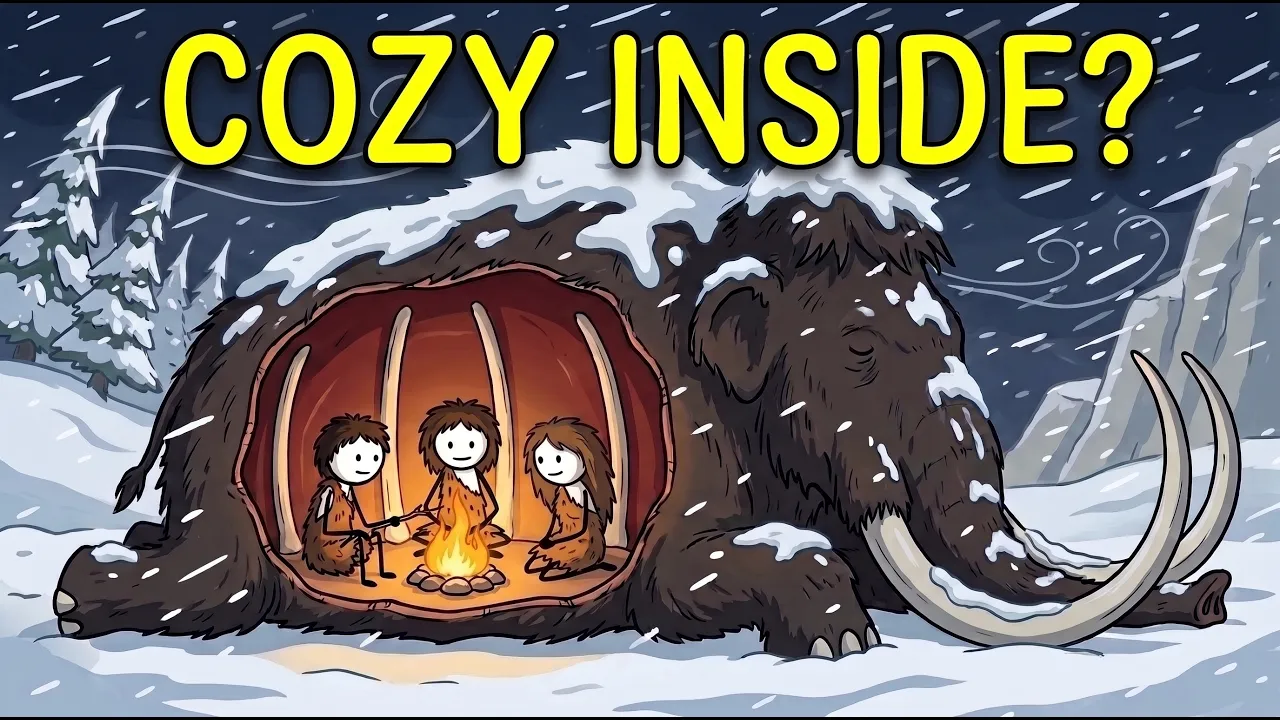
But, there was almost no wood on that landscape, and almost no stone. So, the people there built their homes out of the one material they had in an enormous quantity. I'm talking about mammoth bones. They stacked and interlocked the bones of dozens of mammoths into round, dome-shaped huts. Hundreds of bones in a single dwelling. Jawbones layered like roof tiles. Massive tusks arched over the entrances. These were not quick, throwaway shelters.
They were substantial, engineered structures built to hold up through a brutal winter. And they took real planning and real labor to put together. And inside a shelter like that, you did everything you could to hold the warmth in. You lined the floor. At a site in South Africa, archaeologists found evidence of bedding made from layers of grasses and leaves, carefully arranged, dating back an astonishing 77,000 years.
People were making their shelters comfortable before our species had even left Africa. And it didn't stop at the floor, because think about that mammoth bone hut for a second. It's built out of bones, and bones don't fit together perfectly. There are gaps everywhere. And every single gap is a doorway for the wind. So, they sealed them layer by layer. They stretched animal hides across the inside of the walls and pinned them over the openings.
They cut blocks of sod and stacked them against the outside, and some groups even packed snow against their shelters because a thick layer of snow is actually a very good insulator. It traps air, and trapped air holds heat. Layer by layer, the wind ran out of ways to get inside. A shelter wasn't just walls anymore. It was a system, and it kept people alive on nights that should have killed them. But a warm shelter creates a new problem, and it's a big one.
To keep a fire going through a long winter, you need fuel, a lot of it. And gathering fuel means someone has to keep going outside into the cold over and over all winter long. You are tied to that shelter. You can't just wander, and that means the food you need has to either be nearby, or it has to already be stored, which brings us to the third threat, and honestly the one that killed the most people, hunger. Here's the part about winter that people forget because we've completely erased it from our lives.
In winter, the world stops producing food. The plants die back or go dormant. The berries are gone. The roots are harder to find and harder to dig out of frozen ground. Many of the animals have either migrated away or gone into hiding or grown lean and desperate themselves. For a hunter-gatherer, winter isn't just cold. It's a season when the land itself stops feeding you, and that turns survival into a math problem.
You have to gather enough food during the warm months to carry a group of people through months when almost nothing new is coming in. So, ancient humans became experts at storing food, and they had a few brilliant ways to do it. The first was drying. If you slice meat thin and let it dry out either in the sun or over the low smoke of a fire, you pull the moisture out of it, and without moisture, it doesn't rot. Dried meat could last for months.
The smoke did double duty, adding a layer of preservation on top of the drying. A rack of drying meat in autumn was, in a very real sense, a group's insurance policy against starving in February. The second method was to use the cold itself as a tool. The frozen ground was a natural freezer. Dig a pit down into the permafrost, pack it with meat from a big kill, and the cold would keep it edible for a very long time. Winter, the thing trying to starve you, became the very thing that preserved the food keeping you alive.
But the most valuable food of all in winter wasn't meat exactly. It was fat. When you're burning enormous amounts of energy just to stay warm, lean meat isn't enough. Fat is the most concentrated source of energy there is, and in the depths of winter it was worth more than almost anything. Ancient humans rendered animal fat down into tallow, a stable, storable, energy dense fuel for the human body. They mixed dried meat with fat to make a dense, long-lasting food that packed a huge number of calories into a small portable package.
In a season where every calorie was a battle, fat was the difference between a group that made it to spring and one that didn't. So now you're warm, you're sheltered, and you've stored enough to eat. You've beaten three of winter's four death sentences, but there's one more, and it's the one people almost never think about. Because it doesn't attack the body, it attacks the mind, the darkness. In winter, especially the further north you go, the days get short and the nights get long, brutally long.
You might have only a handful of hours of usable daylight, and then 15, 16 hours of cold darkness with nothing to do but wait. You can't travel far. You can't hunt well in the dark. You are stuck in a small space with the same few people for a very long time, night after night after night. And that kind of confinement, that endless waiting, can wear a person down in a way that cold and hunger never could. But here's what ancient humans did with those long dark hours.
They didn't just endure them, they filled them. This was the time for all the work that didn't need daylight or good weather, sitting by the fire, repairing tools, shaping new spear points, sewing and mending clothing for the rest of the winter, twisting plant fiber into cordage, carving. The long night wasn't wasted time. It was workshop time. The hours when a group prepared everything it would need the moment the weather broke.
And it was more than just work. Around that winter fire in the dark is where people talked, where the older members of the group passed down everything they knew to the younger ones, where the stories got told, the same stories over and over, carrying the group's memory and its knowledge across the generations. A huge amount of what we think of as human culture, the myths, the songs, the shared knowledge, was forged in exactly these conditions.
People pressed together against the dark, keeping each other warm, keeping each other sane, keeping each other human until the light came back. Winter didn't just test the body. In a strange way, it built the mind. And when you step back and look at all of it together, something surprising comes into focus. Winter didn't just get survived. Winter shaped us. Think about it. The pressure of the cold is what pushed humans to invent fitted clothing.
The lack of caves is what pushed them to invent real architecture. food gap is what pushed them to invent storage and preservation. And the long dark nights are a huge part of where culture itself got made. Nearly every one of the technologies that let our species spread across the entire planet into every climate on Earth was forged in the effort to survive the cold. The hardest season didn't just fail to kill us. It made us more capable than we had any right to be.
So, here's the full picture. Winter came at your ancestors with four weapons. The cold, and they answered it with fire and with sewn fitted clothing. The night, and they answered it by building shelters out of whatever the land gave them. Even the bones of mammoths. The hunger, and they answered it by drying, freezing, and rendering their food into stores that could carry them for months. And the darkness, and they answered it by turning the longest, coldest nights into the workshop and the classroom where human culture was born.
Every single winter was a test that a huge number of people did not pass. Survival wasn't guaranteed. It was earned every single year through preparation and skill and sheer stubbornness. And now, look at you. You turn a dial and the room gets warm. You open a door and there's food that was grown on the other side of the planet in the middle of December. You complain that the sun sets too early from inside a house your ancestors could not have imagined, having never once in your life felt the specific fear of watching the first snowfall and wondering if you had stored enough to see the spring.
You don't survive winter anymore. You barely notice it. And that's not because winter got any weaker. It's because a hundred thousand years of human beings freezing and starving and huddling in the dark slowly figured out how to beat it, one invention at a time, so that you would never have to.
The words are the caption track's own and nothing is reworded or re-transcribed. Paragraph breaks are placed between sentences so the text reads as prose.
Use this transcript
Three free tools that work on the material around a video like this one. No signup, no login.
Hook Analyzer
Paste the first 30 seconds of your own draft for a hook score and rewrites.
Policy Pre-Flight
Check your draft against YouTube's advertiser-friendly guidelines before you record it.
Channel Skill Generator
Read this channel's public videos and transcripts, and download a writing brief for it.