Getting the transcript
Reading the captions from YouTube. A video nobody has opened here before takes 10 to 30 seconds; this page fills in on its own.
Getting the transcript
Reading the captions from YouTube. A video nobody has opened here before takes 10 to 30 seconds; this page fills in on its own.
Let's Talk Money! with Joseph Hogue, CFA · @josephhogue
Where viewers went back to watch this video again, from YouTube's public Most replayed graph, lined up with what was said at that moment.
Most replayed moment #1
47:177.7x the video's typical replay level
right there. >> I think so. So, yes, for me, again, I I'm loading up, but I would say buy big. Let's meet Let's meet at Buy Big. >> I I I I could agree. I think we should we can meet up with uh with buy big here. SoFi Technologies, Sofi. >> This is your company. Again, I I want to
Said at 47:10
Most replayed moment #2
40:507.1x the video's typical replay level
I will continue to load up on it and and ride that higher. >> Yeah, I think it makes sense. For me, it's there like between load up and buy big, but it's definitely a buy. >> And for me, a lot of this comes down to, you know, my my risk tolerance as an
Said at 40:44
Most replayed moment #3
20:575.1x the video's typical replay level
boat eventually. So, lots of other stocks to buy folks. You don't have to load into the the highest risk uh stocks out there. What's the next one? >> Let's let's continue on this line and we go to couch investor that is main position right now is Nebius. Nebas is
Said at 20:50
The graph counts replays. It does not show where viewers stopped watching.
Words
10,437
Runtime
53:44
Speaking pace
194wpm
Reading time
43min
194 words per minute, between the 181 median and the 201 75th percentile of 349 measured videos. That distribution comes from the 349-video hook study.
Opening (first 30 seconds)
Hey bow tie nation, Joseph Hog here. Among hundreds of finance YouTubers, thousands of stock picks and everyone shouting bye bye bye. I'm narrowing it down to the nine hottest stocks being recommended right now, including Service Now, Oracle, AMD, and SoFi Technologies, ranking from the treasure to the trash. For help on this, with hundreds of stock picks across YouTube, I'm bringing on Adriano of Edconomics. I love Adriano's videos following finance YouTubers. It's here. Someone sent me a link to his July midyear update ranking the best YouTuber picks. I managed to make the AT
97 words, the words spoken in the first 30 seconds at 194 words per minute.
Free, no signup. See how the first 30 seconds hold attention, with rewrites.
Sentence shape
| Measure | This transcript |
|---|---|
| Sentences | 588 |
| Average words per sentence | 17.8 |
| Longest sentence | 143 words |
| Questions asked | 50 |
| Sentences containing a number | 64 |
Most used terms
Filler phrases
531 in total: uh 206 · you know 111 · like 90 · um 33 · kind of 27 · I mean 25 · right? 15 · basically 13 · actually 11.
A literal whole-word count of the same phrase list the Prepublish browser extension uses, so a phrase inside another word is not counted and a phrase used in its ordinary sense still is. It is a count and not a judgement.
Free, no account. See where attention is likely to drop, with a rewrite for each weak line. The free check shows the scores and the one issue costing the most. Or run it on the words above first.
Free · No login · See a sample audit first if you prefer.
What this transcript is
Every word below is the caption track YouTube publishes for this video, pulled from the video itself and reproduced unchanged. It is not Prepublish's writing, not a summary, and not a re-transcription: it is the video's own published captions. English captions, generated automatically by YouTube, in the video’s original language. Source: the video on YouTube. A channel that would rather this page did not exist can ask for its removal through the contact page, and it is removed.
Hey bow tie nation, Joseph Hog here. Among hundreds of finance YouTubers, thousands of stock picks and everyone shouting bye bye bye. I'm narrowing it down to the nine hottest stocks being recommended right now, including Service Now, Oracle, AMD, and SoFi Technologies, ranking from the treasure to the trash. For help on this, with hundreds of stock picks across YouTube, I'm bringing on Adriano of Edconomics. I love Adriano's videos following finance YouTubers.
It's here. Someone sent me a link to his July midyear update ranking the best YouTuber picks. I managed to make the AT tier list year. I think my best picks were list was right around 40 to 50% at this point. Adriano, thank you for joining us. How do you follow so many YouTubers and the stock picks and just keep up with all of it. >> Thank you very much, Joseph. It's incredible for me. Just incredible to be here. Like I follow your channel since years now, maybe seven years.
So, I'm really excited to be honest. I'm also a little bit scared. It's the first time I do something like this. So, yes, I hope your audience can understand my Italian English. >> No, great to have you here. Love those videos you're putting out, the following the other YouTubers and and what picks uh you like best. Um, do you keep that all in a spreadsheet or >> Yes, I mean to be honest, every night like around 10 o'clock, my wife fall asleep and I come into my office and I start watching videos of YouTubers and researching, write everything down and I go like every day until 2:00 in the night.
So, I watch really a lot of content and try to keep up with everything. In the meanwhile, of course, I also research my own stocks and yeah, that's how I do it. By the way, your picks in the beginning of the year were incredible. I think you had Bloom Energy and the PaloAlto Networks, if I remember correctly, that went really extraordinary. >> Both doing really well. I know Bloom Energy up about 191% being added to the S&P 500 index just this week.
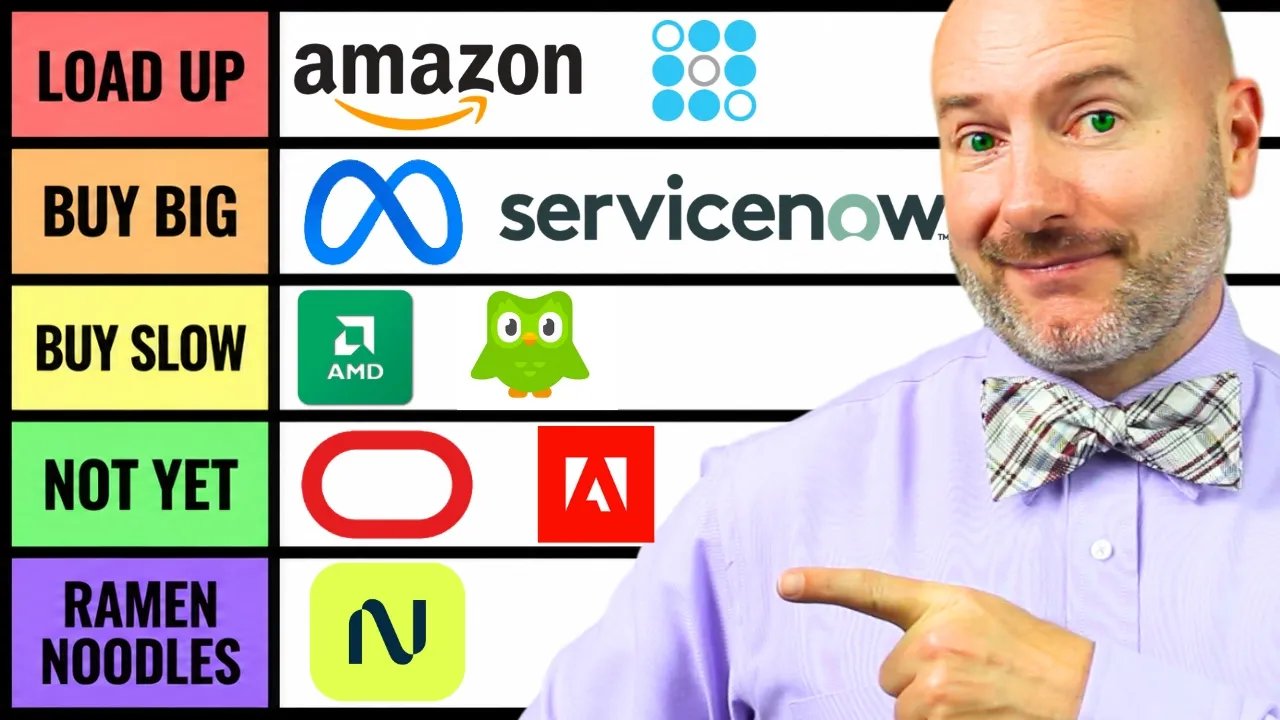
So, doing really well. Keep on riding that one. Let's get started though because this is a massive list. We've been trolling YouTube to find the nine most recommended stocks. Stock everyone is screaming bye bye bye. We're going to dig in here which YouTuber is saying by the bull in the bare case for each. Why we'd like it or maybe don't like it so much then ranking each one. And we've got five tiers here that we're going to put each stock into from truly the best stocks to buy.
First we've got the load up. That's don't wait. Pause the video and buy this stock. Next just below that below that the buy big. Still a strong buy, but not betting all the house uh just yet. Then in the middle here, buy slow. We like it, but with some hesitation. This is probably better for a slow dollar cost average. So, a little bit now and a little bit every once in a while just in case for any pullbacks there. Then we get to the bottom tiers here.
Not yet. There's something not to something to like about this stock, but just too much downside right now. And then the ramen noodles tier for us. as in I hope you like eating ramen noodles three times a day because this stock could lose all your money. Let's get started on our first stock. What do you got for us? >> Yeah, I I have to interrupt you. This ramen noodle is like in really funny in Italian it would be pasta and biano like pasta without sauce. >> Pasta without sauce.
I like it just the the cheap seats there. Okay. Uh well, what's what's our first stock? What are we covering here? >> I think we cover meta stock with Joseph Carlson. >> Okay. So Joseph Carlson been talking about Meta. Uh what's uh what has he's been saying about it? What do you like it? What's the bull and car case for this? >> Well, the bull case for Meta, it's quite straightforward. Like revenue is growing really really fast.
I think in the last quarter they presented a 27% year-over-year and is accelerating growth. So not only is already growing very quickly since years is even growing quicker and stronger in the last quarter. The bull case of Joseph is that AI will actually improve the business. So all this cap expanding will make the algorithm better, will make the users more happy with the product because they will be served the better content and will also make the advertiser happier because they will get a better return on capital with better advertising spending, more optimization and and this could create extra growth for the business.
However, there is also the flip side of it and the flip side is that you know there is really a big amount of capex and who knows what kind of return of investment they can have on all this money that they're spending. >> I think I think he's absolutely right here and you're you know you get that advertising revenue advertising between Amazon and Meta really is are the two dominant players in advertising right now. like you said, 27% year-over-year growth through almost $60 billion in the in the second quarter.
And you're right, the AI is improving its its advertising with the recommendations, the engagement, that real targeting and ad conversion for better or worse. I I think Meta is becoming so good at uh at advertising across Instagram, across Facebook that uh it's really keeping us engaged and clicking. Um the valuation here, go ahead. I have a couple more points before we talk about valuation. >> I think like you know one big bull point is that the lawsuit is finally going. >> So for like many months we have this lawsuit over Ang and now finally the settle and this could be like I would say a lot of uncertainty around the meta went away and this I think it's it's really good.
It's really good very strong. On the other end, the bear a very big bear argument for me personally is that Zuckenberg keeps having complete control over the company. So you like have a minority shareholder, you have like 15 16% of Meta, but you have like 60% of voting power. For me personally, this creates a little bit an imbalance. You know, I have to buy into a company, but then my shares don't really count. And I think this kind of put valuation a little bit down compared to other magnificent seven. >> And it's interesting because I I think it seems like we are in kind of an era of uh one key leader in in a company.
I mean we had Tim Cook which actually just handed over reigns of Apple there but he was you know a huge figure there. Obviously Elon Musk with all of his companies controlling share and and really controlling voice in there and and Zuckerberg with Meta. Um it's it it does seem to have that that key person risk as well as just the voting control. Uh what about valuation though? >> Well valuation if for my research I think like if we think about for example the PEG ratio I think is the only Mac 7 that have a PEG ratio under one.
So that's makes it really really compelling. On the other hand, again if investors start being spooky about Zach going crazy like in 2022 valuation was much lower. So it is already low but this doesn't necessarily mean that cannot go even lower if people start thinking oh uh market is going crazy let's uh panic sell. >> Okay so we have a a price to earnings to growth under one which is always a good sign. I think the PE there, the price to earnings is is around 23 versus a 26 for 5-year average.
So, it is relatively less expensive than it has been in the past and like you pointed out less expensive than some of the other mag 7. So, we got that bull case. We got the uh the advertising against that risk to the 130 $145 billion expected uh capital expenditures building out all that AI infrastructure. And if that's ever going to uh you know going to going to be paid back, $130 billion against basically advertising revenue of about 60 billion.
It's a long time for for that to be uh to be paid back. So, where do we where do we put this here? We've got a got a very strong bull case, but a couple of uh hesitant ones. Yes, I think uh I mean overall personally I it's not part of my portfolio, let's be clear, but I'm very tempted from it. So it's like I think it's a buy. I wouldn't put it like in the highest tier. I don't remember the name, but I would say it's probably right under it.
What What's your take? >> Uh well, yeah, I I like it. I you know, it's hard to go wrong with some of these MAG7 stocks. Just the dominance in a key area. I do like its its lock on advertising. I heard Zuckerberg doing a a an interview a couple years ago where basically he just talked about basically destroying the the rest of the advertising uh you know industry uh and bringing it all on Facebook with AI and it was a very compelling case.
So, you know, I do I do think that risk to the capex as well as the valuation's good but not great and the key person risk keeps it out of that top load up category. But but I'd go buy big here. you know, I would I would be adding this to the portfolio. >> I agree. Let's go buy big service now. Okay. Service Now, it's very interesting. I think it was recommended by Jeremy, but of course, many other YouTubers as well are following now.
Basically, during the last year, we got this kind of, you know, software apocalypse. Everybody was selling out of software because of course with this AI coding there is some changes going on in this sector. However, service now mode seems really really probably the stronger amongst the software industry and it seems like the bears kind of over reacted. I mean, they they really oversold the company and now it's up 70% from the lows in a couple of months, but it's still quite far from the highs.
I think it's like 40 40% below the all-time highs. So, we still have some room to improve. I think the AI will disrupt service now story right now is kind of over with this deal with Antropic. We are seeing a change in sentiment in the last weeks and um yes it's a much stronger mode that what people believed uh it has. >> Sure. I I think we're getting to kind of a push pull from AI on this. Uh it has clawed back a lot of its uh returns from that software selloff the software apocalypse that uh that started the year I I started buying the shares.
Um a and you know it makes for an it still makes for an attractive entry point I think uh on one one key uh key item that uh yes there is the risk that AI could ultimately reduce some of that uh software as a service the seats the workflows some of that pricing pressure on the stock but I think what people are missing is service now's uh uh leadership in kind of an orchestration layer between agents and uh and the models right you know it used to be um companies were spending just as much as possible on AI token maxing was what it was called and they were blowing through their entire AI budgets in like a month.
Well, now it's moved to value maxing, right? Where they're trying to get the best bang for their buck for that AI ad spend or that AI dollar spend. And what Service Now is doing here is it's setting sitting in between the agents and the models to really tell uh tell companies tell those enterprise customers where is the best model to use for their AI agents. Right? So it's it's it's more of an efficient control over those agents.
So they don't spend, you know, I think I saw one uh one company spent $500 million in one month on its uh on its agents. Uh basically it's its entire ad budget or AI budget for the >> right. >> Yeah. So uh so I I think uh I think that's just really an underappreciated role that Service Now is going to play and it's really going to help. You know, Q2 subscription revenue was up 25% year-over-year to 3.9 billion. So that doesn't necessarily sound like AI is eating away at its software sales just yet anyway. >> Yeah.
I mean I I have a question actually. You know I know that you are an expert in security that you follow a lot cyber security and I know that service now lately bought three companies and one of them is a big cyber security company. They actually even took depth in order to buy armies I think it's called because they want to expand their service and offer and offer also cyber security to all their clients. That seems smart.
However, I also see some execution risks there and I don't really understand how compelling is this cyber security company they acquired. Do you think they did good or do you think uh there are risk there? >> You know, I I I think there is a lot of execution risk there in in basically just being has been or and also ran in the cyber security space. I mean, we've got so many uh pure play cyber security companies. Crowdstrike, Palo Alto, really the best being invited to to look at Anthropics Mythos model before it was released just to just to work out the bugs there.
A lot of the other players, especially any that aren't pure play cyber companies and leaders, dominant leaders in different segments of cyber security, I think they're just not going to have a seat at the table. And that's what worries me about Service Now. uh probably one of the things that keeps it from this uh the load up tier for for me. I have to say I have to agree personally I'm also a little bit conflicted because at $90 right after earnings I was almost buying but I say ah no okay I already have Adobe I already have exposure to software let's wait and now they skyrocket so I'm already thinking yeah I feel it's a little bit late >> so I would say you know under 100 was probably a lot up now I think we have to put it a little bit lower what do you think >> I I think you're right I I would buy big here.
I mean, I do own the shares. I wouldn't be uh loading it up uh to add to my portfolio just yet. You know, the the forward price to earnings is still 27 times uh 90 times price to earnings there. So, even a stock that is just blowing the doors off the competition, that's still pretty expensive for that. Um I do think I think we get another opportunity to buy more into this stock. I I think that those software concern concerns come back uh for the rest of the year, maybe into next year eventually. and and you see a lot of these software stocks sell off.
So, I think you get an opp another opportunity. I think you you add to it, add some to it now if you if you don't have much of a position, but uh but wait for for something better on that. >> Yeah, I have to agree. And um yes, and it's a great company. Was always expensive. However, and so it could be much more expensive than now. It's still a buy. It's not a screaming buy. >> Not a screaming buy. Okay. What's What's our next stock here?
Next talks we have Oracle and it was suggested by business leads Brian Brian and I know Tom Nash Tom Nash is heavy into Oracle as well. Uh it's it's it's done really well and then it's done not so well over the last year. Uh what can you tell me about this? >> Basically if you see the backlog the backlog of Oracle it's crazy. We have like five 600 billion in backlog. So potentially the future revenue is going to be insane.
However, a lot is connected to the open AI deal and so there is in one side there is the bull that say listen this company is going to grow so quickly and there is so many contracts and there is so much demand for what for for their cloud and for their computing power. On the other hand, the bears say yes, but wait a second. All this OpenAI deal and all this money that they're supposed to gain, OpenAI currently doesn't have this money.
So, are we really sure that they're going to pay? Uh because again, OpenAI business model is still to be proven. Sam Alman seems a little bit uh I don't know, let's say not the most trustable of the CEO. And so there is like a two side of the coin. >> Sure. I I do think you know half when you talk about that backlog that's the big bull side is the huge backlog of uh of of leasing for its cloud infrastructure that's spending hundred billion dollars trying to build out.
Uh but the problem is yeah open AI is about half of that backlog. So and like you said open AI doesn't have that money and and it's unclear whether it's going to have that money. So, it's it's a little bit like having a an IOU, take taking an IO owe you to the bank saying, "Hey, my my broke ass uncle owes me all this money. Can you give me a loan on this?" And the bank's just going to laugh at your face. Um, so there is there is a little bit of a doubt and and I think what's what the problem is here with Oracle is it doesn't have the cash flow of Meta, of the other hyperscalers, Meta, Google, you know, all those others that have hundreds of billions of dollars in cash flow to be spending this capex. you know, Oracle is going deeply in the red on cash flow, spending this hundred billion a year.
Um, cloud infrastructure growth did grow really well, 93% year-over-year in the last quarter. But, uh, the one thing that scares me about these is um, these these um, you know, these NeoCloud companies, which Oracle is basically becoming a NeoCloud company. It does have the the legacy software stuff, but it's a basically just a cloud leasing uh, company. And what what worries me is, you know, I I'm old enough to remember OPM, right?
Other people's money. And for you that you don't know, in the 80s that was a company and a lot of the companies like it were leasing out IBM mainframe technology, right? You had these IBM computers, those mainframes that were a huge room full of computers. And um so they were buying the IBM mainframes, leasing them out to other companies to use. And what happened is uh you know they they're continuously buying that expensive hardware that gets technologically uh outdated within a few weeks.
You know as soon as IBM comes out with a a new mainframe and here the analogy is with Nvidia they're now on 18month cycles refreshing their chips coming out with newer chips that means Oracle that means Nebius that means Cororeweave. they're all going to have to be on that that u that treadmill, that hamster wheel of buying those new chips every time they come out or their older chips and their older hardware is going to be outdated and they're not going to get nearly as much money as they thought uh they they could get out of the the older stuff on a resale value.
That's what happened to this OPM. The other people's money turned out to be a fraud because they had to start cooking the books to cover up for that that bankrupt situation. Obviously, not saying Oracle is going to be become a fraud or or bankrupt. it still does have that that uh software aside that puts it I think a little bit an advantage over some of these other neoclouds like Nebius like uh Corewave like others but um but yeah I I do think it eventually catches up with them that uh I mean to expand on this argument I know that some of this uh buildout some of this infrastructure has already been paid so some clients paid some money in advance and this kind of makes you feel like I think in the point of view of Brian of Tom Nash This makes you think, okay, they actually are serious about it.
They they really need it. They really want it. They even pay in advance. On the other hand, I see that right now they have a revenue of 60 billion and they have depth for 120 billion. So for me, when the depth is double the current revenue and we're not speaking about profit, we are speaking about revenue that makes it kind of scary, right? >> Sure. Sure. And you know valuation we're looking at 27 times uh it is cheaper you know 36 times 5year average on that PE ratio.
So it is relatively cheaper than it's been uh you know in the past couple of years on that on that huge uh growth in the AI infrastructure buildout. Um but valuation isn't necessarily the problem. It's that returns on the enormous infrastructure investment. So uh where do we put this one? I I would put this probably at at maybe not yet and I know that's going to make mad a lot of a lot of investors a lot of Oracle investors.
Maybe Tom Nash uh will will give me a mean phone call or something. But my my view here is >> I mean I mean let's let's be honest here. If you believe that the AI hype will continue, I think you can easily buy and you can even buy slow by slow even by big. If you really believe OpenAI is going to honor their agreement is a buy because it's cheap compared to the future uh revenue that we will have. Since I personally don't believe it, I'm going to agree with you and I'm gonna say, "Okay, not yet.
Maybe." I mean, I'm going to pass on this one because it's pretty risky for me. >> Yeah. Not quite ramen noodles. You know, it's it's got that that software that it can still fall back on. And I do agree. I mean, AI is changing our our world and it will continue to grow. I'm just not sure it's going to grow as fast as people uh people expect it or or people are pricing into uh some of these stocks right now. you know, maybe it's just a hold over PTSD from the uh the dotcom crash when yes and the internet did change our lives eventually, but uh just not as quick as the expectations were for some of those companies and uh and I think Oracle is going to be in that same boat eventually.
So, lots of other stocks to buy folks. You don't have to load into the the highest risk uh stocks out there. What's the next one? >> Let's let's continue on this line and we go to couch investor that is main position right now is Nebius. Nebas is already in big profit but you know and so let's continue in this cloud. Nebus I think is like an oracle at the power like you know it's supposed to grow from 2 billion of revenue of 25 billion in just a couple of years.
So if this story is going to continue actually Neocloud is even better position. However, again for me, I re I don't really understand the mode that a company like Nebios has compared to an Amazon, to a Google, to a Microsoft. I mean, what's their competitive advantage there? They still sell the same kind of computing power, but it feels like there is a kind of giant against how you say David against Goliath kind of story, right? >> Exactly.
Exactly. And you're right. You know I think Nebius if Oracle does well then Nebus will do well core will do well but again I think it's just u it is it is that that risk that that happens and and let's be honest here where who are who who are Nia's customers it's these other hyperscalers that don't have their own capacity uh for their own their own data centers well >> for now they don't have the capacity you know $140 billion a year spending on spending their own data centers Google, Alphabet spending, you know, 100 plus billion a year.
Uh Amazon is spending, you know, 100 plus billion a year. These hyperscalers, they are eventually going to get to the point where they say, you know what, we've got our own data center. We don't need we don't need Dambius. We don't need Oracle. And that's what worries me really about these Neocloud companies is that um they are spending so much to get this leasing product and these and these data centers online for these customers that are eventually going to not going to need them and then they're going to be saddled with all this debt all this uh hardware that is technologically obsolete because Nvidia keeps on making new better chips then uh yeah it's it's a u this is a trade you know I think these neocloud nebas oracle coreweave I think they are a trade I think you can do very well on them if you get in at the right time and get out at the right time.
But for a long-term investment, this one this one scares me and I think it's going to make a lot of uh lot of ramen noodle sales on this one. No. And there and there is again there is also a depth attached. So it's not even that they are buying everything with cash from past operation. No, they're taking leverage in order to build out this infrastructure that who knows for how long is going to be useful. On the other hand, again, let's be honest here.
I have problem with the valuation because it's all about the assumption of the future and I don't have really the technical knowledge and expertise to really project how fast they're going to grow, how sustainable is this growth. So, you know, I have problem understanding if it's uh very expensive or or not. At least with Oracle, I know that it's kind of cheap if this is going to happen. >> Sure, >> with I don't even know that.
So for me it's kind of even more risky and I'm more even more scared. So I'm Yeah, I guess. >> Sure. Well, when you got when you got a company trading for 74 times its earnings, 43 times its sales, it is hard to make a case for that the valuation is cheap enough to take the risk, right? When you've got these other when you've got Oracle to uh you know, if you truly believe in the AI buildout story is going to continue, it's going to make these companies these neoclouds profitable, then why not just go with Oracle and sleep well at night?
Um, so, so yeah, I think I think Nebius, maybe Couch Investor wants to come on sometime and and explain his side, but uh I I'd take a hard pass on this one. I I'd put it in that ramen noodles category. >> Ramen noodle it is. >> Okay. What's uh what's the next stock here? >> Next stock we got Adobe with Parv. Love Adobe. >> Okay, so yeah, Park Tat Tatavosian. I always always mispronounce the name. Sorry about that. uh going with Adobe and you know I mean I use Adobe it's got obviously it's got the PDF uh you know uh software there as well as Premiere Pro is kind of the editing software.
Uh what can you tell us about uh about that? Well the bullcase for Adobe was very straightforward. I'm I'm at a full disclosure I own Adobe so I'm kind of biased here but Adobe in the last year has been really the cheapest stock of the whole S&P 500. I think at a certain I think also today forward P is around 10. So it's really really cheap on a valuation point and if you if you look at the numbers the numbers are still very strong.
So there is this story that AI will distract Adobe on the other end there is very little evidence on the numbers maybe a little bit of slow in growth but they are still growing are just growing a little bit slower. So I think valuation wise extremely compelling. I I I like the company. Of course there is also the other side. For example, the CEO assign now they just announced this new CEO. I think it's called Anil Shakra Chakraarta Chakraarti.
Uh however again there is an insider internal CEO. However, the other big manager just quit after they announced Chakraarti. So there is a lot of uncertainty on the direction on the management. The CFO also resigned a couple of months ago. So there is is not so clean. If we are honest here, I think that the numbers are great. Valuation is still very compelling. However, is not the same Adobe of five years ago. So the mode it is a little bit shrinking.
There is more competition and this AI tools are incredible. Personally I still believe that Premiier and Photoshop are one step more advanced. So if you really want control, you have to use Adobe. However, of course, for many jobs and for many people, Canva is enough. >> Sure. And I I agree. you know, uh, Acrobat PDF, Photoshop, Premiere Pro. I mean, those are the go-to uh the go-to uh software for creators like us. And, you know, like I said, I I I use Premiere Pro, uh, PDF, uh, I've used Photoshop, but but I also use Canva and I also use uh, Camtasia.
Uh, so, you know, there are there is competition, but it but it's got some fantastic franchises. The problem is is just, you know, being so deeply in the creator economy like we are and seeing what AI can do. Um, you can make the case for some of these other software companies, uh, Service Now, um, Apploven, some of these other software companies that, uh, maybe not quite being replaced, uh, quite as quickly as as expected with AI, with uh, with Premier Pro, with with Adobe and its its products.
I think that is the first to be replaced by AI. when I see what AI can do with editing with photo uh you know image production and some things like that then there is just there's going to be no need for Adobe in 5 years unless it can figure out some way around this. So the idea the the the question investors have to ask is you know is 15 times price to earnings cheap or is it a value trap if AI permanently disrupts this business?
So I would put this in in not yet. I think you make the case for buy slow if you're looking at it again more like a trade more like uh like we talked about with with Oracle >> I think it's still I think it's still too cheap. So I think for me personally even if there is more risk even if the MOT is shrinking I think it's still really a bargain. So I see at least I don't know I have a fair value at least at $350 I think they could go there.
However, of course, I'm also very careful. Like you said, you know, you don't know 5 years from now, 10 years from now, they might be gone. So, I would say, you know, be very careful and ready to exit as soon as you're not convinced anymore if you buy slow. >> So, I think I think you could make the case for buy slow. You know, trading at a price to earnings of 15 16, that's about half of where it has been over the last 5 years, at 30 times average there.
So, you could definitely get in this and uh and make some money uh for a long time. Set it and forget it stock. I would say absolutely not. So I I'm still not convinced. I' I've got it in my in my not yet column, but uh but you could definitely make the case for for buy slow. See how it turns out and see if you can make some money on it. What's up next? Next we have AMD is one of the like more bullish like it's very talk.
A lot of people are very bullish on AMD. I know that I think you know more about semiconductor than me. So I am a little bit uh yeah let's let's let's talk about it. It's still very interesting. I think Tom Nash right suggested but al of course Jeremy there is a lot of a lot of big YouTubers that that are in are you are you holding? >> I I actually sold out of mine and we were we were in it at $107. uh nobody it was all Nvidia was the whole story and and I had started looking at that u you know CEO Lisa Sue was was promising those profit margins were going to come up was promising a new uh GPU and and really my case was that uh a lot of AMD's CPUs and and lower lower scale GPUs could be used in that inference side of AI.
So not necessarily the training uh which you would need the stronger Nvidia GPUs on but but AMD had a real strong case for you know the inference side of that and that ended up coming out you know we we made it something like 300 340% uh on our AMD stock and when I finally sold it I had some calls uh against it to to lower the risk when it got real high and and it did uh it did come down there. So but you know I mean you could still make the case here. data center revenue up 107% year-over-year 6.7 billion so it is obviously still uh still competing very strongly what I like about >> I think it's expected that 70% more for the next year and then we have >> of course the the other I think the big bull case for AMD is that everybody is making deal with them we have anropic we have openai we have meta we have Microsoft everybody wants their chip also because no one want to be completely dependent from Nvidia >> exactly So everybody anyway wants to wants also AMD chips and this is creating like an incredible revenue growth and uh it's very strong.
On the other end we also have Google and Amazon starting making their own chips. So it's like you know so now it's okay they probably are not going to need AMD chips anymore in the future and maybe they're also going to sell to someone else. So I would say there is more competition coming in the coming years and for me personally I don't really understand if it's because historically semis are always being sold. So is this gone or or we are still like in two three years from now we are still seeing whatever extra supply demand will go down and all these stocks will plunge. >> Sure.
Well, that's the big that's been the big question, right? With that semiconductor uh cycle being so cyclical, and I think we're just seeing it extended. You know, there there is so much money being poured into the hardware, the the data center hardware, especially those CPUs, the GPUs, and and that that it's just extending the cycle. But it's hard to make the case that um that that it is still cyclical, you know, because we've heard the story before, and it's never different.
This time is not different, right? Um, we're seeing some real adoption in uh, you know, AMD's epic CPUs, its Instinct AI accelerators. But you're right, there is a lot of competition coming. All the hyperscalers are building up their own TPUs to compete and to be, you know, really specialized a AI use cases in those chips. I will say that CEO Lisa Sue has come through in a big way on that profitability. uh it was something like 7% a year ago and that's really why AMD was lagging so much was yes it was seeing the u the uh the revenue growth but it just wasn't converting that into into earnings it was spending so much it was spending so much on marketing advertising and R&D uh now it's increased that to 17% operating margin in a year which is a huge increase in profitability and that's what's brought the stock up >> Lisa Sue if we I mean Lisa Sue is one of the best CEO around right we have to say I think is like it gives me really a lot of trust.
On the other end, valuation wise to me right now again it doesn't seem so cheap. It's not like you know two years ago and anyway I mispric it and I misv value AMD already in the past. So I'm not the best for value this company. However to me it doesn't really feel cheap. If I would have to choose between AMD and Nvidia I feel like Nvidia is a little bit cheaper now compared to Yeah. >> based on its growth. I think it is.
I think based on uh you know that growth Nvidia is actually the cheaper stock right now on that price to earnings to growth. So AMD has caught up you know Nvidia is now going to be competing in those CPUs as well as well as the networking uh the complete AI system. So you've still got a lot of competition with Nvidia. It's got the uh it's got the moat and the cash flow to compete. So you know I think AMD can still win significantly uh you know without even beating without having to beat Nvidia.
But the uh there is that competition not just with Nvidia, with the other hyperscalers. I think that keeps it out of really a high conviction uh play, but but you know, I'd still be willing to put it into kind of a buy slow uh buy slow uh uh tier. >> Yeah, I have to agree with you. Buy low seems accurate. Also, I was listening this morning to Jeremy Lee video. He said that is his best buy for this year for one year time frame.
And I think it's true. like this hype and this buildout can continue and I think at least for another year is still in a good position and is still a very strong company with a great CEO. So buy low, why not? >> Sure. Sure. We've still got hundreds of billions of dollars, trillions of dollars in total from the uh from the hyperscaler spending on on capex for those AI data centers and that's a lot of that's going to go to AMD.
Uh who's next? >> Next we have Amazon. Amazon it's yeah very interesting company very hyped as well I would say many people think Amazon is really a solid bet and I would have to agree with that if I think about 20 25 years in the future so if if my like time frame of investment would be buy and forget I think Amazon is very well positioned I think their mode is incredible their infrastructure and their logistic network is unmatched and I think in the coming decade with robotics with drones we're going to see a revolution of Amazon so they're spending a lot of capex as well I think over 200 million 220 million 220 billion sorry but uh it's going to be yeah it's well spent uh so I think I'm very I'm kind of bullish on Amaz lower stress, higher return, higher potential uh stocks.
I think the only thing that stops stops Amazon is just a tragedy of its own success that it gets to be gets to be too big that the government steps in or or somebody says, "Hey, monopoly here." Because what you've got here is three massive growth engines and really dominance in each. has got e-commerce where online store sales grew 15%, cloud ad a AWS grew 37%, advertising its fastest, its strongest growing u you know strongest growing segment there 26%.
And really what it's creating here is just kind of a flywheel between these. Okay, that e-commerce all that e-commerce data feeds into its advertising making it more efficient, more targeted and better conversions really driving that. So you've got you've got a company that is uh just dominating three massive growth drivers uh for this. Um it's probably for me it's the it's the strongest combination of scale, growth and competitive advantage uh of all the hyperscalers and probably most stocks in general. >> Yeah.
And with Amazon you can really really sleep well at night I would say. So it's one of the safest bet. However, let's take a little bit bearish approach. What do you think about this? There is an argument I heard I don't remember by who but there is an argument that with agentic shopping so if in five years or 10 years agents will shop for us so we will not even choose anymore or not even agents will do everything and shop for us will know our taste and we'll automatically shop what we need it might be that Amazon get bypassed or that we don't need it so much do you think it's possible or you think it's just a fantasy >> sure well you know I mean that's That kind of argument can be made for pretty much about anything, right?
Uh if if AI becomes so efficient and so scalable that that it basically does everything for us, then uh I mean basically you're you're investing in maybe Open AI and Anthropic when they're when they're public and that's it because they're they are going to control everything. Um you know in in the meantime I'm going to still go with you know who's who's dominating their sectors and I think nobody does it better than than Amazon.
U I'm curious to know your assumption about Amazon. I have like 14% margin. So margin expansion to 14% and over 10% growth. I think growth could be 12 maybe even higher. So to me it comes out that is also a cheap company right now. >> Sure. >> Do you agree with this assumption? What what's what's your take on margin especially because margin and Amazon have always been very challenging because they always reinvest everything.
So as soon as they gain money they disrupt an industry they gain a lot of money but they reinvest everything immediately. And what do you think? >> And you know, I mean, that's always been Amazon is the stock that I that I always regret not buying sooner. Okay. Because, you know, after the do, it fell something like 80% after down to, you know, a split adjusted about like 60 cents per share. Uh, but I never bought it because if you just look at it on a price toearnings basis, it was has always been terrifically expensive.
What you need to understand though is you know Amazon has always spent so heavily on growth that uh that yes it is once it the profitability is lower it doesn't convert nearly as much revenue uh into earnings as a lot of its competitors a lot of other stocks but that growth is always there I mean this company is growing in revenue by 20% year-over-year in the second quarter and when you consider the scale of that you know hundreds of billions of dollars in revenue growing 20% year-over-year that is very strong um And and I think it's smart growth.
You know, it's it's been able to to do that at the same time of investing this hundreds of billions of dollars in capital expenditures. You know, if we look at some of the margins here, the EBA margin. So, uh profitability for earnings before interest, taxes, depreciation right now, it's at uh 21% that is actually above its 5-year average, 15%. Um so, so it is quite a bit above its long-term average. I think we're seeing a real a real inflection point over the last couple of years in Amazon where it is maybe going to a little bit more profitability, you know, seemed like for a decade plus than uh they didn't care at all about earnings.
So, they were plowing everything back into the company. And I think it's paid off. You know, they've built that e-commerce, they built the cloud, and uh and now they're building that advertising, but they built those those segments up to be uh wide moes. Uh and I think it paid off. So, I I'd put this in >> load up. >> Was that load up? I I I I own Amazon. I I will continue to load up on it and and ride that higher. >> Yeah, I think it makes sense.
For me, it's there like between load up and buy big, but it's definitely a buy. >> And for me, a lot of this comes down to, you know, my my risk tolerance as an investor. Maybe a little bit older. I don't want a whole b a whole bunch of the risk. And Amazon gives me that. You know, Amazon gives me the growth. It might not be the uh the 100% year-over-year uh returns that some of these other high-risisk high return stocks will, but but it is hard to go wrong with Amazon.
Speaking about risk, the next company is my company, Dolingo. [laughter] They definitely are very different risk profile. It's a 7 billion company. So, it's uh and it's extremely volatile, very risky. However, I'm very bullish on it. is my biggest holding because I think it's really like the story around it is kind of wrong. The CEO is incredible. The mission is incredible. So they want to teach basically a billion people around the world and the CEO is Vanami seems very very capable to me when I listen to the earnings I'm always very excited and I think the bare case that AI will disrupt Dolingo that no one have to learn anymore in the future because AI will automatically translate the meta glasses with put subtitles when people speak another language.
I think uh it's wrong again as a I'm a European, I'm Italian, I had to learn English and it's not and I cannot have a channel on YouTube without learning English. So now I'm learning German with Dolingo because I live in Austria and again a translation tool even if it's great is not really the same. And I think people will always want to learn English will always want to learn languages and in general people learn also as an hobby.
So yeah, I think Dualingo is being mispriced. >> Okay. Okay. And and I think Dualingo is probably one of the stocks that I see most often uh you know, fall quite a bit after maybe a disappointment, but then rise just as high uh after another surprise. So, so it's very volatile. You got to be ready for for the steep drops to to buy back in to to load up again and and wait for that upside. you know, just as a personal experience as well.
Um, you know, my wife has been using Dualingo for for about three plus years. He had learned Portuguese, had gotten really good at it. I tried it that I think my problem was I tried it for a little over a year and and the app does so well at gamification and habit formation that that you want to use it every single day. Uh, I think my problem was I tried using I tried learning Italian and German at the same time. So, so of course, you know, I I I got >> You should have gone with Italian.
Italian is much better. I I got well I'm gonna I I am going to walk the uh the via Franen and uh next year so I'm definitely going to have to get back into uh into Italian and learn some stuff there. But but I found that how long ago did you try the app? Because again another very good side of Duolingo is that they really change and optimize continuously. They run hundreds and hundreds of experiments every day. And I also like I used Dualingo 3 years ago and it's completely different than Dualingo now.
So I'm really confident that the exe the execution on the company is uh really outstanding. >> So I think that's you know that's a great bullcase for the for the company that they're always optimizing and they've got all that data coming in every single day because if you're on the app you are playing every single day. It's it's amazing habit formation and gamification. So so that idea of getting better and better. Um you know so the question isn't necessarily engagement it's is does engagement translate into effective language language learning and and you know satisfaction and then revenues uh from that growth and and you know decreasing that churn.
Uh what can you tell me about >> the point of the company? >> Sure. >> The point of the company is that this year they say okay we stop really growing and optimizing for revenue we optimize for the product. We want the product to be better. So there is more people will use it and now we have a daily active user growing at 26 27%. So daily active user are like because the product is better and then next year two years from now we will uh turn on the monetization switch and then again if user growth is 25% revenue growth and and profit growth will also be 25%.
I think they also have more margin leverage. So for me personally again it's not like some months ago when it was trading at $100 was really really mispriced. I have my fair value at 200. So it's not that disconnected anymore but I still see an upside. And again I love the company and that's mostly the reason why I'm invested in. >> Okay. And I can see I can see the valuation's come down quite a bit. Valuation at about 14 times price to earnings.
Uh you know growth is still very strong. growth has has come down a little as well but growth still about 30% year-over-year revenue growth uh IBIDA growth 80% so you know getting more efficient that's what I like to see I like like to see you know revenue growth uh 20% plus but then you know leveraging that into even faster earnings growth so the company is definitely getting getting more efficient at converting those sales into uh into earnings >> by big >> yeah you know I I actually had this uh may maybe I was just a little disgruntled I had this as buy slow um I I just I was really disappointed at my experience, but but again, my wife is has done so much better than I am.
Maybe maybe I just need to nut up and uh and practice a little bit more myself. Um >> let me make a little bit more bull case for you. Like the fear is that AI will make it very easy to replicate a product like Dualingo with coding and that in general just a stupid app. So we they will have a lot of competition. However, they have like 60 million user for a free product and it's extremely hard to compete with a free product.
So even if you can develop again Dolingo to have that kind of distribution like the mo is in the distribution the mo is on the fact that even if you want to train AI all that data that Dolingo have I think just that value more than 7 billion that is the current market cap. >> Excellent. So, so I think you could probably make the case of Dualingo as a takeover target eventually for for some kind of, you know, company that wants all that data.
I think that that's their most most valuable asset in that data right there. >> I think so. So, yes, for me, again, I I'm loading up, but I would say buy big. Let's meet Let's meet at Buy Big. >> I I I I could agree. I think we should we can meet up with uh with buy big here. SoFi Technologies, Sofi. >> This is your company. Again, I I want to I mean, I will tell I will tell you my take, but I let you uh lead on this. >> Okay.
Well, this is this is all about being a killer app, right? We have the financial ecosystem here. They've got banking, lending, investing, credit cards, the tech platform. Uh and really the cross-selling is the key advantage here. Uh they acquire acquire a member once and they can monetize that that single uh single member across all these products. What I really like about uh about SoFi, and this isn't a, you know, buy anytime.
We actually just started rebying into it a couple of months ago, I had bought and then sold uh sold at the right around uh when it was I think $25 $30 a share beginning of this year and getting a little bit expensive there, but uh bought back in over the last couple of months. Uh because, you know, its key advantage here in that fintech space is still its banking charter, right? It just improves the funding economics. they can get the get those cheap deposits and uh and support the lending the profitability across its other groups.
You know, valuation right now at about a two times price to book value. And that's really where how you want to value uh bank stocks, right? Financials, bank stocks, because that how they hold their assets and their liabilities, the deposits, the loans on their balance sheet. You really get a great sense of what's the true uh asset value of this from their balance sheet. So that's what how you want to value them. Price to book two times. uh it's not the eight times book that when we first started buying into it or even the one and a half times book that you can occasionally get.
So occasionally, you know, Sofi will sell off and you can get for maybe one and a half times on a price to book value. Uh but that growth and just the total market, the addressable market makes 2x still a good buy versus a history of three to four times book value. So this this thing could double and it would still be uh within that range of valuation. Again, let me take again full disclosure. I am long on SoFi is my second biggest position.
So, I'm also very positive on the company. I kind of believe that they are cheap and they are going to do great. However, if I have to say the let's say the bare hat, what about the this exposure onto loan? Basically, the loan business is still the main profit engine. What if a recession come and what if interest rate spike? >> Sure. Well, that's uh I mean that's that's all all financials, all all banks, right? Uh that that loan that loan business.
Uh what I like about SoFi is that it's also diversified into investing, credit cards, and now into its stable coin, which is really built into the into the system, and we're seeing a lot of a lot of pickup in stable coin. Uh not just the regulation, but in the usage. Uh obviously, yeah, if we have if we have a recession, then a lot of the things a lot of the other stocks we're talking about, you know, those higher risk AI stocks are are going to come down just as fast.
I think uh I think SoFi has a very strong defensive moat. I think it's got a killer app there. Um you know, across its ecosystem and I think it's pretty well pretty well set to uh to to withstand a a recession. You know, it's come down from used to be pretty much a student loan book, right? a student loan uh lender and it's since diversified across all different types of loans. So uh not nearly. >> Do you think the quality of their loans is improved over the last years? >> I think it has.
I I think it's well from from just a student loan uh portfolio, student loan targeted portfolio. I think just the fact of expanding into the the scope of those loans into other into other products into mortgages into uh you know car auto and that kind of thing. just that that improvement of scope uh you know helps diversify it. Um now as far as credit default rates and that kind of thing we are obviously seeing some weakness on the consumer side and default rates you know coming up across the board at all financials and all bank stocks.
Uh so so that's something to watch but uh you know you can't uh you can't stop investing just because an investment or recession might be coming because a recession's always coming uh just around the just around the corner in the next couple of years. Uh so I think I think you really go with the ones that have the most. >> I feel it's a little bit different maybe. I mean I think I mean again it's very long that we don't have I was like I started investing in the 2020 2008 2009 recession.
So I feel like has been a while so it might come at a certain point. However I I have to agree with you. What's the thing that got my interest on Sofi is really also this crypto exposure. This stable coin and crypto exposure I think is very interesting. I think now in the last year we get in a very depressed sentiment around crypto but I think the sentiment and the crypto bulls are going to come back and the stable coin will benefit a lot.
I think Bitcoin have a lot of upside potential and I think Sofi in a way will benefit from that as well. >> Sofa definitely set up to benefit on the uh on the crypto and this the the stable coin uh momentum. Uh so there we are nine stocks. Uh so the final tier, the final leaderboard here. Load up Amazon and SoFi. Um I think Amazon's probably a little bit higher conviction here just on its size and uh and dominance in its three main segments, but definitely loading up on SoFi as well.
Buy big, we've got Meta Platforms, ticker MEA, MEA, Service Now, N. I think you can make the case for Dualingo here as well, dy slow, AMD. Um, you know, it's it's got some great progress against Nvidia, but there's always going to be that competition. They're in the uh and I and I think you can make the case for Adobe as buy slow as well. I've still got it as as not yet, but you know, you could you could make the case, especially as a trade for Adobe ADB.
They're in the not yet column. Oracle, OCL. I just I just think there's plenty of other stuff to be be buying and not gambling on what could eventually be a big disappointment in that neocloud a AI hyperscaler competition. And then ramen noodles, the stock that I would avoid here. Feel free to tell me I'm an or an idiot in the comments there, but ramen noodles, you better be better be getting used to them if you're going to be investing in Nebus, ticker NBIS.
I want to thank Adriano of Adriconomics. I'll link to his ranking of 16 finance YouTubers in the description. Make sure you check that out. Great video. Or you know what? YouTube has picked out this video on the right just for you. Click through. See if you like
The words are the caption track's own and nothing is reworded or re-transcribed. Paragraph breaks are placed between sentences so the text reads as prose.
Free tools for your own script: paste a draft and see where it stands before you record it.
Paste your draft and see where viewers are likely to drop off, with a rewrite for each weak line.
Paste the first 30 seconds of your own draft for a hook score and rewrites.
Check your draft against YouTube's advertiser-friendly guidelines before you record it.
Read this channel's public videos and transcripts, and download a writing brief for it.