Getting the transcript
Reading the captions from YouTube. A video nobody has opened here before takes 10 to 30 seconds; this page fills in on its own.
Reading the captions from YouTube. A video nobody has opened here before takes 10 to 30 seconds; this page fills in on its own.
EverythingProfessor · @EverythingProfessor
Where viewers went back to watch this video again, from YouTube's public Most replayed graph, lined up with what was said at that moment.
Most replayed moment #1
5:275.4x the video's typical replay level
to bed stuffed. Your body will prioritize the food over the sleep and you'll pay for it tomorrow. Hitting snooze. The alarm goes off, you hit snooze. 9 minutes later it goes off again, you hit snooze. This repeats until you absolutely must get up and you
Said at 5:19
Most replayed moment #2
10:533.9x the video's typical replay level
face, it's too bright. If complete darkness feels uncomfortable or unsafe, use a red-tinted nightlight. Red light has the least impact on melatonin, but true darkness remains ideal. You evolved to sleep when the sun went down.
Said at 10:46
Most replayed moment #3
12:153.4x the video's typical replay level
Lying down starts triggering drowsiness instead of alertness. Your bed becomes a sleep tool instead of a multi-purpose surface. Ignoring sleep debt, you got 5 hours Monday through Thursday. Friday night you sleep 12 hours. Debt repaid.
Said at 12:08
The graph counts replays. It does not show where viewers stopped watching.
Words
2,881
Runtime
17:01
Speaking pace
169wpm
Reading time
12min
169 words per minute, between the 160 25th percentile and the 181 median of 349 measured videos. That distribution comes from the 349-video hook study.
Opening (first 30 seconds)
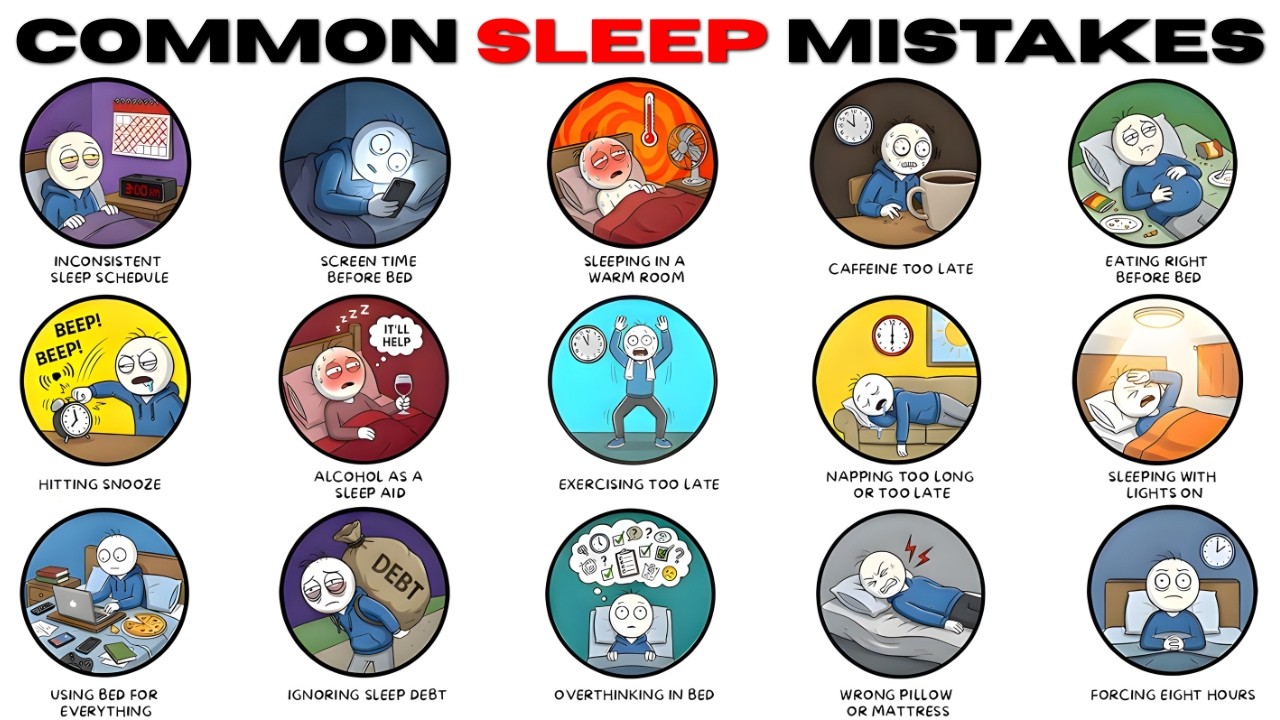
Inconsistent sleep schedule. You wake up at 6:00 a.m. Monday through Friday, then the weekend hits and suddenly you're sleeping until noon. It feels like freedom. It's actually sabotage. Your body runs on a circadian rhythm, an internal clock that regulates when you feel awake and when you feel tired. This clock expects consistency. When you shift your sleep schedule by 4 or 5 hours on weekends, you're essentially giving yourself jet lag without leaving your time zone. Researchers call it social jet lag and
85 words, the words spoken in the first 30 seconds at 169 words per minute.
Free, no signup. See how the first 30 seconds hold attention, with rewrites.
What this transcript is
Every word below is the caption track YouTube publishes for this video, pulled from the video itself and reproduced unchanged. It is not Prepublish's writing, not a summary, and not a re-transcription: it is the video's own published captions. English captions, generated automatically by YouTube, in the video’s original language. Source: the video on YouTube. A channel that would rather this page did not exist can ask for its removal through the contact page, and it is removed.
Inconsistent sleep schedule. You wake up at 6:00 a.m. Monday through Friday, then the weekend hits and suddenly you're sleeping until noon. It feels like freedom. It's actually sabotage. Your body runs on a circadian rhythm, an internal clock that regulates when you feel awake and when you feel tired. This clock expects consistency. When you shift your sleep schedule by 4 or 5 hours on weekends, you're essentially giving yourself jet lag without leaving your time zone.
Researchers call it social jet lag and it's making millions of people exhausted. The fix is boring but effective. Wake up within an hour of the same time every day, including weekends. Yes, even if you stayed up late. Your body will adjust. You'll start feeling tired at appropriate times instead of lying awake until 2:00 a.m. wondering why you can't sleep. The first few weekends will feel punishing. You'll want to sleep in, but after a few weeks of consistency, something shifts.
You'll actually feel rested. You'll stop needing three alarms. Your body will know when to sleep and when to wake without forcing it. Screen time before bed. You're scrolling through your phone in bed. The room is dark except for that glowing rectangle inches from your face. Your brain has no idea it's supposed to be winding down. Blue light from screens suppresses melatonin, the hormone that tells your body it's time to sleep.
Your phone, tablet, laptop, and TV all emit this light. When you stare at screens before bed, you're chemically signaling to your brain that it's still daytime. Your body delays sleep preparation because it thinks the sun is still up. The standard advice is to stop screen use an hour before bed. Most people ignore this. If you won't quit screens entirely, at least enable night mode which reduces blue light emission. It's not perfect, but it helps.
The deeper problem isn't just the light, it's the stimulation. Social media, news, emails, these keep your mind active when it should be slowing down. Your brain doesn't transition from doom scrolling to deep sleep instantly. It needs a buffer. Try reading a physical book instead. Boring maybe, but effective. Your ancestors didn't have insomnia because they were anxious about their Instagram engagement. Sleeping in a warm room.
Your body needs to drop its core temperature to initiate sleep. This is non-negotiable biology. When your bedroom is too warm, you're fighting against the very mechanism that makes sleep possible. The ideal bedroom temperature for most people is between 65° and 68° F. That's cooler than most people keep their homes. It might feel uncomfortable at first, but your sleep quality will improve dramatically. Here's what happens when you sleep too warm.
You toss and turn because your body can't regulate temperature properly. You wake up more frequently. You spend less time in deep sleep and REM sleep, the stages that actually restore you. You might sleep 8 hours and still feel exhausted because the quality was terrible. The fix is simple. Turn down the thermostat at night. Use breathable bedding. If you share a bed with someone who runs cold, get separate blankets rather than compromising on room temperature.
A cool room with warm blankets is the optimal setup. Your body can regulate by sticking a foot out or pulling covers closer. A warm room gives you no options. Caffeine too late. That afternoon coffee feels necessary. By 2:00 p.m. you're dragging so you grab another cup to power through. 8 hours later, you're staring at the ceiling wondering why you can't fall asleep. Caffeine has a half-life of 5 to 6 hours in most people.
That means if you drink a cup of coffee at 4:00 p.m., half the caffeine is still in your system at 10:00 p.m. A quarter remains at 4:00 a.m. You might fall asleep eventually, but caffeine disrupts sleep architecture even when you don't feel awake. Deep sleep suffers. You wake up tired despite getting enough hours. The general rule is to cut off caffeine by early afternoon. Noon is ideal for most people. 2:00 p.m. at the latest.
This includes all sources, coffee, tea, energy drinks, pre-workout supplements, even chocolate in large amounts. If you're dependent on afternoon caffeine to function, that's a sign your sleep is already compromised. You're caught in a cycle. Bad sleep leads to caffeine, which leads to worse sleep, which requires more caffeine. Breaking the cycle feels terrible for about a week. Then you stop needing the afternoon hit because you're actually rested.
Eating right before bed. You eat a big dinner at 9:00 p.m., then try to sleep at 10:00. Your body has a choice, digest or sleep. It can't do both well. Digestion is an active process. Your body diverts resources to break down food, generates heat, and keeps systems running that should be powering down. Eating close to bedtime, especially heavy or spicy meals, almost guarantees disrupted sleep. You might not wake up fully, but you'll cycle through sleep stages poorly.
The ideal cutoff is 2 to 3 hours before bed. This gives your body time to handle the bulk of digestion before sleep begins. A small snack is fine if you're genuinely hungry, but a full meal is sabotage. Acid reflux compounds the problem. Lying down with a full stomach pushes acid toward your esophagus. You might wake up with heartburn or simply experience fragmented sleep without knowing why. If your schedule forces late eating, keep it light.
Avoid heavy proteins and fats that take longest to digest and never go to bed stuffed. Your body will prioritize the food over the sleep and you'll pay for it tomorrow. Hitting snooze. The alarm goes off, you hit snooze. 9 minutes later it goes off again, you hit snooze. This repeats until you absolutely must get up and you feel worse than if you'd just gotten up the first time. Those 9-minute snooze cycles are doing real damage.
When you fall back asleep after the alarm, you're initiating a new sleep cycle that you'll never complete. You enter light sleep, maybe start drifting deeper, then get yanked out again. This fragments your sleep architecture and leaves you groggier than simply getting less sleep would. The grogginess you feel after snoozing has a name, sleep inertia. It's the fog of being pulled from sleep mid-cycle. Hitting snooze multiple times maximizes sleep inertia.
You're giving yourself the worst possible start to the day. The fix is to set your alarm for when you actually need to wake up and get up immediately. No negotiations. Feet on the floor. If you need motivation, put your alarm across the room so you have to physically get up to silence it. It feels brutal at first, then your body adjusts. Mornings become less painful because you're not repeatedly traumatizing yourself awake.
Alcohol as a sleep aid. A nightcap helps you relax. You fall asleep faster. This seems like evidence that alcohol helps sleep. The evidence is misleading. Alcohol is a sedative. It does help you fall asleep faster, but sedation is not the same as sleep. Once alcohol is in your system, your sleep architecture falls apart. REM sleep, the stage critical for memory and emotional processing, gets suppressed. You wake up more frequently even if you don't remember it.
Deep sleep suffers in the second half of the night as your body processes the alcohol. You might sleep 8 hours after drinking and feel like you got four. That's because you did, functionally. The time spent unconscious wasn't quality sleep. The more you rely on alcohol for sleep, the worse it gets. Your body adjusts, requiring more to achieve the same sedative effect while the sleep disruption compounds. If you drink, stop at least 3 hours before bed to give your body time to metabolize the alcohol.
Better yet, don't use alcohol as a sleep tool at all. A glass with dinner is different from a drink specifically to help you sleep. One is social, the other is self-medication. Exercising too late. Exercise is great for sleep except when you do it at the wrong time. Then it's a stimulant that keeps you wired when you should be winding down. Physical activity raises cortisol and adrenaline, hormones that make you alert.
It also raises your core body temperature. Both need to drop for sleep to begin. If you finish an intense workout at 9:00 p.m. and try to sleep at 10:00, your body hasn't had time to reverse the physiological arousal. Morning and afternoon exercise generally enhance sleep. Your body has hours to cool down and shift from activation to recovery. Evening exercise can work if it's gentle, like yoga or light stretching. But high-intensity training within 3 hours of bed is usually a mistake.
Everyone's different. Some people genuinely can exercise late and sleep fine, but if you're struggling with sleep and working out in the evening, try shifting your workout earlier. It's one of the easiest variables to test. The best exercise for sleep is the exercise you'll actually do, but timing matters. Give your body time to transition from performance mode to rest mode. Napping too long or too late. Naps can restore you or destroy your nighttime sleep.
The difference is timing and duration. A short nap, 20 to 30 minutes in the early afternoon, can boost alertness without affecting nighttime sleep. You wake up before entering deep sleep so there's no grogginess. Your sleep drive, the pressure that builds the longer you're awake, doesn't fully reset. Problems start when naps extend beyond 30 minutes or happen too late in the day. Long naps push you into deep sleep. Waking from deep sleep causes intense grogginess that can last hours.
Late naps reduce your sleep drive so much that you're not tired at bedtime. You lie awake, finally fall asleep late, wake up exhausted, and need another nap. The cycle continues. If you must nap, set a timer for 25 minutes. Nap before 3:00 p.m. Any later and you're borrowing against tonight's sleep. Some people shouldn't nap at all. If you have insomnia, napping perpetuates it by reducing sleep pressure. Tough it out during the day, build up sleep drive, and you'll sleep better at night.
Short-term pain for long-term gain. Sleeping with lights on. Total darkness isn't just comfortable, it's biologically necessary for optimal sleep. Even small amounts of light can suppress melatonin production and disrupt sleep architecture. Your body detects light through your eyelids. That nightlight, the LED on your TV, the glow from your phone charger, these all register. Your brain interprets any light as a signal that it's not fully nighttime.
Melatonin production decreases accordingly. Studies show that sleeping with even dim light exposure reduces time spent in deep sleep and REM sleep. Participants felt less restored despite sleeping the same number of hours. Light exposure during sleep has also been linked to increased rates of depression and metabolic issues. The fix is aggressive darkness. Blackout curtains, tape over LED indicators, phone face down or in another room.
If you can see your hand in front of your face, it's too bright. If complete darkness feels uncomfortable or unsafe, use a red-tinted nightlight. Red light has the least impact on melatonin, but true darkness remains ideal. You evolved to sleep when the sun went down. Recreate those conditions and your body responds. Using bed for everything, your bed should mean one thing to your brain, sleep. If you also use it for working, watching TV, scrolling social media and eating, your brain stops associating it with rest.
This is called stimulus control. Your environment triggers behavior. A desk triggers work mode. A couch triggers relaxation. When you do everything in bed, your brain doesn't know what mode to enter. You lie down to sleep and your brain thinks maybe it's time to check email. The fix is ruthlessly simple. Bed is for sleep and intimacy only. Everything else happens elsewhere. Watch TV on the couch, work at a desk, scroll your phone in any room except the bedroom.
If you live in a studio apartment, this gets harder but stays important. Create visual separation. Use screens in a chair, not in bed. Make the bed feel distinct from other activities even if it's in the same room. This takes time to establish. Your brain built its current associations over years. But after a few weeks of strict bed for sleep only behavior, the association strengthens. Lying down starts triggering drowsiness instead of alertness.
Your bed becomes a sleep tool instead of a multi-purpose surface. Ignoring sleep debt, you got 5 hours Monday through Thursday. Friday night you sleep 12 hours. Debt repaid. Right? Wrong. Sleep debt doesn't work like financial debt. You can't accumulate a deficit and pay it back with one big deposit. The damage from sleep deprivation accumulates in ways that weekend catch-up can't reverse. Chronic sleep deprivation affects cognitive function, immune health, hormone regulation and emotional stability.
These effects don't vanish because you slept in Saturday. Studies show that recovery from sleep debt takes far longer than the debt itself. A week of 5-hour nights might require weeks of adequate sleep to fully reverse. Weekend recovery sleep also disrupts your circadian rhythm, making Monday even harder. You've shifted your schedule, induced social jet lag, and now face the week in worse shape than before. The only real solution is consistent, adequate sleep most nights. 7 to 9 hours for adults with remarkable consistency in timing.
You can't cheat the system. If you must choose between a few extra hours during the week or a big weekend catch-up, choose the weekday hours. Gradual is better than binge. Sleep isn't a resource you can stockpile or recover in lump sums. Overthinking in bed, you lie down. Your body is tired. Then your brain starts reviewing every mistake you've ever made, projecting future catastrophes, and composing arguments for conversations that will never happen.
Sleep becomes impossible. Anxious thoughts at bedtime are incredibly common. The quiet darkness removes distractions, leaving your mind free to spiral. The more you try to force sleep, the more anxious you become about not sleeping. Which makes sleep even harder. It's a trap. The counterintuitive solution is to get up. If you've been lying awake for 20 minutes, leave the bed, go to another room, do something calm and boring in dim light.
Read something uninteresting. Only return to bed when you feel genuinely drowsy. This breaks the association between bed and anxious wakefulness. Bed should trigger sleep, not rumination. By leaving when sleep won't come, you protect that association. For chronic overthinkers, pre-bed brain dumps help. Write down everything swirling in your head before getting into bed. Tasks, worries, random thoughts, get them out of your brain and onto paper.
Your mind can let go more easily when it knows the information is captured somewhere. Wrong pillow or mattress. You can do everything else right and still sleep poorly because your bed itself is the problem. Bad sleep surfaces create misalignment, pressure points, and discomfort that fragments sleep without waking you fully. Your spine should maintain neutral alignment while sleeping. If your pillow is too high or too flat, your neck bends unnaturally.
If your mattress is too soft or too firm for your body type and sleep position, your back suffers. You might not wake up with obvious pain, but you'll wake up unrefreshed. Pillows should be replaced every 1 to 2 years. They lose support, accumulate dust mites, and stop doing their job. Mattresses last longer, but not forever. If yours is more than 7 to 10 years old, it's probably compromising your sleep. Testing matters more than price.
An expensive mattress that's wrong for your body is worse than a cheap one that works. Side sleepers need different support than back sleepers. Heavy people need different firmness than light people. Don't underestimate this variable. You spend a third of your life on this surface. Investing in correct sleep equipment pays dividends every single night. Forcing 8 hours, 8 hours is the standard recommendation. It's also oversimplified to the point of being misleading.
Sleep needs vary significantly between individuals, and chasing a number can backfire. Some adults function optimally on 7 hours. Others genuinely need nine. Genetic variations affect sleep requirements. So do age, activity level, and health status. The person who needs 7 hours will lie awake anxious if they force themselves to bed early enough for eight. The person who needs nine will be chronically underslept if they limit themselves to eight.
The goal isn't a specific number, it's waking up feeling rested without an alarm. If you consistently wake up before your alarm refreshed, you found your number. If you need multiple alarms and still feel exhausted, you need more sleep or better quality sleep. Experiment for yourself. Track how you feel with different amounts. Pay attention to natural wake times on days without obligations. Your body knows what it needs better than any general guideline.
Sleep quality matters more than quantity anyway. 6 hours of deep uninterrupted sleep often beats 8 hours of fragmented poor quality sleep. Optimize for how you feel, not how long you are in bed.
The words are the caption track's own and nothing is reworded or re-transcribed. Paragraph breaks are placed between sentences so the text reads as prose.
Free tools for your own script. No signup, no login.
Paste your draft and see where viewers are likely to drop off, with a rewrite for each weak line.
Paste the first 30 seconds of your own draft for a hook score and rewrites.
Check your draft against YouTube's advertiser-friendly guidelines before you record it.
Read this channel's public videos and transcripts, and download a writing brief for it.
Sentence shape
| Measure | This transcript |
|---|---|
| Sentences | 285 |
| Average words per sentence | 10.1 |
| Longest sentence | 26 words |
| Questions asked | 1 |
| Sentences containing a number | 35 |
Most used terms
Filler phrases
12 in total: actually 6 · like 5 · right? 1.
A literal whole-word count of the same phrase list the Prepublish browser extension uses, so a phrase inside another word is not counted and a phrase used in its ordinary sense still is. It is a count and not a judgement.