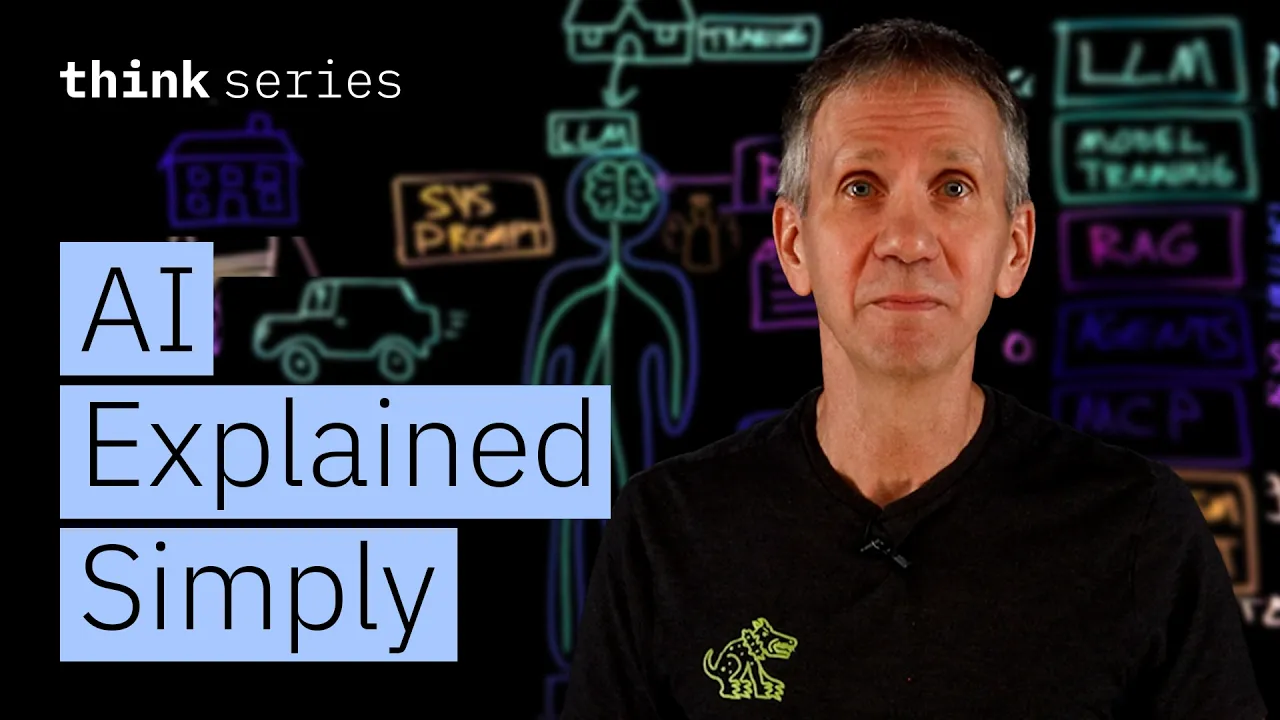
AI Simplified: 6 Concepts You Need to Know About Modern AI transcript
IBM Technology · @IBMTechnology
Words
1,451
Runtime
8:49
Speaking pace
165wpm
Reading time
6min
165 words per minute, between the 160 25th percentile and the 181 median of 349 measured videos. That distribution comes from the 349-video hook study.
Opening (first 30 seconds)
AI is everywhere, and along with it are a bunch of new terms and concepts being thrown around as if everyone already understands what they mean. Here's a news flash, not everyone does. And if you're one of those people still trying to grasp what all this stuff really means, then this video is for you. We're going to simplify modern AI and explain it in terms of six essential concepts that you need to know. So let's get started. The simplest definition
83 words, the words spoken in the first 30 seconds at 165 words per minute.
Sentence shape
| Measure | This transcript |
|---|---|
| Sentences | 86 |
| Average words per sentence | 16.9 |
| Longest sentence | 45 words |
| Questions asked | 5 |
| Sentences containing a number | 0 |
Most used terms
- ai24
- brain13
- system10
- model9
- learn8
- call7
- intelligence7
- human6
- school5
- tools5
- basically4
- feet4
Filler phrases
15 in total: like 5 · basically 4 · actually 2 · sort of 2 · kind of 1 · literally 1.
A literal whole-word count of the same phrase list the Prepublish browser extension uses, so a phrase inside another word is not counted and a phrase used in its ordinary sense still is. It is a count and not a judgement.
What this transcript is
Every word below is the caption track YouTube publishes for this video, pulled from the video itself and reproduced unchanged. It is not Prepublish's writing, not a summary, and not a re-transcription: it is the video's own published captions. English captions, published by the channel, in the video’s original language. Source: the video on YouTube. A channel that would rather this page did not exist can ask for its removal through the contact page, and it is removed.
Transcript
AI is everywhere, and along with it are a bunch of new terms and concepts being thrown around as if everyone already understands what they mean. Here's a news flash, not everyone does. And if you're one of those people still trying to grasp what all this stuff really means, then this video is for you. We're going to simplify modern AI and explain it in terms of six essential concepts that you need to know. So let's get started.
The simplest definition I know of for artificial intelligence is this. AI is a subfield of computer science focused on trying to match or exceed human intelligence in a computer. That's it. Just make a computer as smart or smarter than we are. So we're basically using ourselves as a standard for what is and is not intelligent, which may be assuming facts not in evidence, but I digress. I found that analogies are really helpful in trying to understand new ideas because they anchor these new ideas in old ideas that we already know and understand.
So let's try to simplify all this terminology and represent it in the form of an analogy with something that you're already very familiar with, and you've known it your entire life because it's you. So, let's start with human intelligence. Human intelligence starts with the brain, okay? For modern AI systems, the brain is the model. And these days, much of that work is done by something we call a large language model.
So that's the brain of this system. That's where the core intelligence exists. That's where the reasoning capabilities exist. That's where the content gets generated and content- we call it generative AI because it's able to generate. Well, it can generate words, images, sounds, all kinds of different things. And it uses probabilities to predict output based upon a certain input. So if you question, it's basically doing an autocomplete on steroids.
Complete this sentence, but it's doing it for an entire paragraph or an entire document even for that matter. So there we have a brain, now it's smart, but the brain by itself that's untrained is not very useful. But what did you have to do with your brain? Well, you had to train it and you went to school. So we send an LLM to school basically so that it can learn language. Can learn math, it can learn history, and what is the analogy for that?
Well, it's model training and tuning. That's how we get the LLM to understand all of these basic functions and basically teach it how to think. Now we have intelligence in the form of this brain and training, but if we really want it to be useful, we need to add more information to this brain. For instance, if you stopped learning the moment you graduated from school, then... You wouldn't know anything about the latest current events, the newest technological advances, or even the latest weather forecast.
So you augment that learning with other information sources. We do that in AI with something we call RAG, Retrieval Augmented Generation. This is a way of extending the knowledge of the AI through trusted external sources. So it helps reduce hallucinations. Those are those confident errors where the AI makes bad guesses and just gets it really wrong. It also helps ground the AI in information that we take to be true.
So to our human analogy, this would be like reading up on the latest research papers, product documentation, or news reports, as an example. So while a brain in a box can be very useful, giving that brain the ability to take actions based upon its reasoning makes it even more powerful. Because after all, you wanna go places. You wanna move things around, build things, all that kind of stuff. You wanna interact with the world around you as a person.
Well, AI, in other words, would be more powerful if we give it hands and feet so that it can take actions toward a particular goal and accomplish specific tasks. So we give access to tools so that can do things like read and write to a database. It can write code. It can search the web and maybe even buy stuff for you. A whole bunch more. So this is what we call an AI agent. Simply stated, an agent is a model using tools in a loop autonomously.
So a model, using tools in a group autonomously, agents move past just answering questions by giving it the hands and feet to actually get stuff done. But how are you going to connect your brain to the parts of your body that actually take action? Well... In you, a person, you have a central nervous system composed of billions of neurons passing messages back and forth throughout your body. For an AI agent, this communication can be accomplished with something called Model Context Protocol, or MCP for short.
MCP connects the models to the tools, the brain reasons and the plans, and MCP provides the orchestration layer to coordinate the actions of the hands and the feet. Now if we quit with that, we would have a fully functional human being or AI in this example, but it would be lacking a very key component, a set of guiding principles to control what gets done and what doesn't. One of the themes of the college class I teach on cybersecurity that I call secure thinking is that just because you can do something doesn't mean you should.
The principles that guide our behavior are learned from our parents, teachers, and friends over time. With AI, we don't have that same luxury of time to turn decades of spills and falls to learn what we should and should not do. AI is unleashed soon after its birth and well before it has had time to mature, to learn, and really understand what we refer to as common sense, which isn't all that common maybe. Well, like a young child, AI can be surprisingly naive and lacking in what we referred to as street smarts, which is why it can be easily tricked into doing things that shouldn't.
We call these kinds of attacks prompt injections. They're essentially the AI equivalent to social engineering attacks, which abuse the tendency of people to trust each other. How do we protect humans from falling for social engineering attack? Well, we train them. As children, we learn things like be courteous and helpful, but also don't talk to strangers, don't hurt other people, don't steal, that sort of thing. So it's ethics and proper behavior.
The way we teach that to an AI in a way that doesn't require constantly having to rebuild the model, which is time consuming, expensive, it would be like sending it back to school every single time, is through something we call a system prompt. And the system prompt is a set of guidelines that you give the model to constrain what it does. That way, when a malicious actor comes along and asks our AI how to build a bomb, it already knows that it's not supposed to answer that question and it declined.
But then a clever user might come along and say, well, I'm a chemistry student and I want you to tell me all the things I should never mix together because they would explode. Well, then the AI will happily oblige unless it's been explicitly told not to. So just as we continue to learn as people what to look out for so that we don't fall for the latest scams and phishing attacks and things of that sort, we also have to adapt.
The system, the AI system prompt over time as we learn new ways that bad actors are trying to misuse the system. So there you have six key AI concepts, simplified and explained in human terms, literally. So there's the brain, the large language model. There's the training, sending it to school. There's retrieval augmented generation to give it updated knowledge. The hands and feet that give it agentic tools. There's MCP, the central nervous system.
And the system prompts, sort of the angel on the shoulder, giving it the guiding principles and telling it what to do and what not to do. Of course, there's a lot more to a modern AI system, but this is a decent starting point for a fundamental understanding. But take a look at the video linked at the end of this one that I did on artificial intelligence, machine learning, deep learning, and generative AI, if you wanna dig deeper.
The words are the caption track's own and nothing is reworded or re-transcribed. Paragraph breaks are placed between sentences so the text reads as prose.
Use this transcript
Three free tools that work on the material around a video like this one. No signup, no login.
Hook Analyzer
Paste the first 30 seconds of your own draft for a hook score and rewrites.
Policy Pre-Flight
Check your draft against YouTube's advertiser-friendly guidelines before you record it.
Channel Skill Generator
Read this channel's public videos and transcripts, and download a writing brief for it.