Getting the transcript
Reading the captions from YouTube. A video nobody has opened here before takes 10 to 30 seconds; this page fills in on its own.
Getting the transcript
Reading the captions from YouTube. A video nobody has opened here before takes 10 to 30 seconds; this page fills in on its own.
Nic Munoz · @nic-munoz
This video has no Most replayed graph yet: YouTube shows one only once a video has enough views. These are the moments viewers replayed most in Nic Munoz's most watched videos.
Most replayed moment at 7:20
2.4x that video's typical replay level
Walter Isacson describes it. He added his opinion that learning how nature acted was more important than knowing the theoretical reasons why. Nor is it much important to us to know the manner in which nature executes her laws. It is enough if we know the laws themselves. It is of real use to know that China
Said at 7:12
Most replayed moment at 5:09
3.5x that video's typical replay level
How often do you see that in every genius biography? Albert Einstein, Thomas Edison, Elon Musk, all of them spent countless hours alone just reading. And that knowledge added up exponentially throughout their life. And it it just goes back to that Warren Buffet quote. Read 500 pages like this every day. That's how
Said at 5:02
The graph counts replays. It does not show where viewers stopped watching.
Words
11,051
Runtime
52:36
Speaking pace
210wpm
Reading time
46min
210 words per minute, above the 201 75th percentile of 349 measured videos. That distribution comes from the 349-video hook study.
Opening (first 30 seconds)
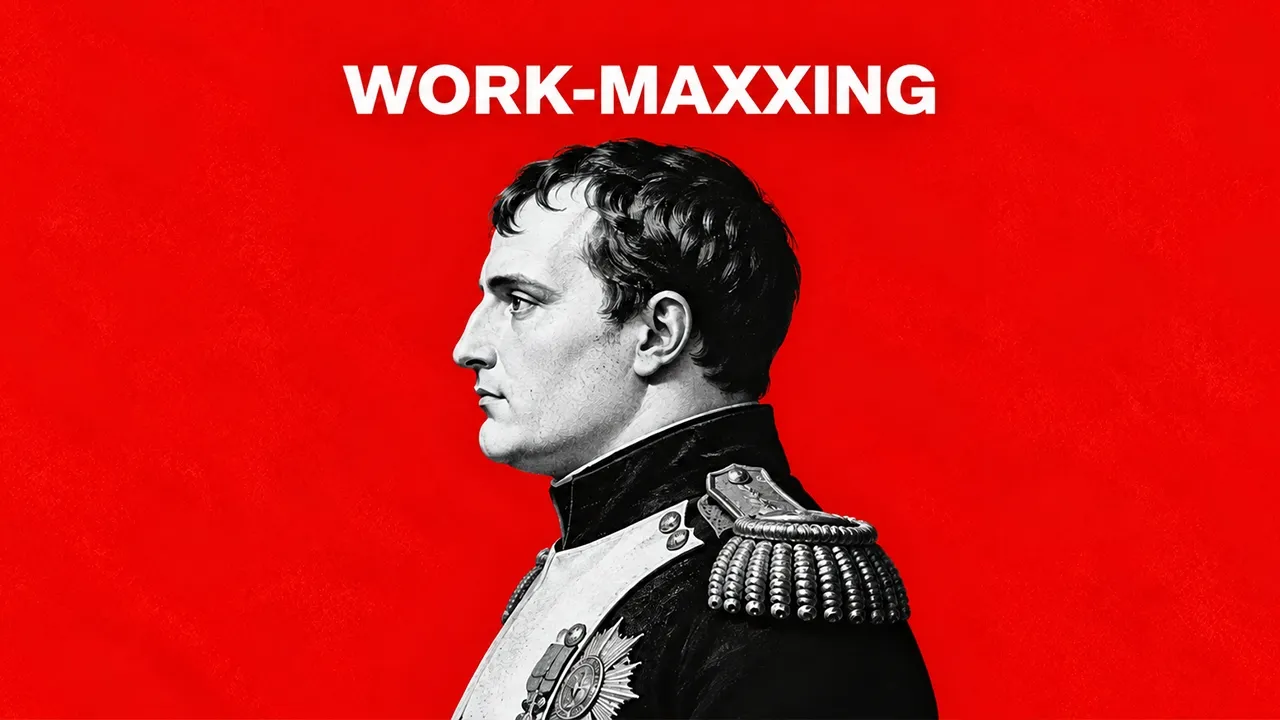
Napoleon was one of the greatest workaholics in history, so much so that even John D. Rockefeller, probably the greatest entrepreneur of all time, said that, "I have thought that if he had applied himself to commerce and industry, he would have been the greatest businessman the world has ever known." In preparation for this video, I read as much as I possibly could on Napoleon's work habits, his life, and his routine. And let me tell you that as I've been studying him, I've come to realize that especially in the world of AI, when you have to be commanding agents, Napoleon is the
105 words, the words spoken in the first 30 seconds at 210 words per minute.
Free, no signup. See how the first 30 seconds hold attention, with rewrites.
Sentence shape
| Measure | This transcript |
|---|---|
| Sentences | 635 |
| Average words per sentence | 17.4 |
| Longest sentence | 87 words |
| Questions asked | 7 |
| Sentences containing a number | 50 |
Most used terms
Filler phrases
100 in total: like 40 · actually 24 · literally 14 · I mean 9 · sort of 4 · kind of 3 · uh 3 · you know 2 · right? 1.
A literal whole-word count of the same phrase list the Prepublish browser extension uses, so a phrase inside another word is not counted and a phrase used in its ordinary sense still is. It is a count and not a judgement.
Free, no account. See where attention is likely to drop, with a rewrite for each weak line. The free check shows the scores and the one issue costing the most. Or run it on the words above first.
Free · No login · See a sample audit first if you prefer.
What this transcript is
Every word below is the caption track YouTube publishes for this video, pulled from the video itself and reproduced unchanged. It is not Prepublish's writing, not a summary, and not a re-transcription: it is the video's own published captions. English captions, generated automatically by YouTube, in the video’s original language. Source: the video on YouTube. A channel that would rather this page did not exist can ask for its removal through the contact page, and it is removed.
Napoleon was one of the greatest workaholics in history, so much so that even John D. Rockefeller, probably the greatest entrepreneur of all time, said that, "I have thought that if he had applied himself to commerce and industry, he would have been the greatest businessman the world has ever known." In preparation for this video, I read as much as I possibly could on Napoleon's work habits, his life, and his routine.
And let me tell you that as I've been studying him, I've come to realize that especially in the world of AI, when you have to be commanding agents, Napoleon is the most important person in history that you can study. So, in this video, we're going over the 15 work habits that made Napoleon Bonaparte, starting with the first one, compartmentalization. The most important thing when it comes to how Napoleon works is in his mind.
He was able to compartmentalize things like no other human ever before. In this Andrew Roberts biography, it describes as this amazing quote. It says, "Napoleon was capable of compartmentalizing his life so that one set of concerns never spilled over into another. Probably a necessary attribute for any great statesman, but one he possessed to an extraordinary degree. Different subjects and different affairs are arranged in my head as in a cupboard.
When I wish to interrupt a one train of thought, I shut that drawer and open another. Do I wish to sleep? I simply close all the drawers and there I am, asleep." What you have to understand about Napoleon is that he is literally the equivalent of a modern-day CEO. How his army was structured was exactly how a modern-day corporation is structured today. He has himself as the top general right at the top, and then underneath him, he has all these groups of people called corps.
And a corps is pretty much a mini army. Each corps is led by a very competent general like a Davout or a Murat or a Ney, and Napoleon just talks to all of his generals underneath him. And when you look at Napoleon's army as a whole, this is exactly how a modern-day business is sort of run. You have the CEO at the top, and then underneath the CEO, you have all these directors that report to the CEO that command the troops on the front lines.
The point is that if Napoleon were alive right now, he would probably be a CEO and he would probably be the best CEO. And what this comes down to is the ability to compartmentalize different subjects and different problems in his mind. I mean, Napoleon on a day-to-day had to deal with a crazy amount of things. The vision of the army, the enemy movements, the supply lines, negotiating peace agreements, the morale of the army, every problem that could possibly spring up in a business was always on his plate at all times.
And yet, even in this complete chaos, Napoleon was able to always concentrate on one thing at one time and block out everything else. That's what made him great. A modern example of someone who does this extremely well and who's probably a modern-day version of Napoleon is Elon Musk. In his biography by Walter Isaacson, which I have right here, in this book the author describes how Elon works and he describes Elon as a serial tasker.
You could describe Napoleon in the exact same way. But what Elon does is he is someone who is always working on the bottleneck of the company and he focuses all of his attention on the bottleneck until it is comp pletely solved. Then he'll take a break for 5 minutes and play Polytopia or play on X and then moves on to the next bottleneck and completely focuses on that. I cannot stress this enough. Napoleon is the exact same way.
When he's answering correspondence, he is completely focused on it. When he's strategizing a military campaign, he is completely focused on the strategy. But the point is that whatever he's focused on, he is 100% completely focused on that thing. There is no outside world except for his work, the work in front of him that needs to get done, and him solving it. There's There's just nothing outside of it. That's what compartmentalization is.
Let's go back to the Andrew Roberts biography and believe me, we are going to be going back to this book a lot. An aide-de-camp wrote of how much his staff admired the strength of mind and the facility with which he could take off or fix the whole force of his attention on whatever he pleased. In the middle of this hurricane in his private life and the growing knowing realization that the woman he worshipped was at best lukewarm in her affections towards him, Napoleon was putting the finishing touches to a bold campaign plan that would lead to a string of seven or more victories on top of the five already won.
Guys, this quote is from when Napoleon is in Egypt going out conquering and he gets word that his woman Josephine back in Paris is cheating on him and it gets even worse because he literally wrote her a letter asking him if this is true. This letter gets intercepted by the British and the British take it and they publish it everywhere making him out to seem like a All this going on, there's all this propaganda around him, his name is being tarnished, his reputation is being ruined, the woman he loves is completely cheating on him and he is completely putting it away in a different box.
It's non-existent to him. He is purely focused on the strategy and the mission of conquering Egypt. That is literally how great Napoleon is. Key lesson, when you are doing work, you have to put everything aside. You have to live in a world that doesn't exist, a world where there's only you and the problem, the work that's right in front of you. There has to be a maniacal sense of focus. It's super simple but no one does it.
I have read hundreds of biographies. You can look at these shelves, I've read all of them. Over 200 and the one lesson that these is the one single thing that you should take from all of them is this lesson of focus. Napoleon was so brilliant because he had masterful control of focus and he was able to compartmentalize things in his mind. So much so that even the psychologist that Sigmund Freud commented on this and I was weirded out finding this out but it's super interesting what Freud has to say on Napoleon.
He said, Freud believed that Bonaparte was an exceptionally good sleeper, someone who could dispose of his waking thoughts simply by deciding to go to sleep. Freud imagined that once Bonaparte was asleep, his robust ego would have resisted anything that attempted to wake him up, even the infernal noise of an exploding cart, horse and girl. This is how well Napoleon was able to compartmentalize things in his mind and if you want to become a great man of history or just a great worker, a great CEO, a great founder, anything great in general, learn this lesson of focus and learn how to compartmentalize things in your mind.
Two, sleep around the work. One of the craziest things about Napoleon is that he was able to sleep a very little and still get a huge amount of work done. And Andrew Roberts actually describes his sleep ethic in his biography. He said, "He needed 7 hours sleep in 24, but he slept as one secretary recalled in several short naps broken at will during the night as in the day. Since his bedroom was close to his study in all his palaces, he could be at work in his dressing gown at any time of the day or night with his secretaries on rotations to take dictation." It's actually so mind-blowing how optimized Napoleon was for everything that he literally had different secretaries rotating positions throughout different parts of the night so that he could literally wake up and start dictating at a moment's notice.
But it gets even crazier because this was a schedule in Paris when he was really governing mostly. But his schedule when he's on campaign is completely different and it's just this superhuman level of work ethic. Napoleon would often sleep for just an hour or two a night, then take short naps in the day, sometimes while fully clothed lying on the table or sitting upright in his carriage so he could continue working without delay.
And keep in mind that this isn't just one source commenting on how little Napoleon was able to sleep, but this is many, many people throughout his life in his Imperial Guard or in Josephine's crowd that are commenting on his ability to sleep very little hours. Thomas Bugeaud of the Imperial Guard wrote to his sister on November 30th and told how within 2 miles of the enemy the emperor came there himself and slept in his carriage in the middle of our camp.
He was always walking through all the camps and talking to the soldiers or their officers. And on top of that, another soldier from the Italian campaign again said, "Bonaparte sleeps among us. He walks with us. He looks us in the eye." This is one of those principles that makes Napoleon out to be one of those mythological figures like an Achilles or an Odysseus, right? But Napoleon was a real person and he was actually able to operate this way.
He was able to operate very functionally with very little sleep. And everyone commented on this, which is kind of one of those things that makes him superhuman. But, I think there is an actual principle that you can take from this. You see, one thing that you see with a lot of CEOs in the modern day is that they are so completely optimized, but they are completely optimized about the wrong things. They like need 8 hours of sleep or else they can't work.
They have to sleep on their eight sleep and get the coldest like foam for their sleep or else they can't work. Uh but, when you look at the greats of history, like a lot of them weren't like this. While on campaigns, Caesar, Hannibal, and Alexander were all sleeping in tents with their soldiers. During sprints to a new invention, Edison, Tesla, and Newton were all sleeping in their labs. And on top of that, the main key lesson from this is that they all slept around their work.
Napoleon operated in the same way as all these greats. He didn't sleep when he needed rest. He slept when the work allowed him to sleep. And that's really the lesson. When you look at the greats of history and you see that they're in a sprint, that they're really going for something with all their heart, with all their energy, and with all their soul, they always sleep around the work. Three, dictation at all hours. Now, compartmentalization and sleeping around the work are great principles, but we're going to get into something that's way more applicable for the modern world.
And I've actually never heard anyone talk about this. The reason is because as the world progresses more into the age of AI and the age of AI agents, there are still a lot of principles that are going to stand the test of time, and this is probably the most important one. Let me explain this with another source. One of the women in Josephine's entourage actually has a whole bunch of letters, and in a lot of the parts of these letters, she talks about Napoleon.
And in one of them, she said, "Bonaparte dictated with great ease. He never wrote anything with his own hand. His handwriting was bad and as illegible to himself as to others, and his spelling was very defective. He utterly lacked patience to do anything whatever with his own hands. The extreme activity of his mind and the habitual prompt obedience rendered to him prevented him from practicing any occupation in which the mind must necessarily wait for the action of the body.
Those who wrote from his dictation, first Monsieur Bourrienne, then Monsieur Maret, and Méneval, his private secretary, had made a shorthand for themselves in order that their pens might travel as fast as his thoughts. He dictated while walking to and fro in his cabin. When he grew angry, he would use violent imprecations which were suppressed in and which had at least the advantage of giving the writer time to catch up with him.
He never repeated anything that he had once said, even if it had not been heard, and this was very hard on the poor secretary. For Bonaparte remembered accurately what he had said and detected every omission. He always derived amusement from causing anyone uneasiness and distress. His great general principle, which he had applied to everything both great and small, was that there could be no zeal where there was no disquietude.
Now, there are million pieces of gold in this little tiny paragraph. But, the reason why I wanted to tell you this is to show you that Napoleon was a master at dictation. You see, after Napoleon became emperor, he never had to write things down himself. What he did was he had all these secretaries constantly around him. He would walk around the room and talk about what he wanted them to write, and they would write down handwrite exactly what he said.
Because you can speak faster than you can write, and so this allowed Napoleon to be extra efficient and extra fast. Keep in mind that Napoleon throughout his life would write 50,000 letters. When you think about how much you yourself have written in your own life and then compare it to the output of Napoleon, you just come to the realization that this guy is just better. He just has more output. He just does more. And you actually get the same feeling with a lot of the greats in history.
It's just book after book after book. You see that their output and their writing is insanely high. You have Hamilton with the Federalist Papers, Caesar with his writings on his campaigns, and Napoleon is the exact same. So, what does this have to do with AI and the modern world? And hold with me here because this is probably the most brilliant realization I've had recently where you really get to see the remarkableness of Napoleon.
I just moved to Austin, and I've been surrounded with some of the top founders and CEOs in the world. And one thing that I found that I don't see a lot of people talking about on the internet is that they were always talking to their phones. The world is changing, and what you're finding is that the keyboard or the touchpad on your phone, the type board, they're just going extinct. More and more people are now dictating to their AI, and that's why it's so important to study history because Napoleon was the master at dictation.
At a moment's notice, he always had a secretary around him to begin dictating even in the middle of the night like we talked about before, and he wouldn't wait for them. He would talk as fast as he wanted to, and he would always expect them to keep up. Because he was so good at dictation, his communication was also flawless, and because of this, he was able to clearly give orders to his army, deal with politicians efficiently, and organize community projects with just singular letters.
But all of this stems from the art of dictation, from being able to speak to your secretary, or to be able to speak to your AI. It's all about being able to speak out a letter in a moment's notice. And so, if you want to work like Napoleon, here is my recommendation. Set up a Crock-Pot or a GPT Astra or whatever AI is available to you, put it on your phone, and then be constantly dictating. Have it handle all of your communications and be dictating 24/7.
That is how Napoleon worked. He had secretaries writing letters around him 24/7. That's why his communication was so good, why his army was so well run. Everything stems from his mouth, and he was he just had an extreme amount of output. And that actually leads quite nicely to the next principle. Number four, the correspondence machine. Napoleon communicated with his staff much more frequently than his contemporaries.
He would often send dozens of letters in a single day, dictating short messages as if you were texting. This coordinated his staff in a way that was previously unheard of. This is just so brilliant. Napoleon was living in the modern world before there was a modern world. And this principle is especially important if you are a CEO that's leading a group of managers. As I talked about earlier, Napoleon is a CEO and he had a group of generals and marshals under him that he would communicate with using letters.
And so, I wanted to use this section to talk a little bit about what Napoleon talked about in his letters and how Napoleon wrote these letters so that you can have a bit more of an understanding of how the communication should be at your company. The first thing is that your communication should be a constant flow of information. When you look at how much mail Napoleon sent out in a single day, there's a great description in this here that really shows this.
On that day alone, Napoleon had written letters to Davout complaining of the marauding of the Württemberger troops in Poland, to Clark about raising a company of Alban Sappers, to Marie Louise saying that he had been 12 hours in the saddle since 2:00 a.m., to Cambacérès that the frontier was quiet, to Eugène ordering 30,000 bushels of barley, and no fewer than 24 letters to Berthier about everything from a paymaster who should be punished for incompetence to a fever hospital that needed to be relocated.
Preparing for the attack on Russia caused Napoleon to write nearly 500 letters to Berthier between the beginning of January 1812 and the crossing of the Niemen and another 631 to Davout, Clark, Lacuée, and Murat between them. This level of output for communication is genuinely insane. It's almost unheard of and it allows his presence to really be felt in his organization. That's super important. I'm going to repeat that.
Your presence needs to be felt. It needs to be felt. It needs to be felt. It needs to be felt. Your company is an extension of you. If you are the founder, your company is an extension of you and your presence needs to be felt. Another quote from the enter Robert's biography, "Napoleon's divisional commanders were immediately impressed by his capacity for hard work. Subordinates could never say they would attend to something and then let it slide.
And the staff, who had been stationary in Nice for 4 years, suddenly felt the pulsating effect of Napoleon's energy. In the 9 months between his arrival in Nice and the end of 1796, he sent more than 800 letters and dispatches, covering everything from where drummer boys should stand in parades to conditions under which the Marseille should be played." I absolutely love that sentence. His army felt the pulsating effect of Napoleon's energy.
Geez, that is absolutely brilliant. Your company needs to feel your energy pulsating through it. Think about the way Elon's energy pulsates through SpaceX and Bezos at Amazon and Bill Gates at Microsoft. And this is why the amount of output that comes from you is so important because it is the output of your communication to your generals that allows your presence to be felt, that allows your energy to pulsate and ripple through the company.
The book gets even crazier when it describes it what the communication was actually like. Like, what is actually in these letters? "The avalanche of praise he generally lavished on his troops was in sharp contrast to the acerbic tone he adopted towards his generals, ambassadors, counselors, ministers, and indeed his own family in private correspondence. Severe to officers was his stated mantra, kindly to the men." Whoa, that last line is so insanely brilliant.
If you can't tell, I'm going to be repeating a lot of the lines in this episode. "Severe to the officers, kindly to the men." This is another recurring pattern. Napoleon is extremely strict with his officers. He is very clear and concise in his letters to them and he knows that he needs to be hard on them in order to drive results. He is a lot nicer, a lot more enthusiastic, and a lot more general in his bulletins where he's writing to the masses of people where in Napoleon's words, he was kindly to the men.
The point is this, as a correspondence machine, you want to make your letters extremely short, concise, and just to the point. That along with a huge amount of output will make your presence be felt at a company and will increase the speed of your organization vastly. And on top of that, if you want to be a correspondence machine, then you need to be constantly consuming the best information even at night. I mean, Napoleon would get up in the middle of the night and start dictating to his secretaries.
I know that sounds crazy, but it's true. And that is why if you are a founder or a CEO or a conqueror, I recommend the FitNexa Somnipods 3. Let me put them up close to the camera so you can actually see how cool they are. I pretty much listen to something 24/7, whether it's an audiobook or a podcast or some sort of AI. I always have something in my ear. I'm constantly constantly listening to something. And I've been using these Somnipods 3 for a couple months now and they are just so great.
I mean, my favorite part about them is that I can even sleep in them. I always had this problem where I would put on headphones, but they would always press against the pillow or they would fall off after I fell asleep. But my favorite thing about these things is that they're really small and fit right in your ears, so they don't press into the pillow at all. And I always wake up with them still in my ear and they're super comfy, so after a while you don't really notice them, which has always been the problem for me with other ear pods.
The noise canceling is really good, so you can listen to white noise or a podcast without turning the volume super high. I mean, just last night I was listening to a podcast on P.T. Barnum and I was just thinking about how amazing these little ear pods are. I mean, just look how stylish they are, too. Like they look good. So if you are a founder who wants to consume more information and fall asleep in extremely comfortable ear pods, you can check them out using my link.
And if you use promo code Nick Mihailovski's 10, you will get $10 off your purchase. Once again, that is the link in the description or you can go to fitnexa.com. Now onto number five, eat little food. So we already talked about how little Napoleon needed to sleep, but the other thing that Napoleon needed a very little of is food. I don't have this one with me on my shelf or anything, but there's this author named Las Cases, which documented Napoleon's life on Saint Helena, which is the island that he was exiled to the second time.
And in his book on him, he wrote, "Nature," he said, "had endowed him with two important advantages. The one was the power of sleeping whenever he needed repose at any hour and in any place. Another was that he was incapable of committing any injurious excess either in eating or drinking. If," said he, "I would go the least beyond my mark, my stomach instantly revolts." Now, this was true for his entire life, but when he became sick on Saint Helena, this was especially true.
The book continues, "The emperor eats very irregularly, but generally very little. He often says that a man may hurt himself by eating too much, but never by eating too little. He will remain four and 20 hours without eating only to get an appetite for the ensuing day. But if he eats little, he drinks still less. A single glass of Madeira or champagne is sufficient to restore his strength and to produce cheerfulness of spirits.
He sleeps very little and very irregularly, generally rising at daybreak to read or write and afterwards lying down to sleep again." Now, on top of this, Napoleon was an extremely fast eater. When he wasn't on campaign, his meals would last around 20 to 30 minutes, which was slow for him. Because when he was on campaign, his meals would only be eight to 15 minutes. I Sorry I keep bringing up Elon, but it's insane how similar they are.
And in this biography, the author actually had dinner with Elon. And in the dinner, the author describes how Elon literally devoured a steak in like a single gulp. And then one of Elon's workers who said that Elon does everything fast, that he even pees fast is what he said in the biography. It's so weird because having weird food habits is actually something that you see in a lot of these biographies of great men. Steve Jobs had a lot of weird diets throughout his life, sometimes eating only fruits and vegetables, sometimes eating only a certain type of fruit that was picked on a certain type of day.
Michael Jackson was kind of similar, being a vegetarian for a lot of his life. Newton, Da Vinci, Tesla were all notoriously known for being light eaters. And so there's definitely something to this, and I'd like to share my theory on why this is a thing. When you go back to hunter-gatherer times, whenever you were hungry, you went to go hunt and that's how you got food. And when you think of when your body is most optimized in the day, it's when you're hungry because you need food.
And so, your mind and your body is already optimized to go hunt. Now, the modern equivalent of hunting is working. And so, when we're working, we're in the optimized state of work. And so, I think when you look at history and you see a lot of these great people being light eaters, it is because they're always in this optimal state of work. I don't know if this theory holds up. I've tried it in my own life. I'm also a very light eater and it actually works really well.
I always feel like I'm in an optimal state of work. But, you know, other people might say differently. Six, complete concentration. This one [clears throat] is absolute gold because so many of the principles that you use in war can also be used in business. And this is probably the most important one because it goes back to the primary lesson of focus. Going back to the Andrew Roberts biography, it talks about the difference between Napoleon's style of warfare and the Austrian's style of warfare, who was Napoleon's enemy.
By contrast, Napoleon planned to adopt a daring maneuver known in military academies as the strategy of the central position. He would remain between the two forces opposing him and would strike first at one and then at the other before they would coalesce. It was a strategy to which he would adhere throughout his career. It is contrary to all principle to make cores which have no communication act separately against a central force whose communications are open.
This was one of his maxims of war. So, the strategy of the central position is so brilliant. Pretty much, Napoleon would get his entire army together into one big block. He would then try to divide the enemies army into two little blocks. Then, after his enemies army is divided, he would turn his whole army into the one block and completely destroy it before turning around and conquering the other block. This would allow his entire army to focus all of its force on one half of his enemies army and completely destroy them before the enemies army even has time to think about attacking the other half.
The exact principle of this strategy can also be applied to your work. When your concentration is divided, the impact lessens. But if you simply completely attack one task until it is completely annihilated, and only then move on to the next task, things will go much better for you. Never split your forces. This is how you lose. Now, going back to Elon Walter Isaacson's book, Walter Isaac talks about Elon being a serial tasker because he will completely focus on one task until it is completely finished before moving on to the next task.
Most people try to be multitaskers. They try to focus on multiple things at the same time, and they never get anything done. But if you are a serial tasker, you focus first on one thing until it is completely finished, and then move on to the next thing, you will get twice as much done as the multitasker. Simply because all of your concentration is on one thing. Once again, I will say, "Never split your forces. That is how you lose." Focus is on an exponential curve.
On Saint Helen, Napoleon would read for 12 hours straight, not doing anything else. When he did something, he did that thing until it was completely finished. Another thing that a lot of people comment on Napoleon is his eyes. When he would stare at people, he was with a complete concentration. He wouldn't be looking around the room. He would have two eyes completely set on that person. And multiple people throughout his life commented on him.
And what's even crazier is that a lot of great men have this exact same stare. That you just see people around them comment on this intense stare. And it's because they're so focused on what they're doing. John D. Rockefeller, Steve Jobs, Michael Jackson, everyone commented on this this intense stare that he had. Same with Julius Caesar and Napoleon, the conquerors. Every one of these great men had this intense focused stare.
And everyone comments on it. And it is my belief that it is because it is the strategy of the central position. When they are focused on a person, they are completely focused on the person, and the entire world just fades away. So, this is a simple concept that you can apply in all aspects in life. In war, in conversations, in your work. Focus on one thing until it is completely done and only then move on to the next thing.
Don't try to be a multitasker, be a serial tasker. One thing until it's finished and only then move on to the next thing. Number seven, create systems. This, in my opinion, is the most important principle that made Napoleon so great after he became an emperor and this was his invention of the core system. Napoleon pioneered an operational level of warfare that lies between strategy and tactics. His corps has become the standard unit adopted by every European army by 1812 and which lasted until 1945.
It was his unique contribution to the art of war and its first use in 1805 can be regarded as heralding the birth of modern warfare. I love that description because the core system is really the crown jewel of Napoleon when it comes to invention. Maybe Napoleonic law comes close, but in my opinion, the core system is just truly brilliant. Yes, I know Napoleon didn't actually invent the core system, but when you look at history, the only person you remember when it comes to the core system is Napoleon and that on this chan- in this channel is what matters.
Let me tell you a little bit more about the system. Maneuvers between 1803 allowed Napoleon to divide his army into units of 20,000 to 30,000 men, sometimes up to 40,000 and to train them intensely. Each corps was effectively a mini army with its own infantry, cavalry, artillery, staff, intelligence, engineering, transport, victualing, pay, medical, and commissary sections intended to work in close connection with other corps.
Moving within a one day's march of each other, they allowed Napoleon to swap around the rear guard, vanguard, or reserve at a moment's notice depending on the movements of the enemy. So, in either attack or retreat, the whole army could pivot on its axis without confusion. Corps could also march far enough apart from each other not to cause victualing problems in the countryside. The core system was not just what allowed Napoleon to do so much, but it's also what allowed him to move so fast and on top of that be more flexible than any army in the world at the time.
And a lot of this was because Napoleon didn't have to talk to the entire army. He could simply talk to his top generals, and they would go and lead the cores. The work principle here is simple, and that's that you need to create systems that allow you to move faster and be more flexible. There's two ways in history that you can really go about this. The first way is the way Napoleon did it. It's also how Jensen did it at Nvidia, or how Rockefeller did it at Standard Oil.
It's based on cores. So, pretty much what a core is, it's a mini army. Each army has its own cavalry, its own infantry. It has all the different parts of his army, and it can move on its own. Napoleon's whole army was a bunch of cores, a bunch of little armies that he could get the best generals to work for, and he would only communicate with the generals. Or you can do it the second way, which is more of how Elon Musk did it, or Steve Jobs, where you build cores based on sections.
So, think about how at Apple, Steve Jobs had a section for the Lisa, and a section for the Macintosh, and a section for the Apple II. Each one of these was effectively a core, only they each focused on a different part of the company. Or Elon at SpaceX, where he divided it into five sections that included propulsion, relationships, uh aeronautics, stuff like that. And so, each different core is more based on an area rather than all similar cores.
The really important thing to take away from this, though, is that you need cores under you. You need groups of people, and then really competent people leading those groups of people. This was really important in Napoleon's life, and it even talks about in the memoirs of Remi Son, how focused Napoleon was on leading the people in his cores. I mean, he literally thought about his officers' names as he went to sleep. And believe me, this is an unbelievable quote.
"Bonaparte's reception by the troops was nothing short of rapturous. It was well worth seeing how he talked to the soldiers, how he questioned them one after the other, respecting their campaigns or their wounds, taking particular interest in the men who had accompanied him to Egypt. I've heard Madame Bonaparte say that her husband was in the constant habit of pouring over the list of what are called the cadres of the army at night before he slept.
He would go to sleep repeating the names of the corps and even those of some of the individuals who compose them. He kept these names in a corner of his memory and this habit came to his aid when he wanted to recognize a soldier and to give him the pleasure of a cheering word from his general. He spoke to the subalterns in a tone of good fellowship which delighted them all as he reminded them of their common feats of arms.
If you want to work like Napoleon then you need corps. The better you can get at building managing and running corps then the more effective you will be. Eight, speed, speed, speed. The next three principles are going to be similar but I couldn't get rid of any of these quotes. They are all phenomenal. I can't believe I got these quotes from $20 bucks. All of the next three principles are about moving fast and being a complete bundle of energy.
For Napoleon, he once told men of all that after he had left Brienne he started to work 16 hours a day and never stopped. Everything around Napoleon happened at a tremendous pace. Mollien recalled him going from a mass to a levée at Saint-Cloud in the summer of 1806 walking fast with an escort of foreign princes and grand French dignitaries who were out of breath in their efforts to keep up with him. He hated wasting a minute of the day and was constantly performing several tasks simultaneously. >> [laughter] >> Napoleon moved with a speed that was unmatchable.
He was fast in everything that he did and this philosophy really reflected in his corps. He forced his corps to live off of the land so that they could move forced marched them throughout the day so that they would be the fastest moving army. He did everything that he possibly could. He shouted at them, "Faster, faster, faster." I mean, here's what the Andrew Roberts biography says. "Living off the land allowed Napoleon a speed of maneuver that was to become an essential element of his strategy.
The strength of his army, he stated, like the power in mechanics, is the product of multiplying the mass by the velocity. He encouraged everything that permitted faster movements including the use of forced marches, which more or less doubled the 15 miles per day a demi-brigade could move. "No man ever knew how to make an army march better than Napoleon," recalled one of his officers. "These marches were frequently very fatiguing.
Sometimes half the soldiers were left behind, but as they never lacked goodwill, they did arrive, though they arrived late." Every great army and organization throughout history that was successful moved faster than the people around them. Caesar would force march his army tens of miles every day just to build their endurance. Hannibal would march his army through swamps and mountains simply because it was faster and unexpected.
When Zuckerberg was conquering universities, he literally thought of himself as Augustus going off and conquering different parts of the world. And his whole philosophy was based around speed of getting to the college faster than his competitors, of expanding and building a network of social users faster than the people around so that he could later use monopoly tactics. I mean, even when you look at evil commanders, someone like Hitler, one of the most effective parts of his strategy was speed.
The blitzkrieg was a blitz, and because it was a blitz, because it was so fast, he was able to run through France. When you look at great companies in the modern day, someone like Elon is always talking about speed of light velocity. Guess who else is talking about speed of light velocity? Jensen Huang. At Nvidia, they literally have something called speed of light velocity, where every part of the chip-making process has a time of completion that is supposed to be at the speed of light.
Everyone great who has done something in history was able to move fast. I always like to say, "Speed is essence. Speed is essence. Speed is essence." And so, if you want to work like Napoleon or any of the other greats, then you need speed. Nine, constantly asking for more. I know this is going to sound crazy, but when you read a lot of these biographies, there's something that I call the crybaby effect. And that's that a lot of these great people are big whiners.
They're always whining and crying for more. They want more out of everything. I I the crybaby effect because when you think of a baby crying, the mother always goes and comforts him. And so the baby begins to develop this pattern in his mind that whenever it cries, the mother will go over and give him comfort and will rock him or whatever gets a baby to stop crying. I don't know. I don't have a baby. The point is that a lot of the greats are always doing this.
They're crying and asking for more and they get in this loop where the more they whine, the more they complain about things, people will sort of succumb to what they're asking for. Napoleon, and I'm saying with all the love in the world, was constantly whining. At Toulon where he had the task of capturing this fort called Fort Mulgrave, this is what the book describes it as. Napoleon threw himself into the project of capturing Fort Mulgrave by keyholing nearby towns.
He got together 14 cannons and four mortars as well as stores, tools, and ammunition. Constantly imploring, complaining, and raging there wasn't enough gunpowder, the cartridges were the wrong size, trained artillery horses were being requisitioned for other uses, and so he sent scores of letters with demands to Bouchotte and even on occasion to the Committee of Public Safety itself, going over the heads of Cartaux and his immediate superiors.
Guys, this is insane and the book later describes a very similar situation where it says, "Certainly his demands on Paris were constant and on April 1st he managed to get 5,000 pairs of shoes delivered." His demands were constant. He was constantly writing letters to everyone to get more ammunition, asking for more troops, more supplies, more intel, more, more, more. This is what makes the greats so much of the time.
They just do more. It was the exact same situation for George Washington during the Revolutionary War where he had all of these secretaries around him constantly writing and he was dictating to them and he was always asking for more, more bullets, more everything from Congress. A lot of great people make the best out of really bad situations by just asking and complaining for more. This is actually something that so many people are scared to do because they're scared of being disliked, but the people who are actually successful are not scared of being disliked.
Most people who are actually great actually are disliked by the people underneath them because they're always asking for more. They're pushing their troops to be better. They're asking for more supplies in different in in different areas. Think about the best people going out to raise money right now. It's not someone who is timid and shy and asking for a low amount of money for a high percentage of the company, but it's people who are asking for very large amounts of money for a low percentage.
It just makes your company seem more valuable. It makes you seem more grand. The people who are doing greater in life simply ask for more. They just ask. The worst case scenario is that the person you're asking for says no, but the best case scenario is that you get more. And more when it comes to greatness, at least when it comes to ammunition, is always better. 10, boundless boundless energy. When you study Napoleon, you will find something that is very common among the greats, but very rare among the commoners.
And that is that this guy had an unbelievable amount of energy. It was just volume. So much of his success came down to the amount of output he was able to do himself. And I'll give you a couple examples. At Malta, on the way to Egypt, it says in the Andrew Roberts biography, "In his six days at Malta, Napoleon expelled all but 14 of the knights and replaced the island's medieval administrations with a governing council, dissolved the monasteries, introduced street lighting and paving, freed all of the political prisoners, installed fountains, and reformed the hospitals, postal service, and university, which was now to teach science as well as the humanities.
In six days, he transformed the entire island." Like, how is this even possible? There's also another example from Las Casas who literally lived with him on St. Helena. "I have known the emperor to be engaged in business in the Council of State for eight, nine hours successively, and afterwards arise with his ideas as clear as when he sat down. I've seen him at St. Helena peruse books for 10 or 12 hours in succession on the most abstruse subjects without appearing in the least fatigued.
He has suffered unmoved the greatest shocks that every man experienced. On his return from Moscow or Leipzig, after he had communicated the disastrous events in the Council of State, he said, "It has been reported in Paris that this misfortune turned my hair gray, but you see, it is not so." Pointing to his head, "And I hope I shall be able to support many other reverses, but these prodigious exertions are made only, as it were, in despite of his physical powers, which never appear less susceptible than when his mind is in full activity.
His mind was in full activity." I love that. Remember that so much of being a great leader and a great worker is about being able to inspire the people around you to work as hard as you. And Napoleon was, frankly, a master at this. In war, he was to say in 1808, "Moral factors account for three quarters of the whole, relative material strength accounts for only one quarter." His personal courage had further bonded him to his men.
The energy that you radiate towards your work pulsates through the company. I know we went over that at the beginning of the video, but we're going over it again because it's just the best lesson you can take. The energy that you put towards your work pulsates through the company. One thing that you find when you read a lot about the history of Apple is that Steve Jobs was yelling at everyone. People were scared to be in his presence, but he was constantly passionate about what they were building.
He was constantly giving these inspirational and motivational speeches, and his energy radiated through Apple. You could feel Steve Jobs when you bought something from Apple. Elon Musk is the exact same story. When you look at a Tesla car or when you see a Cybertruck or when you look at a Starship, you see Elon's presence radiating through the product. And again, you see the same relationship where he's constantly yelling at people to do more, to be better.
He was just the most energetic towards his work and towards his employees. Caesar, Hannibal, Alexander all practically the same person. They were all constantly pushing these armies. They had this intense stare. They forced marched them through these insane marches, and they would be right there at the front lines with the people fighting for them. They simply had more energy. They had poundless boundless energy and this is why they were at the top.
Guys, you don't get to be remembered in history on accident. It's whole on purpose and they studied the greats of history and they took these lessons. Simple lessons. Speed, output, volume, energy. And these simple lessons are what create the greats of history. Just so you can see how insane Napoleon was about this. He said, "One can remain for 24 or if necessary 36 hours without eating, but one cannot remain 3 minutes without gunpowder." Along with his energy and activity, his letters conveyed a meticulous attention to detail in everything from the price of rations to the proper building of palisades.
And the funny thing is that this guy actually endured multiple days without eating because he was so focused, so concentrated on his work that he forgot to eat. You see the same thing with Leonardo da Vinci when he was painting the Last Supper. People remember him just staring at the painting forgetting to eat for a whole an entire day. If you want to work like Napoleon, you have to work like your life literally depends on it.
It is this belief that you only have a limited amount of time on this earth, that life is short and you have to make use of every moment that gives you this speed is essence mentality, that your work is a life or death that allows him to work like this. This energy is the life force of every single company and you can especially see it in Napoleon's army. So, if you want to work like Napoleon, have this boundless boundless energy. 11, never leave the scene of action.
As the founder and CEO, you have to have a ground presence at the scene of action. This does two things. One, it adds a sense of urgency where you need it most and two, it shows your troops that you're willing to get your hands dirty and do real work. In the Andrew Roberts biography, it says, "Dauphin was impressed with his artillery commander reporting to Paris, I always found him at his post. When he needed rest, he lay on the ground wrapped in his cloak.
He never left the batteries." Napoleon was always at the scene of action. I mean, he is literally sleeping on the ground right next to cannon. And it gets even crazier because this didn't stop when the battle started. The book continues. Napoleon showed considerable personal bravery in the batteries and redoubts of Toulon, at one point picking up a blood-soaked ramrod from an artilleryman who had been killed near him and helping to lead the and fire the cannon himself.
The reason I'm talking about this as a work habit is because this is what really inspires the people around you to do great work. It's sharing the danger, sharing the pain, sharing everything that they go through with them. The next quote I'm about to share with you is one of my favorites from this entire book. It's like 800 pages, but it really shows what makes Napoleon like a really genuine virtuous person. I'll just read you the quote.
"Napoleon's troops appreciated his courage and his ability to magnify their own. When all the gunners trying to establish a battery of cannon within a pistol shot of Fort Mulgrave were killed or wounded, Napoleon christened it Hommes Sans Peur, men without fear, and thereby continued to receive volunteers to man it. Nobody better understood the psychology of the ordinary soldier. Nobody Nobody understood better the psychology of the common soldier." That is great quote.
Every CEO needs to understand the psychology of the everyday worker, the everyday the person at the bottom. There's this great quote from the book of Elon which literally perfectly describes this principle, and it talks about how Elon learned this lesson from Napoleon. Here's what Elon said. "When the team is being asked to work super hard, I have to be right there with them, and they have to see it. If I fall asleep in the middle of the factory floor at 4:00 in the morning and wake up 4 hours later, they see that.
They are like, 'If the CEO is willing to take that level of pain, I can do it, too.' It was a world of hurt. I would wake up smelling like oil and iron filings. It was rough, but I was asking people to really go all out. I can't expect them to go all out if I'm not doing the same. This is the principle you never leave the scene of action. You are always at the bottleneck. You are always right at the problem that the company is struggling to solve because that is the role of the CEO.
The founder really in a perfect world it should take on the most pain. They should take on the most amount of hardship. If you are outsourcing the hardship to the people below you, you will never be a great of history because the greats are the people who take on the most amount of pain and suffering. That is something that Napoleon and Elon understand very well. And so this is the principle. Never leave the scene of action. 12, be in the weeds.
You need to be constantly in the weeds with your troops. Elon isn't working in some shiny office. He is constantly with the engineers. Steve Jobs, same thing. He was in the design lab with Jony Ive's. Even Rockefeller wasn't always in his office. He was constantly with the ledger writers going over the ledgers. Where this principle stems from is frontline leadership. You have to be in the weeds with your troops. My favorite example of this from the life of Napoleon comes from when he is an emperor.
When you are a king or an emperor, you don't have to do any of the hard things. You don't have to do any difficult, you never have to get dirty. You could have the best treatment from the best people 24/7 for the rest of your life. But what I love about Napoleon is that even after he was an emperor, he was still going on campaign and even getting in the weeds himself. There's this beautiful story from the Andrew Roberts biography where he conquered this general named General Mack.
And after he conquered them, one of the generals actually commented on Napoleon's appearance. Here's what the book says. The surrender took on the Michelsberg Plateau outside Ulm when an Austrian officer remarking on Napoleon's mud-spattered uniform said, "How fatiguing the campaign in such wet weather must have been." Napoleon said, "Your master wanted to remind me that I am a soldier. I hope you will own that the imperial purple has not caused me to forget my first trade." Your master wanted to remind me that I am a soldier is one of the coldest lines ever said in all of history.
But what the story really shows is that even as an emperor, Napoleon was still leading from the front lines. I really love this story because it really shows the epitome of someone getting to the top and still choosing to lead from the bottom. It's the leader being the servant, the biblical principle. Success is so dangerous because it always goes to your head. You always think that you're better than you actually are and you forget your real trade.
You forget the person that you were at the bottom. Napoleon understood this very well and he actually re flected on his younger years of when he was this person when he's older and he has this brilliant description. "Do you know how I managed?" Napoleon later recalled of this period of his life, "by never entering a cafe or going into society, by eating dry bread and brushing my own clothes so that they might last the longer.
I lived like a bear in a little room with books for my only friends. These were the joys and debaucheries of my youth. Wherever you are, no matter at what position, it doesn't matter if you're in your mom's basement or if you're the CEO of one of the biggest companies in the world, you need to be in the weeds. Never forget that you come from dust and one day you will return to dust. That's a line from the Bible, from Ecclesiastes.
This single line will keep you humble and it will stop you from making stupid mistakes, as it did for Napoleon, at least until he went into Russia. 13, remedy by extreme. This is a really interesting principle that I haven't seen talked about very much, but I was reading the memoirs from Saint Helena and it says this, "The emperor has no faith in medicine and never takes any. He adopted a peculiar mode of treatment for himself.
Whenever he found himself unwell, his plan was to run into an extreme, the opposite of what happened to be his habit at the time. This he calls restoring the equilibrium of nature. If, for instance, he had been inactive for a length of time, he would suddenly ride about 60 mi or hunt for a whole day. If, on the contrary, he had been harassed by great fatigues, he would resign himself to a state of absolute rest for 24 hours.
These unexpected shocks infallibly brought him an internal crisis and instantly produced the desired effect. This remedy, he observed, never failed. This one is one that I find so interesting because Napoleon was a man of extremes. He was extreme about everything that he did with his relationship with Josephine, with his work and his sleep. And this is another one with his remedies. Whenever something was wrong, he would remedy to the opposite.
And I love the way he thinks about this too, about finding an equilibrium, about going too far in one direction and needing to treat rest in an extreme way similar to the way he treats work. When you look at a couple modern-day examples of someone who has achieved very high amounts of success, you can think of like Mr. Beast and Hermosi. And I found it very interesting that they both treat rest in the same way that Napoleon treated rest, where they treat their rest as extremely as they treat their work.
For Mr. Beast, he talks about how he works every single minute of every single day until he literally cannot work anymore. Then, he'll take an afternoon off and he'll just binge in anime. After that, he gets back to work for every single minute of every single day, is what he says. Alex Hermosi has a very similar thing, where he works until he cannot work. And in his words, he said something like the output of gets like marginal diminishing returns or something.
But once he reaches this point where his output begins to go down, he says, "The way I rest is simply by watching Netflix in a dark room until I'm good again to work." And so, these men find a sort of equilibrium in the universe, as Napoleon said, by using extreme tactics in rest in the same way that they use extreme tactics in their work. And so, I named this principle remedy by extreme. This not only shows that you have to be extreme about your work, that when you do something, you have to be, I guess, more extreme about it.
Let's use a Hermosi quote, "If you want to be exceptional, then you have to be the exception. You have to be extreme about things." But it also shows that there is an equilibrium in the universe that you have to reach. And so, if you treat your work in an extreme way, you should also treat rest in an extreme way, as well. 14, allow for flexibility. One of the things that made Napoleon so great, especially among Prussian generals or Austrian generals or even Russian generals, was that he was able to be extremely flexible in the way he planned.
Most of the people around him had these very rigid plans where they were so sure that what they thought was going to happen was going to happen. They had no flexibility, no room to maneuver. Napoleon was the complete opposite. He had an extremely flexible nature to everything. What he would do when he was planning a campaign was he would take these note cards and on the front of these note cards he would write down everything that he thought could happen.
And on the back of every note card he would write down what he would do if that thing happens. This allowed for his plans to be extremely flexible because he had all these different plans for any possible scenario that could happen. And so because of this this allowed him to be way more flexible with his army and with his plans than his enemy. People often don't think about the retreat from Russia being masterfully done.
Obviously, Napoleon shouldn't have extended his army all the way to the capital. But in his retreat he was able to be extremely flexible and he was able to minimize the casualties from enemy raids. Napoleon had listened to Oudinot's advice and change his plans accordingly, showing his customary flexibility on the field. He acted quickly, used deception to affect a brilliant faint which drew the Russians south and his whole army had crossed on two makeshift wooden trestle bridges in two days.
It had been a miracle of deliverance, although so expensive that one of the common expressions for a disaster in French became "une Bérézina". Here's a key point. People are way too rigid in their work. They have this small in their head of what's supposed to happen, of what's going to happen, and when that model suddenly gets shifted by reality, they just completely lose it. They stop their work, they stop posting, they stop their business, they just stop.
They freeze. What was so brilliant about the way Napoleon worked is he had a plan for everything. There was no good or bad, there was a plan for everything. And so no matter what happened Napoleon was still able to be flexible and to operate. And so if you want to work like Napoleon, I would use this note card technique that he uses. On the front, write everything that could possibly happen, good and bad, and then on the back, write how you would react to each scenario.
That way, you will always be able to be flexible. And finally, number 15, study the greats. This is my favorite principle. Obviously, this channel is called The Greats because we study the greats, but this is the best principle because it's the most effective for all of life. When Napoleon was in his 20s, he was a corporal, and there's this Ruth Cherb biography that kind of goes over this a little bit. It talks about how the people that he was under weren't that competent, and it describes it.
It says, "The young battalion leader did not have the authority to override the decisions of his superiors, whose lack of competence deeply frustrated him." And so, because of this, the book continues, "He loved to find parallels between himself and ancient heroes. Bonaparte believed Hannibal was the greatest of all the great men of antiquity. Caesar, he thought, was a poet's hero, and Brutus, the Democrats' hero, but Hannibal was the greatest military captain in the ancient world." There was no one Napoleon could really imitate in the world and during his time.
And so, he looked to history for people that he could admire, people that he could learn from. The book continues, "Bonaparte, like Caesar, is one of those dominating characters before whom all obstacles and all wills subside. Their inspiration seems so natural that in classical times, one would have considered them as living under the protection for a genie or a god." Key point, he was looking for mentors in historical context.
Guys, I read over 200 biographies at this point. The one thing that I see in every single one of them is that the greats study the greats. Not a single biography that I've read doesn't mention this. Napoleon studied Caesar, Caesar studied Hannibal, Hannibal studied Alexander, Alexander studied Achilles. The most important thing that Napoleon did in his life was read about the greats of history. He found his golden shadow, and he was able to emulate them and walk in their footsteps.
If you take one thing from this video, if you take one thing from this channel even, that you can go and apply in your own life, take this. Study the greats of history. Find your golden shadow, walk in their footsteps, embody their ethos, and go conquer the world. And if you feel like Napoleon is that person for you, I am actually starting a book club where we will read one or two biographies every month and meet by-weekly to discuss them.
We're starting with Emil Ludwig's Napoleon biography, who my friend said is the greatest biography he's ever read. He's read like 70 biographies, so I'm actually super excited to get dive into this one. We are starting this book on October 1st and our first meeting will be mid-October. So, if you felt inspired by Napoleon, definitely join this club. It is only for the greats of the future and it's going to be uh extremely awesome.
So, yeah, consider joining the greats book club. That is all I have. See you.
The words are the caption track's own and nothing is reworded or re-transcribed. Paragraph breaks are placed between sentences so the text reads as prose.
Free tools for your own script: paste a draft and see where it stands before you record it.
Paste your draft and see where viewers are likely to drop off, with a rewrite for each weak line.
Paste the first 30 seconds of your own draft for a hook score and rewrites.
Check your draft against YouTube's advertiser-friendly guidelines before you record it.
Read this channel's public videos and transcripts, and download a writing brief for it.