Getting the transcript
Reading the captions from YouTube. A video nobody has opened here before takes 10 to 30 seconds; this page fills in on its own.
Getting the transcript
Reading the captions from YouTube. A video nobody has opened here before takes 10 to 30 seconds; this page fills in on its own.
Dalton + Michael · @daltonplusmichael
This video has no Most replayed graph yet: YouTube shows one only once a video has enough views. These are the moments viewers replayed most in Dalton + Michael's most watched videos.
Most replayed moment at 9:40
2.3x that video's typical replay level
a company is winning, you might not understand the value they create for their customers, but don't dismiss it to zero. >> Well, that's the classic thing of um dismissing a product because the design is bad. >> Yeah, man. This HRS looks like crap.
Said at 9:33
Most replayed moment at 9:46
2.1x that video's typical replay level
of founders is, "What do you think is the failure rate for a series B company?" Because like I think in their minds before I ask the question, they think every series B company wins. And then after I ask it, they're like, "I guess mathematically that wouldn't work."
Said at 9:40
Most replayed moment at 14:24
2.8x that video's typical replay level
it is hard to feel like you're working on something where a lot of people think it's a bad idea. That's hard. And I like talking about this because you should brace yourself for that. Like, that is 100% the experience of
Said at 14:17
The graph counts replays. It does not show where viewers stopped watching.
Words
4,063
Runtime
21:18
Speaking pace
191wpm
Reading time
17min
191 words per minute, between the 181 median and the 201 75th percentile of 349 measured videos. That distribution comes from the 349-video hook study.
Opening (first 30 seconds)
Most people who are watching have the ability to be curious about an area that seems perhaps far-fetched, but if it went the right way, could change the world. And you might be surprised because right now it might just not be sexy. It might not be in the zeitgeist, but that that might actually be a good thing. Like that might be your opportunity. Whereas building the 17th AI SDR might raise you your $2 million seed round, but like This is Dalton plus Michael. Today we're going to talk about the thing that I
96 words, the words spoken in the first 30 seconds at 191 words per minute.
Free, no signup. See how the first 30 seconds hold attention, with rewrites.
Sentence shape
| Measure | This transcript |
|---|---|
| Sentences | 337 |
| Average words per sentence | 12.1 |
| Longest sentence | 58 words |
| Questions asked | 29 |
| Sentences containing a number | 18 |
Most used terms
Filler phrases
188 in total: like 118 · you know 20 · right? 16 · um 13 · actually 12 · kind of 4 · basically 3 · I mean 1 · uh 1.
A literal whole-word count of the same phrase list the Prepublish browser extension uses, so a phrase inside another word is not counted and a phrase used in its ordinary sense still is. It is a count and not a judgement.
Run the check on the words above: where attention is likely to drop, with a rewrite for each weak line. The free check shows the scores and the one issue costing the most.
What this transcript is
Every word below is the caption track YouTube publishes for this video, pulled from the video itself and reproduced unchanged. It is not Prepublish's writing, not a summary, and not a re-transcription: it is the video's own published captions. English captions, generated automatically by YouTube, in the video’s original language. Source: the video on YouTube. A channel that would rather this page did not exist can ask for its removal through the contact page, and it is removed.
Most people who are watching have the ability to be curious about an area that seems perhaps far-fetched, but if it went the right way, could change the world. And you might be surprised because right now it might just not be sexy. It might not be in the zeitgeist, but that that might actually be a good thing. Like that might be your opportunity. Whereas building the 17th AI SDR might raise you your $2 million seed round, but like This is Dalton plus Michael.
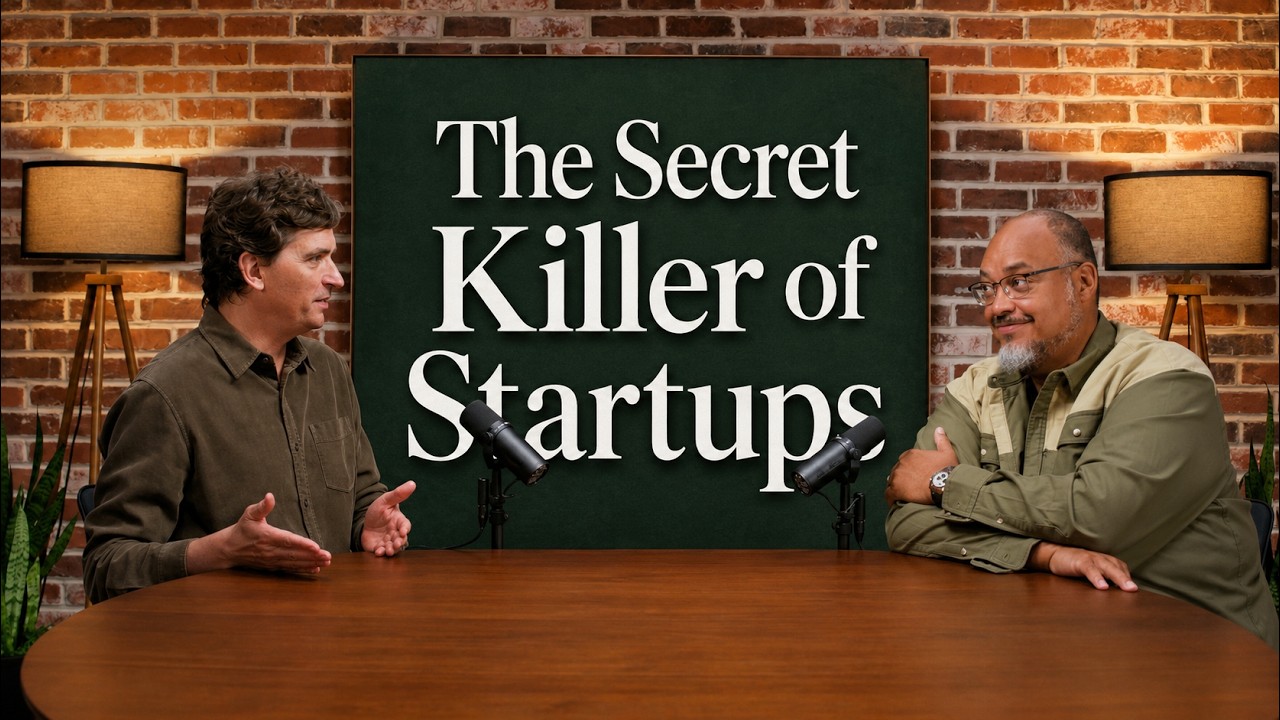
Today we're going to talk about the thing that I believe is the secret killer of startups. And it's not what you expect. It is low ambition. We work with a lot of startups. Let's talk about ambition. And let's talk about what happens when we work with a company that has low ambition. It is extremely counterintuitive because you're >> like, man, I've heard from the world and I've heard from these guys how hard startups are and like only a tiny percentage of people succeed. >> Therefore, >> let me try to like increase my odds of success by aiming way lower.
And if I try to just build like a small little startup, that's going to be way easier than trying to build the next Google, which sounds very hard. >> Yes. >> Right? >> Yes. >> That sounds intuitive, right? But our evidence um suggests that is not the case. Also, it's not creative. This is actually what pains me the most about this thought. It's not unique. Yeah. We're making a video about it. >> Like yeah, you're not the first person to come up with this insight. >> If this insight worked, you would see so much success.
The fact that you don't see it, like this is why I hate first principles thinking sometimes. It's like the fact that there's no evidence to support this is damning evidence. >> it would be like, well, Michael, there's lots of small businesses that aren't venture funded that are >> That's great. Yes, but there aren't a lot of venture funded small businesses that make anyone any money. >> Correct. >> And we've had decades to to experiment. >> That's >> Yeah, so I guess the I guess to steel-man the opposing point is that >> Okay, well, then I guess I should not raise venture capital if I have low ambitions.
And I think we would say, "Yeah." >> Sure. >> I think point granted. >> There it is. >> Yes. >> Almost nothing in this video we're going to talk about is relevant to a un-venture funded company. >> Fair. >> But if you are going to raise money >> Yes. >> of any sort at any stage >> Yes. >> um being low ambition >> toxic >> bad. >> One of the so weird about being low ambition is it goes in the category of things that you'll almost never get feedback on.
So, it's like when you go to a VC pitch, like that no one's going to be like, "You know, this like you're just not brave enough." Like it's just like it's almost weirdly insulting to tell someone. And so, like you might get weird feedback like, "Well, you're not how you don't have enough users or this, your TAM's too small." And and the reality is the world doesn't change enough if you win to be interesting. >> Yeah, almost like the way I would try to frame this for you all is if you're going to do something hard all the odds are stacked against you and you there needs to be a lot of invisible hands that lift you up and pull you forward of people that see what you're doing >> Yes. >> and try to help you perhaps irrationally. >> Yes. >> And there are way more invisible hands pulling you up if you're doing something really ambitious and exciting >> Yes. >> than if it's just like ho-hum, who cares. >> Yes. >> The faceless army is not going to help help you. >> Well, it's weird because it's almost like the world wants big new things. >> Yeah. >> The world wants it.
Like it's like entropy is really working in your favor. Weirdly. >> If you have a big dream, most people will respect you for having a dream. >> Yes. >> And if there's small ways they can help you on your personal journey, >> Yes. >> they will do so. >> Especially if that dream clearly makes the world a better place. >> Yeah. >> This must be some weird aspect of just being human. >> Yeah. >> Where like you just kind of want the world to be a better place.
You want to help people >> someone and they were like, "Michael, my goal is to eradicate cancer. I want there to never be cancer again. No one should ever get cancer." A, okay, great. Like again, I would I would be like really excited to >> Exactly. >> Yes. >> I would have questions. Oh, well, how are you going to do it, you know? >> Sure. >> Um, but man, what a cool mission. >> Yes. >> But if I met someone and they're like, "Michael, my goal is to improve click-through rate of ads by 0.05% that are rendered on mobile through the use of novel AI." >> Again, might be a might be a business, but much harder for that to stick in my mind of of um a mission or a vision that I'm super excited about. >> Well, and let's be clear.
Yes, and there are many software examples for that, too, right? In my mind. So, let's not just use health healthcare, I think it's easy, right? Like cancer, but like hardware / software examples, self-driving cars. Software example, like What? >> Yeah. >> Like the AI products that are giving people superpowers. >> So, when Gmail came out, I believe Yahoo Mail gave you something like 10 megabytes of storage. >> you had to pay.
I think default free was like three or something. >> Yeah. And then Gmail was a thousand. >> Yes. >> And that was on purpose. It was it was a hundred X better than the alternative. >> Yes. >> And so for a lot of products, we would always recommend uh to YC companies trying to be a 100x better >> Yes. >> is like the bar you should be going for. If not, why bother? Why bother making something that's 2% better than the alternatives? >> It's really hard to convince founders that this secret hand is working in their favor.
And like it's something that we've seen in hindsight, right? Like the number of secret hands that were helping OpenAI. >> Right? >> Many. >> And I think this is something that I personally learned from Sam, which is that basically it's like you can tell people these stories about how you're going to do this thing that's going to make a lot of money without having this little impact, and like they might actually believe you.
They just don't care. And like what's weird is that like to win, you need a lot of people to care. You need customers to care, you need investors to care, you need employees to care, you need co-founders to not leave. Like you need care. >> Care. >> Yeah. >> The more ambitious you are, the more you want to make your customer life a better place, the world a better place, the more people have reason to care. And that caring is a variable you get to control when you pick your idea. >> Yeah.
I I don't know if this will resonate for you, but I almost think of a startup or any organization as like a battery or a flywheel or an engine. >> Yes. >> And you want it to be so strong >> Yes. >> and have so much velocity and torque that it can pull forward all of these different people, all these different customers, all these stakeholders because of just like the strength of this thing. >> Yes. >> And if the the core engine is weak and doesn't have much torque, nothing is going to happen. >> Yes. >> Because you're having to pull You're having to pull the world a different direction. >> Yes. >> And so a very ambitious idea, a very ambitious approach into what you're doing.
Has the shot, it has the horsepower and torque to to pull something forward. >> I want to add to that. You don't know how many times other people pitch your company. Right? So, when you have that hero or that a champion inside of a company that you're selling to, they have to go pitch their boss and their co-workers when you're not in the room. When you're raising money, that partner you're talking to, they have to pitch their partners and their LPs, right?
The employee, they often have to pitch their parents, >> Yep. >> their spouse, their friends when you're not in the room. How good of a pitch you giving them? >> Right? >> Are we changing the world or are we optimizing click-throughs by 1%? >> Yeah, I um I met Elon in like 2008. That's like the only time I ever talked to him. >> Yeah. >> And in the first 30 minutes of talking to him, he told me the following line, "My goal is to die on Mars, hopefully not on impact." Clearly he uses that line a lot. >> Yes. >> But it stuck in my mind when I met him as >> Almost 20 years. >> what an interesting ambitious person and he made a big impact.
You know, again, like I I certainly remember the time I met Elon Musk and that was way before he was, you know, famous the way he is now. >> Yes. >> And that simple story that is that ambitious and clearly he just told everyone that. Like it wasn't that I was special. He just walked around life and would tell that to every person he would talk to. And I'm arguing that's how you manifest >> Yes. >> the kind of stuff that he manifested is he would say crazy provocative things, he would back them up, >> Yes. >> and there were all these invisible hands of people, you know, he would just keep putting that story out there >> Yes. >> and got people to work for him, he got people to give him money, he got people wanted him to win. >> And like I think that like what sucks is that sometimes the press and like history can turn all of these stories into like the big man.
Like, oh, and then he hand-built the robot. He hand-built the rocket and he welded and it's like all of these are team games. >> He told people a story that they could believe and sink their teeth into and and devote their lives to that vision. >> they joined his team. And even the people who didn't work there were still >> Who's buying the stock? >> Exactly. They're still part of the team. And so it's so weird to think that like >> I'm telling the story.
I'm part of the team. >> the team, exactly. Exactly. So it's weird to think of these people that are held up as these individual greatness people who really their skill was building the largest teams. >> Yep. >> Their skill was understanding having high ambition allowed them to build the most exciting largest team and that team would power them to fulfilling the ambition. You know, I I come from politics world way back in the way.
Like, you know what that sounds like to me? Obama. Right? And it's like we're going to get a black guy with the last name Hussein to become Or middle name, sorry. Like we're we're going to we're going to need a team here. WE'RE GOING TO NEED A POWERFUL TEAM. And I think that, you know, a lot of people talk about great companies are movements. Like so hard to build a movement off of improving click-through rates by 1% by using AI. >> Yep. >> And what's sad and unfortunate is that you will if you have a good, you know, if you have decent co-founders, you go through YC, blah blah blah.
You'll be able to raise a seed round. Right? Like if you do yada yada amount of revenue, you're probably going to raise a series A. But no one's going to tell you in the back of your mind like, yeah, after that no one's going to care. And you need people to care. >> Yeah. >> So let's put this in the context of AI, because like hilariously I think I would have assumed with AI ambition would have gone away up. But this whole talk of like single-person company, like I don't just there's some stuff in the ether which in my mind is like making Sometimes I feel like ambition's going down.
And I I What do you see there? >> think it's because we're in a market cycle. If the way you're keeping score is what's raising money, >> Yeah. Yeah, that's a good point. >> to get weird ideas. Cuz remember in in 2021, all sorts of stuff was raising money. Think about all the unicorns. Every every 24 hours there'd be a new unicorn minted. And you'd be like, "Wow, I can't believe Remember Cameo was a unicorn?" Like, "Oh, I can get, you know, C-list celebrities to say stuff.
That's the future." Again, actually I like Cameo, but that's It It was probably not the most ambitious idea in the world. >> No. >> Um and so if you're keeping score on what's raising money, you can get really warped ideas about what good is. >> Yes. >> Um and I'm I'm just trying to argue this is going on in AI land. It's like kind of like everything's getting funded. >> Yes. >> And so you're like, "Oh, yeah, I guess I guess my like 15th version of the same thing that other people have done is a good idea." Tricky. >> Tricky. >> No, it's it's definitely interesting as well because ambition high ambition doesn't mean the road's going to be easy.
It doesn't mean that you're going to be popular especially early. >> That's a great segue. Let me give some specifics because I think you could be watching this video thus far and be like, "Man, I should just pitch some like really crazy sci-fi ambitious stuff and like these guys will think that's really smart." >> Um not necessarily. So let me let me give the nuance. >> to kill Nvidia. >> Yeah. The ambition has to be combined with a simple pitch >> Mhm. >> and a pitch where the logical leaps you are making are intuitive and that you are credible at making those logical leaps. >> Yes. >> Okay?
And so, when Elon was talking to me about dying on Mars, I at that time he was running Tesla, he knew a lot about hardware and in my conversation with him, he talked about all the ways that like NASA was underperforming. So, actually there was quite a bit of substance in my conversation with him about how he was going to actually do it and his argument that the thing that was holding back space colonization and exploration was institutionalized slowness because it was run by the federal government. >> Yes. >> So, he had a whole There was a lot there, guys.
Um and that is how you make a credible pitch. >> Yes. >> When we heard Sam pitch OpenAI, he actually knew the researchers that were doing the work and were recruiting them to work on it. >> Yes. >> was all based on papers that were coming out that were being written. Yes. It wasn't Sam just being like, "Oh, I'm going to make magic AI. Give me money." >> No. >> There was a whole lot of substance there. >> Yes. >> And so, if you're watching this and you're trying to triangulate what, you know, Dalton and Michael are saying about Ambition, you have to root it in things that you know about and make very simple low leap of faith arguments on how you'll be able to do it.
That is so important for Ambition. >> I love that. But I want people to understand that that might not be as hard as you think. Right? Like AI wasn't the buzzword it was it is today 10 years ago. Figuring out who the leading AI researchers was was a was a question of curiosity. It wasn't a state secret. Figuring out what the leading papers were was a question of curiosity. Like I'm not saying that Sam isn't incredibly talented.
I'm saying that like understanding how broken NASA was was a question of curiosity. >> Yes. >> Like there >> SpaceX the the NASA people always like this will never work. Like like he had naysayers out of the gate which was the actual experts being like this is the stupidest thing ever the whole time. >> So I think that like you know, most people who are watching have the ability to be curious about an area um that seems perhaps far-fetched, but if it went the right way could change the world and you might be surprised because right now it might just not be sexy.
It might not be in the zeitgeist, but that that might actually be a good thing. >> Yep. >> Like that might be your opportunity where else building the 17th AI SDR >> Yep. >> might raise you your $2 million seed round, but like >> Well, and in both of these cases, maybe you can think of others, it involved disagreeing with authority figures and conventional wisdom. >> Yeah. >> Like it basically required looking dumb. >> Yeah.
Yeah. >> To experts. >> So you would need the combination of a credible argument that you could explain and sit down for half an hour and like walk through all the pieces. >> Yes. >> And have it be an idea that has been discarded by experts that it will never work. >> In fact, you know, we're talking about the difference between being ambitious and being a scenester. >> Yeah. >> I think these are some of the tests, right?
I think you know, we kind of think about a scenester as someone who wants to play the game of startup but not actually do anything, you know? >> Correct. >> Their their ideal is to be on a panel with you and Musk not to change the world. >> Yeah. >> And I think a scenester would be one very afraid of being looked down upon by experts. They want to be embraced by experts by day one and I think a scenester is afraid of ideas that aren't sexy. >> Yeah. >> They want to be part of the zeitgeist immediately.
And so, I think when thinking about trying to work in a company with high ambition, you have to be careful, right? Like, you want to make sure you're not working with someone who's pretending to be high ambition. Maybe the last piece of advice on this front, imagine that we're talking to a founder and he's like after they're like after hearing this, but I don't know if I have this level of ambition. What What do we tell them to do?
Yeah, so this is again might be >> surprising advice from us, but to the extent that you have no idea how to make your startup ambitious, it might actually be more fun and fulfilling to go work somewhere where that is not the problem of the organization. >> Yes. >> And then maybe it'll come to you later, right? There's a lot of people that worked at very ambitious places that end up I mean, a whole string of ambitious ideas later. >> Yes. >> But it's not obvious spending your time working on a low ambition startup idea for years is like actually a good idea. >> You know, I'll try to coin a new phrase like ambition pilled, right?
Like we've certainly worked with founders who have been inside of companies and seen what a company can do. And be like, well, if this company can do this, like I can make a company. And it's crazy sometimes when you meet, you know, talking to a founder who was involved in figuring out like how to make um Starlink work. And you're like, can you imagine just working in a company that's like, well, we're just going to put all the satellites up and have global internet.
And then they did it. And then you're like, oh. Wow. >> I I think the way I would riff on this is basically we've seen so much wacky stuff work because of our jobs. >> Yes. >> We're extremely convincible. >> Yes. >> And part of our um value add as investors was to be like, "Hey, we've seen a lot of people make stuff like this work. You should definitely do it." >> Yes. >> And that is helpful >> Yes. >> to hear from someone that is an authority figure to be like, "Hey, this This sounds as crazy as other stuff I've heard working you should try it." >> Yes.
Yes. And I think people will find that surprising. I think they would expect us to be like, "Well, but if it's a B2B SaaS thing for this and da da da da it's more likely to get funded." And it's like that's not really our KPI. >> No. >> Like whether it can raise a seed round is not the KPI. Um like whether it can actually make a big difference in the world. That's really Those are the companies you care to be helpful to. >> And when you have limited time all you're doing is searching for those companies. >> So, if you're watching this, one, you have our permission as the authority figures obviously to have as much ambition as possible and to make the world a better place.
This road's going to be hard regardless so you might as well make the world a better place. If you're concerned by your level of mission, go work some place with high ambition. And like you're you you can be ambition-pilled and like we've seen it all the time and we certainly see so many founders who come through after working at a place like that and they're like, "Now I'm confident I can make a big difference, too." And then last but not least, do not be fooled by the scene-sters, by the fake people out there.
If they have the tagline that you mentioned with Elon and then have no backup in the Right, it's like if the first minute of the conversation's good and the next >> Yeah. >> 29 minutes you're like, "Oh, this person seems maybe move on." >> Yeah. May- maybe my final parting thought is if we call back to the tarpit concept which you and I have talked about before >> Yes. >> the ultimate meta tarpit >> Mhm. >> is getting caught in a low ambition idea that you know in your heart can never be big.
You know in your heart you're not even excited. >> idea. >> You don't even You're like, "I You're going through the motions explaining it to people. If you burn years of your life on something that you think is a waste of time in your heart of hearts that is a true tarpit. >> That is a true tarpit. >> You got to get out of there. >> I love that. That that is the meta tarpit. Oh, man. >> All right. Great chat. All right.
Thanks, Michael.
The words are the caption track's own and nothing is reworded or re-transcribed. Paragraph breaks are placed between sentences so the text reads as prose.
Free tools for your own script: paste a draft and see where it stands before you record it.
Paste your draft and see where viewers are likely to drop off, with a rewrite for each weak line.
Paste the first 30 seconds of your own draft for a hook score and rewrites.
Check your draft against YouTube's advertiser-friendly guidelines before you record it.
Read this channel's public videos and transcripts, and download a writing brief for it.