Getting the transcript
Reading the captions from YouTube. A video nobody has opened here before takes 10 to 30 seconds; this page fills in on its own.
Getting the transcript
Reading the captions from YouTube. A video nobody has opened here before takes 10 to 30 seconds; this page fills in on its own.
Dalton + Michael · @daltonplusmichael
This video has no Most replayed graph yet: YouTube shows one only once a video has enough views. These are the moments viewers replayed most in Dalton + Michael's most watched videos.
Most replayed moment at 9:40
2.3x that video's typical replay level
a company is winning, you might not understand the value they create for their customers, but don't dismiss it to zero. >> Well, that's the classic thing of um dismissing a product because the design is bad. >> Yeah, man. This HRS looks like crap.
Said at 9:33
Most replayed moment at 9:46
2.1x that video's typical replay level
of founders is, "What do you think is the failure rate for a series B company?" Because like I think in their minds before I ask the question, they think every series B company wins. And then after I ask it, they're like, "I guess mathematically that wouldn't work."
Said at 9:40
Most replayed moment at 14:24
2.8x that video's typical replay level
it is hard to feel like you're working on something where a lot of people think it's a bad idea. That's hard. And I like talking about this because you should brace yourself for that. Like, that is 100% the experience of
Said at 14:17
The graph counts replays. It does not show where viewers stopped watching.
Words
4,303
Runtime
22:47
Speaking pace
189wpm
Reading time
18min
189 words per minute, between the 181 median and the 201 75th percentile of 349 measured videos. That distribution comes from the 349-video hook study.
Opening (first 30 seconds)
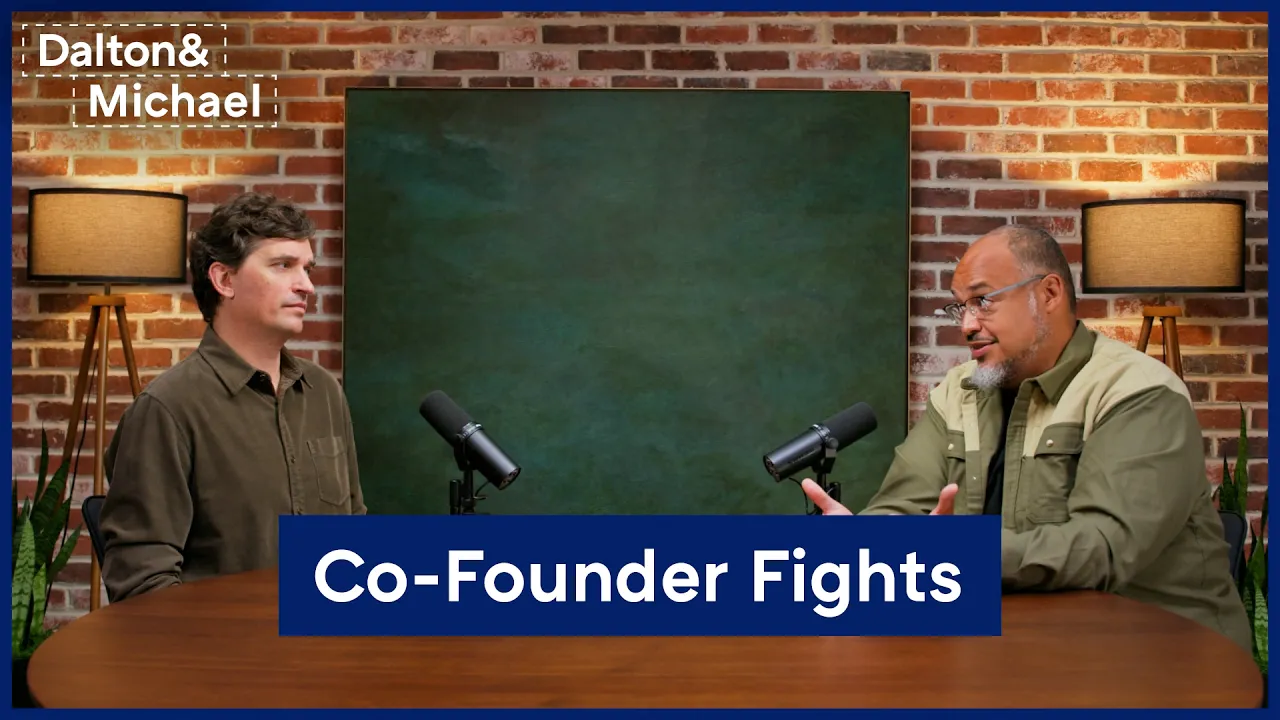
I think a lot of founders have heard horror stories about co-founder breakups and their takeaway is like, oh, I'm a genius. I'm just not going to have a co-founder. Oh, I fixed the problem. >> [laughter] >> I pre-fixed the problem. It's the best sort of thing. This is Dalton plus Michael and today we're going to talk about co-founder fights and co-founder breakups. We have a lot of experience in both of these. >> [laughter] >> Should we start with breakups first or fights first? Where where where do you want to What's
95 words, the words spoken in the first 30 seconds at 189 words per minute.
Free, no signup. See how the first 30 seconds hold attention, with rewrites.
Sentence shape
| Measure | This transcript |
|---|---|
| Sentences | 345 |
| Average words per sentence | 12.5 |
| Longest sentence | 88 words |
| Questions asked | 35 |
| Sentences containing a number | 7 |
Most used terms
Filler phrases
150 in total: like 91 · you know 16 · um 12 · right? 11 · kind of 6 · sort of 5 · basically 4 · actually 3 · I mean 2.
A literal whole-word count of the same phrase list the Prepublish browser extension uses, so a phrase inside another word is not counted and a phrase used in its ordinary sense still is. It is a count and not a judgement.
Run the check on the words above: where attention is likely to drop, with a rewrite for each weak line. The free check shows the scores and the one issue costing the most.
What this transcript is
Every word below is the caption track YouTube publishes for this video, pulled from the video itself and reproduced unchanged. It is not Prepublish's writing, not a summary, and not a re-transcription: it is the video's own published captions. English captions, generated automatically by YouTube, in the video’s original language. Source: the video on YouTube. A channel that would rather this page did not exist can ask for its removal through the contact page, and it is removed.
I think a lot of founders have heard horror stories about co-founder breakups and their takeaway is like, oh, I'm a genius. I'm just not going to have a co-founder. Oh, I fixed the problem. >> [laughter] >> I pre-fixed the problem. It's the best sort of thing. This is Dalton plus Michael and today we're going to talk about co-founder fights and co-founder breakups. We have a lot of experience in both of these. >> [laughter] >> Should we start with breakups first or fights first?
Where where where do you want to What's logical? Let's start at the beginning. Um co-founders, okay. What do we even mean by co-founders? Yeah, so traditionally when you start a tech startup, yes, you don't do it by yourself and if you look to history of how a lot of the biggest companies started, um they tended to have co-founders. I guess there's examples of families I'm thinking of non-tech companies where you started with your family.
But usually there was, you know, another person like the canonical Steve Jobs >> [laughter] >> Steve Wozniak, it was it was two people. Maybe to start by addressing that. I think a lot of founders have heard horror stories about co-founder breakups which we're about to talk about in a second. >> Yes. >> And their takeaway is like, oh, I'm a genius. I'm just not going to have a co-founder. Oh, I fixed the problem. [laughter] I pre-fixed the problem.
It's the best sort of thing. And it's like, man, you guys sure spend a lot of time talking about co-founder problems. >> Have you even thought of my genius? >> a genius. Um >> [laughter] >> Well, again, let's address that. Let's let's steel man that argument. It is true that if you remove a co-founder, [laughter] the odds that you will get in a co-founder dispute dip to zero. >> Yes. >> Clever. >> [laughter] >> However, there are many things in life where I think they're a good idea, but they involve taking a risk and they don't have a 100% success rate. >> Getting married? >> Sure. >> Having kids? >> Kids who like you? >> [laughter] >> Yeah. >> Taking any kind of risk?
I don't know, putting yourself out there, starting a company. >> Sure. >> Starting a company, yeah. Starting [laughter] a company is very risky. It does not 100% chance of success. >> Therefore. >> Therefore, don't do anything. [laughter] Don't do anything if you want to avoid problems. So again, to be very specific, the number one cause of death when you're a founder is it just sort of dies on the vine and you run out of hope and you give up on it. >> Losing the faith. >> And the issue of not having a co-founder is you don't have anyone to talk about and you don't feel like you're on a mission, you don't feel like you're on an adventure. >> Yes. >> Not having a co-founder is fine for a lot of people.
So again, I don't want to get turn this into a debate where we say >> But pooling the faith >> is is very helpful and the numbers don't apply about this. The outcomes are there. >> So I love this setup because what we're the reason why we're making this video is not to convince you that the answer to the SAT question is don't have a co-founder. >> Don't take the SAT. >> [laughter] >> We're like, the SAT is hard, don't take the SAT, Michael.
That's the >> The reason why we're making this video is that doing this thing that we think you should do, we're going to give you some hints when you hit some rocks. And maybe let's put a final point on the why you should have a co-founder bit. >> Yes. >> Let's put it this way. We know a lot of the single founders that have been successful as well >> Yes. >> and sometimes we funded them at YC. >> Yes. >> All of those people created co-founder-like >> relationships >> environments and relationships that did fill the void.
So whether it was employees, whether it was advisors, whether it was friends, there is no way you can get around not having someone to talk to all the time to bounce ideas off of. >> No, right? >> Anything to add there? >> And I feel like those stories are just like because they don't make the headline story, they're not told. >> Yeah. >> But I completely agree with you. So, what happens when you are fighting with your co-founder?
In my experience, there are two realities. You are friends with this person or you're not friends with this person. What I have found is when you are friends with your co-founder, there will be something in the startup that happens that will frustrate the hell out of you, and you will have a particularly harsh thing that you want to say, but because you're friends with this person, more often than not, you're not going to say it, or you're going to put it slightly differently, or you're going to ask yourself, "If I were on the receiving end of this, would this motivate me or not?" Unfortunately, when you're not friends with this person, sometimes it's easier just to boom, boom, fire, fire, and then that can create problems. >> Yeah. >> That can create real problems.
So, that's probably the first thing that I see with a co-founder fight is when it's initiated stupidly, right? Like, you're going to have to fight about some stuff, but it's just like, can we avoid the dumb ones, >> [snorts] >> you know? Like, "Oh, these guys raised money, why couldn't you go raise money?" So, I think that's a big one. Where else are you seeing co-founder fights? >> The biggest root cause is that you end up getting into the relationship for the wrong reasons.
And so, for better or worse, I can't help but think that all human relationships are fundamentally similar in some ways. >> Sure. >> Not always. >> For sure. >> But, you know, if if you end up getting thrown into a pretty intense experience with a complete stranger, and you've taken no time to understand the other person, the chances that you'll have a disagreement are pretty high. You just don't even have the same context. >> Yes. >> Um and so, the biggest issue I see is that they don't even It's like strangers trying to navigate the beginning part of a relationship, and then it sort of dawns on them, "Oh man, this person's a stranger, and I got into this relationship for the wrong reasons." >> Yes. >> Um and I'm mad at myself.
Let me do some lashing out. >> And so, what that looks like in practice is you can't even agree on really basic stuff such as the name of the company. >> Sure. >> Such as what idea are we working on? Such as what should I be doing with my time and what should you be doing with your time? >> It's interesting cuz like there's almost no basis for there being trust. >> Yeah. >> And if there's no trust, we can fight about anything. >> [laughter] >> Just just throw something out there. >> Forever. >> [laughter] >> You can have endless arguments about everything. >> [laughter] >> And especially cuz you're the boss or like everything's on the table. >> Yeah.
[laughter] >> So no, I totally agree with that one. I think another thing that was a misconception that I had was that each co-founder is going to add an equal amount of value at all times. And I see a lot of resentment build up when somebody feels like oh, I'm grinding and my co-founder's not. As if like we're all working on the car factory line and anyone who's not working that the cars aren't moving through. It hasn't been my experience things are always exactly that way.
Well, what's been your experience? >> Yeah, I mean there has to be a mutual respect. >> Yes. >> And what happens is there's all these superficial things in an office hours that someone will want to talk about and then you just keep digging and digging and digging and digging and at the bottom is I don't respect the job or the thing that this person is doing. >> Mhm. >> And that it doesn't really matter what all the upper layers are.
It's pretty hard to fix that if at the core is a is a lack of a mutual respect. >> One of the things amongst friends that can create that respect is I feel like I'm working hard and I don't feel like you are. And it was funny in in my first company, we had four co-founders. And looking back, what I tell founders a lot is at any given time, I think we had two and a half co-founders. And, you know, that means like one and a half people were probably not engaged in the core thing moving the company forward. >> At that time. >> And only over years did I kind of see how that all balanced out.
And it wasn't always the same one and a half people. >> And this makes me [laughter] think of like a another point we touched on a minute ago, but look, man, just like relationships, >> yeah. >> everyone else's is different. And if you try to stand in judgement of how other people made it work, >> yeah. >> you're wasting your time. >> Yes. >> And so some people will be like, "Michael, you were four founders and, you know, you had Emmett and, you know, blah blah blah, you know, that has nothing to do with my >> start-up." >> It's like What what what I'm going [laughter] with this is you're right, that is different. >> Yes. >> But it worked for them and you built Twitch.
You built an enduring thing that still lives on and is bigger than all of you guys. >> Yes. Yes. >> And so if you want to build a big company that's bigger >> than >> than all of you individually, don't assume you could just blindly copy or cargo cult another person's playbook and it will necessarily work for you. >> Nope. >> And so to me, the biggest learning from your co-founding experience is you guys made it work versus you must have four co-founders and they must be this and you must act this way. >> No.
No. >> Right? >> No. >> So, let's move into it's not going to work. I think there's an interesting transition between co-founders fighting, which I think, you know, is going to happen, and co-founders fighting that when we're talking to them, we know >> Yeah. >> they're going to break up before they break up. We know the trust is destroyed. I think that's a really important time in a startup because I I always fear with startups like when you really know the probability of success is zero, most important thing is to stop wasting time.
And you know, sometimes I see people living in this like we haven't decided we're going to break up yet, but obviously >> Yeah. >> [laughter] >> But like everything is dysfunctional, it's not going to get repaired. And it's like, can we get through that phase as quickly as possible? [laughter] Like >> Yeah, I mean, what this looked like to me in office hours with a with a YC company is they would want to meet with me without the other person. >> Oh my god. >> basically want to present some facts about why that person >> about why Yeah.
And so >> kind of what I learned to do after many years of this is to say the facts don't matter. I'm not the judge and jury. You don't need to present the case to me. If you don't think it's going to work and it's bad enough such that you're trying to meet with me and present facts to me, that sounds pretty bad. I think this is pretty far gone. And so counterintuitively, I think, I'd be like, let's not talk about the facts.
It doesn't actually matter. Let's just try to create a go-forward plan that is the most positive for all parties involved to not work together anymore. >> Yes. >> So that everyone feels good about how they were treated, they feel good about the process. >> Yes. >> There wasn't a lot of like legal threats or problems. You just go your separate ways and there's not like um permanent toxic waste in the relationship. You're just like, cool, we're just going to go our separate ways and everyone is going to be okay with it. >> Yes. >> Um that's what I learned to do.
And it works a lot if people are super professional and adult about it. >> I think the thing that always frustrated me when giving >> [snorts] >> office hours on this topic was how unhelpful third parties can be. >> Yep. >> Um you know, co-founder breakups extremely common with pre-product market fit early stage companies, right? Another way of saying a pre-product market market early stage is like it has created no value.
So, like the stock that you have is worthless. >> Correct. You have nothing. >> And so, in a situation where you're having a co-founder breakup and the stock is worth nothing, paying lawyers a bunch of money makes no sense. >> It's idiotic. >> Well, you're fighting over nothing. You're fighting over ego. >> You're spending >> money >> [laughter] >> over nothing. I don't mind if you fight. Can you just also not spend money with your lawyers to fight? >> And, you know, the lawyer is trained well, there's a 0.00000001% chance this becomes Google. >> Yeah. >> And so, you need to fight like And it's like, sorry, when when there's infinite zeros like after the decimal point, it means there's no chance it becomes Google.
It means you're fighting over something that's nothing not worth anything. And the problem is is that a lawyer can suck up infinite amount of your >> Yep. >> anger and monetize it. It makes me feel dirty just saying that out loud. >> That's what that's That's the the service provider. Oh, the client wanted services, which is to write mean letters to the former co-founder. >> [laughter] >> That's a service. >> And I I will provide it. >> Yeah. >> And so, the number of times I then see founders in a situation where it's like, "Oh, crap.
Like, not only are we in a deeper fight, but we now have like debt." I've seen situations where an individual founder is leaving has debt >> Yeah. >> on a on a company that's not worth anything. >> Yeah. >> And like, man, I hope your feelings feel better cuz like your bank account is going to suffer. So, a lot of what we've tried to do at YC is kind of create like a basic framework to deal with these breakups. And like, what I love about giving these off hours is you know, at YC, we have these written down. >> Yep. >> So, like I you know that I didn't I'm not taking a side.
I didn't invent this. Like, you can post fact check me. Jesus. You can post fact check me and like you know I'm going to tell the exact same thing to the other co-founder cuz it's also written down. >> Yeah. >> And maybe we should talk about some of these standards, some of these like, "Hey, how a co-founder breakup should go." >> So, again, just start with the way it should go is sort of no fault from both sides. >> Yes. >> And so, again, unless you catch them committing a felony, okay, that's that's a outside the scope of this conversation.
But, for the most part, make it no fault. >> Yes. >> Don't try to ruin the other person. Don't try to ruin the reputation. Don't try to contact the investors and all this other crap. So, make it no fault. >> Yes. >> Optimize for cleanliness for both sides. So, that requires the least amount of mental angst and anger to separate ways. Make it so that you don't say things you can't take back. >> Yes. >> Preserve the ability to interact with them in the future and the employees.
You know, keep your mouth shut basically. Both parties should. >> Yes. >> And then, vesting is good. Hopefully, you have vesting. Vesting protects both parties in this case because it makes it cleaner to separate. >> Yes. >> I think that oftentimes what we tell founders is that if you're pre-product market fit and the company's going to continue operating and you're the leaving party, you have to understand that the vast majority of the value this company could create hasn't been created yet. >> Yep. >> And so, regardless of your vesting, um you need to make sure that that company has as much equity as possible to motivate the people who are there, the people that might be hired to come create value.
I often talk to that person first and I basically I'm saying, "You get to go and live your life and that company, if it ever creates value, you're going to get some money for it, even though you don't have to contribute to it anytime. Like, you get to hedge. The founder staying doesn't. Make sure the founder staying has as much incentive as humanly possible to try to make that thing valuable. >> [laughter] >> Because >> Well, and again, it reminds me of the the lawyer thing, which is legal advice or certain types of advisers will be like trying to help you craft the ways to maximally screw the other party and extract every penny of value.
And basically, just like scorched earth the situation. >> Yes. >> And guess what? They will take your money to go do that. >> Yes. >> And then their reputation does not suffer because they are lawyers. >> Nope. >> Whereas you are still you have a career and everyone will remember you from doing the scorched earth thing. And so, I would encourage people to think about this as like a game theory infinite games situation, which is if you handle this unremarkably in a good way, like if you do if you're unremarkably, it's like, "Oh, yeah, I worked we we worked together, it didn't work out.
I went and did my own thing and it was no big deal." Very good for your career. >> Yes. >> But being known as the super litigious scorched earth person, you're never going to work again. >> Nope. >> And your lawyer's not going to tell you that. >> Nope. >> And so, if you're just thinking about this, this is actually going on your permanent record >> Yes. >> that you were like cool about it and didn't cause a lot of problems and is likely like the most important takeaway from this part, right, man? >> I completely agree.
And I think that for the founder who's staying, I I always try to reframe it in their head because I think oftentimes anyone who feels bad, like the first instinct is to make yourself the victim. >> Yep. >> And I'm kind of like, "Well, that person's leaving and you're staying. So, it's like they probably like you know, like let's not debate victims, but like I you probably don't deserve >> the bigger victim. Let's have a debate, Michael.
Michael, please tell us please take my side >> [laughter] >> about what a victim I am. >> Yes, like what what I'm experiencing, right? >> And what I often tell that person is you have an opportunity to be generous. Um especially like if you've got funding when it comes to severance, like you have an opportunity to make sure that that co-founder who's leaving can get back on their feet, live their life, go move on to the next thing.
And your incentive to do it is one, if this is your friend, like you want your friend to be okay, right? And then two, understand that everyone in your company is looking at you right now. And like this is the person who at least theoretically you trusted the most. How you treat them >> [clears throat] >> will you treat anyone else better? And it is so cheap to be nice. >> [laughter] >> And and it creates so many positive dividends amongst the other people who are staying, but it's very very hard to be nice when you think of yourself as the victim.
Right? When you're the victim then it's like, well, it's that person has what's coming to them. And I would say that if you think of yourself as the responsible party and you act that way, often you don't trigger victimness on the other side, too. Whereas like so often I'll see the lawyers be like, "Well, you better protect yourself because like they might come after you." And you inadvertently the founder who's staying triggers the fight. >> Yes. >> And you're just like, "What are you doing?" >> [laughter] >> We generally tell people, "Hey, even if you vested, like get down to under 5% of the company, if it's within the first year, under 2%.
Do reasonable severance, sign clean paperwork and and peace out, right? Like you could do that whole thing in a week and spend like $2,000. If you're not doing that it's like you're taking a very hard route. Um and I would say that like it's really really important in these fights, just make sure no one's taking advantage of you. Any time you're spending money, be worried that someone's taking advantage. [laughter] >> If there's a Yeah, if there's a service provider >> If there's a bill. >> that is excited to offer you services and there's a bill and they're paid for their time and not >> Mhm.
[laughter] >> Yeah, that's what it is. Yeah. >> Here's my last piece of advice. It comes back to what you were saying before. Who If you're using someone to mediate this, don't make them the judge. Don't make them >> Because it doesn't matter. If you're not going to work together anymore, it doesn't actually matter what happened. It's irrelevant. Right? >> No. And like, come on, it was a startup. The expected outcome.
Like this is the expected outcome. [laughter] Like don't don't treat this like it's Google breaking up. >> Yep. >> When it's not Google breaking up. And I think often times service providers in their minds, they're like company public company. >> And I would kind of bring this back to one of the original points I made it on this one, which is if you handle this well, this is a non-mortal wound. Like part of the reason there's so much I never want to have a co-founder because I heard my friend and this happened to them and blah blah blah blah.
It's cuz it was handled horribly. And if you handle this well, this is a footnote in both of your careers. >> Yes. >> This is a footnote in the history of the company, right? Apple had a third co-founder. Remember that guy? And then they bought him out and then like it was fine. Like the company lived on. And so the better you can handle this, the less likely this is going to be a big deal >> Yes. >> in your life. >> The more likely that you and your former co-founder will still be friends.
Yeah. So, the quick takeaways. Don't get fooled by service providers. Don't spend a lot of money. Clean paperwork, no fault. If you are pre-product market fit, even if any of the founders leaving, even if you vested a lot of stock, you should probably willing to give a lot back. Um and if you're leaving in under a year, even more so, right? After a number of years, 5% typical. Under a year, 1%, 2%, sometimes less than 1%.
And when you're the leaving co-founder, understand that you want to motivate the team that remains to make that stock worth something. Yes, and you get to go and you get to do something else. If you're the co-founder that remains, understand how you treat this person is how the people around you think they're going to get treated. And don't make your poor startup advisor into judge and jury. On this point, I maybe I'll be a little bit less nice than Dalton.
Like, we don't care. >> [laughter] >> If you made a list of all the things we screwed up in our company, it would be way longer than the things you're pissed at your co-founder about. [laughter] This is your life. And of course, if your co-founder is breaking the law, doing something unethical, killing people, none of this applies. >> [laughter] >> I would call the lawyers. But just just be smart and nice about it and it'll work out.
Great chat. >> All right, thanks.
The words are the caption track's own and nothing is reworded or re-transcribed. Paragraph breaks are placed between sentences so the text reads as prose.
Free tools for your own script: paste a draft and see where it stands before you record it.
Paste your draft and see where viewers are likely to drop off, with a rewrite for each weak line.
Paste the first 30 seconds of your own draft for a hook score and rewrites.
Check your draft against YouTube's advertiser-friendly guidelines before you record it.
Read this channel's public videos and transcripts, and download a writing brief for it.