We're Not Ready for Biocomputing transcript
Clarified Mind · @clarifiedmind
Words
2,727
Runtime
15:36
Speaking pace
175wpm
Reading time
11min
175 words per minute, between the 160 25th percentile and the 181 median of 349 measured videos. That distribution comes from the 349-video hook study.
Opening (first 30 seconds)
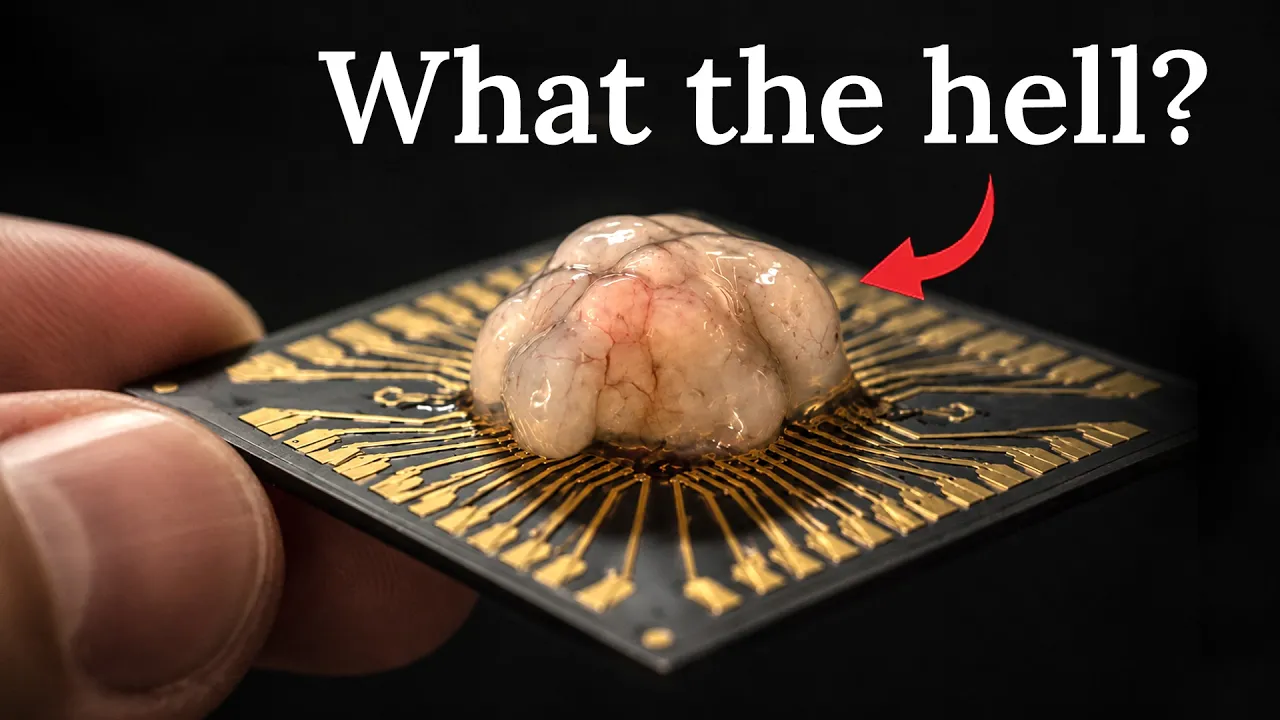
In a few seconds, I'm going to show you one of the most disturbing things happening in science right now, and almost no one is talking about it. That's why we made this video. You're looking at a computer in a laboratory called Cortical Labs. It's playing Doom. But look closer. There's nobody playing it. Or actually, there is. They just can't get out. They are trapped there because this computer is running on living human brain cells, and those cells are the ones playing. So, why would
88 words, the words spoken in the first 30 seconds at 175 words per minute.
Sentence shape
| Measure | This transcript |
|---|---|
| Sentences | 213 |
| Average words per sentence | 12.8 |
| Longest sentence | 41 words |
| Questions asked | 7 |
| Sentences containing a number | 19 |
Most used terms
- music28
- cells26
- brain22
- neurons15
- computer12
- gt12
- living12
- real12
- playing11
- human10
- actually8
- dish8
Filler phrases
32 in total: like 11 · actually 8 · basically 6 · kind of 6 · literally 1.
A literal whole-word count of the same phrase list the Prepublish browser extension uses, so a phrase inside another word is not counted and a phrase used in its ordinary sense still is. It is a count and not a judgement.
What this transcript is
Every word below is the caption track YouTube publishes for this video, pulled from the video itself and reproduced unchanged. It is not Prepublish's writing, not a summary, and not a re-transcription: it is the video's own published captions. English captions, generated automatically by YouTube, in the video’s original language. Source: the video on YouTube. A channel that would rather this page did not exist can ask for its removal through the contact page, and it is removed.
Transcript
In a few seconds, I'm going to show you one of the most disturbing things happening in science right now, and almost no one is talking about it. That's why we made this video. You're looking at a computer in a laboratory called Cortical Labs. It's playing Doom. But look closer. There's nobody playing it. Or actually, there is. They just can't get out. They are trapped there because this computer is running on living human brain cells, and those cells are the ones playing.
So, why would anyone build a computer out [music] of brain cells? It basically comes down to power. AI uses a massive amount of electricity, and that number keeps going up. >> Amazon investing another $15 billion and continuing its massive investments in AI, [music] this time in the form of compute power. >> The computing power it takes to train these models roughly doubles every 6 months. Almost nothing in the real world grows that fast.
But you can't [music] build power plants that quickly. So, there's a growing gap between what AI needs [music] and what we can actually supply, and it keeps getting wider. You can see the panic in what the big companies are doing. They're going [music] after energy now, not just better software. Old nuclear plants that got shut down years ago are being turned back on just to power them. Companies are signing deals to lock up huge chunks of the grid years ahead of time.
It's not really a race for smarter AI anymore. It's [music] turning into a race for electricity. So, a few researchers went a totally different direction. [music] They looked at the brain. Because the brain figured this out a long time ago. Think about what your brain is doing right now, and how little it runs on. Everything you're thinking runs on about 20 watts. [music] We're using whole power plants just to copy a small piece of what your brain does on basically nothing.
And it learns way better than our machines, too. [music] To teach a computer what a dog is, you have to show it thousands of photos. A little kid sees a dog once or twice and just gets it. So, how did we get from that to a dish playing Doom? It took three steps. Back in 2008, researchers grew a sheet of rat neurons and hooked it up to a little robot. And the cells actually [music] drove it around. It sounds bigger than it was.
The neurons just sat flat on a grid of electrodes and connected to their neighbors. That was pretty much it. This was nowhere near a real brain, and it wasn't even the first time someone had wired living tissue to a machine. One team even did it with the brain of a lamprey. The footage always looked a little like a horror movie. And from the start, people had one real doubt. Were the cells actually driving, or was the computer just taking their random [music] signals and making it look that way?
Keep that question in mind. We're coming [music] back to it. The second step came in 2013. A scientist named Shinya Yamanaka showed you could reset a grown-up cell all the way back to the start. He found four proteins that turn a regular cell into a blank, brand new one. And from there, you can turn it into almost anything, including [music] a neuron. That was huge. It meant you didn't have to take neurons out of a brain anymore.
You could just take a bit of skin and grow them. There was another big step, too. If you grow neurons on a flat dish, they only connect [music] to the ones right next to them. But if you let them grow in 3D, they start to organize on their own. They spread [music] out, fold into layers, and form the rough beginnings of real brain regions, kind of like an embryo does. One of those tiny balls of tissue is called an organoid.
Then, in 2022, a company called Cortical Labs put all of this together into something they called Dishbrain. They grew about 800,000 neurons, part mouse and part human, and taught them to play Pong. Two things about this were a big deal. First, a dish of cells was actually working toward a goal. Second, and this is the weird part, they'd figured out how to teach it. They could ask the cells a question and get an answer back.
You're not supposed to be able to do that to [music] a blob of tissue in a dish. So, how do you teach a neuron? You can't give it a treat. So, they used a basic [music] fact about neurons. They hate chaos. If you give them a signal they can't predict, it stresses them [music] out. So, the setup was simple and kind of mean. When they missed the ball, they got hit with scrambled random noise. When they hit it back, the signal went calm and steady.
The neurons have no idea what Pong is. They're not playing to win. They're just trying to make the chaos stop. And they didn't pick that method at random. They based it on an idea of the free energy [music] principle. Basically, it says every living thing is always trying to avoid surprises and keep its world predictable. Because being surprised usually means something's wrong. So, that urge to calm things down isn't [music] something the scientists added.
It might be the most basic thing a living cell does. But, there's a big catch. We can grow brain tissue in 3D, and we can talk to living neurons. We just can't do both at the same time yet. So, in order to talk to them, Dishbrain had to keep the cells flat because the chip that reads them is a flat grid. If you put a round organoid on it, you only touch the bottom layer. So, they had to flatten it out and give up the brain's real shape just to [music] talk to it.
And remember, this is the crude version. Half the design is missing. Which brings us to a big new. Cortical Labs showed off a computer that runs on brain cells. They call it CL1, and it plays Doom. This one was grown from about 200,000 human neurons. They took skin cells, reset them, turned them into neurons, and spread them across a bed of electrodes. Then, they tied the signals to moving and shooting the same way as before.
When it did well, the signal stayed calm. When it took damage or died, the cells got flooded with chaos. And within about a week, it had learned the basics of moving around and shooting. I'm not going to pretend to be calm about this, and I don't think you should be either. It's amazing, and it kind of makes me sick. And I think both of those reactions are fair, because that computer came from a real person. It's literally made of human cells.
I keep imagining what it would be like to be the thing stuck in there, playing the same little piece of game over and over forever, not remembering anything before it, not knowing that anything else even exists. For these cells, there's nothing else, just the game. Are we making a piece of a human being whose whole world is getting shocked inside a violent video game just to save some electricity? For years, we worried about the opposite thing, humans turning into machines, chips in our heads, that whole idea.
Almost nobody expected it to happen the other way around, but that's kind of what's going on here. Now, to be fair, there was a big backlash to all of this, and it was kind of fair. When Cortical Labs published the Pong work, the title used a heavy word. It said [music] the neurons showed sentience. Normally, that word means someone's in there having an experience. But the scientists meant it in a really narrow technical way.
Basically, anyway, the story blew up and a lot of scientists were angry, too. About 30 of them signed a letter saying the company had twisted the word just to get headlines and oversold the whole thing to help the business. The worry was pretty practical. Too much hype leads to backlash and enough backlash could shut down a young field like this. And this research really matters. Scientists use these same cells to build living models of human diseases.
They can watch how a disease develops and test drugs on tissue that's way closer to ours than a mouse's. That could save real lives and replace [music] a lot of animal testing. It would be a real loss if a stunt with Pong and Doom dragged it all down. Doom really was kind of a stunt. The audience asked for it and it made great marketing. But it brings us right back to that doubt from 2008. Is the brain really playing or is the computer just cleaning up random noise and making it look good?
Almost 20 years later, we can finally check. The developer behind the demo, who goes by Sean Cole, released the code so anyone can [music] read it. And what's inside is not just a brain in a box. There are three parts. First, a normal computer chip running an AI that watches the game and decides when to reward and when to punish. Second, the 200,000 human neurons. And third, a translator in the middle passing messages both ways.
Here's the uncomfortable part. Almost all of the actual smarts are on the chip, not in the cells. Reading the screen, running the learning, telling a win from a loss, that's all the computer. The developer was even worried his AI would get so good it wouldn't need the neurons at all. So, he ran a simple test. He took the cells out and replaced them with pure random noise. And the learning just stopped. So, the neurons are doing something real, even if it's a small part.
So, the truth is somewhere in the middle. It's not a brain playing on its own, but the cells aren't just for show, either. It's mostly a normal computer doing the work with living cells adding a small but real piece. That's where we are today. And here's where I think it goes next. I don't think that small biological part stay small. Labs all over are racing to grow this tissue in full 3D and connect with properly. And it's already turning into a business, a huge business.
A Swiss company called Final Spark rents out living human neurons over the internet. You pay a monthly fee, log in from anywhere in the world, and run experiments on 16 tiny human mini brains that they keep alive in their lab. And their whole pitch is the same thing we started with, energy. They say these living chips can run on up to a million times less power than a normal one. So, this weird one-off experiment is basically becoming a product you can subscribe to.
And I believe sooner or later someone's going to connect a full 3D mini brain and close that last gap. But let's go back to that doom machine for a second. Most of the smarts are in the computer, the cells only do a little. So, it would be easy to hear that and just ignore it. But being smart was never the scary part here. Being smart and being awake are two different things. You can be great at solving problems and still not feel [music] anything at all.
So, the real question isn't whether those cells are clever, it's whether anyone's actually in there. >> [laughter] >> And it turns out being able to feel might not need a big smart brain at all. A renowned neuroscientist, Mark Solms, argues almost the opposite of what we were taught. Solms says feeling isn't something that sits on top of intelligence. He thinks it comes first, underneath everything else, and that it comes straight out of the basic drive to stay alive.
Think about what came first in evolution. It wasn't logic or language. The earliest living things weren't solving anything. They were just doing something much simpler and older, moving toward what kept them alive and away [music] from what didn't. So, something like feeling was already around long before thinking showed up. Now, think back to how these cells get trained. Chaos when they fail, calm >> [music] >> when they succeed.
That's the free energy principle again, that same drive every living thing has to avoid surprise and keep itself steady. And if Solms is right, that drive isn't just close to feeling, it might be where feeling actually starts. So, maybe we've had it backwards this whole time. We're not slowly building a mind and waiting for it to wake up at the top, we might be poking at the exact thing feeling comes from, right at the bottom, from the very first moment we turn the dish on.
And if something in that did start to feel, we'd probably miss it completely. We can barely spot it in each other. In 2006, a scientist named Adrian Owen studied a young woman who everyone had given up on. They'd called her vegetative. He put her in a brain scanner and asked her to imagine playing tennis, and her brain lit up exactly like yours would. She was completely awake and aware, she just couldn't move or speak to show it.
And a later study found out that about one in four patients written off like that are actually still aware. So, if we can miss a fully conscious person lying right in front of us, what chance do we have of spotting it in a clump of cells? We like to tell ourselves that feeling needs the right parts, pain receptors, certain brain structures, but even that is shaky. Insects [music] don't have a visual cortex, and they clearly see.
So, feeling might run on parts that look nothing like ours, parts we'd never even think to check. When the noise in the dish gets too loud, the cells turn their response down like they're trying to block it out. Something in pain would do that, but so would something that feels nothing at all. Backing away from a bad signal isn't the same as suffering. And from the outside, there's no test that can tell the two apart.
This is what the philosopher David Chalmers called the hard problem. We can map every single cell in a brain and still have no idea how it turns into an actual feeling. So, let me be honest about both sides of this. Think about what this research could give us. It could help us finally understand diseases. It could replace a lot of animal testing. And all of it comes from a tiny few cells sitting in a dish playing a game that's older than most of the people in the lab.
It looks like nothing, but it might be the start of something huge. For almost the entire history of the universe, there was just matter, and nobody around to feel any of it. Then, at some point, some of that matter arranged itself in a way that did something completely new. It started to feel. We've always thought of that as the rarest thing there is, something it took billions of years of evolution to make. And now we're basically trying to do it again in a lab on purpose.
We take some cells, we wire them up, we train them with calm and chaos, and we watch to see what happens. And don't forget where those cells came from. They started as ordinary skin from a real living person who's still out there right now. We were never really trying to copy human thinking. That was never the scary part. The scary part is that somewhere in that dish, a piece of that person might start to feel something.
And nothing on the would change. The game would just keep playing and nobody would ever know.
The words are the caption track's own and nothing is reworded or re-transcribed. Paragraph breaks are placed between sentences so the text reads as prose.
Use this transcript
Three free tools that work on the material around a video like this one. No signup, no login.
Hook Analyzer
Paste the first 30 seconds of your own draft for a hook score and rewrites.
Policy Pre-Flight
Check your draft against YouTube's advertiser-friendly guidelines before you record it.
Channel Skill Generator
Read this channel's public videos and transcripts, and download a writing brief for it.