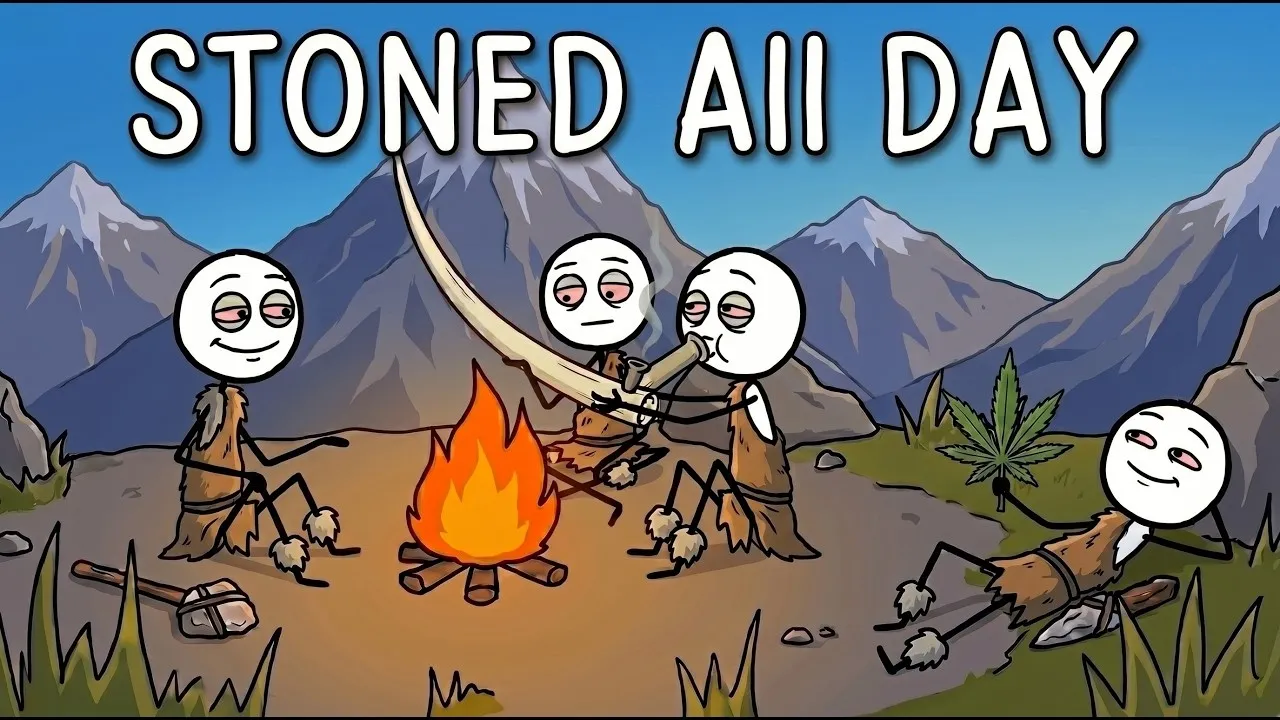
When Did Ancient Humans Start Smoking Weed? transcript
Ink Explainer · @Inkexplainer96
Words
1,688
Runtime
8:24
Speaking pace
201wpm
Reading time
7min
201 words per minute, above the 201 75th percentile of 349 measured videos. That distribution comes from the 349-video hook study.
Opening (first 30 seconds)
Archaeologists cracked open a 27,000 year-old coffin in the deserts of Western China. Inside was a man, blue-eyed, about 45 years old. The man was buried with a harp and a set of horse bridles, and almost 2 lb of marijuana that had somehow stayed green for 27 centuries in the ground. The tomb belonged to a shaman, and the marijuana was a going away gift. The gentleman who packed this man made sure he'd have enough supplies for the other side, but he wasn't the first person to use this plant. The story starts about 12,000 years ago. Somewhere in
101 words, the words spoken in the first 30 seconds at 201 words per minute.
Sentence shape
| Measure | This transcript |
|---|---|
| Sentences | 118 |
| Average words per sentence | 14.3 |
| Longest sentence | 43 words |
| Questions asked | 2 |
| Sentences containing a number | 22 |
Most used terms
- cannabis23
- years13
- plant11
- called7
- people7
- ancient6
- cao6
- found6
- hemp6
- hua6
- hua tuo6
- inside6
Filler phrases
3 in total: like 2 · right? 1.
A literal whole-word count of the same phrase list the Prepublish browser extension uses, so a phrase inside another word is not counted and a phrase used in its ordinary sense still is. It is a count and not a judgement.
What this transcript is
Every word below is the caption track YouTube publishes for this video, pulled from the video itself and reproduced unchanged. It is not Prepublish's writing, not a summary, and not a re-transcription: it is the video's own published captions. English captions, generated automatically by YouTube, in the video’s original language. Source: the video on YouTube. A channel that would rather this page did not exist can ask for its removal through the contact page, and it is removed.
Transcript
Archaeologists cracked open a 27,000 year-old coffin in the deserts of Western China. Inside was a man, blue-eyed, about 45 years old. The man was buried with a harp and a set of horse bridles, and almost 2 lb of marijuana that had somehow stayed green for 27 centuries in the ground. The tomb belonged to a shaman, and the marijuana was a going away gift. The gentleman who packed this man made sure he'd have enough supplies for the other side, but he wasn't the first person to use this plant.
The story starts about 12,000 years ago. Somewhere in East Asia, humans were just starting to figure out farming, and one of the first plants they looked at and thought, "Let's grow this." That plant was cannabis. Imagine being an ancient farmer and finding a plant that can be turned into rope, woven into clothes, eaten for food, pressed into oil, and used as medicine. That's not a crop. That's the ancient equivalent of finding a Swiss Army knife growing out of the ground.
One of the earliest records of cannabis shows up in an ancient Chinese text called the Pen-ts'ao Ching, often described as one of the world's first medical handbooks. Traditionally attributed to the legendary Emperor Shen Nung, the book recommended cannabis for everything from joint pain to malaria. From China, cannabis spread along the Silk Road. Merchants carried silk, spices, and apparently weed. One of those trade paths ran straight through the Pamir Mountains in Central Asia, and that's where the oldest proof of smoking turned up.
High in those mountains, at a burial site called Jirzankal Cemetery, researchers dug into eight ancient tombs from around 500 BC. Inside, they found wooden braziers filled with charred stones that had been used to burn cannabis. And this wasn't just whatever grew on the hillside. This stuff was potent, way stronger than wild plants in the area. These people were choosing the strong stuff on purpose. They'd heat the stones, lay the cannabis on top, and everyone would breathe in the smoke together while they buried their dead.
They were hotboxing funerals 2,500 years ago. Around that same period, a Greek historian named Herodotus was traveling through Central Asia and ran into a group of nomads called the Scythians. The Scythians were legendary warriors. They rode horses, carried bows, and apparently very enthusiastic about their smoke sessions. Herodotus watched them set up small tents, toss cannabis onto red-hot stones inside, and breathe in everything that came off.
And Herodotus wrote the whole thing down. His exact words, "It smolders and sends forth such fumes that no Greek vapor bath could surpass it. The Scythians delighted." Is it just me or does he sound a little jealous? For a long time, historians figured he was exaggerating. Then in 1947, a Soviet archaeologist named Sergey Rudenko excavated frozen tombs in Siberia that had been sealed in permafrost for over 2,000 years.
Inside, they found tent frames, heated stones, and cannabis seeds. Exactly what Herodotus described. He wasn't making anything up. Then in 2013, another Scythian tomb turned up in the Caucasus Mountains with 7 lb of solid gold cups inside. When they tested the residue inside those golden cups, they found cannabis and opium. Ancient warriors were mixing substances out of gold 2,400 years ago. Pretty fascinating, right?
But 7 years later, they found something even stranger turned up at Tel Arad in Israel. Researchers examined altars from an ancient kingdom of Judah shrine, about 2,700 years old, and they found something interesting. One altar had frankincense, standard offering, but the other had cannabis. And they'd mixed it with animal dung to keep the burn slow enough to release the smoke properly, which means whoever prepared this knew exactly what they were doing.
And it wasn't just them. Every culture that came across this plant found a reason to keep it because your body was already wired for it before you ever touched it. You naturally produce a molecule called anandamide, named after the Sanskrit word for bliss. Cannabis just happens to produce a chemical that fits into the exact same slot, like a spare key to a lock your body already had, which explains why halfway across the world in India, they weren't just using it, they were worshiping it.
India has been using cannabis longer than almost anyone. Their oldest sacred text, the Atharva Veda, lists cannabis as one of five sacred plants. Lord Shiva, one of the biggest gods in Hinduism, is called the Lord of Bhang, a drink made from cannabis leaves and milk. The story says after he swallowed a poison that could have ended the world, it was bhang that brought him back to calm. People still make the same drink during Holi and Shivaratri almost 3,000 years later.
But India wasn't the end of the story. This plant kept moving. In China, around 200 AD, a physician named Hua Tuo mixed cannabis with wine, gave it to his patients, and performed surgery while they felt nothing, 1,800 years before modern anesthesia. But being ahead of your time has always been dangerous. Hua Tuo was eventually summoned by Cao Cao, one of the most powerful warlords in Chinese history. Cao Cao suffered from severe headaches, and Hua Tuo was the only man who could treat him.
But Hua Tuo wanted to go home. He wanted to practice medicine and treat ordinary people, not spend his life as a personal doctor to a warlord. Cao Cao took that as an insult. He had him arrested, thrown into a prison, executed. In his final days, Hua Tuo tried to pass his writings to a prison guard, but the guard was too afraid and refused to take them. So Hua Tuo burned everything himself. The formula died with him.
Nobody has cracked it since. And then there's the story that sounds made up. In the Congo, a warlike tribe discovered cannabis and did something nobody expected. They stopped fighting, stopped killing, reorganized everything around the plant, renamed themselves the Bena Riamba, the sons of hemp, and turned their territory into a place called Lubuku, which means friendship. Their greeting became moyo. Moyo meant two things at once, hemp and life, one word for both, because to them there was no difference.
By the time Europeans started colonizing the Americas, cannabis had already been a backbone crop in Europe for centuries. Ships were running on it. It was used to make rope, rigging, and sails. The entire age of exploration was partially held together by hemp fiber, which is the fibrous stalk of the cannabis plant. So when settlers arrived in the New World, bringing hemp cultivation with them wasn't a cultural statement.
It was just practical, like bringing wheat. It spread through the colonies fast, but there was a problem. Tobacco was more profitable, and farmers kept choosing it over hemp. The government kept asking them to plant it, but nobody wanted to grow something that paid less. The Virginia Assembly eventually stopped asking nicely and passed a law making it mandatory. Farmers were legally required to grow it, not encouraged, it was required.
That's how essential it was. For the next two centuries, cannabis was just part of American life, but everything changed when in 1930, a man named Harry Anslinger became head of the Federal Bureau of Narcotics. He held the job for 32 years. Anslinger tied cannabis to black Americans, Mexicans, and Filipinos. Said it made minorities forget their place. This guy also had a problem with jazz music, claiming their music was satanic and went after the people who played it.
He personally targeted Billie Holiday, not for drugs, but for singing Strange Fruit, a protest song about lynching that made powerful people uncomfortable. He stopped calling it cannabis and started calling it marijuana because the word sounded foreign and scaring people was the whole point. He kept a folder of made-up police reports called the Gore Files, linking weed to violence and insanity. He asked dozens of doctors what they thought.
Most said cannabis wasn't dangerous. He ignored all of them and went with the one who agreed. In 1937, the Marijuana Tax Act passed. In 1970, Nixon put it on schedule one, the same category as heroin. A plant that humans had been growing since before they learned to write was now legally one of the most dangerous substances on Earth. Now, listen this. Years later, Nixon's own domestic policy adviser, John Ehrlichman, said something in an interview that put the whole thing in context.
He said, "The administration wanted to go after two groups, anti-war protesters and black communities. They couldn't make it illegal to be against a war or to be black, but they could tie marijuana to one and heroin to the other, criminalize both, and arrest whoever they wanted. That's not speculation. That's a direct quote from the man who helped build the policy." In 1988, the DEA's own judge, Francis Young, spent two years reviewing all the medical evidence and concluded that marijuana should not be classified alongside heroin.
He recommended moving it off from schedule one. The DEA rejected his recommendation and kept it exactly where it was. Cannabis has been part of human life for 12,000 years. It's been illegal for about 90. That's less than 1%. For virtually all of history, this plant was just there. You made rope from it in the morning and burned it at a funeral in the evening. A tribe rebuilt their whole world around it and greeted each other with a word that meant hemp and life in the same breath.
And that shaman in the desert, the one with the harp and 2 lb of weed, he didn't know about drug schedules or political agendas. He just knew the plant did something worth keeping, and the people who loved him made sure he'd never run out. Now, time for the winner of the previous video giveaway. And the winner is on the pinned comment on that video. If you see your name, congratulations.
The words are the caption track's own and nothing is reworded or re-transcribed. Paragraph breaks are placed between sentences so the text reads as prose.
Use this transcript
Three free tools that work on the material around a video like this one. No signup, no login.
Hook Analyzer
Paste the first 30 seconds of your own draft for a hook score and rewrites.
Policy Pre-Flight
Check your draft against YouTube's advertiser-friendly guidelines before you record it.
Channel Skill Generator
Read this channel's public videos and transcripts, and download a writing brief for it.