Getting the transcript
Reading the captions from YouTube. A video nobody has opened here before takes 10 to 30 seconds; this page fills in on its own.
Getting the transcript
Reading the captions from YouTube. A video nobody has opened here before takes 10 to 30 seconds; this page fills in on its own.
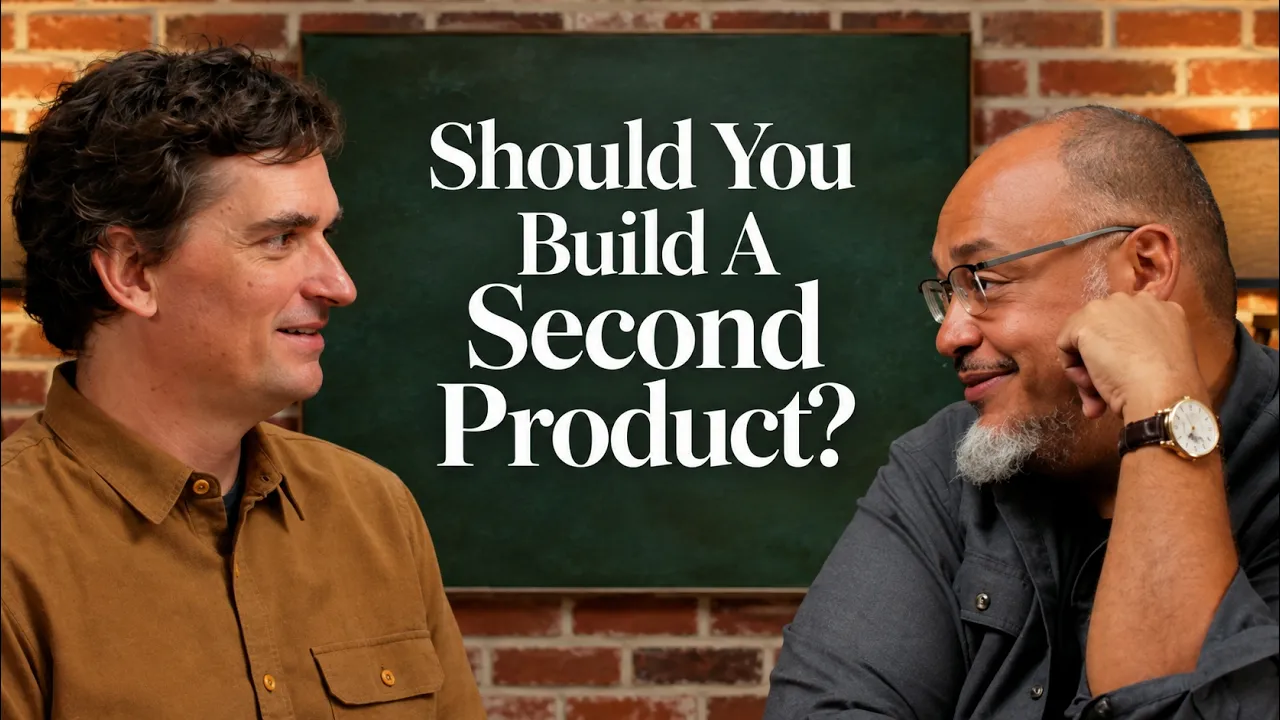
Dalton + Michael · @daltonplusmichael
This video has no Most replayed graph yet: YouTube shows one only once a video has enough views. These are the moments viewers replayed most in Dalton + Michael's most watched videos.
Most replayed moment at 9:40
2.3x that video's typical replay level
a company is winning, you might not understand the value they create for their customers, but don't dismiss it to zero. >> Well, that's the classic thing of um dismissing a product because the design is bad. >> Yeah, man. This HRS looks like crap.
Said at 9:33
Most replayed moment at 9:46
2.1x that video's typical replay level
of founders is, "What do you think is the failure rate for a series B company?" Because like I think in their minds before I ask the question, they think every series B company wins. And then after I ask it, they're like, "I guess mathematically that wouldn't work."
Said at 9:40
Most replayed moment at 14:24
2.8x that video's typical replay level
it is hard to feel like you're working on something where a lot of people think it's a bad idea. That's hard. And I like talking about this because you should brace yourself for that. Like, that is 100% the experience of
Said at 14:17
The graph counts replays. It does not show where viewers stopped watching.
Words
1,934
Runtime
9:27
Speaking pace
205wpm
Reading time
8min
205 words per minute, above the 201 75th percentile of 349 measured videos. That distribution comes from the 349-video hook study.
Opening (first 30 seconds)
Is the reason why you're doing the second product because you've lost all faith in the first product? >> I think that happens a lot and you call it a second product, but that's more of just like a cover story to tell your investors or to tell the world that you're abandoning your initial business. If a cover story is helpful to you, go use a cover story, but you should at least be honest with yourself. What is actually happening here? Like don't lie >> Are we a multi-product company? Yeah. >> [laughter] >> This is Dalton plus Michael and today
103 words, the words spoken in the first 30 seconds at 205 words per minute.
Free, no signup. See how the first 30 seconds hold attention, with rewrites.
Sentence shape
| Measure | This transcript |
|---|---|
| Sentences | 159 |
| Average words per sentence | 12.2 |
| Longest sentence | 63 words |
| Questions asked | 26 |
| Sentences containing a number | 7 |
Most used terms
Filler phrases
93 in total: like 51 · right? 10 · um 9 · you know 6 · actually 5 · kind of 5 · I mean 4 · basically 2 · sort of 1.
A literal whole-word count of the same phrase list the Prepublish browser extension uses, so a phrase inside another word is not counted and a phrase used in its ordinary sense still is. It is a count and not a judgement.
Run the check on the words above: where attention is likely to drop, with a rewrite for each weak line. The free check shows the scores and the one issue costing the most.
What this transcript is
Every word below is the caption track YouTube publishes for this video, pulled from the video itself and reproduced unchanged. It is not Prepublish's writing, not a summary, and not a re-transcription: it is the video's own published captions. English captions, generated automatically by YouTube, in the video’s original language. Source: the video on YouTube. A channel that would rather this page did not exist can ask for its removal through the contact page, and it is removed.
Is the reason why you're doing the second product because you've lost all faith in the first product? >> I think that happens a lot and you call it a second product, but that's more of just like a cover story to tell your investors or to tell the world that you're abandoning your initial business. If a cover story is helpful to you, go use a cover story, but you should at least be honest with yourself. What is actually happening here?
Like don't lie >> Are we a multi-product company? Yeah. >> [laughter] >> This is Dalton plus Michael and today we're going to talk about should I build a second product? What do you think, Dalton? I'm a startup founder. >> Yeah. >> I'm giving you no more context than that. >> Yeah. Well, [laughter] the answer is yes. End the video. Um no, um Look, this is a very common topic um that that founders ask for advice on where they have one thing, their MVP, that does like one thing, you know, it's widgets.
And they're like, "Should we sell this other thing in addition to widgets?" And here's all the reason why it's a good idea. And in the abstract, um I think I would need more information, but maybe just to open up the thinking, if your first product is failing, adding another failing product is usually not the thing and maybe you should just pivot the whole company. And on the flip side, if your first product is a smash hit, growing exponentially, and you have a really good story on why you might want to add a second product, yeah, the answer is maybe.
So, that's just my very quick start. What do you What do you think? >> On this point, I'm a Negative Nancy. I think there's two failure modes and I think you described them perfectly. And I think what's not talked about probably enough is the failure mode of things are going well and you don't build the second product fast enough. That is a failure mode. Because I think fundamentally startups try to basically compare themselves against their peers instead of comparing themselves against like the incumbents.
And often when you look at the incumbent, the incumbent has a suite of products and often if you're ever going to compete with them, you must have a competing suite. And so, you know, let's look at like an example of like Slack versus Notion, right? I think Slack never really figured out how to get this competing suite. Microsoft Teams comes, the enterprise value of Slack goes way down. Notion on the other hand, I think sees the game, and they're like And another probably classic example would be Google Docs.
And they're just like, "If we don't have every office product, we're probably screwed." And that's exactly correct. >> And it's funny to even bring up Microsoft, cuz Microsoft was obviously a one-product company for many years. >> Yes. >> And then they started adding more, and now you don't think of it as a single-product company. And Google was obviously a single-product company for many years until our our friend Paul created Gmail.
But it was a single-product company for what? 6 years? And so it's kind of funny if you're a one-year-old startup copying the playbook of a company that's been around for a very long time. It's like, yeah, they didn't even do the thing you're trying to do. Why would you do it? Right? >> So it's weird. That failure mode is so weird when it's kind of like, "Oh, we're winning." And then you realize, "Oh, no. We're competing against an incumbent, and we're like 1% of the incumbent.
We're maybe way further behind than we ever imagined because we never let let ourselves think that high." But I also think there's this thing that I see, especially in VC-dom, where you basically have this product that's in this weird product-market-fit space. Like, you see descriptions like, "We have product-market fit in a small market." Or we have product-market fit amongst the customers who like us. >> There's like asterisks on it.
It's your way >> Exactly. >> Yeah. >> And so I see this kind of game where sometimes a VC will tell a founder like, "Okay, we have this $20 million business. Let's stack another $20 million revenue and another 20 million." And then like, somehow if we stack enough $20 million revenue businesses together, you can IPO one day. I don't think I've ever seen that work. >> Well, with hindsight, um you can tell stories that that worked, but generally the main product is a hit.
Otherwise, it's not a second product, it's a pivot. Like that's it's kind of like we can we can use whatever words we want for with hindsight. >> Would you ever see a situation where you've stacked 10 mediocre products together versus >> There definitely situations where like one of the second or third or fourth things >> Yeah. >> blows up. >> I mean the the the example top of mind for me is like Posthog is a multi-product company.
They launched multiple products pretty quick. But actually makes sense that that's a product suite. Their initial analytics product was a hit. It worked. >> Yeah. >> And so and it made sense. Okay, you're using Posthog for analytics. >> Let's do session replay. >> Boom boom boom. >> Like that. >> I think that's a great >> Yes. >> textbook study of like a good multi-product setup. I'm not going to name any names for negative stories, but we've seen a lot of those.
We've seen a lot >> If you're DoorDash and you're doing food delivery well, maybe you can do store delivery. Maybe you can do grocery delivery. Right? >> Yes. Yes. Yes. Yes. And almost if you don't someone else will. So you have to do it. So there are probably a lot more examples of companies that had an advantage and didn't go full force, right? >> Yeah. >> And maybe a classic one was I think the entire world got on Zoom during COVID. >> Yeah, Lord knows we did. >> Yeah.
Yeah. Yeah. >> We talk on Zoom all day every day. >> Exactly. And like I mean I think it was damn near subsidized, right? Like the government was telling the schools to get on Zoom and the and so as a startup founder that's a situation where you just be like I'm I don't want to frame it that way, but like how lucky in a na >> we parlay this into like an enduring business that when the lockdowns are over we still have a business? >> Yes. >> I think they tried, but as a still Zoom user I don't think they succeeded in getting people to adopt Zoom for non-Zoom use cases I think is a fair way to put it. >> And I think what's tricky is like as a founder it's so hard cuz this thing's working so well to say I got to move my attention to something else.
And actually I think it's really what's really scary is like unfortunately Zoom is a classic office suite product. And we've encountered this so many times. When you're building an office suite product, you're competing with Microsoft Office and Google's like even if you don't think you are. >> Yep. >> If your ambition isn't to go try to become the next office suite, >> I think my other example that one real quick is Peloton where they had face-melting growth and they tried a bunch of stuff.
I don't think any of that stuff worked and their stock price is not doing great. But it was like, you know, they they realized they needed to sell more things. Um but ultimately, it was sort of a one-trick pony type deal. >> And I think that's so sad because I think a lot of founders are like those are success cases. >> Yeah. Well, and again, they are and like kudos to the founders. Like hooray, but they didn't parlay the hockey stick into like >> Yes. >> an enduring continuing hockey stick.
They They unfortunately had a crash. On the other hand though, um Gmail obviously created by our our friend Paul. Um that worked and he actually faced a lot of internal of not people not wanting to release it and it'll be a distraction and you know, you should listen to the story from him. Um that's probably a different video, but they got it out and that was a hit's second product and is still like the dominant email client and I think it's like one of the most popular products in the world to this day. >> Yes. >> Google Docs is a monster. >> Yes. >> YouTube is a monster.
Hey, welcome to YouTube, right? That's a Google product. Like holy cow, did Google succeed at going multi-product? >> Well, and think about this cuz cuz I've heard PB's story and there was definitely this resistance. But once they figured out Gmail was working, it felt like the rest of their office suite happened >> Yep. >> overnight. Like I remember in my early startup days just switching from Office to Google and I was just like I remember before Sheets came out and it was like, thank god there's Sheets.
Like, thank god there's Presentations. >> And a couple of these came from acquisitions. Like everyone forgets this, but it wasn't That wasn't all in-house stuff. I believe Sheets was an acquisition, right? >> I think presentations and I think Docs were. >> Google understood that email is part of the suite. >> Yeah. >> And like I mean my co-founders back in the day were building the calendar. Right? Cuz Gmail came out and it was like I think they realized very quickly >> [laughter] >> it's part of the suite.
It's impressive how good Google was at even resisting that move and then taking advantage of it when it worked. The last thing I will say though, which I think we want to really highlight is this. Should you be pivoting instead? Right? Like is the reason why you're doing the second product because you've lost all faith in the first product? I think that happens a lot and you call it a second product, but that's more of just like a cover story to tell your investors or to tell the world that you're that you're abandoning your initial business.
And again, if that if a cover story is helpful to you, use a cover story. But you should at least be honest with yourself. What is actually happening here? Like don't lie to yourself. >> multi-product yet? >> [laughter] >> You can tell the story to whoever you want, you know, it's your it's your it's your life founder, but don't lie to yourself. >> No, I mean and and we have this example of Twitch where, you know, our old Justin.tv product was helping to fund Twitch.
But I wouldn't say that we were a two-product company. That would be many steps too far. There was one primary product. So yeah, I agree. That's the kind of awkward thing that's not talked about enough is that sometimes things get to 20 million in revenue and stop growing. And so just be honest about that. All right? Good chat.
The words are the caption track's own and nothing is reworded or re-transcribed. Paragraph breaks are placed between sentences so the text reads as prose.
Free tools for your own script: paste a draft and see where it stands before you record it.
Paste your draft and see where viewers are likely to drop off, with a rewrite for each weak line.
Paste the first 30 seconds of your own draft for a hook score and rewrites.
Check your draft against YouTube's advertiser-friendly guidelines before you record it.
Read this channel's public videos and transcripts, and download a writing brief for it.