Getting the transcript
Reading the captions from YouTube. A video nobody has opened here before takes 10 to 30 seconds; this page fills in on its own.
Getting the transcript
Reading the captions from YouTube. A video nobody has opened here before takes 10 to 30 seconds; this page fills in on its own.
Gabe Bult - The Process · @GabeBultTheProcess
This video has no Most replayed graph yet: YouTube shows one only once a video has enough views. These are the moments viewers replayed most in Gabe Bult - The Process's most watched videos.
Most replayed moment at 9:14
3.0x that video's typical replay level
subscribers. Again, 1300 videos. And these are mostly him just talking, not really doing anything, not much editing, not much B-roll. Anybody could make this video. Literally, anybody could make this video. You can edit this yourself. You can hire out an editor. He's not really editing them. Again, either it is
Said at 9:07
Most replayed moment at 8:54
7.1x that video's typical replay level
will make. So, there's generally a four-step method that will work for this strategy. Number one is strategic YouTube content. And do not post short-form videos. Other creators might tell you to do that, but if your goal is to make money and especially like evergreen income, don't start with that, please. I've seen it
Said at 8:46
Most replayed moment at 6:57
4.0x that video's typical replay level
but averaging 50 to 100,000 views per video. If you see, they're all just screenshots of him talking about something that he knows, something that he does personally, investing in options trading. [music] And he showed me his analytics. He's making 50 to 100,000 per month in AdSense and another minimum
Said at 6:50
The graph counts replays. It does not show where viewers stopped watching.
Words
2,430
Runtime
11:05
Speaking pace
219wpm
Reading time
10min
219 words per minute, above the 201 75th percentile of 349 measured videos. That distribution comes from the 349-video hook study.
Opening (first 30 seconds)
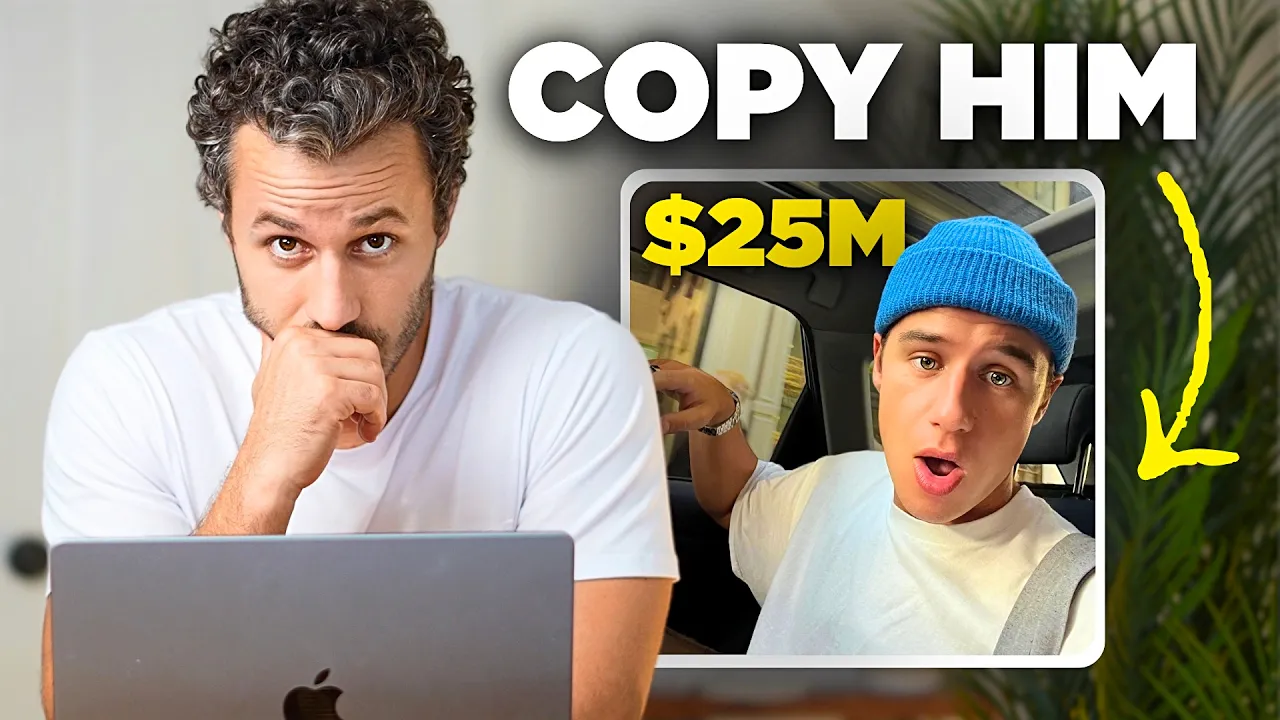
Daniel Dalen made $25 million in 6 months. He never sold a course, doesn't really take sponsorships. He spent 2 years just giving everything away for free. And here is why his strategy changes everything we know about personal branding. My name is Gabe. I've been full-time on YouTube for 5 years. I've had multiple successful channels. I've heard and tried every hack and secret and strategy in the book. But what Daniel is doing is completely different and I think is super interesting. For the longest time, I kind of thought Daniel was a lifestyle vlogger. He's got those POV thumbnails. He's got the aesthetic vibe that's like just
110 words, the words spoken in the first 30 seconds at 219 words per minute.
Free, no signup. See how the first 30 seconds hold attention, with rewrites.
Sentence shape
| Measure | This transcript |
|---|---|
| Sentences | 162 |
| Average words per sentence | 15.0 |
| Longest sentence | 76 words |
| Questions asked | 5 |
| Sentences containing a number | 26 |
Most used terms
Filler phrases
76 in total: like 34 · kind of 11 · you know 10 · actually 7 · uh 7 · literally 4 · right? 3.
A literal whole-word count of the same phrase list the Prepublish browser extension uses, so a phrase inside another word is not counted and a phrase used in its ordinary sense still is. It is a count and not a judgement.
Run the check on the words above: where attention is likely to drop, with a rewrite for each weak line. The free check shows the scores and the one issue costing the most.
What this transcript is
Every word below is the caption track YouTube publishes for this video, pulled from the video itself and reproduced unchanged. It is not Prepublish's writing, not a summary, and not a re-transcription: it is the video's own published captions. English captions, generated automatically by YouTube, in the video’s original language. Source: the video on YouTube. A channel that would rather this page did not exist can ask for its removal through the contact page, and it is removed.
Daniel Dalen made $25 million in 6 months. He never sold a course, doesn't really take sponsorships. He spent 2 years just giving everything away for free. And here is why his strategy changes everything we know about personal branding. My name is Gabe. I've been full-time on YouTube for 5 years. I've had multiple successful channels. I've heard and tried every hack and secret and strategy in the book. But what Daniel is doing is completely different and I think is super interesting.
For the longest time, I kind of thought Daniel was a lifestyle vlogger. He's got those POV thumbnails. He's got the aesthetic vibe that's like just fun to watch and kind of like encouraging and inspiring. He's documenting his life as he's flying around going to different countries. But I kind of figured he was making money the way that most creators do it. You know, you got AdSense, maybe a brand deal here or there. But as I continued to watch him, I realized he wasn't selling anything ever, which was pretty different.
Then I found out he runs a company called Ecom Flow, which has generated $25 million in revenue. And recently he launched these glasses and they sold out like really fast. I was like, "Oh, okay. now this is how he's making money. But then I realized he doesn't care about that money. And so I started digging deeper and deeper into like really how he's making his money and using this personal brand. What I found was very interesting.
His main business, EcomFlow, helps e-commerce brands ship products from China faster and cheaper. But here's the thing. When you hear that, mostly you would think of this as an ecom guy and he's going to sell me some type of course on how to get started with business and ecom or whatever. But instead of doing that, he is using his personal brand to attract actual clients for his business. And we're not talking like making 3,000 or 5,000 at a time.
We're talking millions of dollars. And if you think about it, it really makes sense, right? If you're running an e-commerce brand and you see this guy out in China talking Chinese, really committed to his craft, very disciplined, uh very caring about everything that he does, you're probably going to be thinking like, "This guy knows what he's talking about." out, you're going to automatically trust him. When Daniel launched his glasses brand, everybody was like, "Oh, he's finally monetizing his audience." And like his Shopify thing was just going insane.
But that's actually completely missing the point. The glasses were not actually about making money for his followers. They were about a case study for his brand, EcomFlow, his actual real business. and he is documenting every step of the process from finding manufacturers in China, negotiating prices in Chinese on camera, quality control processes, shipping and logistics, international fulfillment, and even every video he does about the glasses.
That's like a 10 to 20 minute ad pretty much for ecom flow without actually having to sell anything really. So, he's pretty much getting paid to promote his own company and get customers like big customers. So, this is where Daniel is different than the traditional model. And I kind of want to break down some of the math here. The traditional creator model might be to like build up, you know, try to hit for 100,000 or 500,000 subscribers.
You maybe sell a $500 course to 1% of them. If you're really successful, maybe that makes you a million to, you know, $2.5 million. But at some point, you're probably going to plateau because you've exhausted your audience and you can't continue to grow at the same pace. Daniel's path is kind of different here. Sure, he's still trying to build his audience to try to aim for half a million, but if he can attract just five to 10 highlevel clients, he can be talking a million in revenue for each one if they are highlevel people and he's only willing to work with the best.
If he only takes on, you know, 10 new clients a year, that's pretty sustainable as opposed to trying to make the same amount of money by booking a thousand or 2,000 people a year. That's way harder. And the cool thing is if he finds one decentsized client that will join EcomFlow because of his content, it would probably make more than him selling a course for the next 10 years. Now, here's where most people mess up. They see Daniel's cinematic style and his POV thumbnails, and they try to copy it.
But here is the most important thing that they are missing, and that is patience. Daniel did not monetize his audience for like 2 years. In fact, he probably lost tens of thousands of dollars cuz he was paying somebody to go around with him with a camera. I'm sure that person had other things, but that has some cost to it. And that's where a lot of creators uh fail. They try to make money immediately before giving value, before building a relationship with their audience, and they come off as kind of begging.
It's not wrong to make money from day one. I've had a channel that made, you know, almost $3,000 from the first video on a brand new channel. And I totally get that desire to make money right from the beginning. A lot of us aren't in the position that he was in when we started. But that's where some people can have a unfair advantage because Daniel had this business that was funding his lifestyle and his channel. So he could actually afford to play the long game.
And that patience really built something that is impossible to fake and that is trust because for years he just gave and you really just can't fake authenticity for 2 years. But you can use the 8020 model. This is something that I generally use where 80% of your content is pure value. It is relationship building. It is trust building. It is giving. It is not selling anything. And then that other 20% can be soft monetization.
If you are able to have patience, you can offer lead magnets. You can offer things for free. You can talk about your business if you have one without ever directly selling. And if you come across as somebody who knows what they're talking about, people will reach out to you. Like, I have nothing to sell on this channel right now. Literally, you can't give me money. I've had dozens of people message me and ask for one-on-one coaching.
I don't offer that. And so my goal right now is to kind of uh play the long game where yes, I do have a cohort that'll launch a couple times a year, but the rest of the time I'm just 100% giving value for free and not really expecting anything back. If your goal is to build a long-term sustainable brand, you got to have that mix of that 8020 where you're giving a lot of stuff away for free and then you're also building up loyal fans, you are selling stuff, you are making money, but people are much more likely to click on your affiliate link, to download your free miniourse, to go to your community, whatever it is that you are building long term.
They're much more likely to do that if they trust you and they see you as a friend, an expert in the field who's not constantly pushing things. I have posted on this channel for almost a year before I monetized at all with my recent cohort. Now it's closed. You can't get in there. It's not trying to sell anything right now. But it was literally like 95% free value and then 5% softell when I did have something to sell.
So here's what I learned from Daniel that you can copy. First, he documents everything instead of creating. Like Daniel is not sitting down thinking like, "No, what content should I make today?" He is just filming what he's already doing. He is filming his travel, his work, his struggles, his ups, his downs. The content is just a byproduct of his actual life. And even if you have a boring life, there can be beauty in that.
If you can find a story to tell, if you're actually doing things outside of just making videos. Second, he is vulnerable about the process. He shows his failures. He shows himself crying. He shows his uncertainties. He shows the times where things didn't work out, the genuine excitement when things do. And this makes him way more trustworthy than all the other guru creators who just make a highlight reel of their life and show you that.
That's why you actually care about him. And third, he's never positioned himself like a guru. He's not like, I'm going to teach you how to get rich. He's more of this type of vibe of like, I'm just figuring this out as I go along. Do you want to come along on this journey with you, my friend, that I care about? Because, uh, you know, I I want to show you what I have done without trying to teach you anything. It's more of showing.
And for me, that's way more compelling than the I'm an expert, do this type of thing. He has this authenticity advantage where he is not trying to be anything he's not. He's just some kid from the Netherlands who moved to China. He learned Chinese. He's figuring stuff out, started this e-commerce brand. He talks about what he is genuinely passionate about, what excites his soul, right? He's he's not trying to just make content to make money.
He is sharing his passion and that is how he is able to put so much into every single video because he loves it. I know this feeling because I've tried to talk about things I'm not passionate before and I've burned out. But when it's stuff that I love like breaking down people like this or you know YouTube, I can just do that forever. I love it. He's got that same advantage. And then I also noticed that he has this like three to four video cycle that he kind of runs through.
He'll have a problem video. This will be a challenge that his business is facing or something like that. Then he'll have a process video. this is uh showing how he solves this problem or some other problem. He'll have a results video showing all the work that he's put in and how it's led to being where he is now. And then of course he'll just have a lifestyle video where yes, he's touching on all of these points in all of the videos, but he's also just showing traveling or doing something else, his more like personal side of him that's not going to directly lead to sales, but again, it's building that trust.
It's kind of framed like a TV show about building a business where it's not just the same thing over and over again. It's like these different areas all forming this story that we want to travel along with to see what happens in the story. And he is building this main character where he's showing different sides of himself, different sides of his life. And we start to care about that character and we want it to succeed or uh just hear what it's going through.
So here is a framework if you want to get started. Number one, you can stop monetizing and start attracting. Stop building an audience to sell to. Instead of looking at your audience as potential customers and you know if if that's your strategy that's fine but actually look at them as amplifiers of your business if you have anything going on on the side. If you think of Daniel's audience like just on YouTube it's 170 something thousand people that's not enough to make $25 million like selling glasses, right?
Whatever he was selling. It's not enough. But it is enough when you have a business on the side and you're using this as an amplifier for that business. So if you want to start this type of framework, here's exactly how I would do it. Pick one real project that you are working on and document your daily life around that project for 30 days and you want to show everything here. You don't want to just get in the trap of showing the highlights, but you want to show the wins, the losses, the struggles, the building, but don't sell anything.
Next, as your business continues to grow, instead of trying to find 3,000 customers, try to find like three over the course of the next couple months that can really make a big difference in your business. Try to create content that really makes people think, you know, like that guy gets it. He know he knows what he's doing. He really cares. And if you are good and you have a good product, people will start to come to you.
Next, you want every piece of content that you make to demonstrate what you are good at. Kind of be a little bit of proof. You want to think of it kind of like as a portfolio as opposed to entertainment. Your channel, your Instagram will become your resume. I can say this from personal experience. Well, I still haven't gotten a TV show. I've had four offers from TV shows just from having my personal brand online. You literally never know what one person is watching that could literally change your life.
Now, I'm not saying everybody has to follow the strategy. I think there are ways to make uh a lot of money a lot faster on YouTube without waiting 2 years. But if you want to get to that level of, you know, making 25 million, then generally it's not going to happen through selling a course or or affiliates or things like that. It's instead going to happen from having a business and using your personal brand to amplify that business.
If you enjoyed this video and you want to see more like it, don't forget to subscribe and I'll see you next week.
The words are the caption track's own and nothing is reworded or re-transcribed. Paragraph breaks are placed between sentences so the text reads as prose.
Free tools for your own script: paste a draft and see where it stands before you record it.
Paste your draft and see where viewers are likely to drop off, with a rewrite for each weak line.
Paste the first 30 seconds of your own draft for a hook score and rewrites.
Check your draft against YouTube's advertiser-friendly guidelines before you record it.
Read this channel's public videos and transcripts, and download a writing brief for it.