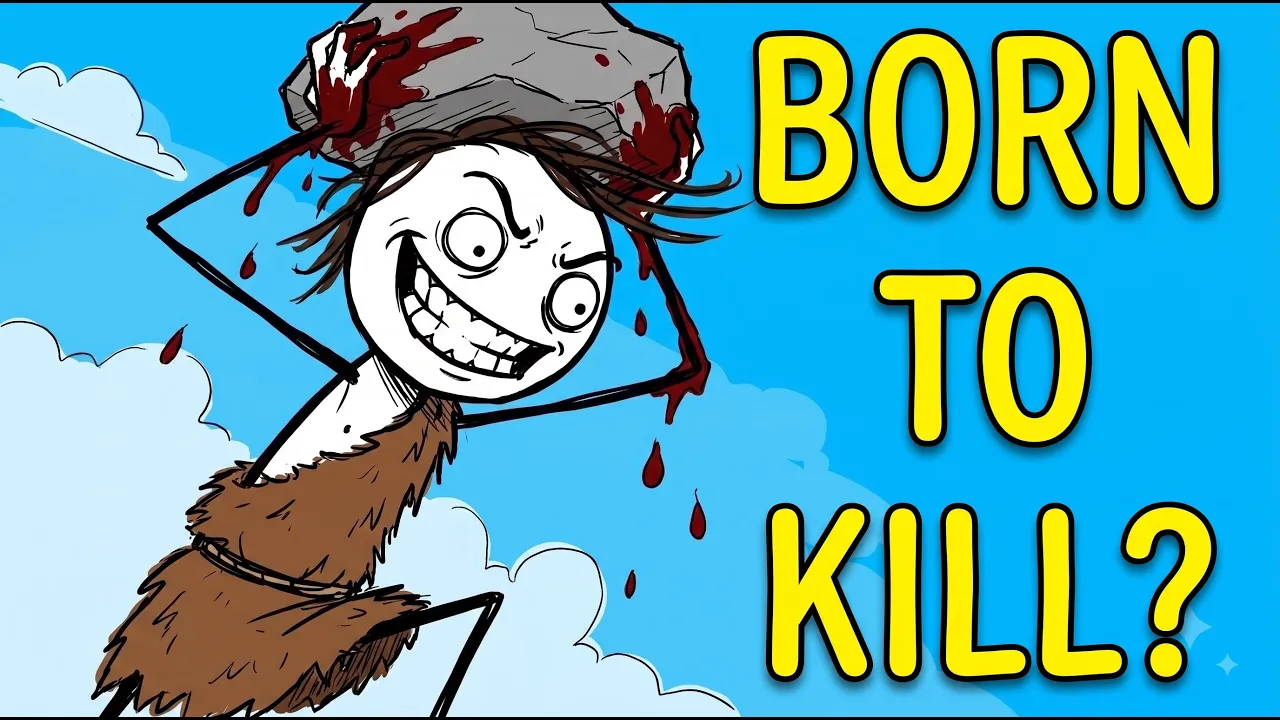
Why Ancient Humans Were The Most TERRIFYING Animal Alive transcript
Ink Explainer · @Inkexplainer96
Words
2,234
Runtime
9:07
Speaking pace
245wpm
Reading time
9min
245 words per minute, above the 201 75th percentile of 349 measured videos. That distribution comes from the 349-video hook study.
Opening (first 30 seconds)
Picture yourself 100,000 years ago, standing in a world full of monsters. Cave lions the size of a car, bears that stand taller than a basketball hoop. Every one of them stronger, faster, and better armed than you. Now, look around. They're all extinct, and you're still here. The weakest animal in that entire world became the most terrifying thing that has ever lived. And by the end of this, you'll understand why a zebra today is more afraid of the sound of your voice than of a lion. Before I show you how a creature this weak took over the planet, look at something stranger. Because the first clue to how terrifying we are isn't in how we hunt. It's in the
123 words, the words spoken in the first 30 seconds at 245 words per minute.
Sentence shape
| Measure | This transcript |
|---|---|
| Sentences | 162 |
| Average words per sentence | 13.8 |
| Longest sentence | 39 words |
| Questions asked | 1 |
| Sentences containing a number | 11 |
Most used terms
- animal15
- years12
- body10
- man9
- arm8
- lion8
- people8
- across7
- scientists7
- single7
- sound7
- afraid6
Filler phrases
9 in total: like 5 · actually 2 · kind of 1 · you know 1.
A literal whole-word count of the same phrase list the Prepublish browser extension uses, so a phrase inside another word is not counted and a phrase used in its ordinary sense still is. It is a count and not a judgement.
What this transcript is
Every word below is the caption track YouTube publishes for this video, pulled from the video itself and reproduced unchanged. It is not Prepublish's writing, not a summary, and not a re-transcription: it is the video's own published captions. English captions, generated automatically by YouTube, in the video’s original language. Source: the video on YouTube. A channel that would rather this page did not exist can ask for its removal through the contact page, and it is removed.
Transcript
Picture yourself 100,000 years ago, standing in a world full of monsters. Cave lions the size of a car, bears that stand taller than a basketball hoop. Every one of them stronger, faster, and better armed than you. Now, look around. They're all extinct, and you're still here. The weakest animal in that entire world became the most terrifying thing that has ever lived. And by the end of this, you'll understand why a zebra today is more afraid of the sound of your voice than of a lion.
Before I show you how a creature this weak took over the planet, look at something stranger. Because the first clue to how terrifying we are isn't in how we hunt. It's in the things we leave behind. Dig into the ground almost anywhere, in almost any century, and you find things no other animal on Earth would ever make. In northern Italy, in a place called Povegliano Veronese, archaeologists opened a grave from around 1,400 years ago and found a man missing his right hand.
It had been cut off clean at the forearm, probably with a single blow. And then he did something no other creature would ever think of. He strapped an iron knife to the stump, tied it on with a buckle and leather, and lived with it for years. We know he used it constantly, because he tightened those straps by gripping them in his teeth over and over every day for years, until the teeth on one side of his mouth were ground down to almost nothing.
This is a man who lost his hand and replaced it with a blade. But that man at least had a reason. The next thing we dig up has none. 9,000 years ago, in the city of Jericho, people took the skulls of their own dead, packed them in wet plaster, and pressed seashells into the eye sockets to make them look alive again. Then they painted them and kept them inside the house, under the floor where the family slept, close enough to look at every single day.
And it gets stranger. On a Scottish island called South Uist, archaeologists found two bodies buried under the floor of a house 3,000 years old. They looked ordinary at first, but when the bones were tested, nothing matched. One skeleton had the skull of one person, the jaw of another, and an arm and a leg from two more people entirely. It wasn't a single body at all. It was several different people taken apart and rebuilt into one, then soaked in a bog to preserve the flesh and kept above ground for years before anyone buried it.
And some of those parts came from people who had died centuries apart, which means someone held onto to pieces for generations, waiting before they built the final body. These people didn't just keep their dead. They took them apart and made new ones. But keeping the dead and rebuilding them still comes from something like love. The last one doesn't. In Kenya, in a region called Turkana, scientists dug up a single shin bone.
It is 1.45 million years old. And a researcher named Briana Pobiner found nine cut marks on it, made with a stone tool, sitting exactly where you would slice to strip the muscle from the bone. It's the oldest clear evidence we have that one of our own relatives butchered another for its meat. And this was more than a million years before modern humans even existed. No other animal buries its dead or paints them or cuts its own kind apart with tools.
We've been doing strange, deliberate, unsettling things since long before we were even us. But being strange isn't the same as being terrifying. To understand why the entire animal kingdom is afraid of us, you have to go back to the one thing this soft little creature could always do better than anything alive. Picture a man on that open grassland in the heat of the day, watching an antelope graze a few hundred meters off.
He has no bow and no trap. Just a sharpened stick and a body that would lose a straight fight to almost everything out here. So he doesn't fight it. He just starts walking toward it. The antelope bolts instantly, explodes across the plain at a speed the man could never touch. And in seconds, it's a dot on the horizon. But the man doesn't chase, and he doesn't speed up. He just keeps walking in the same direction at the same steady pace.
He finds it again an hour later, resting in the shade. It bolts again. He keeps coming. Here's what the antelope's body can't understand. Every sprint builds up heat, and an animal buried in fur has almost no way to get rid of it. It can't sweat like you can. And it can't pant and gallop at the same time because it can't do both with the same breath. So every burst of speed costs it heat it can't pay back while it's still moving.
The man is the opposite. His skin is nearly bare, covered in millions of tiny sweat glands cooling him with every step. He can pour out a liter of water an hour and just keep going. He is the only large animal on that whole plane that can run and cool itself down at the same time. So this was never a chase. It was slow, patient math, and the antelope was always going to lose. The sprints get shorter. the gaps close up.
The animal's body climbs toward a temperature that will cook its own organs until its legs stop answering and it goes down in the dirt and doesn't get up. And it isn't because the man caught it, it's because its own body quit. He just walks the last few steps and finishes it without a fight. Now, some scientists will tell you this kind of hunting was actually rare and they argue about how much it really shaped us. They might be right, but rare or not, it shows you the design underneath.
We were the thing that would not stop coming. Long before we picked up a single weapon, we were already the shape on the horizon that never turns back. But running an animal down takes hours. So, we found a way to end it in a single second from across the clearing. Pick up a rock. Notice how naturally your arm knows what to do with it. You could throw it at something across the street right now and have a real chance of hitting it.
That feels like nothing, but it's one of the rarest abilities in all of nature. A chimpanzee is several times stronger than a grown man. Pound for pound, it would tear you apart, but it can only throw it about 20 miles an hour and it can barely aim. An 8-year-old kid can throw a baseball at 40. The weakest thing in the room throws twice as fast as the animal that could rip its arm off. So, how? The answer is hidden in your shoulder.
Over millions of years, our bodies changed in three specific ways. The waist widened, so the upper body could twist on its own. The shoulders dropped and the bone in the upper arm untwisted. Together, those changes turned your shoulder into a slingshot. When you [ __ ] your arm back, you stretch the tendons across it like elastic, load them with energy, and then release it all at once to catapult your arm forward. It's the fastest motion the human body can make and it shows up in the fossil record around 2 million years ago in an ancestor called Homo erectus.
Think about what that meant. Every other predator on Earth has to touch its prey to kill it. The lion has to close its jaws on you. The wolf has to reach you with its teeth. To eat, they have to walk right into the range of hooves and horns and they get hurt doing it. We didn't. We became the first animal that could kill from a distance, standing somewhere safe while the prey never got close enough to fight back. It started with a thrown rock, then a sharpened spear, then a spear you could launch even harder.
And every weapon in human history since is just a longer, deadlier version of that same moment when a weak little primate realized it could reach out and end a life from across the clearing. But one human with a rock is still just one human. What turned us into a nightmare was what happened when we stood together. Watch a pride of lions hunt or a pack of wolves and it looks like teamwork. It isn't, not really. Each animal is just chasing it's own best shot at the prey and the results happen to line up.
Chimps hunt in groups too and it's the same story with every chimp out for itself. Scientists call this hunting in I mode. Humans do something no other animal can. We hunt in we mode working from one shared plan. One of us drives the prey, others wait at the ambush. Someone signals and everyone adjusts at once because everyone is holding the same picture in their head. And here's the part nothing else alive can do. Each person knows that the others know the plan.
You know that I know that we're doing this together. A wolf pack is just a group of wolves. A band of humans is one mind spread across a dozen bodies. It's a single intention with 30 pairs of hands and it can plan for tomorrow, remember yesterday and pass down everything it learns to the next generation. You're not scary because of your body. You already know your body is weak. You're scary because you were never really fighting as one person.
You were always a piece of something much bigger and that something could think. So give that creature time. Give it the tireless legs, the throwing arm and the shared mind and turn it loose on a planet full of giants. Then look at what's left. In South Africa, there's a place called Kruger National Park home to one of the largest lion populations left on Earth. For every antelope and zebra living there, the lion is the sound that means death.
So a team of scientists went in to test something simple. They wanted to know what those animals are most afraid of. They hid speakers and cameras at the watering holes, the one place every animal is forced to visit. Then they waited for the animals to come and drink and they started playing sounds. First, they played lions, real recordings of them snarling and growling close and loud. The animals lifted their heads and tensed and a few backed away.
But most of them held their ground because a lion is a threat they've lived with their whole lives and learned to survive. Then the scientists played something else. It wasn't a roar and it wasn't a gunshot. It was just the sound of a few people talking calm and quiet at the the of a normal conversation. The savanna emptied. 95% of the animals ran. They were twice as likely to flee from the human voices as from the lions, and they cleared out 40% faster.
Elephants, giraffes, rhinos, leopards, every one of them fled from the sound of people chatting. A zebra at a watering hole is more frightened of the sound of you talking than of a lion breathing down its neck. The scientists gave it a name. They called us the super predator. And this isn't just one park in Africa. On the other side of the world, in the mountains of California, scientists ran the same experiment on wild mountain lions.
Some of the most powerful predators in all of North America. They waited until a lion was feeding on a fresh kill. And then they played the sound of people quietly talking. And the lion, an animal that fears almost nothing, would freeze, abandon its own food, and slip away into the dark. They get the same result nearly everywhere they try it. From the biggest cats down to the smallest mice, the entire natural world has quietly agreed on one thing.
The most dangerous sound on the planet is a human voice. You've spent your whole life a little afraid of the wild. You're afraid of the dark, of the animals out there, of whatever waits at the edge of the firelight. But turn that around. You are carrying every piece of it right now. The tireless legs that ran the antelope into the ground, the arm that kills from across a clearing, and the shared mind that emptied whole continent.
It's all still in you, right where you're sitting. To every other animal alive, you are not the one who's afraid of the dark. You are the thing in it. You are the monster they spent a million years learning to fear. And the most terrifying part is that you walk around every day, soft and slow and clawless, completely convinced you're the weak one, having forgotten what you actually are.
The words are the caption track's own and nothing is reworded or re-transcribed. Paragraph breaks are placed between sentences so the text reads as prose.
Use this transcript
Three free tools that work on the material around a video like this one. No signup, no login.
Hook Analyzer
Paste the first 30 seconds of your own draft for a hook score and rewrites.
Policy Pre-Flight
Check your draft against YouTube's advertiser-friendly guidelines before you record it.
Channel Skill Generator
Read this channel's public videos and transcripts, and download a writing brief for it.