Getting the transcript
Reading the captions from YouTube. A video nobody has opened here before takes 10 to 30 seconds; this page fills in on its own.
Getting the transcript
Reading the captions from YouTube. A video nobody has opened here before takes 10 to 30 seconds; this page fills in on its own.
Buried Earth · @BuriedEarth
This video has no Most replayed graph yet: YouTube shows one only once a video has enough views. These are the moments viewers replayed most in Buried Earth's most watched videos.
Most replayed moment at 8:39
9.2x that video's typical replay level
been working. He'd been too sick to work for weeks or maybe even months before he died. The cause of death was pneumonia in a body already devastated by chronic illness. Hartnell and Brain, exhumed [music] two years later, told similar
Said at 8:33
The graph counts replays. It does not show where viewers stopped watching.
Words
3,200
Runtime
19:54
Speaking pace
161wpm
Reading time
13min
161 words per minute, between the 160 25th percentile and the 181 median of 349 measured videos. That distribution comes from the 349-video hook study.
Opening (first 30 seconds)
In 2008, workers digging a cable trench on an island in Estonia struck human bones. Then came a broken sword, gaming pieces, and rows of iron rivets curving through the soil. The wood had rotted away a long time ago, but the rivets still held the shape of a ship. Seven men lay inside of it as well. And this was the smaller of the two graves because just 2 years later, archaeologists made a second ship discovery nearby with 34
81 words, the words spoken in the first 30 seconds at 161 words per minute.
Free, no signup. See how the first 30 seconds hold attention, with rewrites.
Sentence shape
| Measure | This transcript |
|---|---|
| Sentences | 221 |
| Average words per sentence | 14.5 |
| Longest sentence | 50 words |
| Questions asked | 12 |
| Sentences containing a number | 22 |
Most used terms
Filler phrases
14 in total: like 9 · actually 3 · kind of 2.
A literal whole-word count of the same phrase list the Prepublish browser extension uses, so a phrase inside another word is not counted and a phrase used in its ordinary sense still is. It is a count and not a judgement.
Free, no account. See where attention is likely to drop, with a rewrite for each weak line. The free check shows the scores and the one issue costing the most. Or run it on the words above first.
Free · No login · See a sample audit first if you prefer.
What this transcript is
Every word below is the caption track YouTube publishes for this video, pulled from the video itself and reproduced unchanged. It is not Prepublish's writing, not a summary, and not a re-transcription: it is the video's own published captions. English captions, generated automatically by YouTube, in the video’s original language. Source: the video on YouTube. A channel that would rather this page did not exist can ask for its removal through the contact page, and it is removed.
In 2008, workers digging a cable trench on an island in Estonia struck human bones. Then came a broken sword, gaming pieces, and rows of iron rivets curving through the soil. The wood had rotted away a long time ago, but the rivets still held the shape of a ship. Seven men lay inside of it as well. And this was the smaller of the two graves because just 2 years later, archaeologists made a second ship discovery nearby with 34 more men stacked inside. 41 warriors buried on this shore around 40 years before the Viking age was supposed to have begun.
My name's Joe and this is one buried earth video that is well worth your time. Do subscribe if you enjoy. So when those bones first appeared, nobody was even sure how old they were. Some wondered whether they were the dead of the Second World War, buried and forgotten. It was the objects lying beside them that gave it away. Things that belonged to a world more than a thousand years ago. And so slowly and carefully, the archaeologists began to lift these men out of the earth.
Let me show you the larger ship first where the 34 lay in careful layers, one on top of another. And let's focus on one man in particular. He was older than most of the others, somewhere past 40, and his bones told a very violent story. He had been struck through the arm by a blade, stabbed in the back. A long wound around 10 cm long had been opened around his skull and there were the marks on his neck that the specialists read as a beheading.
This was not a quiet death. Whoever he was, he had been attacked from more than one direction and cut down hard. And yet someone had laid him down with care, placed him among the others in order, not dumped, but buried. So already in this one skeleton, there are two mysteries pulling against each other. Who killed this man so brutally? And who afterwards handled his broken body so gently? I'll circle back to this man later because he isn't even the strangest thing this ground was hiding.
Buried among these 34 men was a secret that no wound, no weapon or sword could ever reveal. Something that would only surface years later under a microscope. Because when it comes to the Vikings, this is one of the most amazing discoveries of all time. So, I told you these ships were buried before the Viking age was supposed to have begun. Let me show you what that actually means, though, because it's stranger than it sounds.
The weapons and the way these ships were built place the graves in the middle of the 8th century, somewhere around the year 750. And there's a single date that is meant to mark the very beginning of the Viking age. That is the year 793. That was when the Viking raiders fell on the monastery in Lindesfam off the coast of England in an attack so shocking that it was written down and remembered for centuries. A raid on a defenseless holy island, its monks killed, its treasures carried off.
For generations, British history books have used that one bloody morning as the starting gun. the moment the Vikings arrive. These ships were hauled onto an Estonian shore around 40 years earlier. So, here is the question that sits underneath everything else we're talking about. What were 41 armed Scandinavian men doing across the sea deep in the Eastern Baltic? A full generation before the West believed the Viking age had even begun.
To even begin answering this, you have to throw out a picture that's probably already in your head. The idea that this Estonian island was a distant edge of nowhere, a wild frontier that these men had blundered onto by accident. It was nothing of the sort. This island sat on a crossroads of the sea. The routes that ran past it linked the Scandinavian world to the island of Gotland and towards the richlands and river roads to the east.
Ships moved through here. It was a place you sailed to on purpose. And there was the reason the Scandinavians were looking east. Beyond these waters lay rivers that ran deep into the continent, roads of water leading towards furs, silver, and the wealth of far-off lands. In the centuries that followed, Scandinavian ships would push down these rivers astonishingly far. Some of them almost to the edge of the Middle East.
What we may be seeing is one of the earliest moments of the eastward reach. Caught in the ground before the history books were ready for it. And the place didn't even look like the way it does now. Back then, the sea reached much further inland. What is dry ground today was open water, a straight that these men could have sailed straight through. In fact, the ships did not end at the old wat's edge. They were found more than 100 m from it upon higher ground, which means that after everything was over, someone had pulled these heavy vessels up out of the water and onto the land.
So, this was not just a voyage into the unknown. It was a journey to a known place. A journey that ended in something that nobody had planned. Those iron rivets did something remarkable. When the ship like this was built, its planks were overlapped along their edges and fastened together with hundreds of them running the length of the hull. Over 1,200 years in the ground, the timber rotted away into faint dark stains into the soil.
But the iron survived and it held its pattern so precisely that archaeologists could read the outline of a vessel that had otherwise completely vanished. It's like a ghost ship drawn in rust. Ships like this almost never survive at all. Timber rots and the sea and the centuries take the rest. The smaller one with the seven men was a rowing boat built for perhaps six pairs of oes. But the bigger one with the 34 men had a kneel.
That's the big long backbone running along the bottom of a ship. The thing that lets it carry a mast and a sail. This was a true sailing ship built to cross open water. And that matters more than it might sound because it tells us that the technology that we think the Vikings had at the time, those fast sea crossing ships that would one day terrify all of Europe, already existed here around the year 750. These men really did have the ships ready to take them anywhere they wanted.
And they didn't even come in lightly. When archaeologists laid out everything buried with these men, the sheer quantity of it was staggering. Something like 40 swords, nearly 100 arrow heads, shields, combs carved from antler, and hundreds of small gaming pieces. The counters from a board game that these men had carried across the sea with them. That board game is worth pausing on. It was a game of strategy and war. One side defended a king in the middle of the board while the other closed in around him trying to trap him.
These were men who in whatever quiet hours that they had sat across a board and practiced the logic of battle with a game. And they really did think that this was worth carrying all the way across the sea. This was not a band of poor, desperate castaways washed up on a beach. This was a well-armed, wells supplied, high status group. the kind of expedition that packed both its weapons and its entertainment for the voyage.
And the finest of those weapons carried some clues. They were cousins in a particular place, the wealthy halls and rich burial grounds of central Sweden. One hilt was gilded and set with 25 deep red garnets. The possession of a man who clearly mattered. The trail, faint but real, was already beginning to point west back across the sea towards Sweden. But as with all amazing discoveries, these held more than just men and weapons.
They held animals as well. And this is genuinely where the burial starts to feel a little bit strange. In the smaller ship, there were bones of cattle and sheep, cuts of meat, either provisions for the journey or an offering for the dead. But there were also two birds, a gosh hawk and a sparrow hawk, both with them birds of prey. And both of them had been buried without their heads. Birds like these were instruments of an elite pastime, hunting on the wing.
In the rich graves of the Scandinavian world, birds of prey turn up again and again besides their masters, a sign of wealth and leisure and power. Their presence tells us once again that these were men of rank. But the careful removal of their heads tells us something else. The burial was not simply practical. There was a ritual here, a meaning we can see the shape of but can no longer read. There was a dog as well, but not in the smaller ship.
This one was in the larger one, and it had been cut clean in half. Which brings us back to how these men actually died. Return to that older warrior, the one past 40, with the wounds all over him. He was not alone. When the bones from the larger ship were examined, many of the men carried the same story written into their skeletons. Blade cuts, deep wounds, the marks of a fight that gave no quarter. And the violence wasn't only in the bones.
Arrowheads were found driven into the wood of their shields, some even buried into the timbers of the ship itself. More than 1,200 years later, you can still see exactly where the arrows struck. Yet, even here, among the wounds, there are small human details. One younger man had been buried with a full gaming set and three dice played carefully onto his lap as if the game might still need to be finished. Another lay a magnificent gilded sword.
Each of these men were arranged and equipped and sent into the ground with thought. This is almost the point where the word warrior stops being a guess based on expensive swords and becomes something written directly into the bone and wood. These men had been in a battle and it was savage. Now, I know we're talking about two different ships, but I do want to focus mainly on the larger one. The seven men in the smaller one do not show the same obvious wounds.
We cannot say for certain that they all died on the same day. The violence is real and it is terrible. But the full shape of this entire story, we don't have the whole picture. So, we know at least how some of them died. But where did they actually come from? For that, scientists turned to their teeth. When you are a child and your teeth are still forming, the chemistry of the place that you live, rocks, water, the soil beneath your feet, gets locked into the enamel of your teeth and it stays there unchanged for the rest of your life and long after your death.
And when scientists read the teeth of these men, the answer was clear. Their childhood chemistry did not match this Estonian island. These men were not local. They had grown up somewhere else entirely. and the strongest trail led back way across the sea to central Sweden and a few of them perhaps from the islands of Gotland instead. But it's also just not the teeth alone that pointed to Sweden. That bit of chemistry can tell you like where people are not from and give you a rough idea, but we do know that it was Sweden for a fact.
It was the teeth and the swords and the decoration and it all just worked together all leaning in the same way west. So now the picture sharpens. Foreign men from the Scandinavian world, most likely from central Sweden who sailed east and died here. And now finally, the secret that I promised you at the beginning, the one hidden in these men that no sword could ever show. Years after the excavation, scientists were able to read something from the bones that the archaeologists on their hands and knees never could.
It was their DNA, the genetic code that records who a person is related to. And when they compared these men in the larger ship, they found something that stops you cold. Four of them were brothers, not comrades, not companions. full-on brothers, four sons from the same mother and same father, laid down close to one another at the belly of that ship on a foreign shore hundreds of miles from home. Somewhere in Sweden, a mother and a father had sent their boys out across the water and not a single one of them came home.
What happened here? Why did they come? And who killed them? And this is where all the astonishing things that the Grand had given up finally goes quiet. Take the purpose of the voyage. We know that they were armed. We know that they were high ranking. We know it ended in violence. But the weapons only prove that there was a fight. And obviously the marks on the bones do as well. They do not tell us what these men had come to do.
Some researchers have suggested that this may not have been a raid at all, but something grander like a diplomatic mission, an important delegation backed by armed men that went catastrophically wrong. Of course, others think it could have been a trade or a quarrel between rival groups. The truth is, we can never see their intentions. We probably never will know, but we can only see the result. So, who defeated them?
Here too, the evidence falls silent. A wound in a bone can tell you that a blade made it. It can't tell you who was holding the blade. It could have been local people defending their own shore. It could have just as easily been other Scandinavians, rivals who had crossed the same sea. We simply just do not know, and I can't find anything in the research that says otherwise. And there's also another question, perhaps the strongest of them all.
Who buried them? Because someone did. Someone gathered these torn bodies, arranged them with care, and laid them in their ships with their swords and their game boards and their birds. This is not the work of an enemy. But whether it was their own surviving comrades or just local people on the island, we also cannot say, which brings us back to the question that this entire video started with. What were these men doing here decades before the Viking age was supposed to have begun?
And the answer reframes the whole thing. The raid on Landisan in 793 didn't just turn the Viking age on like a light. What is switched on was a written record. In fact, Landisan was not even the first time Scandinavian ships had appeared off of England. A few years earlier, men had come ashore further south and killed a royal official who rode out to meet them. But it was the attack on Landisfan, the raid on a sacred place that truly frightened Christian Europe.
And so it was written down and remembered and became the date in history that we could point to and say, "Here, this is where it starts." But the ships were already sailing. Of course, the armed crews were already crossing the open sea. Elite Scandinavian men were already reaching deep into the Eastern Baltic. a full generation before that monk in England ever picked up his pen. It proves that history rarely begins on the neat date printed at the top of a chapter.
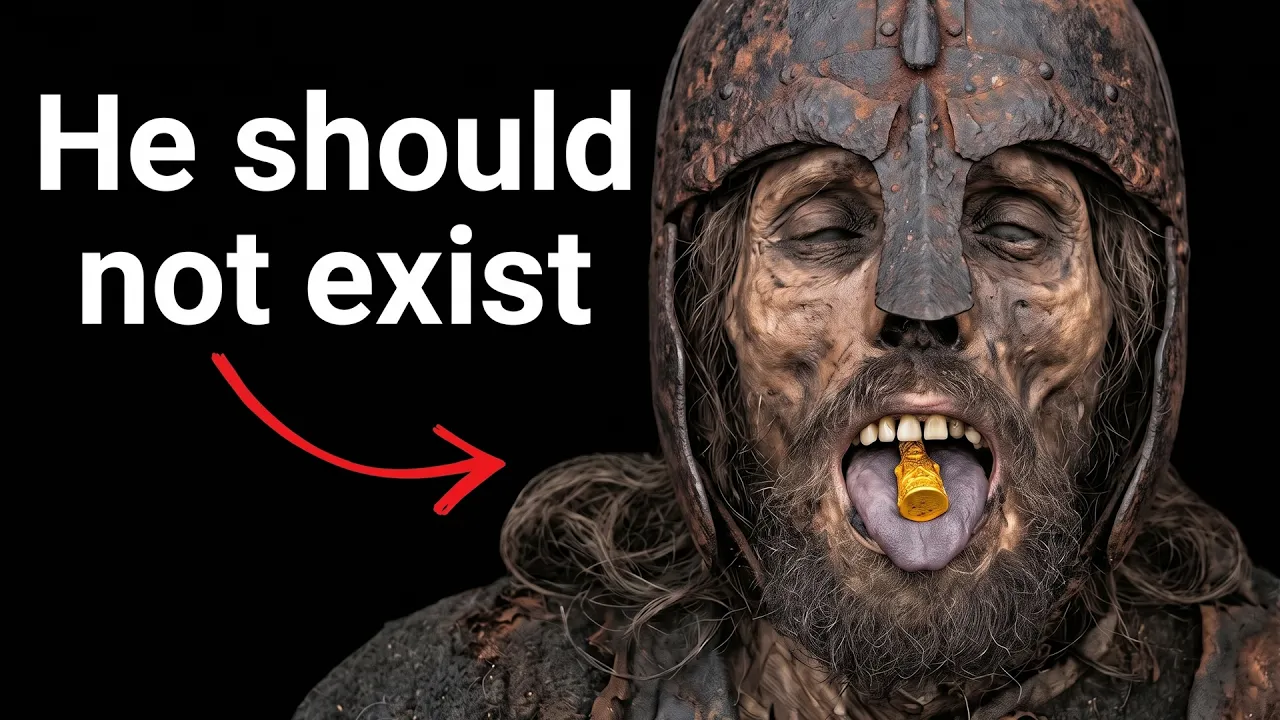
The world we call Viking was already out there taking shape on the water long before anyone wrote it down for the first time, which of course makes sense. You'd almost have to have generations of Vikings just growing and becoming who they were before they would even set sail to somewhere else. Now, here's another thread that is a pinch of salt. By the way, guys, this one this one's going deep. Among all of those hundreds of gaming pieces in the larger ship, one had been placed very deliberately right at the mouth of one of the dead men.
And among these pieces was one shaped differently from the rest, a king. And there is an old story written down in Iceland around 500 years after these men died. And it tells of an early Swedish ruler named Vangar who sailed east on a campaign and he was killed in these very lands. A Swedish king dead in Estonia. You can feel how badly these pieces want to fit. It would be amazing if it was the rich man with the game piece of a king led at his lips.
The saga of the king who died over here. It is so tempting to put a crown on his skeleton and give him that name, but we won't because we're grasping at straws here because there is nothing in the grave that says it was the king. No inscription, no name of any kind, just a gaming piece, and no name tag. And a story written five centuries later is not a birth certificate. The honest answer is we don't know who this man really was, and we almost certainly never will.
So, we just stop there because that's where the evidence takes us to. Just go back one more time to the men that we started with. The old warrior cut down from every side and then laid to rest with such strange and careful tenderness. And the four brothers side by side in the dark of a ship, a family that crossed the sea together and stayed together in death. We can tell you where these men grew up. We can tell you which one of them shared a mother and a father.
And we can tell you in terrible detail how violent the journey ended. Science has drawn all of that out on the bones that lay silent on an Estonian cycle path for more than 1,200 years. And that's it from me, guys. Thank you so much for watching this video on buried earth. The Vikings. I'm We've done two videos now on them, and I'm sure there's many more to come. They're just so fun to learn about. Let us know in the comments section what you thought of this video.
Do you have any insights? And what kind of topics would you love to see me look into and make a video on next? My name's Joe and I'll see you next time.
The words are the caption track's own and nothing is reworded or re-transcribed. Paragraph breaks are placed between sentences so the text reads as prose.
Free tools for your own script: paste a draft and see where it stands before you record it.
Paste your draft and see where viewers are likely to drop off, with a rewrite for each weak line.
Paste the first 30 seconds of your own draft for a hook score and rewrites.
Check your draft against YouTube's advertiser-friendly guidelines before you record it.
Read this channel's public videos and transcripts, and download a writing brief for it.