Getting the transcript
Reading the captions from YouTube. A video nobody has opened here before takes 10 to 30 seconds; this page fills in on its own.
Getting the transcript
Reading the captions from YouTube. A video nobody has opened here before takes 10 to 30 seconds; this page fills in on its own.
Ink Explainer · @Inkexplainer96
This video has no Most replayed graph yet: YouTube shows one only once a video has enough views. These are the moments viewers replayed most in Ink Explainer's most watched videos.
Most replayed moment at 5:21
21.2x that video's typical replay level
roughly 5,200 years ago. That's the oldest direct evidence of string ever found. And then, at Hohle Fels Cave in Germany, they discovered a 35,000-year-old tool carved from mammoth ivory with four holes and spiral grooves, designed specifically for twisting plant fibers
Said at 5:14
Most replayed moment at 3:58
5.5x that video's typical replay level
out by a single event. Instead, a combination of competition, climate change, and shrinking populations gradually pushed them toward extinction. Now, let's talk about the Denisovans. They were different from every other species on this list because we can barely see them. The entire discovery
Said at 3:52
Most replayed moment at 1:24
1.8x that video's typical replay level
called the Natufians about 13,000 years ago. Inside, they found stone mortars carved directly into the bedrock. When they analyzed the residue left in those mortars, they found traces of wheat and barley that had been soaked, germinated, and left to ferment. That's beer, brewed
Said at 1:18
The graph counts replays. It does not show where viewers stopped watching.
Words
2,475
Runtime
10:26
Speaking pace
237wpm
Reading time
10min
237 words per minute, above the 201 75th percentile of 349 measured videos. That distribution comes from the 349-video hook study.
Opening (first 30 seconds)
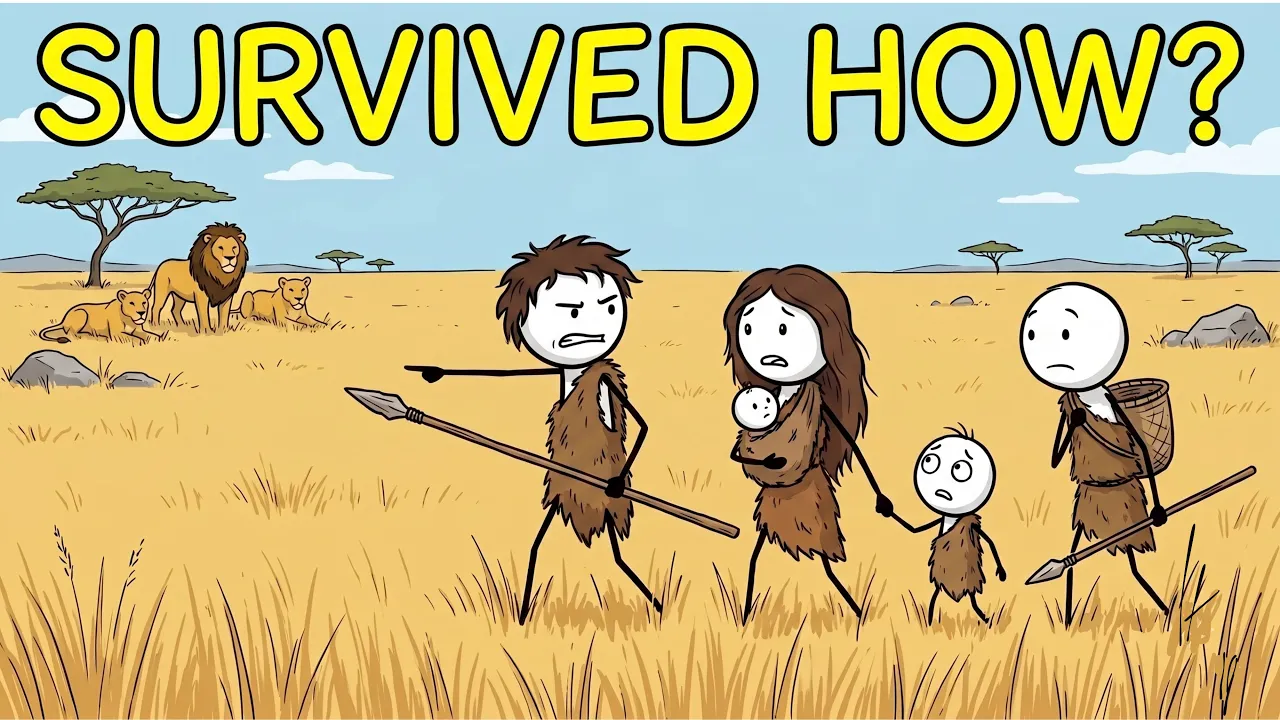
Last night, you walked through the dark without once wondering if something out there wanted to eat you. You locked the door, you switched off the light, and you fell asleep with your back to the window, and nothing about that felt brave. It just felt normal. Now, go back 2 million years. Your ancestor stands about 4 ft tall. He has no claws, no fangs, and no thick hide, and he can't outrun anything that wants to catch him. The sun is going down over the grassland, and he knows exactly what that means. Because somewhere out there in the tall grass, a pair of eyes just opened. For most of human history, the night did not belong
119 words, the words spoken in the first 30 seconds at 237 words per minute.
Free, no signup. See how the first 30 seconds hold attention, with rewrites.
Sentence shape
| Measure | This transcript |
|---|---|
| Sentences | 182 |
| Average words per sentence | 13.6 |
| Longest sentence | 33 words |
| Questions asked | 2 |
| Sentences containing a number | 29 |
Most used terms
Filler phrases
16 in total: like 9 · kind of 4 · actually 3.
A literal whole-word count of the same phrase list the Prepublish browser extension uses, so a phrase inside another word is not counted and a phrase used in its ordinary sense still is. It is a count and not a judgement.
Free, no account. See where attention is likely to drop, with a rewrite for each weak line. The free check shows the scores and the one issue costing the most. Or run it on the words above first.
Free · No login · See a sample audit first if you prefer.
What this transcript is
Every word below is the caption track YouTube publishes for this video, pulled from the video itself and reproduced unchanged. It is not Prepublish's writing, not a summary, and not a re-transcription: it is the video's own published captions. English captions, generated automatically by YouTube, in the video’s original language. Source: the video on YouTube. A channel that would rather this page did not exist can ask for its removal through the contact page, and it is removed.
Last night, you walked through the dark without once wondering if something out there wanted to eat you. You locked the door, you switched off the light, and you fell asleep with your back to the window, and nothing about that felt brave. It just felt normal. Now, go back 2 million years. Your ancestor stands about 4 ft tall. He has no claws, no fangs, and no thick hide, and he can't outrun anything that wants to catch him.
The sun is going down over the grassland, and he knows exactly what that means. Because somewhere out there in the tall grass, a pair of eyes just opened. For most of human history, the night did not belong to us. It belonged to the animals that ate us. Now, you might be thinking that's backwards. Humans were the great hunters. We had spears and fire and big brains, and everything else ran from us. And today, that's true.
But for millions of years, it wasn't. And the proof comes from a child's skull with two small holes in it. So, how did the easiest meal on the savanna become the animal that every predator on Earth is afraid of? To answer that, we have to go into a cave in South Africa. In the 1950s, a scientist named Raymond Dart was studying piles of broken bones pulled out of a cave in South Africa. Some belonged to animals, and some belonged to our early relatives.
And a lot of them were smashed and dented. Dart looked at that damage and saw weapons. He decided our ancestors had used animal bones as clubs, like heavy bats for smashing skulls, and that they were violent hunters who killed everything around them. The idea became known as the killer ape, and for years, that was the story. Humans were born killers. Then another scientist, C. K. Brain, spent years studying a nearby cave called Swartkrans, and he looked at the same kind of damage with fresh eyes.
And one skull stopped him. It was the top of a young child's head dug up back in 1949 and cataloged as SK 54, and it had two small round holes near the back, about 3 cm apart. A club doesn't leave two neat holes like that, but a mouth does. So, Brain took the lower jaw of a fossil leopard found in the same cave, and he lined up its two bottom fangs with the holes. They fit perfectly. That child wasn't killed by another human.
Brain argued it was grabbed by the head and dragged away by a leopard. And once he knew what to look for, he started seeing the same story all over that cave. Our early relatives weren't the killers there. They were the leftovers. And here's the twist. For about 70 years, scientists thought that child belonged to a side branch of the family tree, a cousin species that later went extinct. But in 2024, a new study looked at the shape of the skull again and argued it actually belonged to early Homo, the same group that leads to you.
If they're right, that isn't a distant cousin in the leopard's jaws. That's family. So, who exactly was hunting us? The honest answer is almost everything with teeth. And every one of them had its own way of doing it. Some of the danger came from the sky. In 1924, quarry workers at a place called Taung found the skull of a small child, about 3 years old. It was one of the first fossils of our early relatives ever found in Africa.
And for decades, nobody knew how that child died. Then in 2006, a scientist named Lee Berger looked closely at the eye sockets and found small punctures and scratches in the bone. That same kind of damage shows up today on monkeys killed by crowned eagles. These birds drop out of the sky, grab their prey by the head with their talons, and fly away with it. So, many researchers now think the Taung child was taken by a bird.
For a small child playing in the open, danger didn't only walk on four legs. It could fall straight out of a clear blue sky. Other danger waited in the water. Everybody has to drink, and that makes the riverbank the most predictable place on the whole savanna. At Olduvai Gorge in Tanzania, researchers found the leg and foot bones of our early relatives from about 1.8 million years ago. And in 2012, a scientist named Jackson Njau showed that some of the marks on those bones came from crocodile teeth.
So, every time you knelt down at the water's edge to drink, you were putting your face right next to something that had been lying there all day without moving. But the worst of them came at night. Leopards are ambush hunters. They're strong enough to drag an animal heavier than themselves straight up a tree, and they hunt best in the dark, which is exactly when you can't see anything. So, imagine you're asleep with your group near the cave.
There's no light anywhere. You can't see the edge of the grass, and you can't see what's moving in it. A leopard doesn't charge at you, and it doesn't roar. It creeps closer, low and completely silent, until it's close enough to grab one of you by the head. And by the time anyone wakes up, it's already gone. Brain's explanation for how SK54 ended up in that cave goes like this. Trees grow around the openings of caves like Swartkrans, and leopards drag their kills up into the branches to eat them safely away from hyenas and lions.
When they're done, the bones drop down into the cave below. Over thousands of years, the cave slowly fills up with leftovers. What looked like a killer's trophy room was really a leopard's dinner table. So, you're small, you're slow, and the night belongs to them. Something had to change, or we weren't going to make it. The first answer was the simplest one. Don't be alone. A leopard can take one person walking alone through the grass with almost no risk at all.
But, a group of 20 people is a very different problem. 20 people means 40 eyes. So, somebody is always looking in the right direction. It means noise, because the second one person spots danger, everyone knows about it. And it means a predator attacking one of you has a crowd of screaming people coming straight at it. Baboons still do this today. A single baboon is easy prey for a leopard, but a troop will often gang up on a leopard and chase it off.
But, there was one problem that numbers couldn't fix. Our ancestors used to be good climbers. At night, they could sleep up in the trees, out of reach, the same way chimpanzees still do today. But, over time, their bodies changed. Their legs got longer, which made them great at walking across open ground, and their arms got worse at climbing. We gave up the trees so we could travel farther. And a lot of researchers think that's when our ancestors started sleeping on the ground in the dark, at the same level as everything that wanted to eat them.
And this is where the story turns, because the answer to that problem changed human history more than almost anything else we've ever done. Fire. At Wonderwerk Cave in South Africa, researchers found burned bones and plant ash lying exactly where they burned about 1 million years ago. It's some of the oldest solid evidence that our ancestors were using fire. Here's why that mattered so much at night. Most wild animals keep their distance from fire.
It's bright, it crackles, it moves in ways they can't predict, and it smells like danger. So, a fire in the middle of camp works like an invisible wall. And it does a second job that's just as important. It gives you light. A leopard's whole plan is to reach you before you see it. But, in firelight, the grass around the camp lights up, and a predator's eyes reflect the flames back at you like two small glowing coins.
The ambush stops working because now you can see it coming. So, the camp became a circle of light and everything outside it stayed dark. Inside that circle, you could sleep, you could talk, you could finally let your guard down. But fire only protected you at night and only inside the camp. When the sun came up, you still had to walk out into the grass to find food and out there, the fire couldn't help you. So, we needed a way to fight back from a distance and the answer had already been sitting in our shoulders for a very long time.
You're the only animal on Earth that can throw something hard and hit what you're aiming at. A chimpanzee is stronger than you, but it can only throw it about 20 miles an hour. The fastest baseball pitchers throw it over 100. And in 2013, a scientist named Neil Roach figured out why. When you pull your arm back to throw, the tendons and ligaments in your shoulder stretch like the rubber band on a slingshot. They store up energy.
And when you let go, all that energy snaps forward at once, much faster than your muscles could ever move on their own. Roach found that our shoulders started working this way around 2 million years ago. Now, picture what that meant out on the savanna. A predator walks toward your group. Instead of running, 10 people pick up rocks and start throwing them hard from far away all at the same time. Suddenly, the predator is the one getting hurt and most predators won't risk an injury because a hunter that gets hurt can't hunt and a hunter that can't hunt starves.
So, it backs off. Some researchers think our ancestors went even further and started taking food away from big cats instead of running from them. And we can still see how that works today. In Kenya, a camera crew filming the BBC series Human Planet recorded three Dorobo hunters walking straight toward a pride of lions feeding on a wildebeest. They didn't run and they didn't hide. They walked in slowly and confidently.
The lions backed away and the men cut off a leg of meat and walked back out with it. I'll leave a link to that clip in the description because honestly, you have to see it to believe it. That kind of nerve took a very long time to build. But a rock only reaches so far and a rock won't stop a lion for good. Spears are almost certainly older than any we've found because wood rots away. The oldest piece we have is a broken wooden spear tip from England about 400,000 years old.
But But the 1990s, archaeologists digging in an open coal mine Schöningen in Germany found something that almost never survives, complete wooden spears. They found about 10 wooden weapons buried in wet mud that kept them preserved for about 200,000 years. They were most likely made by early Neanderthals, our close cousins, and they were lying next to the bones of dozens of horses that had been hunted and butchered. But the most surprising thing is how they were built.
Each one is around 2 m long and the heaviest part sits toward the front of the shaft, the same way a modern javelin is balanced, so it flies point first. And in 2019, a team led by archaeologist Annemieke Milks handed exact copies to trained javelin throwers. They hit targets up to 20 m away, hard enough to kill. These weren't just sharpened sticks, they were built to be thrown. And that changed everything about danger.
A spear lets you hurt something from far away and distance means the claws never reach you. So a group of humans could stand in front of a big animal and actually win. The prey had started hunting back. And then something happened that nobody expected. The animals noticed. In 2023, a team led by ecologist Leanne Zanette went to Kruger National Park in South Africa, which is home to one of the biggest lion populations left on Earth.
They hid speakers and cameras at 21 waterholes. When an animal came to drink, a speaker played a sound. Sometimes it was lions snarling and growling, sometimes it was dogs barking or gunshots, and sometimes it was just people talking in a calm, normal voice. You'd expect the lions to be the scariest sound out there. They're the ones actually killing animals in that park, but that's not what happened. About 95% of the species ran away more or left the water faster when they heard people talking than when they heard lions.
They were twice as likely to run and they left about 40% faster. Giraffes, zebras, and hyenas all ran. Elephants and rhinos abandoned the waterholes. And in one video, a leopard hears a few people chatting, drops its fresh kill, and runs. Scientists still debate how much of that fear is ancient and how much comes from modern hunting. But either way, the animals have made their choice. The same kind of animal that once dragged our early relatives up into trees now runs from the sound of our voices.
So here's the full picture. For millions of years, we were the leftovers in a leopard's cave. Eagles took our children out of the sky. Crocodiles waited for us at the water, and the night belonged to hunters who could see in the dark. So we stayed together, and more eyes meant fewer surprises. Then we tamed fire, and the dark finally had a wall in it. Our shoulders learned to throw, and predators learned that we fight back.
Then we built spears, and the hunted became the hunters. Last night, you walked through the dark and didn't feel a thing. You slept with your back to the window. The only glowing eyes in your house probably belonged to a cat asleep on the couch. Most of us have never once had to lie awake wondering if tonight is the night something drags us out of bed. And that isn't because the predators went away. Leopards still hunt at night.
Crocodiles still wait at the water. You feel safe because millions of years of small, slow, frightened people refused to be eaten one fire, one rock, and one spear at a time. The eyes in the dark are still out there tonight. The difference is that now, when they hear us coming, they're the ones who run.
The words are the caption track's own and nothing is reworded or re-transcribed. Paragraph breaks are placed between sentences so the text reads as prose.
Free tools for your own script: paste a draft and see where it stands before you record it.
Paste your draft and see where viewers are likely to drop off, with a rewrite for each weak line.
Paste the first 30 seconds of your own draft for a hook score and rewrites.
Check your draft against YouTube's advertiser-friendly guidelines before you record it.
Read this channel's public videos and transcripts, and download a writing brief for it.