Getting the transcript
Reading the captions from YouTube. A video nobody has opened here before takes 10 to 30 seconds; this page fills in on its own.
Getting the transcript
Reading the captions from YouTube. A video nobody has opened here before takes 10 to 30 seconds; this page fills in on its own.
Five Minutes Late with Jesse Grant · @fiveminuteslatepod
This video has no Most replayed graph yet: YouTube shows one only once a video has enough views. These are the moments viewers replayed most in Five Minutes Late with Jesse Grant's most watched videos.
Most replayed moment at 5:15
11.2x that video's typical replay level
watching this right now, proves that there is some sort of thread that you're unraveling, and that you will follow down the line. Which leads us to the second pillar of the intellectual life, which is that only a few books are
Said at 5:08
Most replayed moment at 7:33
15.7x that video's typical replay level
another person." And so it's much more about the real world application on top of the theory. With that said, moving on to lesson number three from Napoleon, which is to revisit core books all the time. Now, Napoleon wouldn't just read a
Said at 7:25
The graph counts replays. It does not show where viewers stopped watching.
Words
5,012
Runtime
29:47
Speaking pace
168wpm
Reading time
21min
168 words per minute, between the 160 25th percentile and the 181 median of 349 measured videos. That distribution comes from the 349-video hook study.
Opening (first 30 seconds)
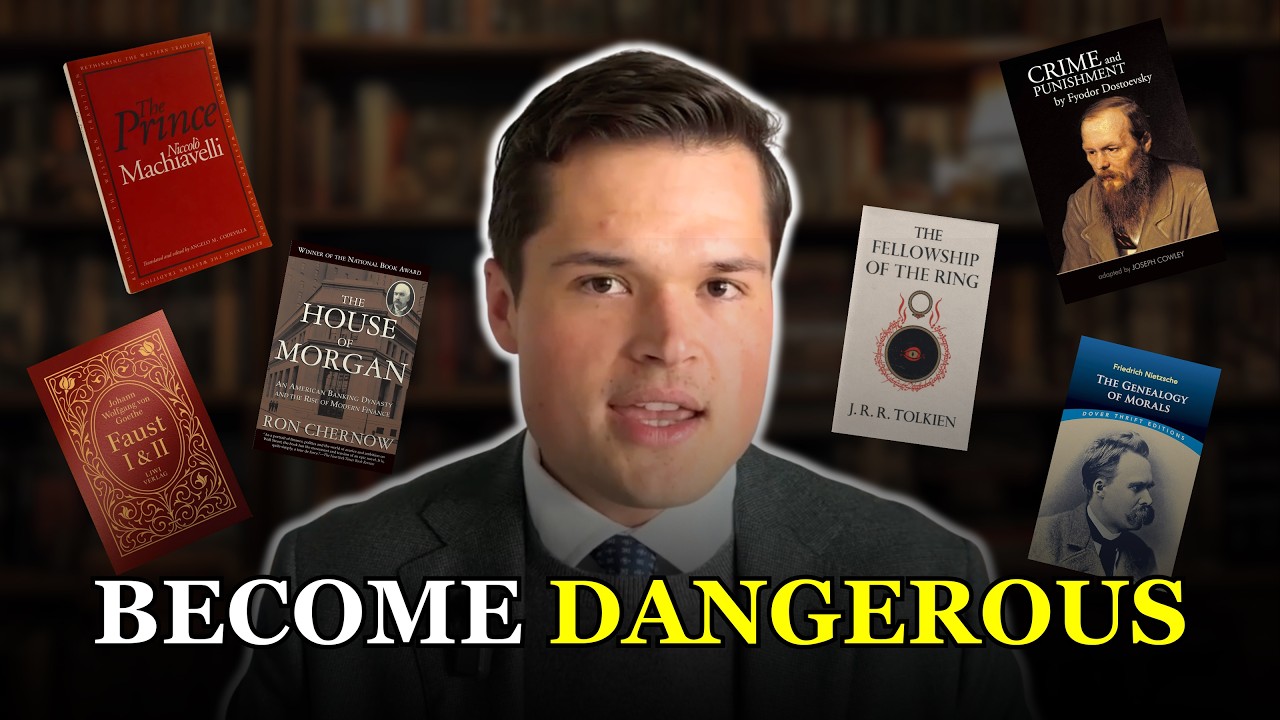
In today's video, I want to discuss the 17 books I think are mandatory reading for anybody who wants to pursue a self-education and self-intellectualization journey. And these books are going to be from all different walks of life, from all different belief systems, from all different philosophies, from all different political perspectives. But I think that's the most important thing you can do as a self-educated person in order to develop an intellectual mind in order to develop a capable mind, a dangerous
84 words, the words spoken in the first 30 seconds at 168 words per minute.
Free, no signup. See how the first 30 seconds hold attention, with rewrites.
Sentence shape
| Measure | This transcript |
|---|---|
| Sentences | 242 |
| Average words per sentence | 20.7 |
| Longest sentence | 95 words |
| Questions asked | 1 |
| Sentences containing a number | 18 |
Most used terms
Filler phrases
116 in total: uh 68 · um 27 · actually 10 · like 5 · sort of 2 · I mean 1 · basically 1 · kind of 1 · you know 1.
A literal whole-word count of the same phrase list the Prepublish browser extension uses, so a phrase inside another word is not counted and a phrase used in its ordinary sense still is. It is a count and not a judgement.
Free, no account. See where attention is likely to drop, with a rewrite for each weak line. The free check shows the scores and the one issue costing the most. Or run it on the words above first.
Free · No login · See a sample audit first if you prefer.
What this transcript is
Every word below is the caption track YouTube publishes for this video, pulled from the video itself and reproduced unchanged. It is not Prepublish's writing, not a summary, and not a re-transcription: it is the video's own published captions. English captions, generated automatically by YouTube, in the video’s original language. Source: the video on YouTube. A channel that would rather this page did not exist can ask for its removal through the contact page, and it is removed.
In today's video, I want to discuss the 17 books I think are mandatory reading for anybody who wants to pursue a self-education and self-intellectualization journey. And these books are going to be from all different walks of life, from all different belief systems, from all different philosophies, from all different political perspectives. But I think that's the most important thing you can do as a self-educated person in order to develop an intellectual mind in order to develop a capable mind, a dangerous mind is you have to be able to read books and understand every different perspective and be able to internalize them, intellectualize them, and either agree or disagree or pick small bits that you agree or disagree with from within those books.
Because I think we live in a day today where due to social media and the internet, it can be really easy to just align yourself with one position or only read books that continue to speak about one specific perspective or one specific philosophy. But if you really want to be a self-educated person and you really want to have deep ideas and think about things in a more nuanced and more clear way and understand the world in a more clear way, you can't just read things that you agree with and you can't just read things from your own perspective.
You have to know exactly what you're agreeing with and exactly what you're disagreeing with. And so today's video is going to be broken up into three different segments with these 17 books fitting across three different segments with the first one being the books that are mandatory reading in order to understand the modern world that we live in in order to understand modernity. The next segment of books will be books in order to understand religion in a different way in a deeper way from all different religions from Catholicism to Hinduism to to Islam as well.
And then the third and final section of books will be books to understand the human psyche because I think in order to be a fully uh self-educated person, you have to be able to understand ideas from all three of those sections. And so without further ado, let's get into the first section which is understanding modernity, understanding the modern world that we live in. And the first book I want to recommend here is Theodore Dosski's Brothers Karamazov.
Now for me, this is uh his greatest book he's ever written. And honestly, for me, it's the greatest work of literature I've ever read, the greatest fiction book I have ever, ever read. And the reason being is because it has all the different ideologies, all the different perspectives that are girdling underneath modernity that have helped guide modernity. In many ways, when this book was written, it predicted the very battles, the very ideas, the very philosophies that we are dealing with today in our world in the 21st century, despite this book being written in the 19th century itself.
And so for me, it's one of the most intellectually honest books because it's not a book that pushes just one perspective. Despite the fact that Dossi was a Christian, he also poses, I believe, the greatest argument for atheism within this book while also posing one of, if not the greatest arguments ever found in literature for God as well. He he doesn't strawman any arguments. He really allows you to understand all the different ideologies even beyond uh religious ideologies when it just comes to worldview and politics.
Everything that we're discussing today in the public forum, everything that matters today is within this specific book. And I think if you want to understand the conversations that we are having today and understand the modern world in a deeper way, you have to read the brothers karamatsov. It is absolutely mandatory. I cannot recommend it enough and it also helps you understand the east in a way that uh many other books don't and when so many conversations today are about the east as well uh this book is definitely worth reading to understand more eastern perspectives as well.
But with that said, moving in to the second book to understand the modern world that we live in. This book I put on my previous list of 17 books you have to read, but I'm going to say it again because it's that fantastic. And it is The House of Morgan. This book uh chronicles the Morgan banking family uh how they came to be, how they came to power, how they came to revolutionize the modern banking system. And that's why it is most definitely an important read and a great read because by reading this book you will have a deeper understanding of how the modern banking system actually works.
How how money today actually works and you'll understand how that came to be as well. And then of course one of the most important things in order to understand the world is to understand the economy. Money it's the underpinning of almost everything and it's the transaction of almost anything. So this book is definitely definitely a must-read to understand the modern world that we are living in. Moving on to the third book and this is Decart's meditations on first philosophy.
This is the book which has the famous line I think therefore I am which is the grounding for a lot of different philosophies and modern ideologies that have come out of that. We live in a time of much more self-determination, uh much more relativism, and all of that comes out of Daycart's ideology, comes out of Daycart's writings. And many people out there argue about whether Daycart meant uh one thing when he said that.
Many people argue he meant another. And uh of course, none of us truly know what Daycart truly meant. Um but that doesn't change the fact that this book and this ideology and this philosophy has helped uh birth many modern ideas and has helped create the world that we are living in today. I think this book is a definite must-read if you want to understand uh philosophy in a more contemporary sense. If you want to understand what you're agreeing with, what you're disagreeing with, uh this will contextualize everything in a much more clear way so you understand what we're actually talking about today. when it comes to almost everything philosophical in the modern world.
Moving on to the fourth book. This is of course a must-read to understand anything and that is The Prince by Mackie. Now, of course, everyone knows this book. They know what it's about. It's about power. It's about politics. It's about how how the world uh is formed around power. But I also think this book doesn't get the credit it deserves for almost shaping and revolutionizing the world. This book breathed in a a world view that didn't exist before into the world that we are living in today.
And I think nature uh very much pulled from this book and we like to say that we live in a nichian world. But I do have to say we also live in a world that Machaveli uh brought to be. He wasn't just an evil guy who talked about evil ideas of of power and he also wasn't just a good guy who perhaps was giving a warning about how power is used. He was actually something much more deeper and wrote about something uh I think much more important in more ways than just the superficial way of looking at power.
And of course to understand politics to understand business this book is is definitely a must readad. And then moving on to book number five, we've got Beyond Good and Evil by Nature. This is a book that was definitely inspired in some way by The Prince by Machaveli, but it's also a book which uh transformed the world in its own right. And we live in a world that has been transformed by nature. And I think what this book is really good for and why it should be a must-read for everybody is because whether you agree with what nature is saying or disagree with what nature is saying, you have to say that his uh his autopsy of the modern world, his his dissection of the modern world is very accurate.
You can disagree with the perspective. You can disagree with the philosophy. But you have to say that his uh diagnosis of the modern world is accurate and then because of that you have many other ideas that you need to reckon with and discuss and and basically this book really gets into the nitty uh nitty-gritty of the modern world. And I think it's a great one to disagree with and agree with in some elements as well.
I don't think it really matters here. I think if you really take this book seriously, there will be bits that you absolutely despise and bits that you absolutely love and those bits will be different for everybody. I think this is a book that's really great to write in the margins with to highlight bits and argue with nature himself and of course all of us are probably inferior intellectually to nature but it is a good one to sort of grapple with in that way and it's a challenging book and I think in a self-education journey uh you need to read books that challenge you in a very very deep and profound way and then moving on from there to book number six we've got the rebel by Albear Kimu.
I think this is the best book to understand revolutions and I think we live in a world today which is uh very much within a lot of different revolutions due to social media uh due to modern politics. You have a lot of different ideologies and ideologues and revolutionaries rising up and I think this book uh dissects the mindset and philosophy of revolutions. dissects the danger in them as well. Um, I think this is a must-read to understand the modern world most definitely and it was written during one of the worst times in human history.
Uh, it was written back in the uh mid early 20th century which was just a a just grotesque violent time, a very divided time and of course today we're living in a world that is quite fragmented itself. And so I think to understand the modern world today, this is most definitely a must readad. Next on the book, this is an obvious one. This is George Orwell 1984. I think everybody's probably read this book. And if you haven't, you probably know what it's uh about, what the idea is here.
It's about a kind of some say he's predicting, some say he's just imagining a doomsday scenario about the dangers of uh of politics and government in a certain sense. You have people who say this is a book that's attacking communism. You have others that say this is a book which is pro-communism. Uh and of course this is something which I do find quite funny is people just claim this book no matter what side they are and use it to argue their point.
But I think regardless what opinions and perspectives you have, this is a must-read. You have to read this book. Um, it's just a truly great one. Issues many warnings. And of course, some of it is coming true in some way. Um, and I think if you go into this book thinking, oh, I want to disagree with it or I want to agree with it or I want to take it and claim it for my own political opinion and my own political biases.
You will miss the point. I think when you are trying to go on a self-education journey, when you are trying to take books seriously, I think you need to go into this one with a clear mind, a fresh mind. Just read it and see how the book affects you and impacts you. Uh and don't go in with the binary approach to politics. I think this book sits above uh the modern contemporary political divides. This cuts much deeper.
This gets to the heart of human nature and societal nature and how society organizes itself in many different ways. A truly important book. Go out and read it if you haven't. If you live under a rock and you've never heard about it, please go and purchase this book. Next on the list, I've got Mrs. Doway by Virginia Wolf. And why I've put this book in here in into understanding the modern world is because this book is very much about how the human mindset, the human worldview, the human philosophy has changed due to the industrial revolution and the way that we have restructured society, restructured our lives, restructured how we all operate together.
And for better or for worse, this book explores how that has changed our minds. How almost we are different humans in a in a way. We are different to the humans that existed just 150 years ago. Th those times are over and the modern times that we have built have had an effect on our minds which have changed us in some way. This book is very interesting. Um it's quite uh dark. It's quite sad. It's quite gut-wrenching at times. truly a fantastic masterpiece of literary work.
Next on the list, I've got Plato's The Republic. This is for obvious reasons. Of course, this outlines so many different ideas around justice and and uh and how we should structure society and structure the world. And people pull from it for democracy. people pull from it uh for for other political ideas and and phil philosophies as well and so societal ideas. It's truly just a fantastic piece of literature and Plato is just a a one-of-a-kind thinker and I think he's got to be at the foundation of any sort of intellectual journey.
If you are looking to learn more about the world, learn more about yourself, learn more ideas, understand things at a deeper level, you've got to start with Plato. And there are many other great books uh pulling from Plato, but this one for me is is the best and most foundational work that you should read from Plato to understand Plato and understand the world and really learn a lot from it. Then next on the list is a little bit of a different one, but this is White Knights from Dostki.
This is a really short book that DSTVKI wrote. It's a love story. You may be thinking, why is this on this list on on trying to develop a better mind and understanding the modern world? But for me, something about understanding the modern world is also understanding human relationships. And what white knights is about is about how the the modern view, the contemporary view on love and romance, dstvki believed, corrupted romance and love itself.
And that too often today we view love as not a commitment to another person, but just a mere emotion. And so then when you fall in love with the idea of somebody or you're in the honeymoon phase, whatever it is, then you get into the nitty-gritty of a proper relationship, you have ups and downs and people are abandoning others when they are in that low period, that down period because they feel like love should be an emotion, a good emotion.
And when you don't feel good, all of a sudden that means you're not in love. Dossiki believed this was a complete erosion of the meaning of love which goes beyond just relationships but goes to your family, goes to your friendships, goes to your community, everything. And he believed that this corruption of the idea of love was having profound negative effects on the world. And this is a piece of literature which explores how that happens, why that happens, and beyond literature, it's really just a great piece of psychoanalysis and a great piece of contemporary analysis and pretty much predicted uh the modern world that we live in today.
When it comes to relationships and love and the way we connect with others, uh we have forgotten um a bit of that duty, a bit of that commitment. And I think this book is just fantastic. And I think when you are on an intellectual journey, it's important to not just get caught into more intellectual ideas, academic ideas or um or economic ideas, but also think about relationships. Think about the smaller, more intimate parts of the world because that is just as important in developing a strong intellect, a strong mind, and having a clear understanding of what's really going on.
What's going on within yourself, what's going in with within others, and what's going on within your relationship with others as well. Moving into section number two into religion at book number 11, I've got the Suma Theologica by uh Thomas Aquinus, who I think is probably the greatest intellect uh to ever come out of the Catholic Church, to ever come out of the Catholic uh theological tradition. Truly the best writer.
I mean, he his work is just fantastic. Whether you're Catholic, whether you're Muslim, whether you're agnostic, whether you're atheist, it doesn't matter. uh his work is profound and I think in order to have an understanding about the theological tradition in order to have the best understanding about theological arguments it's much better to read uh the Suma theologica by St. Thomas Aquinus than it is to watch a Jubilee video.
For example, I think when we're on a a journey of theology or philosophy or just an intellectual journey, it can be easy to go down the rabbit hole of watching YouTube videos and content and podcasts about this stuff. But none of that gets remotely close to the level of depth, understanding, intellect, and philosophy that Thomas Aquinus uncovers within this piece of work. Truly a a fantastic mind and a mind that has been read by all the serious thinkers whether they are atheist, whether they are uh Muslim, whether they are Hindu, they've all pulled from from Suma Theologica, they've all pulled from St.
Thomas Aquinus just a mind beyond his years written in the middle ages. But it reads like something that you could only achieve today given all the information we know and all the books we have available to us. How he was able to have the ideas he had. How he was able to write what he wrote back then. I will never ever know. And then moving on to book number 12. This is this of course has to be here and it is the Bhagavat Gita which is a Hindu book but a great book to read no matter if you're Hindu or not.
I'm not Hindu but I absolutely love this one as a read because it goes into ideas of of duty and God and God's relationship with the world um and understanding it in a spiritual way. I I I just love this book. I think it's one of those books where when you read it, you're going to be highlighting line after line after line, and you're going to think, "Geez, I'm just highlighting the entire page here." You can spend 15 minutes, 20 minutes on just one page, uh, thinking about it.
Uh, sometimes arguing with it, sometimes contemplating it, um, sometimes it'll force you to put the book down. But truly a fantastic book and a a must- readad in order to have ideas about theology and religion. no matter what uh religion or lack of religion you are. Then moving on to book number 13 and this is the Tao Ting by Laozer. Now Laur was a Chinese philosopher, a Chinese thinker um and truly phenomenal. And what this book did also was inspire CS Lewis himself.
Um who pulled from ideas of the tow as this book is about living in harmony with the towel. Um in other words, it would be translated to the way uh the way of life, how you should operate in life, how you should live in harmony. And I think what's great about this book is it's something that allows you to gain an understanding of the Chinese philosophy as well. Um I was very lucky as a kid to live in China uh for some time of my childhood actually for a lot of time of my childhood due to my parents' work living overseas um as they were journalists and they were stationed there in Beijing and uh I think this book is a great one for someone who's never been to China or has never lived in China to understand the Chinese mind and the Chinese philosophy.
Um, Lousa is is just phenomenal, a truly great thinker and I think this is his best work and probably his most accessible as well. And of course, it inspired CS Lewis. So, you don't have to be um, you know, familiar with China. You don't have to be from China. You don't have to live in China. Um, you can be whatever religion or ideology and you can gain a lot from this book. leading in to book number 14 which is the uh Mukadima by Iben Kaldun.
Now this book is a a Islamic book but it's different rather than just reading the Quran which I've put into my other video of 17 books that are must readad. I think this book is really great because it pulls from the Islamic teaching, the Islamic ideas and also has things to say about the economy and the western economy that we operate in today actually took a lot of ideas from this piece of work from this book from this ideology from this way of looking at society looking at the economy and I think a lot of people don't realize this but there is a big uh Muslim and Arabic influence in the western economy.
Um, and I'm not Muslim, but it is something which is great to read if you truly want to have a deeper idea about the world. If you truly want to approach things with intellectual honesty, this is an important read. It will you will see a lot of comparisons or you'll be able to draw a lot of comparisons from this book into the modern economy that we're living in today and see how a lot of it was influenced uh from this work as well.
That wraps up the religion section. And then for the final three books, which is in the section uh part three of this video, which is understanding the human psyche, it's not enough to just understand the world you're living in. It's not enough to just understand uh religion and theology at a deeper level. But it's also important, I think, on an intellectual journey to understand how the human mind actually operates.
And something I just have to put in here because it's probably had the best effect on me on understanding the human uh psychology, understanding the human psyche. I think it's the greatest um way to understand how how the human mind actually operates and the most fun way to gain knowledge here. And this is book number 15, which is just the collected works of William Shakespeare. I think he is the greatest storyteller that the world has ever produced.
Um, I don't put him as my favorite writer, but I do say he's the best storyteller and I think his works are the best work of clinical psychology. I think before clinical psychology was even a thing. Uh, his plays are just fantastic to understand how we operate with one another, how the human mind works, and you can continue to just unravel and meditate and contemplate on the ideas that William Shakespeare goes over in all of his plays.
And it goes beyond ideas too. I think so often when it comes to intellectualizing the human mind, you can just think of philosophy and ideas and science and uh and how the brain operates and fight or flight models, whatever it is, but this humanizes it. This pulls it into societal context. Shakespeare puts it in ways that makes it intimate, that makes it personal, that makes it in a way where it's not just like you're reading a document and learning about the human mind, but you're actively experiencing the human mind when you read or go and watch Shakespeare.
I obviously recommend to go and watch it. They were written to be watched and to be acted out and to be embodied in that way rather than just read. But of course, it's hard to uh to go and see Shakespeare all the time. And so, get a a big book of the collected works of William Shakespeare. More bang for your buck than buying them individually. And read all of them many times over. Just fantastic storyteller, my favorite storyteller ever.
Not my favorite writer, but definitely my favorite storyteller and something you have to read in order to understand the human psyche. Moving into book number 16 and this is the interpretation of dreams by Sigman Freud. Now Freud I think birthed the modern world of psychology, the modern world of the mind. He he coined many ideas. He invented many ideas about the mind which has been either proven to be true or just seen as true because he was able to coin them. because he was able to pinpoint them and almost just write them into existence.
But Sigman Freud uh he is the uh underbelly. He is the foundation. He is the grounding of all works of modern uh psychology of modern psychiatry understanding the human mind. Just a must readad um and even on top of uh reading his works I will throw in a great movie as well um which is Freud's last session. go and watch Freud's last session as well as a little bonus. It won't give you the full understanding of the human mind, but it's a great uh piece of storytelling, a great film to understand Freud himself and then go and read his works, especially the interpretation of dreams, which is probably his most foundational work, his most famous work and his most accessible work as well.
Which leads us in to the final book, book number 17, which is Crime and Punishment by DSTVski. Again, DSTVKI gets three books in the top 17. You can tell uh that I like him. And the reason I'm putting crime and punishment in here uh in terms of understanding the human psyche is because this book really gets into how we decide ultimately ourselves what good and evil is and how that decision isn't as isn't as clearcut as we may think.
We may think that if we decide to do something or we see something as right and just in our own mind that then when we act it out, we will be fine with it. It will be okay. But sometimes that doesn't happen. And in Crime and Punishment, what happens with the main character is he believes that doing a specific action is actually the right thing to do. um even though it goes against the common law, the common principle, the commonly held belief, he does it and it comes back to bite him in a very personal internal mental uh way.
Which is why I say this book is definitely a must-read to understand the human psyche because we all make these decisions all the time. And sometimes it's not as clear-cut as we think. And we do live in a world where it's all about my truth, your truth, and subjective truth. But I think this is the best argument for objective truth because sometimes when we decide we want to do something and we think it's okay, we then learn after the fact that it was not okay. and we learned that ourselves even though we didn't think that would happen.
We thought we were acting out our own truth. Turns out our own truth didn't actually exist. I think that's the argument this book puts forward. Um and it is just a truly a masterpiece work of literature. So go out and read Crime and Punishment by DossiKi most definitely. Um and that wraps up these 17 book recommendations uh to to try and build your mind in the best way possible. I hope you guys enjoy it. Um, I don't want to go too deep into all of these books because I want to leave it for you guys to experience yourself, but I hope that my recommendations inspire you to go out and read all of these books.
I hope this helps in some way. I did make a video which was similar to this a few months ago. Go back and watch that one because there are some books which have overlapped, but there are also some books which are different and new because of course I didn't just want to make the same video again and talk about the same books again. I wanted to have some new recommendations and new ideas here as well. But hope you guys enjoyed it.
Go out and read these books. Thank you all for the support on the channel, the continued growth of the channel. I'm truly blown away. And um yeah, hope you guys liked it. And until next time, take care.
The words are the caption track's own and nothing is reworded or re-transcribed. Paragraph breaks are placed between sentences so the text reads as prose.
Free tools for your own script: paste a draft and see where it stands before you record it.
Paste your draft and see where viewers are likely to drop off, with a rewrite for each weak line.
Paste the first 30 seconds of your own draft for a hook score and rewrites.
Check your draft against YouTube's advertiser-friendly guidelines before you record it.
Read this channel's public videos and transcripts, and download a writing brief for it.