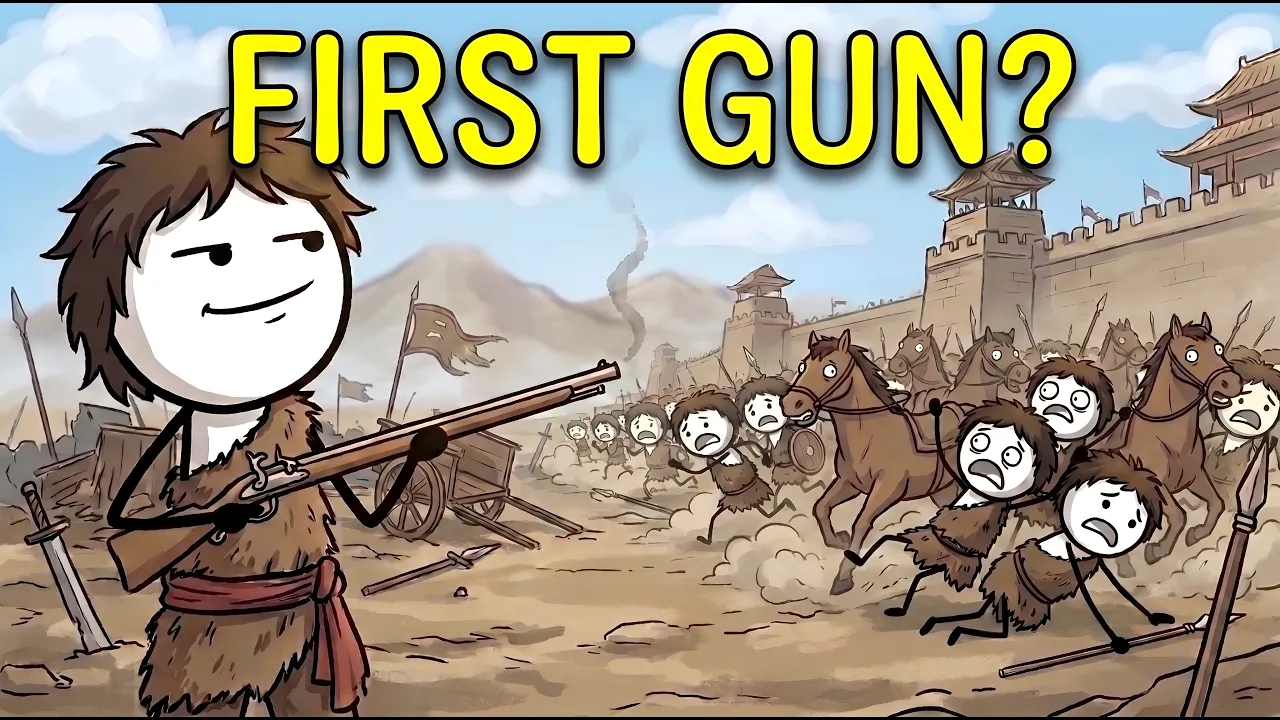
How Did Human Accidentally Invented Guns? transcript
Ink Explainer · @Inkexplainer96
Words
2,735
Runtime
12:47
Speaking pace
214wpm
Reading time
11min
214 words per minute, above the 201 75th percentile of 349 measured videos. That distribution comes from the 349-video hook study.
Opening (first 30 seconds)
Somewhere on Earth in the next 2 minutes, a human being is going to be shot. That's the average and it holds every single day. There are more than a billion guns on the planet right now, roughly one for every eight people alive. But how did we even get here? Because not a single one of these guns was ever supposed to exist. The men who started all of this weren't trying to build a weapon at all. They were trying to make a medicine, a medicine for living forever. So go back 1,200 years and imagine that job is yours. You just landed in China
107 words, the words spoken in the first 30 seconds at 214 words per minute.
Sentence shape
| Measure | This transcript |
|---|---|
| Sentences | 215 |
| Average words per sentence | 12.7 |
| Longest sentence | 41 words |
| Questions asked | 3 |
| Sentences containing a number | 30 |
Most used terms
- fire21
- tube15
- years11
- gun10
- medicine10
- powder10
- weapon8
- flame7
- hands7
- inside7
- walls7
- burned6
Filler phrases
13 in total: like 8 · basically 2 · kind of 2 · actually 1.
A literal whole-word count of the same phrase list the Prepublish browser extension uses, so a phrase inside another word is not counted and a phrase used in its ordinary sense still is. It is a count and not a judgement.
What this transcript is
Every word below is the caption track YouTube publishes for this video, pulled from the video itself and reproduced unchanged. It is not Prepublish's writing, not a summary, and not a re-transcription: it is the video's own published captions. English captions, generated automatically by YouTube, in the video’s original language. Source: the video on YouTube. A channel that would rather this page did not exist can ask for its removal through the contact page, and it is removed.
Transcript
Somewhere on Earth in the next 2 minutes, a human being is going to be shot. That's the average and it holds every single day. There are more than a billion guns on the planet right now, roughly one for every eight people alive. But how did we even get here? Because not a single one of these guns was ever supposed to exist. The men who started all of this weren't trying to build a weapon at all. They were trying to make a medicine, a medicine for living forever.
So go back 1,200 years and imagine that job is yours. You just landed in China and you're an alchemist, half scientist, half wizard. And the emperor himself is paying you to find the secret to eternal life. And today you're fully locked in. You're testing a new recipe. You grind a yellow mineral, some burned wood, and a strange white crystal into one bowl. You lean in close and your entire workshop explodes. Your hands are burned.
Your face is burned. The building is catching fire around you and you have no idea that you just made the most important mistake in human history. Because that flash in your bowl is going to spend the next thousand years getting better at one thing and every single [clears throat] fix will create a brand new way to die. So how does that happen? But before we get into that, let's see what gunpowder looks like after 1,200 years of upgrades.
Which brings me to today's sponsor, World of Warships. World of Warships is a free-to-play online multiplayer game with over 850 ships from 13 [music] different nations. Destroyers, cruisers, battleships, aircraft carriers, and even submarines. You name it and this game has it all. And every ship is recreated from real historical documents and blueprints from the first half of the 20th century. So it's basically a floating museum, except you get to take the exhibits into battle.
What I like most is that every class plays differently. [music] So winning isn't just about firepower, it's about strategy, positioning, and knowing when to strike. The visuals have had a major overhaul, too, with new maps, improved lighting, storms that can roll in during battle, and water that looks incredibly real. You can head into combat alone or team up with [music] friends and hunt as a pack. And with new ships, nations, events, and cosmetics added every month, there's always something new waiting for you.
Whether you're returning after years away or stepping aboard for the first time, now is a great time to jump [music] in. Use my link in the description or pinned comment with code Impact Force and you'll receive 20 days of premium, the Japanese cruiser [music] Tenryu, a commander, a port slot, and all the other rewards shown on screen completely [music] free. Thanks to World of Warships for sponsoring this video. All right, back to the question that started all of this.
How does a failed medicine become the machine that changed everything? Well, the first thing you need to know is that your explosion wasn't rare. All across China, alchemists were blowing themselves up chasing the exact same dream. Because this wasn't some fringe hobby. The hunt for immortality was the biggest research project on Earth. And the emperors weren't just paying for it from a safe distance. Whenever their alchemist produced something promising, they drank it, which was a terrible idea.
Because the recipes were loaded with mercury and arsenic. Several Chinese emperors died exactly like that, poisoned by their own immortality potions. The potion for living forever had a body count. But those three ingredients in your bowl were something different. The yellow mineral was sulfur, which they used to treat skin problems. The burned wood was just charcoal, the same stuff you barbecue with. But the white crystal that was the special one.
It was saltpeter, a crust that grows naturally on cave walls, in damp cellars, and on old manure piles. Yes, one of the main ingredients of gunpowder is something people scraped off dirt animals had peed on. And we know these explosions really happened because around the year 850, a Chinese text finally wrote them down. It wasn't a recipe, it was a warning. It described the mixture bursting into flames, scorching hands and faces, and burning entire buildings to the ground.
The first written record of gunpowder in human history is basically one alchemist telling everyone else, "Guys, stop doing this." And here's why it kept exploding. A normal fire has to pull oxygen out of the air, and that takes time. That's why a campfire burns for hours. But saltpeter has oxygen locked inside the crystal itself. So, when the mixture ignites, it doesn't wait for air. It feeds itself, and the whole batch burns almost instantly, releasing a massive cloud of hot gas.
Out in the open, that's a flash in a bang. But trap that gas inside something with walls, and the pressure has nowhere to go. So it escapes through the weakest point, violently. That is the entire principle behind every gun ever made. A fire that carries its own oxygen locked inside a tube. The alchemists had no idea why it burned like that, but they knew they had found something powerful. So they gave it a name. And the name tells you exactly what kind of people discovered it.
They didn't call it a powder, they didn't call it a weapon, they called it huo yao, which means fire medicine. Because in their heads, this was still medicine research. It just needed some adjusting. The deadliest discovery in human history started its life filed in the medicine cabinet. For about 200 years, fire medicine stayed mostly harmless. It went into fireworks, flares, and flaming arrows. Then war found it. In the year 1132, at the siege of a Chinese city called De'an, defenders on the walls were holding something brand new.
A long spear with a bamboo tube strapped to the tip, packed with fire medicine. Now put yourself on that wall. An enemy soldier is climbing a ladder toward you. You lower the spear, touch a flame to the fuse, and the tube erupts a roaring jet of fire pouring straight down into his face. They called it the fire lance. It was a one-shot flamethrower on a stick, and it only burned for a few seconds. But for those few seconds, you were holding a dragon.
Now, here's the accident inside the accident. Soldiers started packing junk into the tubes along with the powder. Broken porcelain, scrap iron, small stones, anything to make the flame nastier. But then somebody looked at the wounds afterward and noticed something strange. The flame only reached a few feet. The junk flew much farther, and it punched deep into bodies. The garbage was doing more killing than the fire. So, over the following decades, the weapon flipped.
The flame stopped being the point, and the stuff flying out of the tube became the point. Nobody sat down and invented the bullet. The bullet started as trash packed into a bamboo tube. But here's where the whole design hits a wall. If you want the junk to fly farther, you need more powder. And bamboo can only hold so much pressure. Pack in too much, and the tube doesn't fire, it bursts. Imagine being that soldier. You grip the lance with both hands, you touch the fuse, and instead of fire shooting out the front, the whole tube explodes in your fists.
Your own weapon takes your hands off. That happened often enough that Chinese metalworkers were handed a new job: build a tube that cannot burst. So, they cast it in bronze, and the moment the tube became metal, it stopped being a fire lance. It became a gun. And we still have the oldest gun ever made. It was dug up in Heilongjiang province in northern China, and it dates to the year 1288, matched to a battle recorded there that same year.
It's a small bronze tube about the length of your forearm, weighing 3 and 1/2 kg. No trigger, no handle, no sights, just a metal pipe with a hole for the fuse. And you don't have to imagine what firing that was like. While researching this video, I found footage of one of these early hand cannons rebuilt and fired. Watch this. >> 13th century hand cannon. >> [snorts] >> That's it. That's the ancestor of your modern pistol.
A pipe, a fuse, and a bang. And every musket, every rifle, and every pistol that came after is a descendant of that pipe. And the gun did not stay in China. In the 1200s, the Mongol Empire was fighting wars from the Pacific coast all the way into Europe, and gunpowder traveled with those armies. Within decades, the recipe was everywhere. By 1326, an English manuscript contains the first European picture of a gun. It's a strange vase-shaped pot lying on a table firing a giant arrow.
The artist drew it carefully and explained nothing because there were no words for it yet. Europe took the idea in one direction: bigger. Because Europe had a wall problem. Every serious city was wrapped in stone walls that had shrugged off armies for centuries. And in 1453, gunpowder ended that era in under 2 months. A Hungarian engineer named Orban built the Ottoman Sultan a monster, a bronze cannon over 8 m long firing stone balls heavier than three grown men, dragged toward Constantinople by 60 oxen.
The walls of Constantinople had stood for a thousand years. Orban's cannons hammered them day after day until they cracked, and the city fell. After that, every wall on Earth was just a question of time. So, cannons ruled sieges, but you can't carry a cannon. Soldiers needed that power in their hands. So, gunsmiths shrank the tube back down into the hand cannon, a metal barrel mounted on a wooden pole. And that created a problem that sounds ridiculous today.
You couldn't aim it. To fire, you held the weapon in one hand and pressed a burning cord into a small hole on top with the other, which means at the exact moment of firing, you were looking at the hole, not at the enemy. Early gunners pointed the barrel in a general direction, looked away, and hoped. The fix arrived in the 1400s, and it was the first real trigger. They called it the matchlock. A small metal arm held the burning cord for you, and when you squeezed a lever, the arm swung down and pressed the cord into the powder.
That one mechanism changed the shape of war. For the first time, both hands held the weapon and both eyes stayed on the target. Guns finally looked like guns. But the matchlock had a fatal flaw, and it was hanging right there on the weapon, the burning cord itself. Rain put it out, so armies couldn't fight in bad weather. At night, the glowing tip gave away your position in the dark. And every soldier was walking around with an open flame inches from the bag of gunpowder on his belt.
The gun worked. The fire was the problem. So, around the year 1500, gunsmiths built a gun that made its own fire. It was called the wheelock, and it worked exactly like a cigarette lighter. A steel wheel, wound up with a key, like a clock, spun against a chunk of pyrite, that shiny yellow rock people call fool's gold, and sprayed sparks into the powder. No cord, no flame, nothing for the rain to kill. You could carry it loaded, hidden under a coat, and fire it in an instant.
There was just one problem. Yet, the clockwork inside was so complex that only master craftsmen could build it at prices only nobles could pay. The wheelock was a brilliant answer that no army could afford. The answer armies could afford came around from a French gunmaker named Marin le Bourgeois, working for King Louis the XIII. His design was almost embarrassingly simple. Clamp a piece of flint into a spring-loaded arm, pull the trigger, and the flint snaps forward, scrapes down a steel plate, and showers sparks into the powder.
That's the flintlock. It was cheap, rugged, and reliable, and it stayed the standard weapon of the entire world for 200 years. Napoleon's armies carried flintlocks. The American Revolution was fought with flintlocks. But here's the part nobody tells you about those 200 years. The gun still had one enormous weakness, and it dictated how every battle looked. Loading. To fire a single shot, a soldier had to stand up, pour powder down the muzzle, ram a lead ball down after it with a rod, prime the pan, and pull back the arm.
For a trained soldier under pressure, that took around 20 seconds. 20 seconds of standing completely defenseless while men ran at you with bayonets. And this is exactly why old battles look so strange to us. Long lines of men standing upright in the open, firing all at once. They weren't being stupid. They were surviving. You fired together so that while your row reloaded, the row behind you stood ready. The entire formation was a machine built around one flaw, those 20 seconds.
And the man who started fixing that flaw was not a general. He was a Scottish church minister named Alexander Forsyth, and his problem was ducks. Forsyth loved duck hunting, and his flintlock kept betraying him in the marsh. When he pulled the trigger, the powder in the pan flashed, first a bright puff of light, and only then, a split second later, did the gun actually fire. The duck saw the flash and dove before the shot arrived, every single time.
So, in 1807, this country minister patented a new kind of chemical, one that needed no spark at all. It exploded the instant you struck it. Now ignition was instant, sealed, and waterproof. No flash, no delay, no wet powder. Rain had been beating guns for 600 years, and it finally lost because ducks kept dodging a clergyman. From there, the last step was almost obvious. By the 1860s, gun makers took everything one shot needs, the striking chemical, the powder, and the bullet, and sealed all of it inside one small brass case, the cartridge.
Loading stopped being a 20-second ritual and became a 1-second motion. And once loading was instant, you could stack cartridges in a magazine and fire them one after another. The revolver, the repeating rifle, the modern pistol, every firearm built since then is just a faster way of feeding that same brass case into that same metal tube. So, here's the full picture. Alchemists searching for eternal life accidentally created a fire that carries its own oxygen, and they named it medicine.
Soldiers strapped it to spears and made flamethrowers. The garbage packed into those tubes turned out to be deadlier than the flame. So, the projectile took over. Bamboo burst. So, the tube became bronze. The tube grew into cannons and brought down thousand-year-old walls, then shrank back into human hands, where every version of it carried a flaw. You couldn't aim it, so the matchlock. Rain killed the cord, so the wheellock.
Nobody could afford it, so the flintlock. 20 helpless seconds, so a duck-hunting minister invented instant ignition, and a small brass case finished the job. Nobody planned any of this. It took a thousand years, an exploding workshop, burst bamboo, falling walls, wet cords, and one very frustrated duck hunter. And now, look at you. You'll hear that sound again tonight in a movie, a show, a game, and it will cost you nothing, not even a flinch.
But every gunshot you have ever heard, real or on a screen, is the same chemical event that exploded in that alchemist's bowl 1,200 years ago. Fire medicine going off inside a metal tube. The men who discovered it were trying to defeat death itself. Instead, they handed death its favorite tool. And somewhere on Earth, in the next 2 minutes, another one is going to go off. They were searching for eternal life. Think about that the next time you hear one.
The words are the caption track's own and nothing is reworded or re-transcribed. Paragraph breaks are placed between sentences so the text reads as prose.
Use this transcript
Three free tools that work on the material around a video like this one. No signup, no login.
Hook Analyzer
Paste the first 30 seconds of your own draft for a hook score and rewrites.
Policy Pre-Flight
Check your draft against YouTube's advertiser-friendly guidelines before you record it.
Channel Skill Generator
Read this channel's public videos and transcripts, and download a writing brief for it.