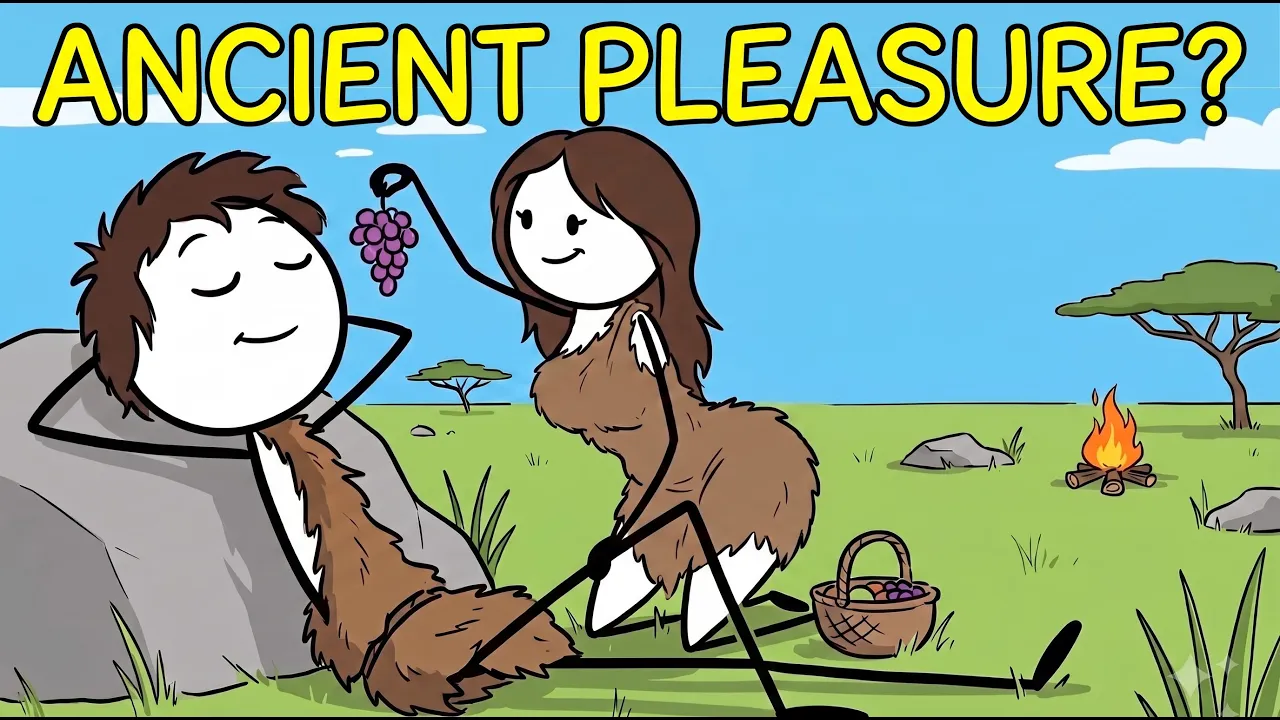
What Did Ancient Humans Do For Pleasure? transcript
Ink Explainer · @Inkexplainer96
Words
3,346
Runtime
14:47
Speaking pace
226wpm
Reading time
14min
226 words per minute, above the 201 75th percentile of 349 measured videos. That distribution comes from the 349-video hook study.
Opening (first 30 seconds)
The last time you were bored, you reached for your phone without even deciding to. Music, a game, something to watch. That reach is one of the oldest things about it. 40,000 years ago, a human sat by a fire with the same restless itch you get, and no phone, and nothing invented yet to kill it. So, they made their own fun from scratch. And what they came up with on those long empty nights became music, games, and sex. And one of those three quietly turned into a business we still call the oldest profession on Earth. It runs from a bone flute in a freezing cave to a Roman brothel,
113 words, the words spoken in the first 30 seconds at 226 words per minute.
Sentence shape
| Measure | This transcript |
|---|---|
| Sentences | 237 |
| Average words per sentence | 14.1 |
| Longest sentence | 52 words |
| Questions asked | 2 |
| Sentences containing a number | 27 |
Most used terms
- people21
- years19
- sex17
- city13
- music13
- oldest11
- bone10
- human10
- cave9
- named9
- real9
- small9
Filler phrases
13 in total: actually 7 · like 3 · kind of 1 · literally 1 · you know 1.
A literal whole-word count of the same phrase list the Prepublish browser extension uses, so a phrase inside another word is not counted and a phrase used in its ordinary sense still is. It is a count and not a judgement.
What this transcript is
Every word below is the caption track YouTube publishes for this video, pulled from the video itself and reproduced unchanged. It is not Prepublish's writing, not a summary, and not a re-transcription: it is the video's own published captions. English captions, generated automatically by YouTube, in the video’s original language. Source: the video on YouTube. A channel that would rather this page did not exist can ask for its removal through the contact page, and it is removed.
Transcript
The last time you were bored, you reached for your phone without even deciding to. Music, a game, something to watch. That reach is one of the oldest things about it. 40,000 years ago, a human sat by a fire with the same restless itch you get, and no phone, and nothing invented yet to kill it. So, they made their own fun from scratch. And what they came up with on those long empty nights became music, games, and sex.
And one of those three quietly turned into a business we still call the oldest profession on Earth. It runs from a bone flute in a freezing cave to a Roman brothel, where the prices are still scratched on the wall. To get any of this, you have to kill one myth first, because almost everyone believes the wrong thing about ancient life. The myth is that survival never stopped. Every hour spent hunting, gathering, running, fighting, with no time for anything else.
It sounds right, but it's almost certainly not true. When anthropologists studied hunter-gatherer groups still living close to the way our ancestors lived, they actually measured it. The real work of staying alive, finding food, getting water, making and fixing tools took around 4 to 6 hours a day. That was it. The rest of the day belonged to them. So, picture it. The hunt is done, everyone's eaten, and you're sitting there with hours of daylight still left, and nothing you're forced to do.
No phone, no book, nothing has been invented yet. Just you, the people around you, a fire, and time. And empty time does something specific to a human being. Your brain is the hungriest organ you own. It burns about a fifth of your energy, and it never switches off. It always needs something to do. When it gets nothing, that feeling is boredom. And boredom pushes you to act. Every human who has ever lived has felt it.
So, every night in every camp, the same quiet thing was happening. Restless brains, capable hands, and empty time, all together in the firelight. That combination is an engine. It has to make something. And the first thing it made was music. A cave in what's now southern Germany, 40,000 years ago, deep in an ice age, someone sits by the fire slowly hollowing out the wing bone of a vulture. They cut a V-shaped notch in one end to blow across, then drill five small holes down the side, each one spaced for a finger.
Then, they lift it, blow, and a clear note fills the cave. This isn't a guess. In 2008, an archaeologist named Nicholas Conard was digging in a cave called Hohle Fels when his team pulled 12 fragments of bone out of the ground. Fitted back together, they formed a flute, the wing bone of a griffon vulture, five finger holes, a carved mouthpiece, about as long as your forearm, and roughly 40,000 years old. In another cave close by, they found more, carved from swan bone and mammoth ivory, dated as far back as 43,000 years.
Okay, real quick, I've got to tell you about today's sponsor, because it's genuinely become part of how I make these videos. And once you see what it does, you'll get why. So, here's the situation everyone's in right now. All the best AI models live in separate places. You're paying for ChatGPT over here, Claude over there, Gemini somewhere else, three logins, three subscriptions, three bills every month. And the second a newer, better model drops, you're either paying for a fourth thing or stuck on something already out of date.
Chat LLM by Abacus AI fixes all of that by putting every one of them under a single roof. One login, one price. You open a drop-down and just pick GPT, Claude, Gemini, whatever the task calls for. And if you'd rather not think about which model is best, there's a feature called route LLM that reads your prompt and automatically routes it to the strongest model for that specific job. And the price is the part that got me.
Every model, every feature, all of it, $10 a month. That's cheaper than a single one of those subscriptions on its own. So, if you've been juggling a dozen tabs and a stack of subscriptions, go check it out. The link's on screen and down in the description. Making that flute was hard. Whoever made it had to figure out that a hollow bone could make a sound. Then they had to learn that the holes changed the note and where to place them.
Then they carved the whole thing by hand with sharpened stone, just to make an object that grew no food and caught no prey. All it did was make a sound that felt good to hear. So, music wasn't something humans got around to once life was easy. It was one of the very first things they made. People were playing melodies 30,000 years before anyone planted a single crop. And we actually know what it sounded like. Researchers built exact copies of these flutes and played them, and I'll put a link in the description so you can hear it yourself.
It's almost the same sound that echoed through that cave 40,000 years ago. So, why sink that kind of effort into sound? Because music does something to a group of people. When they play or sing together, they fall into the same rhythm. Their timing lines up and so does their breathing. Moving in sync like that builds a powerful sense of being one connected group instead of a pile of separate strangers. And in an ice age, a group that feels connected shares more, fights less, and outlasts one that's falling apart.
Music wasn't a break from survival. It was quietly doing survival's work. But music has no stakes. Nobody wins a song. And the next thing humans made for fun changed exactly that. One day, a person sitting by a fire picked up a small bone from a sheep's ankle. It had four sides and each side was a different shape. So, it landed a different way every time it was thrown, and no one could control the result. That bone was the first dice.
These ankle bones are called knuckle bones. Archaeologists find them at ancient sites all over the world, often worn smooth from being thrown thousands of times. People used them to play. And almost as soon as they played, they started betting. My throw beats yours, so I take your arrowhead. Betting something you own on a random result is one of the oldest games there is. It turns out gambling is older than money. People were staking their possessions long before coins even existed.
And then games got serious enough to bury with a king. In the 1920s, a British archaeologist named Leonard Woolley was digging out the royal tombs of the city of Ur in what's now Iraq. And among the gold and the bodies, he found game boards, real ones. They were made of wood inlaid with shell and deep blue lapis lazuli. 20 squares to a board packed with dice and playing pieces, and about 4,600 years old. Today, we call it the royal game of Ur.
And one king loved his enough to have it buried with him so he could keep playing in the next life. And somehow, we know how to play it. A man at the British Museum named Irving Finkel found a clay tablet from more than 2,000 years ago written by a Babylonian scribe that spells out the rules. He sat down and decoded it. So, now you can play the exact same game a Mesopotamian king played, move for move. So, notice what just changed.
Music was free. Games and gambling were different. Now, a win or a loss meant something real changed hands. For the first time, fun had a value you could put a number on. That's the first small opening. And soon, a whole economy is going to force its way through it. But, there's one more pleasure to deal with first. And it's the oldest one of all. Sex is obviously older than humans. Every animal does it. So, the real question isn't when humans started having sex.
It's when sex became more than just biology, the point where it turned into something people thought about, told stories around, and made art about. And we have an answer. Thanks to one small carved stone. In 1933, a French diplomat and archaeologist named René Neuville was going through a museum collection in Bethlehem when he noticed a small pebble unlike anything he'd seen before. It had turned up in a cave called Ain Sakhri.
It's a piece of calcite, small enough to hold in one hand, and worked into its surface are two people, face-to-face, arms wrapped around each other. It's about 11,000 years old. And it is the oldest known sculpture of two people having sex. The people who made it were hunters called the Natufians, living in the hills of the Middle East at the very end of the Ice Age. And it wasn't found in a grave or buried as an offering with the dead, which means it most likely belonged to someone still living.
A person who carved it, kept it, and carried it around with them. A private little object about wanting someone, sitting in a person's hand 11,000 years ago. And that isn't even the beginning. In the same German cave as that oldest flute, archaeologists found a small human figure carved around 40,000 years ago. And it's one of the oldest sculptures of a person ever made. This was tens of thousands of years before anyone farmed or wrote a single word.
And humans were already shaping the body out of stone and making images tied to attraction and sex. It was art that early. So, line them all up. Music, games, sex. All three are ancient, and all three are deeply human. And at this point in the story, every single one of them is still free. Nobody was selling any of it. So, what changed? The answer has almost nothing to do with pleasure itself. The answer is cities. To see what a city actually did, you have to start with the world it replaced.
For almost all of human history, you lived your whole life inside a group of maybe 30 to 50 people and you knew every single one of them. You knew their parents and you knew who owed who. In a group that size, there are no strangers and that changes everything about how things move. Almost nothing gets bought or sold because everyone is connected to everyone else. Food, help, tools, favors, all of it flows through family and reputation.
You don't sell a fish to your cousin, you give it to him and you know it comes back around. A world with no strangers barely needs money at all. Then, about 6,000 years ago in Mesopotamia, between the Tigris and Euphrates rivers, humans did something they had never done before. They built cities, thousands of people packed into one place and a city breaks those old rules instantly. Suddenly, you're surrounded by people you have never met and never really will know.
Strangers everywhere and strangers can't run on favors and family because there's no shared history keeping score. So, the city needs a new tool. It needs money and prices and trade between people who owe each other nothing. And once anything can be bought, everything gets tested against the market. Grain, tools, labor, a cup of beer, all of it gets a price. And so does sex. We know it happened early because it shows up in the oldest writing on Earth.
The first people who ever wrote things down, the Sumerians, left behind lists of jobs scratched into clay. Some of them about 4,400 years old and on those lists, sitting between cook, scribe and barber, is a word for a woman who sold sex, karkid. Now, scholars actually argue about that word. Some read it as prostitute, others think it meant something closer to an unattached woman, one with no husband and no father to answer to.
But look at what that debate is really telling you. Either way, the city had produced something that never existed in a band of 40 people, a category of woman who stood outside the family on her own, surviving in a world of strangers and money. That is brand new, the city created it and it worked its way into the oldest story humans ever wrote down. The Epic of Gilgamesh, written more than three and a half thousand years ago, opens with a wild man named Enkidu who lives out among the animals and the person the story sends to civilize him is a woman named Shamhat who does it by drawing him into human life through sex.
In the oldest surviving story we have, a woman who trades in sex isn't a villain and isn't a joke. She's the one who turns a beast into a human being. So, by the time of the first cities, selling sex is real, it has a name, and it's woven right into the culture. But, it was the Greeks who turned it into an organized industry with a price list. Here's what surprises people about ancient Greece. The same civilization that gave us philosophy, geometry, and democracy also ran one of the most organized commercial sex trades in the ancient world out in the open with no real shame attached to the men who used it.
Later Greek writers credited a lawmaker named Solon, around 2,600 years ago, with opening the city's first public brothels at a fixed, deliberately cheap price so that any man could afford one. Historians think that particular story is more legend than fact. But, the bigger picture is solid and well documented. In Athens, prostitution was legal, it was public, and the state collected a tax on it. And that one detail changes what the whole trade is.
Once a government is taking a cut of the money, selling sex isn't a vice hiding in the shadows anymore. It's part of the economy, sitting in the city's budget right next to grain and silver. And the trade had clear levels. At the bottom were the pornoi. That word comes from the Greek verb meaning to sell, and it's the root of the modern word pornography. They were the cheapest workers, most of them enslaved women, priced at roughly a day's wage for a common laborer.
At the top were the hetairai, educated women trained in music, poetry, and conversation. Hired to attend the private drinking parties where powerful men gathered. Sex might be part of what they offered, but so was wit and argument and good company. And a handful of these women climbed shockingly high. The most famous was Aspasia. She became the long-term partner of Pericles, the man who ran Athens. And the great thinkers of the age wrote about how sharp she was.
These were women that history actually bothered to name at a time when a respectable Athenian wife was expected to stay home and never be discussed in public at all. So, look at what the trade has become. Price tiers, career levels, a tax. Every feature of a modern industry. And remember where this whole thing started, just a few minutes ago. A shared song around a fire that cost nothing. But, everything so far still reaches us as word, laws, lists, and story all written down.
To actually walk into one of these buildings and read what people wrote on the walls, we need something else. We need a disaster. In the year 79, Mount Vesuvius erupted and buried the Roman city of Pompeii under meters of volcanic ash. About 20,000 people lived there, and in a matter of hours, the whole city simply stopped mid-motion and stayed frozen for almost 1,700 years. Bread still sitting in the ovens, meals still on the tables, an entire Roman town sealed exactly where it stood.
Then, in 1862, an Italian archaeologist named Giuseppe Fiorelli uncovered a narrow two-story building near the center of town. Ten small rooms, five downstairs and five upstairs, and every room had a stone bed built against the wall with a raised block at one end for a pillow. Above every door was a painting, and the paintings made it completely obvious what this place was. This was the Lupanar, the best-preserved brothel in the entire ancient world.
The name comes from lupa, the Latin word for a she-wolf, which was also slang for a woman who sold sex. The building's name literally means the wolf den. And this building can still talk to you because its walls are covered in writing. Archaeologists have recorded more than 120 separate pieces of graffiti inside it, the highest concentration of writing found anywhere in the city. Customers scratched notes about their visits.
They bragged, they complained, and they left names and dates like reviews carved into the plaster. And the workers left their marks, too. Their names are still on the walls. Murtha, Successa, Felix, real individual people named in the rooms where they worked 2,000 years ago. The graffiti even gives us the prices. The cheapest sex in Pompeii started at about two asses, a small Roman coin, and we know exactly what that was worth because two asses was roughly the price of a single day's bread.
The cheapest human intimacy in the city cost about the same as a loaf, but almost none of that money reached the women. The Lupanar was run by an owner called a leno, and the women working those stone beds were mostly enslaved, bought at market. Many of them brought from the far edges of the empire. The customer paid the owner. The woman got a room made of stone and a name scratched on a wall, and that name might be the only trace of her entire existence that survived.
No grave we can point to, no family record, just Merth in faded letters in the wolf den, preserved by the very same ash that killed the city. That is the real face of the oldest profession in the ancient world, not a scandal and not a joke. It's an industry built on the same thing most ancient industries were built on, people who never got to choose. But think about what those people actually had. They got the work of staying alive done in a few hours, and the rest of the day was theirs.
And they filled it with things that grew no food and won no fight, music, games, art, each other, made by hand for no reason but the wanting. Then cities came, and cities brought strangers, strangers brought money, and money did the one thing to pleasure that had never been done before. It put a price on it. Now look at your own night. The music comes through a subscription you pay for every month. The game was built by a company that studies exactly how to keep you playing.
Even the videos feel free, but they aren't, your attention is the thing being sold. Every empty hour you've got is something a business is trying to fill, and the biggest companies that have ever existed are all fighting over the same quiet time your ancestors filled with a bone flute and a handful of ankle bone. The wanting never changed. You reach for music and play and closeness for the same reason a human did 40,000 years ago in a freezing cave.
The only difference is that somewhere along the way someone worked out how to charge for it. They invented pleasure for free. We've spent every year since trying to sell it back.
The words are the caption track's own and nothing is reworded or re-transcribed. Paragraph breaks are placed between sentences so the text reads as prose.
Use this transcript
Three free tools that work on the material around a video like this one. No signup, no login.
Hook Analyzer
Paste the first 30 seconds of your own draft for a hook score and rewrites.
Policy Pre-Flight
Check your draft against YouTube's advertiser-friendly guidelines before you record it.
Channel Skill Generator
Read this channel's public videos and transcripts, and download a writing brief for it.