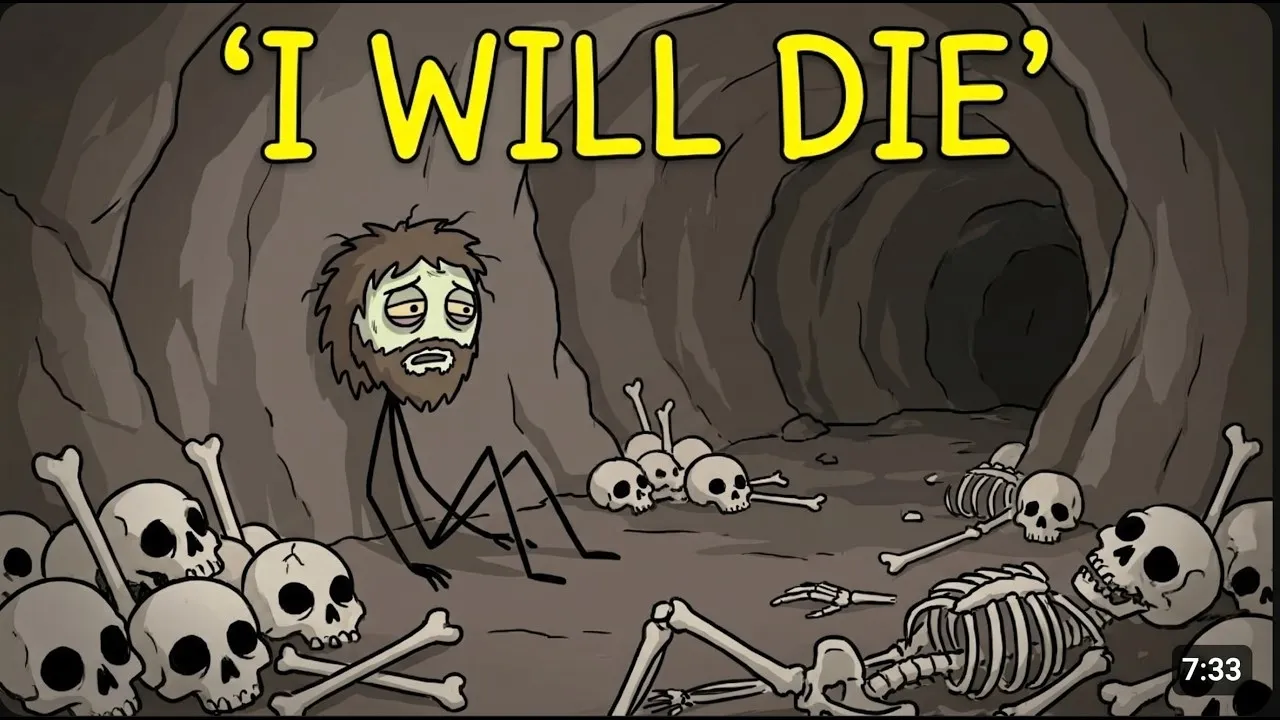
What did Early Humans do when they got Sick transcript
Ink Explainer · @Inkexplainer96
Words
1,415
Runtime
8:03
Speaking pace
176wpm
Reading time
6min
176 words per minute, between the 160 25th percentile and the 181 median of 349 measured videos. That distribution comes from the 349-video hook study.
Opening (first 30 seconds)
The last time you got sick, you probably did what everyone does. You opened Chat GPT, searched your symptoms online. You took something from the medicine cabinet. Maybe you called a doctor. Maybe you just spent three miserable days on the couch rewatching something you'd already seen before. But either way, you understood what was happening to you. You had some idea of what to do next. For most of human history, you had none of that. No name, no plan, no medicine cabinet, no understanding of what
88 words, the words spoken in the first 30 seconds at 176 words per minute.
Sentence shape
| Measure | This transcript |
|---|---|
| Sentences | 116 |
| Average words per sentence | 12.2 |
| Longest sentence | 39 words |
| Questions asked | 2 |
| Sentences containing a number | 10 |
Most used terms
- humans15
- people11
- ancient10
- body10
- years10
- ancient humans8
- medicine8
- sick8
- inside7
- human6
- generation5
- today5
Filler phrases
8 in total: actually 4 · like 2 · literally 2.
A literal whole-word count of the same phrase list the Prepublish browser extension uses, so a phrase inside another word is not counted and a phrase used in its ordinary sense still is. It is a count and not a judgement.
What this transcript is
Every word below is the caption track YouTube publishes for this video, pulled from the video itself and reproduced unchanged. It is not Prepublish's writing, not a summary, and not a re-transcription: it is the video's own published captions. English captions, generated automatically by YouTube, in the video’s original language. Source: the video on YouTube. A channel that would rather this page did not exist can ask for its removal through the contact page, and it is removed.
Transcript
The last time you got sick, you probably did what everyone does. You opened Chat GPT, searched your symptoms online. You took something from the medicine cabinet. Maybe you called a doctor. Maybe you just spent three miserable days on the couch rewatching something you'd already seen before. But either way, you understood what was happening to you. You had some idea of what to do next. For most of human history, you had none of that.
No name, no plan, no medicine cabinet, no understanding of what was happening inside your body. Just pain, fever, weakness, and your body failing in ways you couldn't explain. And yet, people still survived. They still raised children, built communities, and eventually entire civilizations. So, what did they actually do when they got sick? The answer is stranger, more creative, and far more human than you'd expect. Let's go back, way back.
For the first 200,000 years of our existence, modern medicine didn't exist. Humans had no idea that invisible microscopic organisms were responsible for making them feel like they were dying. From their perspective, illness appeared almost supernatural. There was no visible wound, no predator, no obvious cause. One day you were fine, and the next your own body seemed to turn against you from the inside. So, ancient humans came to the only conclusion that made sense to them.
The Sumerians believed illness was caused by demons. Ancient Egyptians believed it was punishment from the gods. Indigenous cultures across every continent developed similar ideas. The body was seen as a vessel, sickness as an intrusion, and healing as the removal of whatever had entered inside. At first, this sounds primitive, but here's the fascinating part. They weren't completely wrong. The explanation was wrong, but the instinct behind it was surprisingly close to the truth.
Ancient humans just didn't know it was bacteria, viruses, or parasites. It would take another 200,000 years for us to finally understand what was actually making people sick. But in the meantime, humans got creative. The earliest healers weren't doctors in the modern sense. They were the people who were the doctors of that era, who believed they could communicate with whatever force was causing the illness and convince it to leave.
Archaeological evidence for this goes back at least 40,000 years. Burial sites from that era show people with severe injuries and disabilities that should have made survival impossible alone. Crushed bones, missing limbs, conditions that would have prevented hunting or even moving properly. And yet, many of those injuries healed, which means those people survived long after being injured. Someone was feeding them, protecting them, keeping them alive while they recovered.
Even before medicine existed, humans were already trying to heal each other. The oldest surgical procedure we know of is trepanation, drilling a hole in the skull. We have skulls from 10,000 years ago with clean, deliberate holes bored through the bone. And here's the part that stops you cold. The bone had healed around the edges, meaning the patient survived, meaning someone 10,000 years ago cut open a human skull with a stone tool, and the person lived long enough afterward for their bone to start growing back.
We don't know exactly why they performed trepanation. The most common theory is that they believed something was trapped inside the head. Not because they understood neuroscience or biology, but because humans are incredibly persistent. They experimented, improvised, and kept trying things that should have been impossible to survive. That's what ancient humans did when they got sick. They improvised on the edge of death.
But healing wasn't only spiritual, not even close. Because while shamans performed rituals and skulls were drilled in desperate attempts to cure suffering, something else was happening quietly in the background. Something less dramatic, but far more important in the long run. Humans were observing, remembering, passing knowledge from one generation to the next. Not through myths, but through experience. They began noticing that certain plants actually changed how sick bodies felt.
Some reduced pain, some lowered fevers, some helped wounds heal. Ancient humans discovered that certain plants did specific things to sick bodies. Willow bark reduced fever. We know this because ancient Egyptian medical texts from 1500 BCE specifically recommended. Willow bark contains salicin, which your body converts into salicylic acid, which is the active compound in aspirin. They didn't understand the science behind it.
They just knew it worked. So, they kept using it, passed it down, refined it, and years later we extracted the compound, synthesized it, put it in a white tablet, and sold it in every pharmacy on Earth. The molecule is the same. The knowledge is 100,000 years old. Turmeric, garlic, honey, ginger, echinacea, every single one of these has a long history of documented medical use. Ancient humans were observing outcomes, remembering what worked, and passing that knowledge forward from generation to generation.
But, this is where the story gets more complicated because not everything ancient humans did actually worked. And strangely, those failures reveal just as much about us as the successes do. When a fever wouldn't break, when the plants failed, when the ceremonies changed nothing, people turned to something else. Ritual, repetition, and community. They gathered around the sick. They sang. They prayed. They stayed awake through the night beside them.
They refused to let sick people suffer alone. And without realizing it, some of those actions were genuinely affecting the body. Social support can lower stress hormones. Feeling cared for can reduce pain. Even the belief that help is coming can create measurable biological changes inside the body. The placebo effect is not imaginary. It is a real, documented, consistently reproducible medical phenomenon. And ancient humans had discovered ways to trigger it tens of thousands of years before anyone understood what it was.
Sometimes healing came from medicine. Sometimes it came from presence, ritual, and the feeling that you weren't facing suffering alone. Collective belief and emotional support were creating real effects inside the body, even if people at the time had no scientific explanation for it. And the truth is, modern medicine never fully replaced that. Modern medicine is extraordinary. Antibiotics, surgery, vaccines, machines that let us see inside the human body without opening it.
We have treatments today that would have looked like miracles to almost every human who lived before the 20th century. But even with all of that, one thing hasn't changed. Research consistently shows that patients who feel genuinely cared for often recover better than those who receive the same treatment but feel ignored or unseen. Doctors who spend more time with patients tend to get better outcomes regardless of the medication they prescribe, because healing was never just about the treatment itself.
The care surrounding it matters, too. Ancient humans understood something we still keep rediscovering today. Underneath all the rituals, plant remedies, shamans, and desperate medical experiments was one simple idea. They refused to do nothing. For 300,000 years, the human response to illness was never just surrender. It was resistance. People refused to sit back and watch each other die without trying something. Every culture in every era created its own ways of fighting disease.
Some of those methods were completely wrong, sometimes even dangerous. But the impulse behind them mattered, the refusal to accept that a person should simply die from something invisible and unexplained. That impulse is the reason medicine exists at all. Think about what your ancestors survived without any of the things you rely on today. No antibiotics, no vaccines, no hospitals. People could literally trip, get a small cut, and die a week later from infection.
A bad tooth could turn into a death sentence. Childbirth was terrifyingly dangerous. Even drinking water from the wrong place could fill your body with parasites or disease. Measles, smallpox, cholera, the flu alone wiped out millions. Humans spent most of history surviving things that sound almost ridiculous today. And the only reason many of those diseases no longer terrify us is because generation after generation kept experimenting, learning, and trying to heal each other instead of giving up.
And humanity didn't even discover bacteria until the 1670s when Anthony Van Leeuwenhoek looked through a microscope and saw microscopic life for the first time. Before that, humans had spent hundreds of thousands of years fighting enemies they literally couldn't see. So, if all of those people hadn't kept trying, would you even be here today?
The words are the caption track's own and nothing is reworded or re-transcribed. Paragraph breaks are placed between sentences so the text reads as prose.
Use this transcript
Three free tools that work on the material around a video like this one. No signup, no login.
Hook Analyzer
Paste the first 30 seconds of your own draft for a hook score and rewrites.
Policy Pre-Flight
Check your draft against YouTube's advertiser-friendly guidelines before you record it.
Channel Skill Generator
Read this channel's public videos and transcripts, and download a writing brief for it.